


More news on this day
Europe’s peak summer travel rush hit fresh turbulence today as 112 flights were cancelled and 2,660 delayed across major hubs in Italy, England, France, Ireland, the Netherlands and several neighbouring countries, disrupting plans for tens of thousands of passengers at the height of the holiday season.
Get the latest news straight to your inbox!
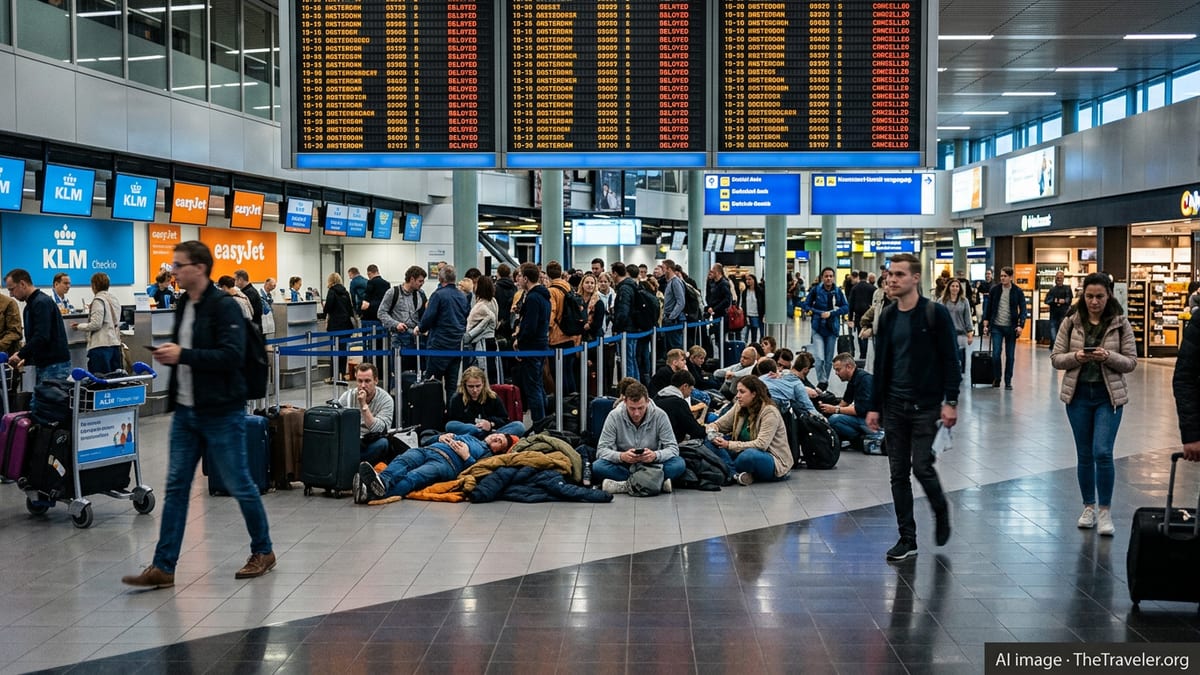
A fresh wave of disruption across Europe’s hubs
Operational data compiled from airport and airline reports indicates that the latest disruption is concentrated in a belt running from Spain and Italy through France and the United Kingdom to Ireland, the Netherlands and parts of central Europe. While the overall number of cancelled flights is lower than on some previous strike days, the high volume of delays is creating knock-on chaos across the network as aircraft and crew rotate through multiple sectors.
Patterns seen in recent days, including the 2,022 delays and 98 cancellations reported across Spain, England, Italy, Switzerland, Denmark, Ireland, France and the Netherlands earlier this week, suggest that the system is operating with little spare capacity. Even modest schedule shocks are translating into widespread delays, with late-arriving aircraft forcing rolling hold-ups on subsequent flights.
Today’s figures, with more than twenty delayed flights for every cancellation, point to airlines attempting to operate most of their programmes despite mounting strain on resources. For travellers, however, a delayed departure can mean missed connections, curtailed holidays and extra accommodation costs, particularly when flying through heavily banked hub airports where turnaround windows are tight.
Smaller regional airports and secondary city gateways are also feeling the effects, as disruptions at major hubs in London, Paris, Amsterdam, Rome and Milan ripple outward. This has left some passengers stranded far from their intended destinations, relying on last-minute rebookings or overland alternatives where available.
Weather, staffing and air traffic control all under pressure
Publicly available operational summaries from flight-tracking and passenger-rights services indicate that the latest wave of disruption is being driven by a familiar combination of summer thunderstorms, constrained staffing and saturated air traffic control sectors. Recent analyses of European delay patterns have highlighted how en-route restrictions in busy airspace, particularly over France and Italy, can trigger extensive flow-control measures affecting flights between countries that are not themselves experiencing local problems.
Industrial action remains a recurring factor. Earlier this year, an air traffic control strike in Italy led to hundreds of cancellations in just a few hours, with the resulting disruption spilling into neighbouring states long after the strike window closed. Historical data from Eurocontrol also shows that French air traffic control stoppages have previously generated hundreds of thousands of minutes of network-wide delay, hitting the United Kingdom, Spain and Italy particularly hard.
Alongside industrial tension, the rapid rebound in travel demand has exposed lingering staffing shortages at airlines, ground handlers and airport security providers. Several European hubs have only gradually rebuilt their workforces since the pandemic, and recruitment has struggled to keep pace with record summer schedules. When storms or airspace restrictions force short-notice changes, there are fewer spare crews and stand-by aircraft available to absorb the shock.
Weather is adding another layer of complexity. A series of hot-weather patterns and electrical storms over western and southern Europe in recent days has disrupted departure flows, particularly in the late afternoon and evening. When aircraft are held on the ground or diverted to alternate airports, the resulting displacement of aircraft and crews can take a full day or more to unwind.
Spain and Italy feel the strain as tourism peaks
The latest disruption comes just as Mediterranean destinations enter their busiest weeks of the year. Separate reporting today from Spain highlights 20 cancellations and 639 delays across Madrid, Barcelona and Malaga alone, underscoring the strain on key gateways that funnel holidaymakers to coastal resorts and island destinations. These airports sit on major corridors linking the Iberian Peninsula with the United Kingdom, France, Germany, Italy, the Netherlands, North Africa and transatlantic markets.
Italy is facing similar pressures. Earlier strikes in its air traffic control system and airport services have left schedules finely balanced, with little margin for additional disruption. Major Italian airports are handling intense outbound flows to Spain, Greece and northern Europe while also welcoming large numbers of inbound visitors. When flights into Rome, Milan or Naples run late, the impact is often felt immediately on onward services within Italy and to neighbouring countries such as France, Switzerland and Austria.
These southern hubs are also intertwined with low-cost carrier networks that rely on high aircraft utilisation and tight turnarounds. Analysts note that once a single rotation is pushed back by weather or congestion, subsequent sectors can start to depart progressively later, turning an isolated delay into a full-day cascade for passengers booked on evening departures.
Tourism bodies have been warning for months that even relatively small operational shocks could have an outsized impact during the core July and August holiday period, particularly as new border-control rules and heightened security checks add a few extra minutes to each passenger’s journey through the airport.
New border checks and tight capacity compound delays
Beyond immediate operational issues, structural changes in how Europe manages its borders are influencing today’s disruption. The European Union’s new Entry/Exit System, which has introduced biometric registration for many non-EU travellers, has already been linked in recent coverage to longer queues and missed connections at some airports. While authorities have given airports flexibility to suspend the checks temporarily during peak periods, implementation has been uneven across member states.
Airline and airport groups have repeatedly cautioned that rolling out new technology in the middle of the summer peak would be challenging. Reports from travel industry outlets indicate that some states, including parts of France and Italy, are still ramping up their systems, while others such as Ireland are not fully participating. This patchwork has created uncertainty for carriers planning minimum connection times and for passengers trying to judge how early to arrive at the airport.
Capacity constraints at key hubs are also playing a role. Data from Eurocontrol and industry associations in recent months has shown that en-route air traffic management delays, driven by both staffing and weather, have climbed above pre-pandemic averages on several occasions. With flights in many regions now operating at or above 2019 volumes, even minor restrictions quickly translate into airborne holding and ground delays.
Airlines have made some pre-emptive schedule cuts to create breathing space, particularly on shorter European routes where alternative services are available. Nonetheless, the persistence of triple-digit cancellation counts alongside several thousand delays suggests that the balance between demand and available capacity remains fragile.
What today’s chaos means for summer travellers
For passengers travelling today or over the coming weekend, the latest figures are a reminder that resilience in Europe’s air transport system remains limited. Travel advisers generally recommend checking flight status frequently, using airline apps and airport departure boards, and allowing longer connection windows than in previous years, especially when itineraries pass through congested hubs in the United Kingdom, France, the Netherlands, Italy or Spain.
Consumer-rights organisations point out that, under European passenger protection rules, travellers on EU-departing flights may be entitled to assistance and, in some cases, financial compensation when severe delays or cancellations are linked to airline operations rather than extraordinary circumstances such as air traffic control strikes or extreme weather. Passengers are encouraged to keep boarding passes, delay notifications and receipts for any additional expenses incurred.
Travel industry analysts expect episodic disruption to continue across the region throughout July and August, particularly on days when thunderstorms, industrial action or system outages intersect with already-busy schedules. Some carriers have urged customers to travel with hand luggage only, where possible, to speed airport processing and reduce the risk of missed connections when flights are retimed at short notice.
For now, Europe’s skies remain open but congested, with today’s tally of 112 cancellations and 2,660 delays serving as another warning that the post-pandemic rebuilding of aviation capacity is still a work in progress, even as passenger demand surges to new summer highs.