


More news on this day
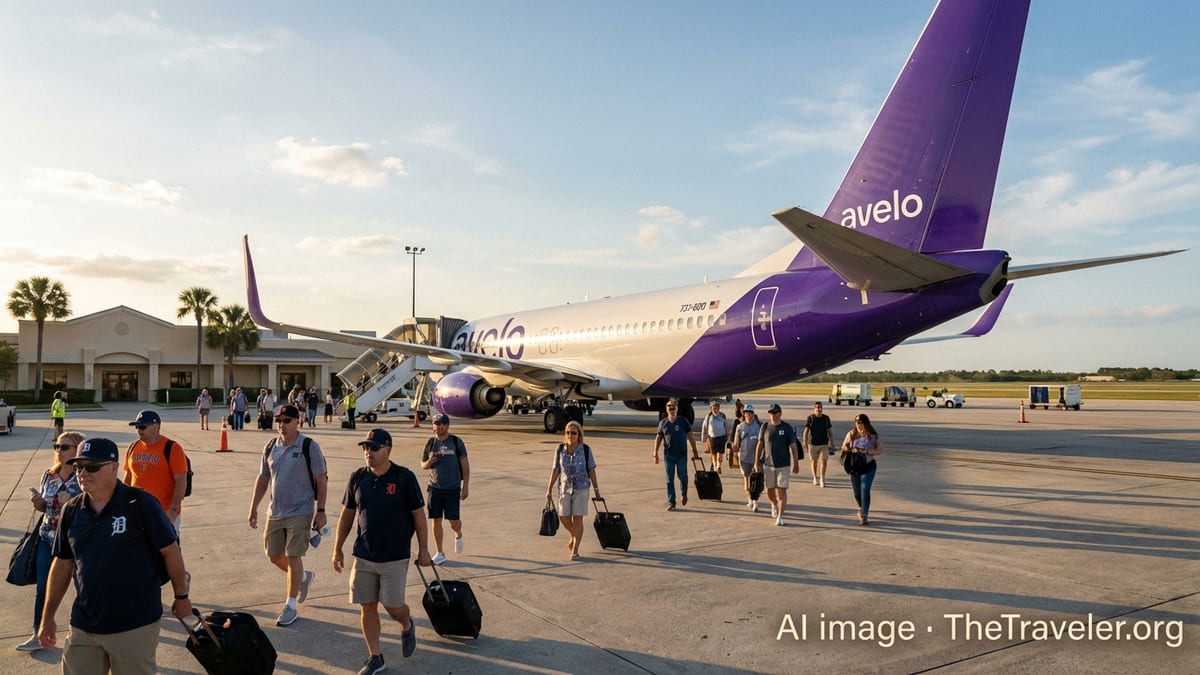
In just over a year, Avelo Airlines has turned Lakeland Linder International Airport from a commercial blank spot on Florida’s map into one of the carrier’s key East Coast bases, testing how much demand hides between the larger hubs of Tampa and Orlando.
Get the latest news straight to your inbox!
From first flights to full-fledged base
Avelo’s Lakeland story began in June 2024 with twice-weekly service to Tweed New Haven Airport in Connecticut, a route aimed at Central Florida’s sizable Northeast visiting-friends-and-relatives market. Publicly available airport and airline information shows that the New Haven link quickly became the backbone of Lakeland’s new passenger operation, giving residents an alternative to busier airports on either side of Interstate 4.
Within a year, Lakeland Linder city documents report that Avelo had expanded to seven destinations, including Grand Rapids, Nashville, New Haven, Long Island, Wilmington in the Philadelphia region, Rochester and San Juan. The breadth of that network marked a sharp shift for an airport that, until then, had focused largely on cargo services and general aviation.
By early 2025, Avelo had elevated Lakeland to base status, joining New Haven and Wilmington, Delaware, on the airline’s short list of crew and aircraft hubs. Local coverage indicates that the carrier added dozens of jobs and based Boeing 737 aircraft on the field, effectively anchoring the airport’s transition into a regional passenger alternative.
The decision to build a base in Lakeland aligned with Avelo’s broader point-to-point strategy, which targets secondary airports near major population centers. In Central Florida, that approach places Lakeland within reach of Orlando’s theme parks and Tampa Bay’s beaches while sidestepping the congestion, higher fees and slot constraints at the region’s larger airports.
Performance indicators and passenger response
While detailed financial results by route are not publicly disclosed, several indicators suggest that Avelo’s Lakeland experiment is gaining traction. Flight performance trackers assign high on-time ratings to Avelo operations touching Lakeland, signaling a relatively reliable schedule that can be a differentiator in the low-cost space.
Published planning documents from local and state agencies describe higher-than-anticipated passenger growth once Avelo entered the market, noting that commercial demand at Lakeland was previously constrained by a lack of service rather than by underlying population or income levels. Some of those analyses suggested that a small number of daily departures on narrowbody jets could be enough to support sustainable operations if fares stayed competitive with nearby airports.
Customer commentary gathered in online forums and social channels, though anecdotal, also points to generally busy flights on several Lakeland routes, especially to New Haven and Wilmington. Travelers frequently compare the ease of parking and short security lines at Lakeland with the time spent navigating larger terminals, underscoring one of Avelo’s central value propositions.
At the same time, the network out of Lakeland has seen adjustments, with frequencies tweaked and some seasonal flying patterns emerging. This reflects the airline’s broader practice of refining capacity across its system, shifting aircraft toward routes that demonstrate consistent demand while trimming those that underperform.
New links and a broader Caribbean reach
The next phase of Avelo’s Lakeland growth has started to come into focus in 2026. Public announcements from the airline and airport show that Avelo has continued to layer in new domestic routes and is preparing a deeper push into the Caribbean from Central Florida.
This year’s expansion has included additional connections such as Atlanta service, reinforcing Lakeland’s role as a link between mid-sized Southeastern and Northeastern markets. Aviation industry coverage notes that Avelo plans to increase its aircraft presence at Lakeland, a step that typically precedes more experimentation with destinations and schedules.
One of the most notable moves is new nonstop service planned between Lakeland and Aguadilla, on Puerto Rico’s west coast, set to begin in mid-November 2026. That route would give Lakeland a direct leisure and diaspora connection into the Caribbean, mirroring Avelo’s strategy in other bases where it has paired Northeast and Midwest origin markets with sun destinations.
For Lakeland Linder, the Puerto Rico link also represents a symbolic milestone: a shift from purely domestic flying into international and territorial markets, broadening the airport’s appeal and testing how far its catchment area extends beyond central Polk County.
What routes could be next from Lakeland?
With Avelo now deeply embedded at Lakeland, attention is turning to where the airline might fly next. Industry observers often point to the carrier’s existing network as the clearest guide. Cities already connected to Avelo’s other bases, particularly New Haven and Wilmington, are viewed as logical candidates for additional Lakeland service if aircraft time and demand line up.
Short- to medium-haul markets in the Southeast, such as Savannah, Greenville-Spartanburg or Charleston, are frequently mentioned in local speculation because they fit Avelo’s preference for secondary airports near fast-growing metro areas. These cities also match the typical stage lengths of existing Lakeland routes, which helps with fleet utilization and cost control.
On the northern end, additional Midwestern or mid-Atlantic points could be considered. Places like Pittsburgh, Columbus or Hartford fall within Avelo’s current or historic footprint and have track records of supporting low-cost carriers on limited weekly schedules. If Lakeland continues to show that it can attract price-sensitive leisure and visiting-friends-and-relatives traffic, similar two- or three-times-weekly flights could emerge in future announcements.
Any further expansion is likely to remain selective. Analysts note that Avelo has generally favored depth over breadth at its bases, preferring to build clusters of routes that can share marketing and operational resources rather than scattering single spokes across the map.
Balancing opportunity and risk at a growing base
For Avelo, Lakeland remains both a showcase and a test case. Success here could validate the airline’s bet on underused regional airports situated between major hubs, encouraging similar plays elsewhere in the Southeast and beyond. Publicly available traffic and budget data from the city indicate that Lakeland Linder is already seeing meaningful gains in passenger volumes and airport revenues linked to Avelo’s presence.
Yet the risks are equally clear. Lakeland sits within driving distance of two of Florida’s busiest airports, which gives travelers plentiful alternatives if fares or schedules at Linder become less attractive. Any prolonged economic downturn, spike in fuel costs or shift in competitive dynamics at Orlando or Tampa could force Avelo to reassess capacity at its Central Florida base.
For now, the airline appears committed to deepening its Lakeland footprint, supported by a growing list of destinations and the prospect of new Caribbean flying. If upcoming routes perform as strongly as early services to the Northeast, Lakeland’s status within Avelo’s network could continue to rise, turning a once-quiet airfield into one of the most closely watched small-city success stories in U.S. aviation.