


More news on this day
Surging fuel costs and mounting climate pressures are accelerating a shift in how Europe travels, with Germany and several neighboring countries rapidly expanding high-speed and long-distance rail as an alternative to short-haul flights and private cars.
Get the latest news straight to your inbox!
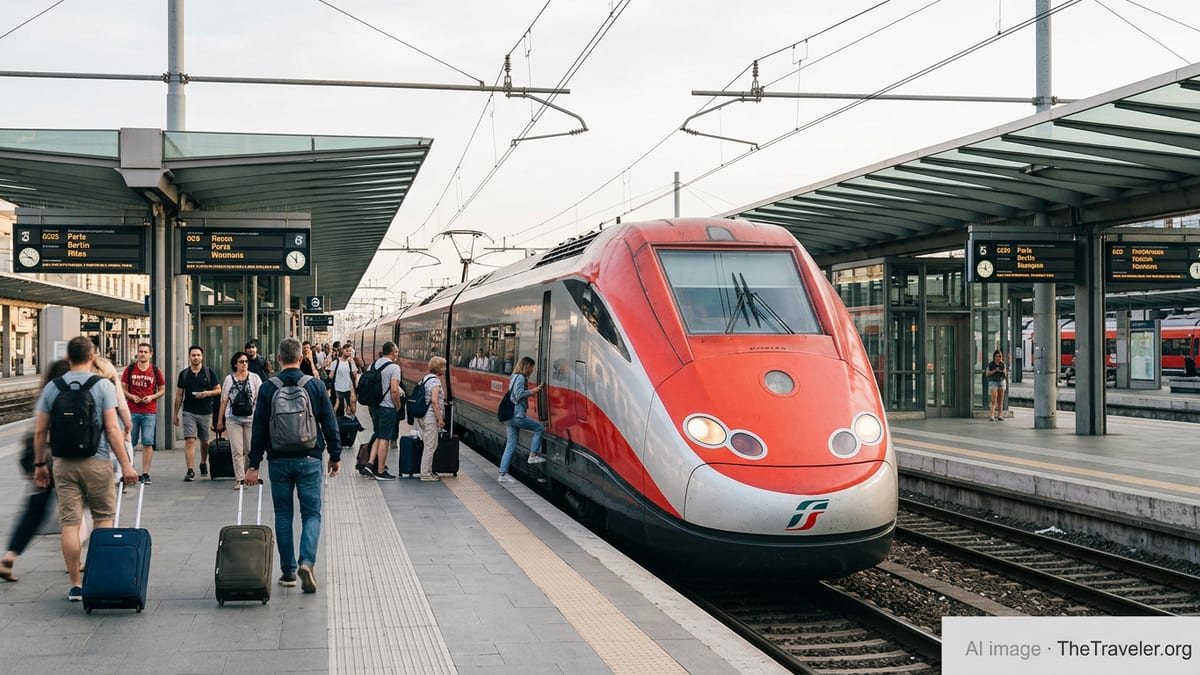
Fuel Prices, Climate Targets and a New Rail Logic
Across Europe, higher fuel costs for cars and aircraft are reshaping travel choices and investment priorities. Research on European transport emissions shows that aviation has rebounded quickly since the pandemic, while road transport remains the largest source of greenhouse gases, prompting policymakers to look harder at rail’s lower-carbon profile and energy efficiency.
According to recent assessments from the European Environment Agency, emissions from domestic rail in the EU have fallen since 1990 even as overall transport activity has grown, in contrast to rising emissions from aviation. Publicly available data compiled by transport NGOs indicate that per passenger kilometre, trains in Europe typically emit around five times less carbon dioxide equivalent than planes on comparable routes.
This combination of elevated fuel prices, regulatory pressure on airlines, and demand for more predictable travel costs is now feeding into a broader modal shift. Studies published over the last two years argue that banning some short-haul flights where robust rail alternatives exist, alongside investment in high-speed corridors, can materially cut emissions from long-distance mobility while keeping connectivity intact.
Germany’s Network: High-Speed Trains Meet Flat-Fare Tickets
Germany sits at the center of this transition, both geographically and in policy terms. Its InterCity Express (ICE) network already links major cities at up to 300 km/h and forms a backbone for north–south and east–west European rail traffic. Recent corporate reporting from Deutsche Bahn notes that long-distance and regional rail demand has continued to grow, with competition from long-distance coaches weakening as more passengers move to rail.
At the same time, the nationwide "Deutschlandticket" has introduced a flat monthly fare for local and regional public transport, with evaluations by the Federal Transport Ministry suggesting it has boosted ridership and encouraged a shift away from private cars for everyday journeys. While the ticket does not cover high-speed ICE services, it simplifies access to the broader network and allows travellers to combine slower regional legs with long-distance trains bought separately, lowering the overall cost of cross-country rail trips.
Private operators are also responding. Market updates show companies such as FlixTrain have added capacity and new routes on key intercity corridors, using conventional but fast rolling stock to compete on price with both Deutsche Bahn and low-cost airlines. This mix of public flat-fare schemes and open-access competition is creating more rail options precisely as road fuel and aviation-related costs rise.
European High-Speed Expansion and Cross-Border Links
Beyond Germany, the European Commission has set out an updated high-speed rail action plan aimed at knitting together existing national networks into a faster, more seamless system. Under proposals linked to the Trans-European Transport Network, the EU wants to cut travel times between key cities by 2030, in some cases by several hours, by closing missing links and upgrading lines to at least 200 km/h.
Published EU material highlights potential time savings on routes such as Berlin to Copenhagen, where infrastructure works on the Danish and German sides are expected to reduce current journey times of around seven hours to approximately four. Similar upgrades are underway or planned on Mediterranean and Atlantic corridors in Spain, on links between northern Italy and neighboring countries, and on routes connecting Austria and Central Europe, expanding the catchment of high-speed and fast intercity services.
New and planned services underscore this direction. Spain’s operator Renfe has begun running high-speed AVE connections between Barcelona and Toulouse, improving rail links across the Pyrenees. In parallel, multiple operators are exploring or announcing additional high-speed and night-train routes linking France, Italy, Germany and Austria, aiming to offer viable rail alternatives on journeys that were once the domain of regional air traffic.
Night Trains and Long-Distance Alternatives to Short-Haul Flights
While flagship high-speed lines capture much of the attention, night trains and upgraded intercity services are also part of Europe’s evolving rail era. The European Environment Agency notes that interest in overnight services has grown in recent years as passengers look for lower-emission options that preserve daytime hours and avoid airport procedures.
National railways and newer entrants have launched or revived night routes connecting cities such as Paris, Vienna, Berlin and Rome, framing them as lower-carbon alternatives to regional flights where the total rail journey time can compete once airport access and security are factored in. However, financial and regulatory challenges remain. Recent French coverage has highlighted debates over subsidy levels and cost structures for night trains, illustrating that long-distance rail still faces hurdles in matching the economics of dense daytime high-speed or low-cost air services.
Despite these tensions, environmental studies suggest that even partial substitution of short-haul flights with rail can yield significant greenhouse-gas savings. Joint research commissioned by European institutions indicates that where a frequent, well-connected high-speed or fast intercity line exists and total journey time is under about three hours, rail is increasingly competitive and capable of capturing a substantial share of passengers from aviation.
Travelers Recalculate Time, Cost and Carbon
For travelers, the new rail era is being shaped as much by perception and convenience as by infrastructure. Surveys cited by advocacy groups show that passengers strongly value simplicity in booking and through-ticketing, and that a notable share of Europeans would choose rail more often if cross-border tickets were easier to find and compare.
At the same time, economic analysis from insurers and research institutes documents how sustained higher fuel and carbon-related costs are changing the relative price of flying versus taking the train, especially over medium distances within Europe. With aviation facing tighter climate policies and fuel-related expenses, rail’s reliance on increasingly decarbonised electricity gives it a structural cost and emissions advantage that is expected to widen over time.
The result is a region in the midst of a modal rebalancing. Germany’s dense network and policy experiments, Austria’s nationwide climate ticket, Spain’s expanding high-speed grid and the EU’s cross-border action plans all point in the same direction: more passengers on rail and fewer on short-haul flights or long car journeys, particularly on routes where fast, frequent trains now form a credible alternative.
European Commission: High-speed rail plan
European Environment Agency: Sustainability of Europe’s mobility systems 2024
German Federal Ministry for Digital and Transport: Deutschlandticket evaluation