


Landing in Mumbai can feel overwhelming, especially when you walk out of baggage claim and are immediately hit with noise, humidity and a maze of signs for taxis, Ubers, Olas and parking levels like P4, P6 and P7. This guide breaks down, in plain language, exactly where to go at both Terminal 1 and Terminal 2, what a typical Uber or Ola ride costs in 2026, how surge pricing works, and when a simple prepaid taxi is actually the less stressful option.
Get the latest updates straight to your inbox!
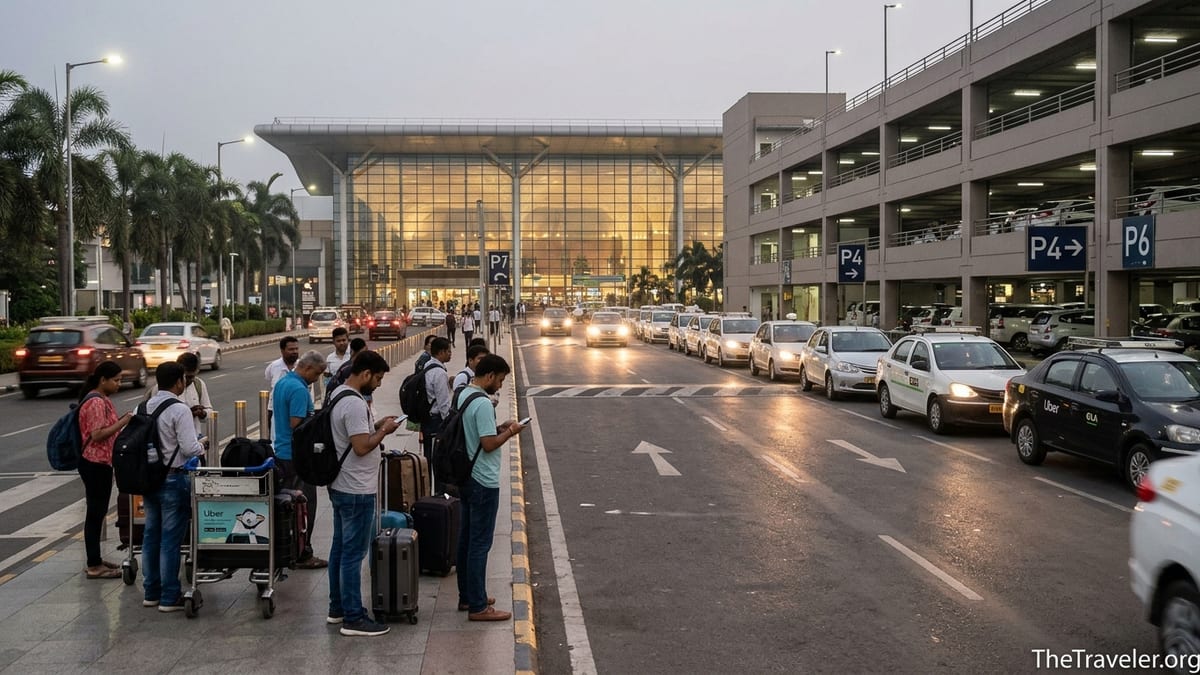
How Mumbai Airport Is Laid Out for Uber, Ola and Taxis
Mumbai’s Chhatrapati Shivaji Maharaj International Airport (BOM) now runs a dual-terminal system: Terminal 1 for domestic flights and Terminal 2 handling all international and most domestic operations. Both terminals are connected to large multi-level car parks, and almost all app cabs and many private pickups are funneled through these parking structures instead of stopping directly at the curb. This is why you will frequently see references to levels like P4, P6 or P7 in the Uber or Ola app.
At Terminal 2, arriving passengers are guided out at the arrivals level, commonly referred to as P6. From here, you may be directed down or up via lifts or escalators to a designated rideshare level such as P4 or across to marked pickup areas. Many frequent travelers describe this as “a bit chaotic but predictable once you know the drill”: you collect your bags, follow signs to parking or app cabs, then use the app to meet the driver at the indicated parking level and zone.
Terminal 1 is smaller and more old-school in its layout. Domestic arrivals step out almost directly to a forecourt where you see metered taxis, prepaid taxi counters and a separate zone used by app cabs. Here the challenge is less about navigating multiple levels and more about choosing between a straightforward prepaid taxi and app cabs whose pickup point can shift slightly depending on airport traffic management.
Understanding this basic layout helps make sense of why your Uber app may say “Meet at P4 Ola/Uber pickup” while a friend flying in a different airline on the same day might be told to meet at “P6 arrivals” or “P7 West.” The airport adjusts flows to manage congestion, so it is essential to trust the live instructions displayed inside your ride-hailing app.
Where Exactly to Meet Uber and Ola at Terminal 2 (T2)
Terminal 2 is where most confusion happens, especially for first-time visitors. Historically, Uber and Ola pickups were concentrated at P7 in the multilevel car park. Airport operations have since experimented with shifting large parts of the app-cab pickup area to P4 to allow faster exit to the city and to relieve crowding. As of mid‑2026, many travelers report that budget and regular categories like Uber Go and standard Ola rides typically stage at P4, while some higher-end categories or special arrangements may allow pickup at P6, which is on the same level as arrivals.
The practical routine usually looks like this: you collect your luggage, order your Uber or Ola once you reach the public arrivals hall, and the app will show a specific instruction such as “Proceed to P4 parking Uber/Ola pickup” or “Meet at P7 West.” Signage near the exits points you toward elevators and ramps leading into the car park. It is common to walk 3–7 minutes from baggage claim to the pickup bay, including elevator waits. If you are tired or traveling with elderly family, this short walk and level changes are worth factoring into your choice of transport.
Travelers often mention that the P4 rideshare area can be hot, crowded and confusing at busy times, especially at night when dozens of drivers circulate in a relatively tight loop. One common strategy is to wait inside the air-conditioned terminal until your driver is 3–5 minutes away, then walk out to P4 so you are not standing in exhaust fumes for 20 minutes. If your app shows a pickup at P6 instead, you will usually exit directly from arrivals and meet your car in a clearly marked lane, which many people find more comfortable since there is less vertical movement involved.
If you are unsure which level to choose, always follow the in-app text and graphical instructions rather than guessing. The app’s blue dot will often show whether you are already at the correct floor. Airport staff and security at the doors are used to this question and can point you toward the correct lift for “Uber Ola P4” or “Car park pickup.”
Uber and Ola Pickup at Terminal 1 (T1)
Terminal 1, which primarily handles low-cost and domestic carriers, has a simpler on-the-ground experience but still separates different transport streams. When you exit the arrivals hall, you will generally see three options: traditional black-and-yellow taxis and prepaid counters near the curb, an auto-rickshaw lane at one end, and a designated area where Uber and Ola cars enter after looping through the domestic terminal’s parking forecourt.
In the Uber or Ola app, you will typically see options such as “Terminal 1 Arrivals pick-up” or a nearby landmark inside the domestic parking area rather than specific P-level codes. Cars cannot usually stop directly outside the doors for long, so your driver may circle or wait in a holding area until you confirm that you have come out. Many frequent users in Mumbai recommend dropping a quick in-app message such as “Outside Gate 2 at T1 arrivals, blue trolley” so your driver can spot you quickly in the crowd.
Because Terminal 1 has more visible competition from auto-rickshaws and local taxis, touts are common. You may be approached by drivers who say “Uber? Ola?” and offer to take you “without app” for a flat amount that is higher than the metered app fare. While this can seem convenient if the official queue is long, it removes your app’s safety features and transparent pricing. For solo travelers or those arriving late at night, sticking to an official Uber or Ola booked through the app, or using the airport’s prepaid taxi booth, is usually safer and more predictable.
If your domestic flight arrives in the middle of heavy evening traffic, pickups at T1 can still be slow. A practical workaround for budget-conscious travelers is to check the estimated Uber or Ola time and compare it with the prepaid taxi line. If the app shows a 15–20 minute driver wait but the prepaid line is moving steadily, it may be worth using the prepaid taxi for that particular trip instead of waiting in the parking loop.
What Uber and Ola Rides Cost from Mumbai Airport in 2026
Fares at Mumbai Airport in 2026 vary with time of day, demand and traffic, but some broad ranges help with planning. From Terminal 2 to South Mumbai areas like Colaba or Fort, a typical Uber Go or comparable Ola category off-peak can run roughly in the 600 to 900 rupee range, taking about 60–90 minutes depending on congestion. At busy evening hours or during monsoon downpours, surge pricing can push this closer to 1,000 rupees or more, especially if you opt for a roomier sedan category.
For closer destinations such as Bandra Kurla Complex (BKC), Kurla or Powai, app fares are generally lower, often somewhere around 250 to 500 rupees for an Uber Go or standard Ola. These short-city trips are where you most clearly see the trade-off between app cabs and traditional taxis. A black-and-yellow taxi queue outside T1 might quote you a similar or slightly higher price, but without the live GPS tracking or cashless payment that Uber and Ola provide.
Trips between the two terminals are short but can still be affected by airport road bottlenecks. A rideshare from T2 to T1 often shows estimates in the 200 to 300 rupee band, even though the actual distance is not large, largely because of airport access charges, parking loops and the time drivers spend navigating the internal road system. For very budget-conscious travelers or those with light luggage, the free inter-terminal coach service or the expanding metro network can be attractive alternatives to paying for a car.
Surge pricing is a reality at Mumbai Airport, particularly between 11 p.m. and 2 a.m. when many international flights land. It is not uncommon to open the app and see an Uber Go almost as expensive as a premium taxi during this window. If you are traveling with family or multiple large suitcases, often a slightly more expensive but larger category such as Uber Premier or an Ola sedan can represent better value than squeezing everyone and their bags into the smallest and cheapest option.
Managing Surge Pricing, Queues and Late-Night Arrivals
Because Mumbai Airport experiences heavy waves of arrivals around midnight and early morning, it is wise to anticipate a potential surge. One common real-world scenario goes like this: you land at 1 a.m., reach the arrivals hall by 1:30 a.m., open Uber and see a 900 rupee fare to South Mumbai for a basic car with an estimated wait of 20 minutes. Meanwhile, the prepaid taxi counter inside the terminal is quoting something roughly comparable and there is a visible line of cabs waiting outside. In this case, many seasoned travelers simply opt for the prepaid taxi, saving themselves the walk to P4 and the uncertainty of driver cancellations.
If you are determined to use an app cab, a few tactics can help. First, add your luggage to a trolley before requesting the ride so you can move quickly once a driver accepts. Second, wait inside the air conditioning until your driver is within a few minutes of the pickup point; only then head to P4 or P6 to avoid standing in humid conditions. Third, if you see very high surge multipliers, it can be worth waiting 10–15 minutes to see if demand drops after a bank of flights has cleared immigration.
Driver cancellations and “ghost cars” are another frustration, especially at peak times. Some locals report requesting an Uber Green or another specific category, seeing a car assigned in 3–4 minutes on the app, only to have the request time out and be prompted to choose a more expensive category. If this happens repeatedly and you are traveling with vulnerable companions or large luggage, switching to a prepaid taxi can reduce stress even if the theoretical fare is higher by 100–200 rupees.
For arrival times in the daytime, especially between late morning and early evening, queues are usually shorter and surge less intense. Business travelers arriving at 3 p.m. often report walking to the rideshare level and meeting their car within 10 minutes at a relatively normal fare. Weekend evenings and the start of long holidays, by contrast, tend to produce both curbside and app-cab congestion, so extra patience and a backup plan are useful.
Luggage, Vehicle Types and Traveling With Families
Luggage is a practical concern that dramatically affects your experience with app cabs at Mumbai Airport. Uber Go and equivalent Ola micro categories are suited for one or two travelers with carry-on bags and perhaps one mid-sized suitcase. Once you move beyond that, such as a family of four with two large checked bags and multiple cabin bags, a larger category like Uber Premier, Uber XL, or a higher-segment Ola sedan becomes more comfortable and often safer, as you are not forcing bags into the front seat or blocking rear visibility.
On the ground, remember that your driver has to navigate crowded parking ramps and often tight pickup lanes at P4, P6 or P7. Having several large trolleys and scattered bags makes this harder. A simple strategy is to consolidate luggage onto one or two trolleys before heading to the pickup level, and to position yourselves at the edge of the designated rideshare lane where your driver can pull in, load quickly and exit without blocking traffic. Many travelers recommend assigning one adult to manage the trolley and another to track the car’s number plate so that loading is completed in under two minutes.
Families with young children or elderly parents often prefer app cabs for the privacy, air conditioning and ability to make quick stops on the way into the city. If you are traveling with a stroller or wheelchair, message the driver in-app once the ride is confirmed to mention that you have “one stroller and two big suitcases” so they can position the car accordingly, often folding down one rear seat if it is a hatchback. For very bulky or unusual luggage such as large musical instruments or sports equipment, you may want to consider booking a higher-capacity vehicle or, if arriving very late, arranging a private car through your hotel in advance.
For solo travelers with minimal luggage, especially those heading to nearby neighborhoods like Andheri, Powai or Ghatkopar, the smallest categories on Uber and Ola are usually adequate and represent one of the most economical ways to leave the airport. Women traveling alone late at night sometimes report feeling more secure with app cabs because of the ability to share trip details and track the route in real time, although using an official prepaid taxi from the airport counter is also generally regarded as safe.
When Prepaid Taxis or Metro Can Be Easier Than App Cabs
Despite the popularity of Uber and Ola, prepaid taxis at Mumbai Airport remain a very valid choice, especially when the rideshare system is under pressure. Prepaid counters are typically located just after customs and again near the exits. You tell the clerk your destination, pay a fixed amount displayed on the board, and receive a slip that you hand to a driver at the taxi line. There is no bargaining and no surcharge for luggage, which many visitors appreciate after a long-haul flight.
A classic example where prepaid wins: you land at T2 around midnight to find that the Uber and Ola apps show long waits, repeated cancellations or surging fares. Instead of trying multiple requests on a weakening phone battery, you walk to the prepaid counter, pay for a taxi to your hotel near Nariman Point, and are on your way within 10–15 minutes. For first-time visitors, this can feel considerably less stressful than navigating to P4, searching for the correct car and dealing with any last-minute driver-side renegotiation.
The growing Mumbai Metro network also changes the equation for some trips. With the T2 metro station on Line 3 opening in stages and connecting to other corridors, an increasingly realistic option is to take the metro into the city and then use a short Uber or Ola ride from a central station. For instance, a traveler heading to western suburbs might eventually find it faster to take the metro from T2 to a hub station, then hop into an auto-rickshaw or app cab from there, avoiding the heaviest airport road traffic.
That said, metro and bus options are best for travelers with light luggage who are comfortable navigating stairs, escalators and crowds. If you are jet-lagged with two large suitcases and traveling in the monsoon, the simplicity of a car door-to-door still usually outweighs any savings from public transport. In all cases, it is worth checking real-time conditions shortly before you land, as weather, construction and events can affect how attractive each option is on any given day.
Practical Safety and Scam-Avoidance Tips
Most rides from Mumbai Airport are uneventful, but certain patterns are worth keeping in mind. At both terminals, especially T1, some auto-rickshaw and taxi drivers outside the official queues may approach arriving passengers offering flat fares to popular neighborhoods at inflated prices, sometimes claiming they are “prepaid” or “airport fixed fare.” If you are using an app-based ride, ignore these offers and walk directly to the designated pickup area. If you are using a prepaid taxi, obtain your slip only from the official counter inside the terminal, not from anyone standing outside offering to “help.”
Within the rideshare areas at P4 and P6, another behavior sometimes reported is unofficial touting, where individuals approach travelers waiting for their Uber or Ola and propose an immediate ride in a parked car for a cash amount slightly above the app fare. Accepting these offers means riding without app-level insurance, tracking or customer support. The safest approach is to ride only in the car that matches the plate number and driver photo within your app, and to avoid sharing your one-time passcode or trip details with anyone who is not your assigned driver.
Once inside the car, keep your phone charged and visible, and watch the route on the map, especially if you are unfamiliar with Mumbai. Detours can be normal due to traffic, but if you are taken off the main roads without explanation, do not hesitate to ask the driver politely why, and, if needed, use the app’s emergency or support options. For payment, cash is still widely accepted, but many visitors find it easier and safer to rely on in-app digital payments so there is a clear record of the fare and no need to negotiate small change at the end of a long ride.
Travelers arriving alone at night can add simple precautions such as sitting in the back seat, sharing their live trip status with a family member or hotel, and confirming the driver’s name before getting in. Hotels in areas like Bandra, BKC and South Mumbai are used to late check-ins from the airport and will often help watch for your arrival or arrange a trusted driver if you request it in advance.
The Takeaway
Using Uber or Ola from Mumbai Airport in 2026 is entirely doable, but it rewards a bit of advance understanding. Terminal 2 relies heavily on multi-level parking zones like P4, P6 and P7, which can be crowded and confusing if you arrive unprepared. Terminal 1 is simpler but full of competing offers from taxis and autos. Knowing approximately what a ride should cost, how surge pricing behaves at different hours, and what alternatives exist such as prepaid taxis or the metro can turn a stressful arrival into a smooth start to your time in Mumbai.
If you prefer maximum control, app cabs are attractive for their transparent pricing, route tracking and cashless payment. Yet there are plenty of situations where the old-fashioned prepaid taxi counter is simply easier, particularly at peak midnight arrival banks, during heavy rains or when traveling with elderly relatives who would rather avoid long walks and waiting at outdoor pickup bays. The key is to keep both options open in your mind and choose based on the specific conditions you see on the day you land.
Whichever option you choose, allow for extra time, especially if you are heading straight into meetings or a connecting train. Mumbai traffic can be unpredictable, but with the right mix of information and flexibility, you can step out of the terminal, find your ride with confidence and be on your way to exploring one of India’s most energetic cities.
FAQ
Q1. Where do I meet my Uber or Ola at Mumbai Airport Terminal 2?
Most Uber and Ola pickups at T2 use the multi-level car park, commonly at P4 or sometimes at P6 or P7. Always follow the live instructions in your app, which will specify the exact level and zone and then use airport signs and elevators to reach that pickup area.
Q2. How long does it take to reach the rideshare pickup zone at T2 after collecting bags?
In typical conditions it takes about 5 to 10 minutes from baggage claim to the app-cab pickup area at T2, including walking, lift or escalator time and minor queuing. At very busy times or if lifts are crowded, this can stretch closer to 15 minutes.
Q3. What is a typical Uber or Ola fare from Mumbai Airport to South Mumbai?
For areas like Colaba or Fort, off-peak app fares for a basic category such as Uber Go often fall roughly between 600 and 900 rupees, with higher prices during surge periods or if you choose larger or premium vehicles.
Q4. Is it safer to use a prepaid taxi or an app cab late at night?
Both official prepaid taxis from the airport counter and properly booked Uber or Ola rides are generally considered safe. Many visitors prefer app cabs for GPS tracking and cashless payment, while others choose prepaid taxis to avoid potential surge pricing and driver cancellations at midnight.
Q5. Can I use Uber or Ola to transfer between Terminal 1 and Terminal 2?
Yes, Uber and Ola operate between T1 and T2, and a ride usually costs in the 200 to 300 rupee range depending on traffic and airport access patterns. However, the airport also offers a free inter-terminal coach, which can be a good alternative if you are not in a hurry.
Q6. What should I do if my Uber or Ola driver keeps canceling at the airport?
If you face repeated cancellations or long waits at P4 or P6, consider switching to another category in the app or using the official prepaid taxi counter inside the terminal. This is often the quickest way to leave during busy arrival waves or heavy rain.
Q7. Which vehicle type should I choose if I have a lot of luggage or a family group?
For one or two people with light bags, Uber Go or similar is usually enough. For families, elderly passengers or more than two large suitcases, choosing a larger category such as an Uber Premier, Uber XL or equivalent Ola sedan makes loading easier and the ride safer and more comfortable.
Q8. Are there common scams to watch out for at Mumbai Airport?
Be wary of drivers or touts outside the official queues who offer rides “without app” for flat cash amounts, or who claim to be prepaid taxis without giving you an official slip. Book rides only through the Uber or Ola app or from the airport’s prepaid taxi counter, and match your driver and number plate carefully.
Q9. Is the Mumbai Metro a good option from the airport?
The expanding metro network, including the T2 station on Line 3, is an increasingly useful option for travelers with light luggage, especially for reaching parts of the western and central suburbs. It can be faster at peak road-traffic times, but still requires walking, escalators and possible line changes.
Q10. Should I book my airport ride in advance or request it on arrival?
Most travelers simply request an Uber or Ola on arrival, which allows for delays at immigration or baggage claim. If you are arriving very late or with a large group, arranging a car through your hotel or planning to use the prepaid taxi counter can provide extra peace of mind.