


More news on this day
Air travel across Dubai and parts of the Middle East remains unsettled this week, as Emirates, Etihad Airways and Flydubai navigate rolling delays and selective cancellations amid continuing regional tensions and changing airspace risk assessments.
Get the latest news straight to your inbox!
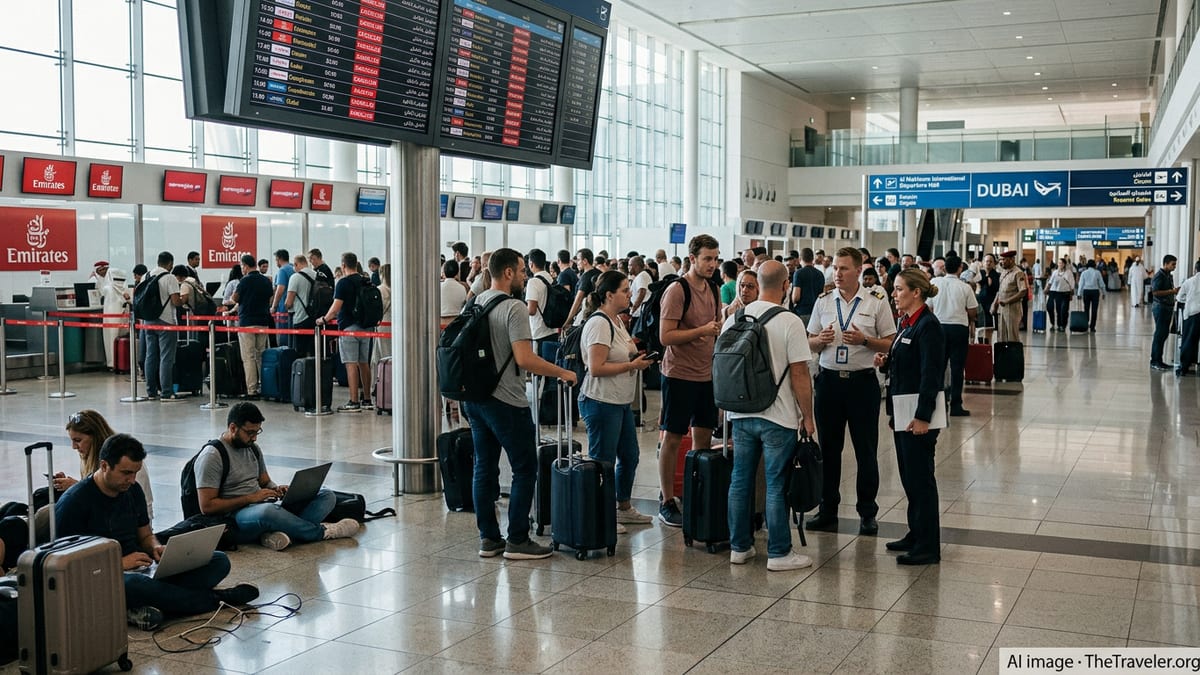
Mixed operations at Dubai and Abu Dhabi hubs
Publicly available flight data and regional media coverage indicate that Dubai International Airport and Abu Dhabi’s Zayed International Airport are open and broadly functioning, but with a patchwork of on-time services, delayed departures and a limited number of cancellations. Reports from Gulf-based outlets over the past ten days describe Emirates, Etihad and Flydubai largely maintaining their core schedules while making day-by-day adjustments on certain regional routes.
Tracking data for Dubai International Airport in early September shows a relatively small proportion of overall services being cancelled, but with disproportionate impact on a handful of carriers and destinations. Figures compiled so far for September suggest that Flydubai has recorded the highest number of cancellations at Dubai, with Bahrain among the most affected routes, alongside some long-haul services to Europe and Africa.
Abu Dhabi has reported a similar pattern of broadly normal operations punctuated by scattered delays. Etihad services to destinations such as Jakarta, Kochi and selected Gulf cities have faced schedule changes on specific days, sometimes linked to operational or weather factors, and at other times coinciding with airspace restrictions further afield. Passenger advisories consistently encourage travelers to check flight status before leaving for the airport and to keep contact details updated for disruption alerts.
Despite the disruption, aircraft movements through the UAE’s main hubs remain high, reflecting both strong underlying travel demand and the strategic importance of Dubai and Abu Dhabi as transfer points between Europe, Asia and Africa. That balance between resilience and vulnerability is shaping how the region’s airlines respond to the current security environment.
Regional security tensions reshape airspace and schedules
The latest wave of disruption has been closely tied to a flare-up in tensions around the Strait of Hormuz and the wider Gulf region. Recent coverage from regional and international travel publications points to a series of drone and missile incidents, attacks on commercial shipping and military assets, and retaliatory strikes across parts of Iran and the Gulf, all contributing to heightened risk assessments for certain airspace corridors.
According to these reports, conflict activity has been concentrated along key maritime chokepoints and in areas of western Iran, Kuwait, southern Saudi Arabia and Yemen’s Red Sea coastline. Aviation safety bulletins from European regulators have extended existing conflict-zone advisories for Gulf airspace into late September, highlighting continued concern over the potential for miscalculation or spillover affecting civil aviation at cruising altitudes.
In practice, this has prompted routing changes for some overflights and, in a smaller number of cases, suspensions or reductions on specific city pairs viewed as higher risk. Carriers in the Gulf have generally sought to maintain connectivity by re-routing around affected zones where feasible, accepting slightly longer flight times and higher fuel burn in exchange for maintaining network breadth.
The broader security backdrop also shapes government travel advisories. Recent updates from Western countries place the UAE, Saudi Arabia, Jordan and Oman in elevated risk categories, citing the possibility of sudden airspace closures, ballistic activity and unplanned diversions. While these notices do not prohibit travel, they underscore the potential for rapid operational changes that can cascade through airline schedules.
International airlines cut back as Gulf carriers hold the line
One of the most visible consequences of the current tensions has been the divergence between Gulf-based airlines and some of their international counterparts. Coverage from UAE media and specialist travel outlets shows that while Emirates, Etihad, Flydubai and fellow UAE carrier Air Arabia continue to serve most of their usual destinations, several European and Asian airlines have opted to suspend or curtail services to Dubai and other Middle Eastern cities.
Air France has extended a suspension of flights to and from Dubai into mid-September, citing the regional security situation and airspace risk. Some Asian carriers have temporarily halted operations to Dubai and Riyadh or reduced frequencies, particularly on routes that would normally overfly sensitive areas. These decisions have narrowed options for passengers relying on non-Gulf airlines to reach the region, even as the local carriers keep their networks broadly intact.
For Emirates, Etihad and Flydubai, maintaining service has involved a mix of tactical schedule changes and operational workarounds. On certain days at the start of the month, these airlines operated delayed services to Bahrain, Kuwait and select South and Southeast Asian destinations, while cancelling a small number of flights or consolidating services where demand and operational constraints allowed.
This strategy reflects the structural role of Gulf carriers as network airlines built around hub connectivity. Completely suspending operations on key trunk routes would risk losing market share and disrupting global traffic flows, so the emphasis has been on incremental adjustments, with frequent public updates about affected flights rather than broad, long-term cancellations.
Passenger impact: rolling delays, rebookings and longer routings
For travelers, the practical impact of the current situation has largely taken the form of rolling delays, occasional last-minute cancellations and longer-than-usual routings on some journeys. Flight-status boards at Dubai and Abu Dhabi airports in recent days have shown a scatter of departures and arrivals departing behind schedule, particularly on busy regional routes and certain long-haul connections linked to affected airspace corridors.
Reports from local media summarizing recent days’ operations list delays of anywhere from 30 minutes to several hours on individual flights operated by Emirates, Etihad and Flydubai. In a smaller number of cases, regional flights have been cancelled outright or diverted to alternative airports because of temporary closures or congestion. International carriers that have paused services entirely have triggered larger-scale rebookings, with passengers rerouted onto Gulf airlines or alternative hubs.
Travel-advisory coverage consistently urges passengers flying to or through Dubai to allow extra time, monitor airline notifications closely and be prepared for short-notice changes. Travelers connecting through the UAE from Europe or North America on their way to Asia and Australasia are being advised to pay particular attention to minimum connection times and to build in additional buffers where possible.
Some regular flyers have reported relatively smooth experiences despite the headlines, noting that many flights still depart close to schedule and that airport operations, security and ground handling continue to function normally. The uneven pattern of disruption means that two passengers flying on the same day may have very different experiences, depending on their airlines, destinations and connection windows.
Outlook for Middle East aviation in the coming weeks
Looking ahead through the rest of September, the trajectory of Middle East air travel will depend heavily on whether regional tensions stabilize, escalate or ease. Conflict-zone advisories currently in place for Gulf airspace are scheduled to be reviewed again at the end of the month, and any further extensions or revisions will likely feed directly into airline risk assessments and scheduling decisions.
Industry analysts note that Gulf carriers have developed considerable experience operating around regional crises over the past decade, including earlier episodes involving airspace closures and missile activity. That history suggests a capacity to adapt routing and scheduling while preserving much of the network, especially for high-demand corridors connecting Europe, Asia and Africa through Dubai and Abu Dhabi.
However, the system remains sensitive to shocks. A single incident involving civilian aviation or a sudden closure of a major airspace segment could force widespread diversions and cancellations in a matter of hours. Even without such an event, the combination of security concerns, air-traffic control disruptions in other regions and weather-related issues, such as volcanic ash in parts of Indonesia, is likely to keep flight operations more volatile than usual.
For now, travelers using Emirates, Etihad and Flydubai can expect most services to operate, but with a higher-than-normal risk of schedule changes. Careful itinerary planning, flexible booking conditions and close attention to airline communications will be key tools for navigating Dubai and Middle East flight disruption as the situation evolves.