


More news on this day
More than 100 flights have been cancelled and at least 2,500 delayed across Europe in a fresh wave of disruption affecting key hubs in France, Spain, the Netherlands, Hungary and several other countries, with carriers such as Air France, Vueling and Transavia France forced to trim schedules and reroute aircraft at the height of the summer rush.
Get the latest news straight to your inbox!
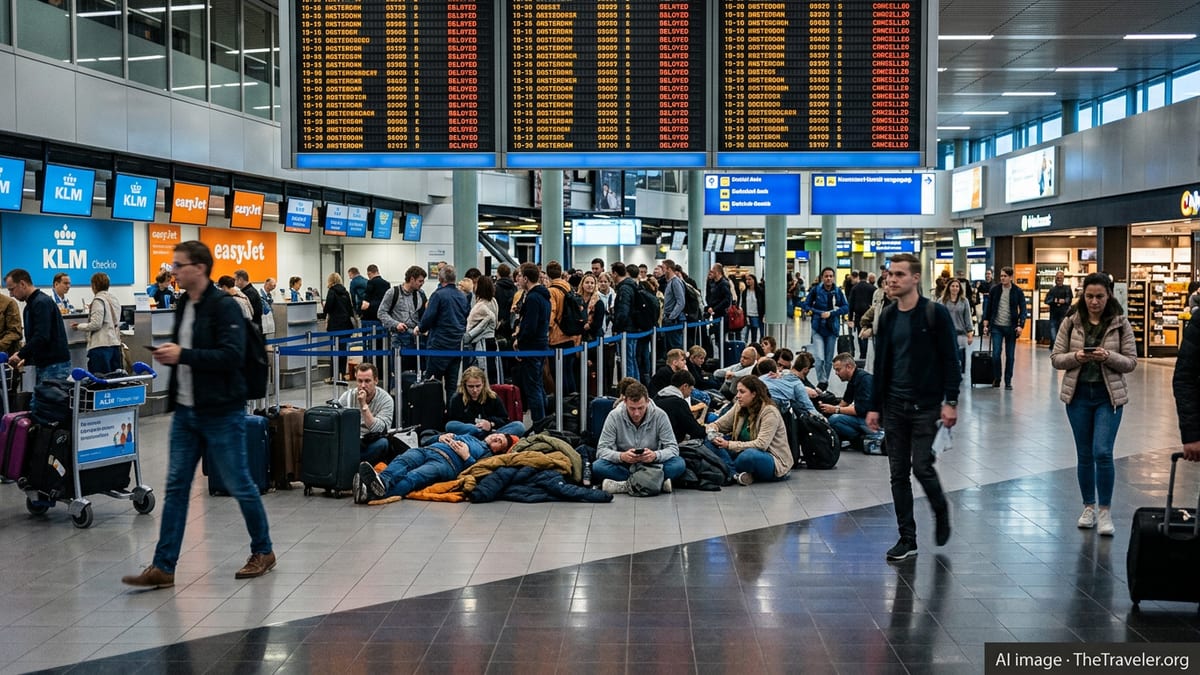
New Wave of Disruption Hits Peak Summer Traffic
According to live operational data from flight-tracking and aviation-network platforms, a total of 104 flights were cancelled and around 2,599 were delayed across European airports over the latest 24-hour period, as pressure on an already stretched network intensified during one of the busiest travel weeks of 2026. The disruptions come as overall air traffic in the region remains above 2019 levels on some days, leaving airlines and air traffic managers with little slack when problems arise.
Publicly available figures show that France and Spain again rank among the major contributors to air traffic flow management delays in Europe, reflecting a mix of capacity constraints, staffing challenges and adverse weather patterns that have persisted through late June and early July. Eurocontrol’s recent network briefings indicate that tens of thousands of flights per week have been subject to flow restrictions, with a significant share of all services experiencing some form of delay.
The latest spike in cancellations and delays has particularly affected short and medium haul routes within Western and Southern Europe. Passengers connecting through busy hubs such as Paris, Amsterdam and Madrid have reported missed onward flights and extended waits at terminals as airlines work through backlogs and reposition aircraft.
While the number of outright cancellations remains a small fraction of total scheduled movements, the concentration of disruption at peak times has created visible congestion on departure boards and has strained airport handling resources, especially during morning and late-afternoon banks of flights.
France, Spain, Netherlands and Hungary Among Hardest Hit
Network performance snapshots highlight France and Spain as recurring hotspots for en-route and airport delays, with area control centres in Reims, Marseille, Brest, Barcelona and Madrid all reporting elevated traffic loads and ongoing capacity issues this summer. These bottlenecks ripple across the continent, as flights operating to, from and over these regions face regulated departure slots and longer routes to bypass saturated sectors.
In the Netherlands, Amsterdam Schiphol continues to feature prominently in daily disruption rankings compiled from live flight data. Even on days with relatively modest numbers of cancellations, a high proportion of departures and arrivals at the airport are experiencing departure holds or extended taxi times, pushing average delays into double digits and creating knock-on effects for aircraft and crews scheduled to operate subsequent legs.
Hungary has also been drawn into the latest wave of disruption. While total traffic volumes over the country are lower than at major Western European hubs, delays and cancellations elsewhere in the network have translated into late inbound aircraft and schedule compression at Budapest and other regional airports, with carriers forced to adjust rotations and, in some cases, cancel individual sectors.
Reports indicate that secondary airports across Belgium, Austria, Portugal and parts of Central Europe are seeing similar patterns, as busy summer leisure routes intersect with constrained airspace and weather systems that are shifting from day to day. Even when local conditions are manageable, upstream issues in French, Spanish or North Sea airspace can cascade outward and affect flights hundreds of kilometres away.
Air France, Vueling and Transavia France Face Operational Strain
The disruption has hit several European carriers that rely heavily on French and Spanish airspace. Publicly available tracking data shows Air France contending with a combination of en-route restrictions over France and busy ground operations at Paris Charles de Gaulle and Orly, translating into a rising number of delayed departures and some tactical cancellations on high-frequency routes.
Vueling, which operates a dense network out of Barcelona and other Spanish airports, has also been affected as capacity and staffing constraints in Spanish air traffic control sectors lead to regulated flows during peak periods. Delays to early rotations can quickly spread across the airline’s point-to-point network, with aircraft and crews arriving late into bases and outstations across France, Italy and the wider Mediterranean.
Transavia France, a low-cost affiliate operating out of French airports, has reported similar operational challenges as it navigates congested holiday corridors linking France with Spain, Portugal, Greece and North Africa. When en-route delays coincide with ground handling constraints at leisure destinations, turnarounds can lengthen and force last-minute adjustments to evening services back to France and the Netherlands.
Other carriers operating in affected corridors, including pan-European low-cost and leisure airlines, are facing comparable scheduling stress. Public dashboards suggest that some have adopted proactive cancellation strategies on selected flights to preserve wider schedule stability and reduce the risk of extensive rolling delays into the late evening.
Weather, Capacity and System Strain Drive Delays
Recent European aviation overviews point to a combination of factors behind the current wave of disruptions. Weather remains a leading cause of en-route delay minutes across the region, with convective storms over Central Europe and heat-driven turbulence episodes over Southern Europe complicating route planning. When storms build along key traffic flows over France, the Alps or the western Mediterranean, aircraft are often held at the gate or rerouted along longer trajectories, adding minutes to each sector.
Capacity and staffing constraints within air navigation service providers are another persistent theme. Transition to new air traffic management systems, such as those being rolled out in parts of the French network, has limited the number of flights that can be accommodated in certain control sectors at busy times. Even modest reductions in available capacity can trigger widespread flow restrictions when demand is close to or above historic peaks.
At the airport level, handling resources are under continued pressure. Ground staff must cope with tightly timed turns, high passenger volumes and heat-related safeguards for ramp operations, which can restrict activity during the hottest parts of the day. Delays in one part of the system often become “reactionary” delays elsewhere, as late-arriving aircraft compress the time available for turnaround and safety checks.
Industry analyses note that while overall on-time performance has improved compared with some past summers, the margin for error remains narrow. When several of these drivers coincide on the same day, the result can be an abrupt jump in cancellations and delays similar to the 104 cancellations and 2,599 delays now recorded across the network.
What Passengers Can Expect in the Coming Days
With European traffic currently running at or above pre-pandemic highs on peak days, aviation forecasters expect further periods of disruption over the coming weeks, particularly if unsettled weather persists over key hubs in France, Spain and the Benelux region. Network managers have cautioned that even short-lived storms or local capacity reductions can generate sizeable backlogs during the morning and evening waves of departures.
Passenger rights frameworks such as EU261 continue to apply when flights are delayed or cancelled within the European Union, Iceland, Norway and several associated territories, though the level of compensation depends on the cause of disruption and the length of delay. Consumer groups are advising travellers to monitor their flights closely on the day of departure and to keep all travel documents and written notifications from airlines in case claims become necessary.
Operational data for recent weeks suggests that most flights are still reaching their destination on the scheduled day of travel, but travellers face an elevated risk of longer-than-normal journey times and occasional missed connections on multi-leg itineraries. For those with critical connections or cruise departures, travel planners recommend allowing additional buffer time or considering earlier flights when possible.
As peak summer continues, airlines and air traffic managers are expected to keep adjusting schedules, staffing and contingency plans in an effort to reduce the scale of last-minute cancellations. However, with 104 flights already cancelled and thousands more delayed in a single day, Europe’s tightly packed summer sky remains vulnerable to further shocks from weather, capacity limits and the sheer volume of people on the move.