


More news on this day
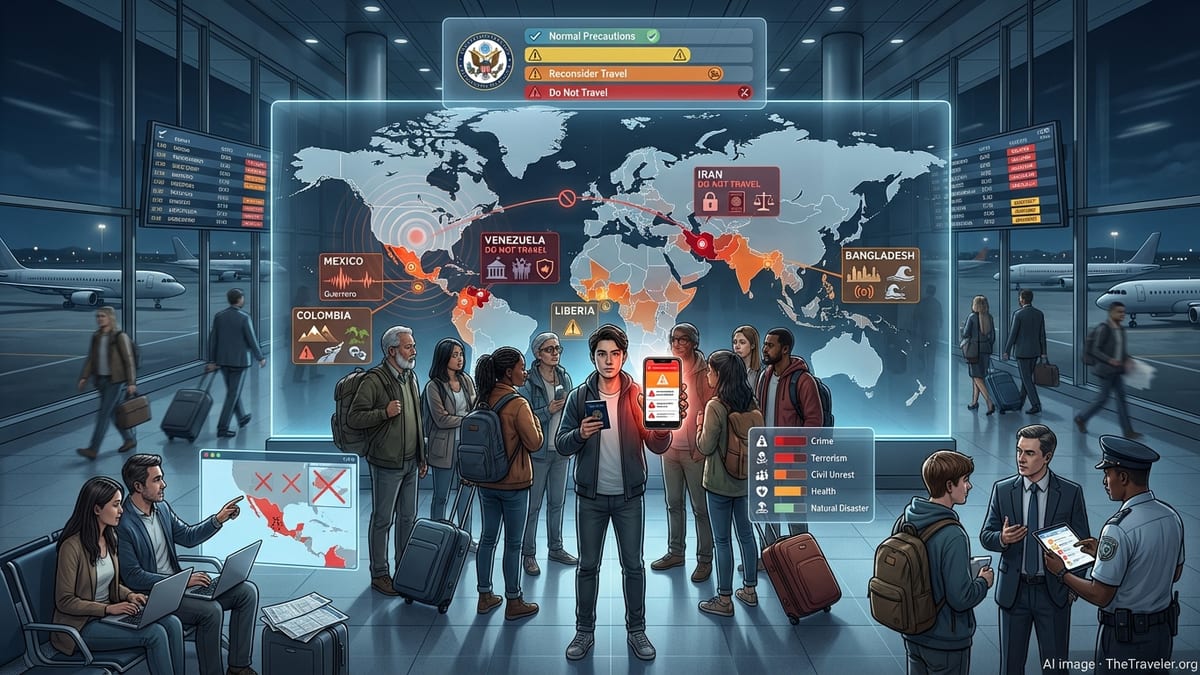
The United States has highlighted 23 countries as carrying the highest level of travel risk, with a series of recent advisories underscoring growing concerns about conflict, crime, civil unrest, and the limited ability of U.S. missions to assist travelers in emergencies.
Get the latest news straight to your inbox!
Level 4 “Do Not Travel” Designation Expanded
Publicly available information from the U.S. Department of State shows that its strictest Level 4 “Do Not Travel” advisories now apply to 23 countries and territories, reflecting what officials describe in published material as the most serious security, crime, and political instability concerns worldwide. The list currently includes Russia, Ukraine, Syria, Iran, and Haiti, alongside a number of countries facing armed conflict, terrorism, or state fragility.
Level 4 is the highest advisory category in the State Department’s four-tier system. Guidance explains that this designation is used when the risk to personal safety is considered so severe that U.S. citizens are urged to avoid travel altogether. The advisories emphasize that in such locations, U.S. embassies and consulates may have limited, highly constrained, or even no ability to provide emergency services.
Recent updates to individual country pages highlight how quickly conditions can deteriorate. Russia, Syria, and Iran are cited for risks such as arbitrary detention, terrorism, and regional conflict, while Haiti and several African states are flagged for extreme gang violence, kidnapping, and a collapse in basic public security. In Ukraine, the ongoing war continues to drive an elevated threat environment that includes missile strikes, drone attacks, and frequent disruptions to civilian infrastructure.
These highest-level warnings are not blanket bans on travel, but they serve as a clear signal that those who choose to visit such destinations may face life-threatening hazards, along with restricted consular support if something goes wrong.
Russia, Ukraine, Syria, Iran and Haiti Under Intense Scrutiny
Russia remains under a Level 4 advisory that outlines a complex mix of risks. According to publicly available travel guidance, U.S. citizens are advised against travel due to the ongoing impact of Russia’s full-scale invasion of Ukraine, the potential for harassment or detention of foreigners, and limited communication channels between Washington and Moscow. The advisory also notes that the U.S. government’s ability to assist citizens inside Russia is significantly constrained.
Ukraine is also designated Level 4 due to the active armed conflict, frequent air attacks, and the unpredictability of military developments. Travel information points to heightened danger in frontline regions and areas close to the borders where Russian and Belarusian forces are present. Even in cities far from the front lines, air raid alerts and critical infrastructure strikes remain part of daily life.
Syria continues to be assessed as one of the world’s most dangerous travel destinations. The advisory for Syria highlights persistent civil conflict, terrorism, kidnapping, and the near-total absence of functioning consular services inside the country. Large areas are controlled by competing armed groups, and basic services, including medical care, can be extremely limited or unavailable.
Iran’s Level 4 advisory cites risks including the possibility of wrongful detention of foreign nationals, regional tensions, and terrorism. Publicly available information notes that dual U.S.–Iranian citizens may face particular vulnerability to detention and may not be recognized as U.S. citizens under local law. Meanwhile, Haiti’s advisory has been repeatedly tightened as gang violence, kidnappings, and disruptions to food and fuel supplies have worsened, especially in the capital Port-au-Prince and surrounding areas.
Broader List of 23 Countries Reflects Diverse Threats
The 23 countries and territories assessed at Level 4 span several regions and a wide range of security dynamics. Alongside Russia, Ukraine, Syria, Iran, and Haiti, the list includes conflict-affected states in the Middle East, North and East Africa, and the Sahel, as well as locations where organized crime, kidnapping, or political instability dominate the risk profile.
In parts of the Sahel and Horn of Africa, travel advisories describe converging threats from armed insurgencies, terrorist organizations, and weak state institutions. Countries such as Somalia, Sudan, South Sudan, Mali, and others are highlighted in public documentation for the prevalence of roadside bombings, ambushes, and attacks on hotels, transportation hubs, and government facilities. In some areas, foreign travelers can be targeted for kidnapping for ransom or political leverage.
Other states are included primarily due to extreme levels of violent crime, fragile governance, or prolonged internal crises. In several Caribbean and Latin American countries on the Level 4 list, advisories point to gang control of key urban neighborhoods, widespread firearms possession, and strained law enforcement capacity. Travelers are warned that carjackings, armed robberies, and kidnappings can occur in both major cities and along key road corridors, sometimes in broad daylight.
For several Level 4 destinations, health systems are overstretched or damaged by conflict, which can turn routine illnesses or injuries into medical emergencies. Travel guidance stresses that evacuation options may be limited or prohibitively expensive, and that local hospitals may lack essential medications, equipment, or specialist care.
What Level 4 Means for Travelers
The State Department’s four-tier system ranges from Level 1 (“Exercise Normal Precautions”) to Level 4 (“Do Not Travel”). Explanatory materials describe Level 4 as the point at which the U.S. government strongly recommends that citizens avoid travel entirely because the risk to safety outweighs potential benefits. In practice, this means that nonessential tourism and business travel are discouraged, and those who proceed anyway are urged to adopt exceptional risk-mitigation measures.
At Level 4, U.S. embassies and consulates may have restricted staffing, limited movement, or may even have suspended in-country operations. Public documentation notes that in some places, the U.S. government cannot evacuate citizens, provide on-the-ground assistance during active security incidents, or ensure access to medical care or safe transportation. Communication disruptions, checkpoints, and curfews can further complicate any response to emergencies.
Travelers who nevertheless decide to enter Level 4 countries are encouraged, in widely available guidance, to prepare detailed contingency plans. This includes arranging secure local transportation, confirming reliable accommodations in safer areas where possible, and establishing clear communication channels with family or contacts outside the country. Many experts cited in media coverage recommend carrying extra supplies, maintaining a low profile, and avoiding routine patterns that could attract unwanted attention.
Insurance considerations are also critical. Some travel insurance policies exclude coverage for countries with active war zones or official “Do Not Travel” advisories. Prospective visitors are advised to check policy terms carefully, particularly regarding medical evacuation, trip interruption, and coverage exclusions linked to terrorism or civil unrest.
Steps Travelers Can Take Amid Rising Global Risks
The expansion and tightening of Level 4 advisories come as international travel has rebounded strongly from the pandemic-era slowdown. With more U.S. citizens again planning complex itineraries, risk experts quoted in travel industry coverage emphasize the importance of doing thorough research on local conditions, even in destinations that may not yet be at Level 4 but have seen recent unrest or political uncertainty.
Publicly available guidance from U.S. government channels encourages travelers to review the latest country-specific advisories shortly before departure, since security situations can change rapidly. Travelers are also urged to enroll in the free Smart Traveler Enrollment Program, known as STEP, which provides email or text alerts about emerging threats and helps consular staff contact citizens in an emergency.
Seasoned international travelers often recommend maintaining photocopies and digital backups of key documents, including passports, visas, and medical records, and leaving a detailed itinerary with a trusted contact at home. Basic precautions such as avoiding public displays of wealth, limiting use of ATMs in isolated areas, and relying on reputable transportation providers can reduce exposure to opportunistic crime in many environments.
While the vast majority of trips abroad continue to proceed without serious incident, the concentration of 23 countries at the highest warning level underscores a more volatile global security landscape. For U.S. travelers, the latest advisories indicate that careful planning, flexibility, and an honest assessment of personal risk tolerance are now more essential than ever when considering destinations such as Russia, Ukraine, Syria, Iran, Haiti, and other Level 4 locations.