


More news on this day
Europe’s already stretched air travel network lurched into deeper turmoil this summer, as a fresh wave of disruption linked to staffing shortages, weather and airspace constraints pushed delays to an estimated 2,110 flights and forced about 150 cancellations across major hubs in London, Oslo and Paris.
Get the latest news straight to your inbox!
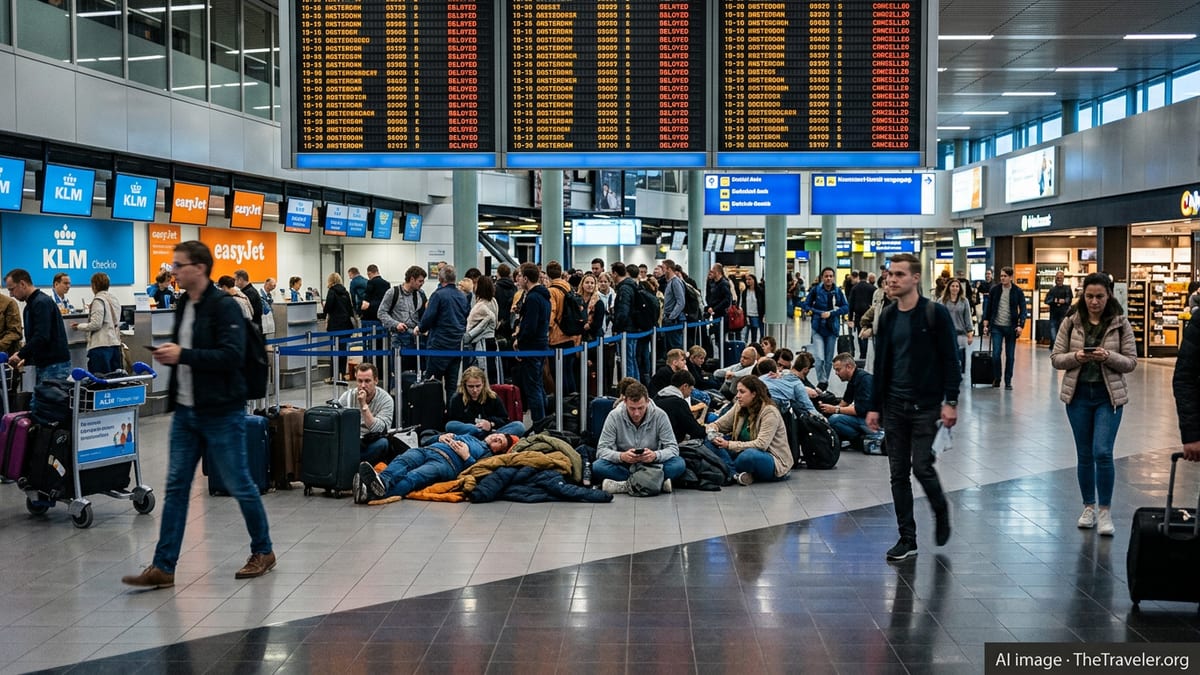
Summer 2026 Becomes a Flashpoint for European Air Travel
The spike in delays and cancellations at London, Oslo and Paris forms part of a pattern that has emerged across Europe in 2026, with several single days of severe disruption already documented. Publicly available operational data and analytics show multiple episodes where more than 1,500 flights were delayed or canceled in a day at major hubs, including Paris Charles de Gaulle, Amsterdam Schiphol and Oslo Gardermoen, underlining how fragile peak‑season schedules have become.
On 28 May 2026, for example, disruption centered on Amsterdam, Paris, Helsinki, Oslo and Milan led to at least 1,545 delayed flights and 33 cancellations in a single day, according to independent flight‑tracking analysis. Similar patterns resurfaced in late June and mid‑July, when delay totals again exceeded 1,500 flights across European hubs, including Paris and London, reinforcing concerns that congestion and capacity limits are colliding with strong demand.
Against this backdrop, operational reports for London, Oslo and Paris point to a cumulative burden that now easily runs into the thousands of disrupted flights for the summer period, with the latest wave of problems adding an estimated 2,110 delays and about 150 cancellations. Those figures highlight not only the headline‑grabbing days of crisis, but also the steady build‑up of smaller incidents that together amount to a sustained aviation crunch.
Airports in these cities also began 2026 with weakening punctuality trends. Regional punctuality reports for January and February 2026 show on‑time performance slipping compared with the previous year at several large European gateways, including London and Paris, while Oslo’s figures, though stronger, still reflected weather‑related strain. That deterioration set the stage for the heavier disruptions seen as summer demand peaked.
Norwegian Air Traffic Controller Strike Ripples Through Oslo
The most visible recent trigger in Northern Europe was an air traffic controller strike in Norway in late August 2026, which generated widespread delays and cancellations at Oslo Gardermoen. Travel industry coverage describes how the industrial action forced airlines to pare back schedules and slowed traffic flows through the country’s main hub, intensifying an already difficult travel period for passengers transiting Norway and connecting onward across Europe.
While the strike’s immediate impact was focused on Norwegian airspace, its knock‑on effects were felt on routes linking Oslo with London and Paris, where aircraft and crews struggled to stay in position. Disrupted rotations on Scandinavian and broader European networks contributed to rolling delays that continued even after some services were restored, illustrating how quickly a localized labor dispute can translate into wider regional problems when airports are operating close to capacity.
These events came on top of earlier summer disturbances tied to weather and congestion in continental Europe. When combined with the structural punctuality pressures already evident in 2026 data for major hubs, the Norwegian strike added another layer of volatility, helping to push the total number of delayed and canceled flights associated with Oslo’s operations into the hundreds over the course of the season.
Passenger accounts shared on public forums also depict a patchwork of cancellations and extended waits on routes into and out of Oslo, as well as missed connections at larger European hubs. Although such individual experiences do not provide system‑wide statistics, they align with the overall picture drawn by operational reports of mounting disruption and longer recovery times when things go wrong.
London and Paris Under Sustained Operational Pressure
In Western Europe, London and Paris have been at the center of repeated disruption events in 2026. Flight‑disruption monitoring services documented a major surge on 30 June 2026, when London Heathrow and Gatwick were listed among the airports experiencing the heaviest delays, as more than 1,500 flights across Europe were delayed or canceled that day and total disruptions exceeded 1,600. Another spike on 14 July 2026 again highlighted Paris Charles de Gaulle as a key pressure point, with more than 1,500 delays and over 70 cancellations recorded across several hubs.
These acute events add to a longer trend of eroding on‑time performance at major airports serving the two capitals. European punctuality reports for early 2026 show Charles de Gaulle with around seven in ten flights arriving on time in February, while London airports such as Heathrow and Gatwick recorded similar or slightly better figures. Although still handling the vast majority of flights without major delays, these statistics represent slippage compared with 2025 and leave less buffer when systems come under strain.
Persistent staffing constraints at airlines and ground handlers, lingering infrastructure bottlenecks, and high traffic volumes during peak travel periods have all been cited in public reporting as contributing factors. Air‑traffic flow restrictions and adverse weather on key days further squeeze the system, forcing airports and airlines to implement tactical cancellations to keep overall operations safe and manageable. London and Paris, among Europe’s busiest hubs, are particularly exposed when those pressures coincide.
For travelers, this has translated into a season of uncertainty across major UK‑France‑Norway corridors. Reports from consumer groups and travel forums describe missed connections in London on routes to Paris, as well as long delays returning from other European destinations via the UK capital. Similar testimonies appear on cross‑Channel rail services between London and Paris, which have also suffered intermittent disruption during heatwaves and infrastructure incidents, compounding the sense of instability for those planning multi‑modal trips.
Passenger Rights and Compensation Frameworks in Focus
As disruption mounted in 2026, regulators and consumer‑rights organizations across Europe reiterated guidance on what passengers can expect when flights are delayed or canceled. Under the UK’s post‑Brexit passenger rights regime, broadly aligned with the European Union’s EU261 rules, travelers departing from or arriving at UK airports are generally entitled to care, re‑routing or refunds when flights are significantly delayed or canceled, and in some cases to fixed‑sum financial compensation if the disruption is within an airline’s control.
Updated advisories from the UK Civil Aviation Authority for summer 2026 emphasize that airlines must provide meals, refreshments and accommodation when needed during extended delays, and that passengers should keep receipts and travel documents to support any subsequent claims. The regulator also highlights that compensation may not apply in cases deemed to involve extraordinary circumstances, such as severe weather, security incidents or certain air‑traffic management decisions, which limits payouts in some of the most chaotic episodes.
Across the wider European network, consumer‑advocacy platforms have reported rising volumes of compensation checks and claims as travelers seek redress for disrupted summer journeys. These services draw on operational data to flag days when disruption has been particularly intense, such as the late‑May and mid‑July events, and encourage passengers to verify whether their specific circumstances meet the legal thresholds for compensation under EU or national rules.
The surge in claims is prompting renewed debate about whether existing regulations strike the right balance between consumer protection and the financial burden on airlines and airports still rebuilding after the pandemic. Industry groups argue that structural issues in European airspace and air‑traffic control, as well as increasingly volatile weather patterns, are driving many of the recent disruptions, while passenger advocates maintain that carriers should bear more responsibility for staffing and scheduling resilience.
What Travelers Can Do Amid an Uncertain Outlook
With the 2026 peak season already marked by several high‑impact disruption days and an estimated 2,110 delays and 150 cancellations concentrated at London, Oslo and Paris alone, forward‑looking travelers are adjusting their plans. Public guidance from regulators and travel organizations consistently recommends checking flight status before leaving for the airport, allowing extra time for connections, and considering earlier departures when itineraries involve onward travel on separate tickets.
Consumer advice also stresses the value of understanding passenger rights in advance. Knowing when airlines are required to provide meals, accommodation or re‑routing, and under what conditions compensation may be due, can help travelers make quicker decisions at the airport, such as whether to accept a proposed alternative flight or request a refund and rebook with another carrier. Keeping digital copies of boarding passes, booking confirmations and receipts is particularly important when disruption affects multiple legs of a journey.
Some travelers are opting to diversify their transport options on shorter routes, using rail instead of air when feasible between cities such as London and Paris. However, recent disruption on cross‑Channel services shows that rail is not immune to operational problems, especially during heatwaves or infrastructure failures, so contingency planning remains important regardless of the mode of transport chosen.
As the European aviation system continues to operate near capacity, industry analysis suggests that sporadic waves of disruption are likely to recur, even outside of headline‑grabbing events such as strikes. For passengers moving through major nodes like London, Oslo and Paris, the 2026 “aviation crisis” is therefore less a single incident than an accumulation of stress points that may continue to shape travel decisions into the autumn and beyond.
Europe flight delays surge at Schiphol, Paris, Helsinki and Oslo, May 28, 2026
Weather and congestion disrupt more than 2,100 flights across European hubs, June 10, 2026
London and other hubs hit by 1,500 plus delays and cancellations, June 30, 2026
UK Civil Aviation Authority summer 2026 passenger disruption guidance