


More news on this day
More than 4,265 flights were delayed and at least 189 were canceled across the United States on August 24, 2026, with Boston, Chicago, and Dallas emerging as major pain points in another turbulent day for the nation’s air travelers.
Get the latest news straight to your inbox!
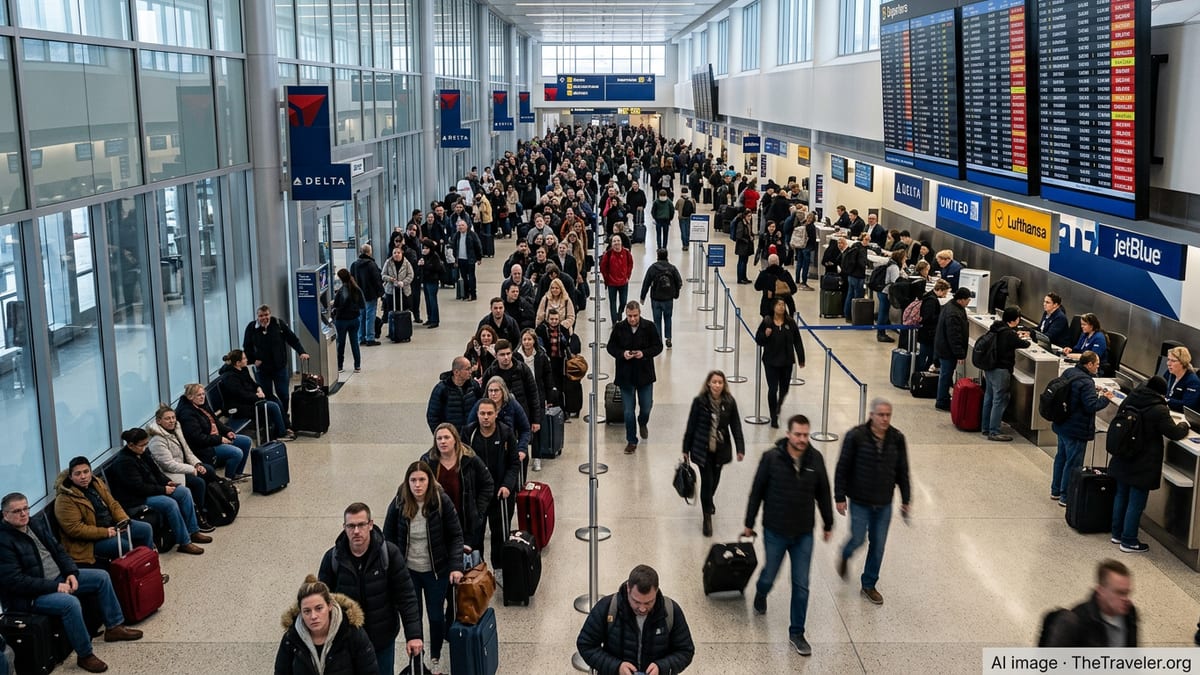
Heavy Disruption Across Three Key U.S. Hubs
Aggregated data from real-time tracking platforms and airport status dashboards indicate that Boston Logan International, Chicago O’Hare, and Dallas Fort Worth International accounted for a significant share of Monday’s nationwide disruptions. FlightAware’s live statistics for major airports show hundreds of delays and dozens of cancellations at Boston alone, with similar patterns playing out at O’Hare and DFW as the day progressed.
At Boston Logan, FlightAware’s dedicated cancellation page logged more than 570 delays and over 80 cancellations within, into, or out of the airport over the course of the day. These figures placed Boston among the country’s hardest-hit gateways, echoing patterns seen in late July when heavy rain produced hundreds of delays and dozens of cancellations at the same facility, according to local coverage based on the same tracking service.
Chicago O’Hare and Dallas Fort Worth, two of the nation’s largest connecting hubs, also experienced substantial operational strain. Recent federal summaries describe O’Hare as the busiest U.S. airport by scheduled flights for the 2026 summer peak, with more than 3,000 daily operations planned, while DFW remains one of the primary through-points for domestic and transcontinental traffic. In such high-volume environments, even modest slowdowns can quickly translate into hundreds of delayed flights as crews and aircraft fall out of sequence.
Tracking tools that aggregate national data suggest that, by late evening, the combined impact at the three airports contributed materially to a national total surpassing 4,200 delays and close to 200 cancellations. The figures underline how quickly localized issues at a handful of hubs can ripple outward across airline networks and affect passengers nationwide.
Weather, Volume, and Network Complexity Converge
Publicly available planning documents and recent daily air traffic outlooks from the Federal Aviation Administration highlight weather as a persistent wildcard for 2026’s summer travel season. In its August traffic reports, the agency has repeatedly flagged Boston and other East Coast hubs for potential slowdowns when rain and thunderstorms move through key corridors.
The FAA’s broader performance data show that detailed statistics for operations and delays are compiled monthly and released with a delay of several weeks, but preliminary narratives already emphasize how convective weather can degrade throughput at busy coastal and Midwestern airports. When runways and arrival paths are constrained for safety reasons, airlines are forced to sequence arrivals and departures more conservatively, driving up taxi times and airborne holding.
In parallel, O’Hare’s latest federal overview describes a sizeable increase in scheduled peak-day flights for summer 2026 compared with the previous year. That added volume, layered onto complex hub structures at O’Hare and DFW, leaves little slack in carrier schedules. Reported ground-based passenger delay hours in recent analytical work from congressional and transportation researchers illustrate how these structural factors can amplify the effect of any single storm system or equipment bottleneck at the three airports.
Boston has drawn particular scrutiny from travelers and local media this summer, with social media posts and forums documenting recurrent clusters of delays even on days when other major hubs appear to be operating more smoothly. Recent coverage citing FlightAware data, for example, described hundreds of delays and several dozen cancellations in a single weather-affected day at Logan, a pattern that resembles Monday’s disruption in scale if not in the exact mix of flights and carriers.
Passenger Impact From Missed Connections to Stranded Crews
For travelers, the numerical totals translate into missed connections, extended airport waits, and in some cases overnight stays. When Boston, Chicago, and Dallas all experience elevated disruption, the effect often spreads beyond those cities to secondary airports that rely on them for onward connections.
O’Hare and DFW function as central nodes within several major carriers’ networks. According to Department of Transportation reporting frameworks and schedule databases, large numbers of passengers booked on itineraries between smaller regional markets depend on same-day connections through these hubs. A delay on an early Boston to Chicago flight, for example, can cascade into misaligned banks of departures to the Mountain West, West Coast, or Canada.
The same dynamic affects airline crews and aircraft. When an aircraft arriving late into Boston or Chicago is scheduled to operate a subsequent leg, that second flight may be forced to depart late or be canceled if crew duty-time limits are at risk of being exceeded. Analytical reports compiled for policymakers have calculated millions of ground-based passenger delay hours at major U.S. hubs when these knock-on effects are taken into account.
Travelers caught in Monday’s disruptions were encouraged, through carrier advisories and general best-practice guidance, to monitor flight status frequently, use mobile apps to rebook on alternative itineraries, and consider flexible travel dates where possible. The uneven distribution of delays, with some airports running close to schedule, occasionally allowed passengers to reroute through less affected hubs when inventory and fare rules permitted.
How 2026 Compares With Recent Summers
While precise year-on-year comparisons for August 2026 will only become available once federal datasets are finalized, historic records from the Department of Transportation provide useful context. Monthly Air Travel Consumer Reports compiled from 2025 data show that Boston Logan, Chicago O’Hare, and Dallas Fort Worth have all featured prominently in national tallies of delayed operations, reflecting both their size and operational complexity.
Previous summers produced similar flashpoints. In late July 2026, a day of heavy rain over Boston triggered nearly 300 inbound delays and more than 30 cancellations tied to Logan alone, according to regional news coverage drawing on FlightAware data. The pattern was mirrored at Chicago and New York-area airports during other storm events, suggesting that Monday’s disruption is part of a broader seasonal cycle rather than an isolated incident.
Longer-term analyses prepared for congressional committees have quantified the economic cost of this recurring turbulence, estimating that major hubs like Boston, Chicago, and Dallas each account for substantial shares of nationwide passenger delay minutes. In those studies, Chicago O’Hare and Dallas Fort Worth rank near the top of U.S. airports for total hours of passenger delays, with Boston also contributing significantly despite handling fewer flights overall.
Industry observers note that this summer’s challenges are unfolding amid relatively strong demand. Domestic schedules published for 2026 show peak-day flights at O’Hare rising compared with 2025, a trend that can bolster airline revenues but that also increases exposure to systemwide disruption when weather or staffing constraints intervene.
Calls for Resilience as Peak Travel Continues
The latest wave of delays and cancellations is likely to renew attention on longer-term efforts to improve the resilience of U.S. air travel. Federal performance portals point to ongoing investments in air traffic technology and airport infrastructure, while regulatory reporting frameworks aim to give policymakers clearer visibility into chronic bottlenecks.
Recent actions highlighted by transportation officials ahead of the 2026 summer season included targeted steps to manage operations at chronically congested hubs, particularly Chicago O’Hare. Publicly available FAA announcements described efforts to coordinate with carriers on responsible capacity planning, with the goal of reducing the kind of “endless delays” that have drawn criticism from travelers and elected officials.
Analysts suggest that Monday’s statistics will likely feature prominently when federal delay datasets for August are eventually published, offering another case study in how weather and high utilization interact at the nation’s largest hubs. The concentration of more than 4,000 delays and nearly 200 cancellations on a single day underscores the stakes for both travelers and the broader economy as the U.S. aviation system continues to operate close to its limits during peak periods.
For now, passengers planning to travel through Boston, Chicago, or Dallas during the remaining weeks of the summer peak are advised by public tools and consumer advocates to keep a close eye on forecasts and to build additional buffer time into itineraries, particularly when tight connections or last flights of the day are involved.
FlightAware: Boston Logan cancellations and delays