


More news on this day
Europe’s rail network is entering a new phase of integration as governments, EU institutions and operators align infrastructure upgrades with redesigned timetables that promise markedly shorter travel times on key cross-border routes.
Get the latest news straight to your inbox!
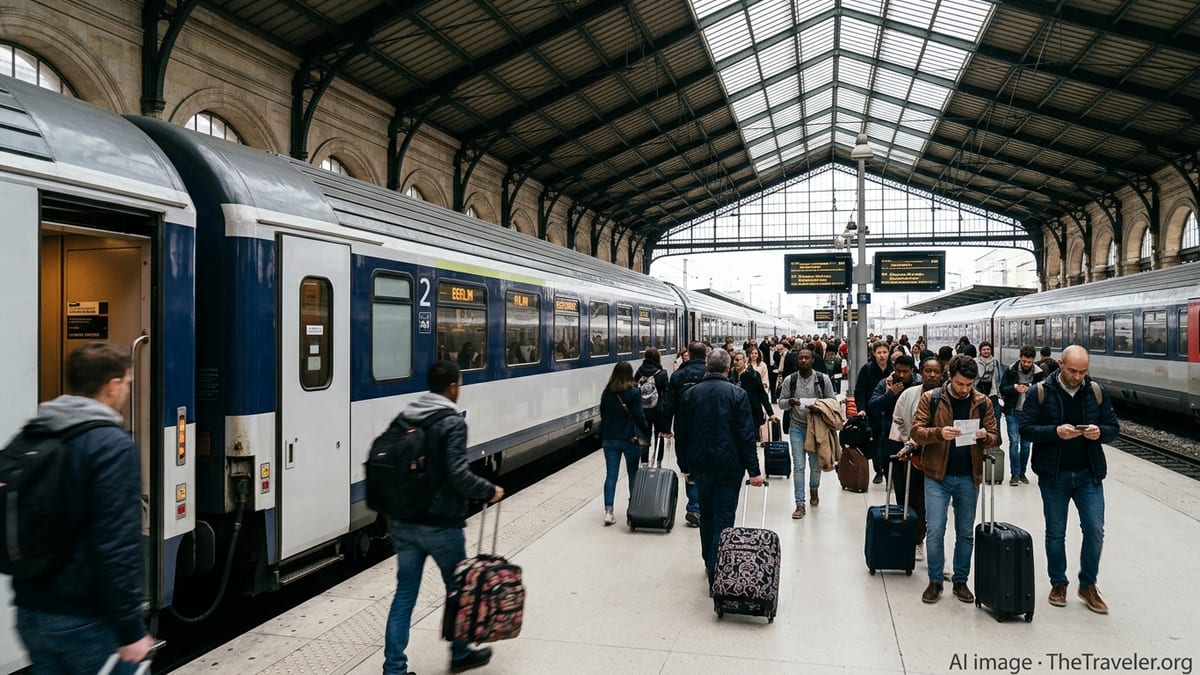
High-Speed Rail Plan Targets Major Journey-Time Cuts
A central driver of the new timetable strategy is the European Commission’s high-speed rail action plan, presented in late 2025 as part of broader efforts to make train travel a viable alternative to short-haul flights. Public documents describe a network built on lines capable of 200 km/h and above, with specific target journey times between major cities used to guide investment and scheduling choices.
According to the plan, routes such as Sofia to Athens are expected to see journey times cut from around 13 hours 40 minutes to about 6 hours once new infrastructure and services are fully in place. Similar reductions are envisaged on other cross-border axes, including links in Central Europe, reinforcing the idea that timetables are no longer being designed in isolation but as part of an EU-wide mobility grid.
A factsheet accompanying the action plan highlights that the journey time targets are being treated as design parameters for both infrastructure and service patterns. Instead of simply adding capacity where demand is strongest, planners are working backwards from desired end-to-end times and then shaping track upgrades, rolling stock deployment and stopping patterns to fit those benchmarks.
This travel-time focus is already filtering into national rail strategies and cross-border projects, where operators are preparing new services that can take advantage of faster lines and better-timed connections over the coming timetable periods.
Integrated Timetables Reshape National Networks
In Germany, the nationwide integrated regular-interval timetable concept known as Deutschlandtakt illustrates how schedule design is being used as a long-term planning tool. Government publications describe an approach that synchronizes long-distance, regional and local trains at set hubs every hour or half-hour, with infrastructure upgrades chosen according to what is needed to meet those precise timing goals.
The German strategy aims to shorten overall journey times not only through headline high-speed segments but also through reduced waiting times at key nodes and more reliable connections. This timetable-first logic is increasingly visible in regional planning documents, where states such as North Rhine-Westphalia reference the federal target timetable as the backbone around which their own 2030 and 2040 service concepts are being built.
Elsewhere in the Alpine region, Swiss operator SBB is preparing changes associated with the December 2026 and December 2027 timetable switches. Company communications outline a sequence of targeted improvements following a major service expansion in northwestern Switzerland, with further adjustments designed to optimize connections and travel times rather than simply add trains.
The emphasis on integrated regular-interval patterns is significant for international travelers because it supports smoother cross-border transfers. When neighboring countries adopt similar philosophies, long waits at frontier stations can be reduced and multi-leg journeys become more competitive with air travel on a door-to-door basis.
New Cross-Border Services Promise Point-to-Point Speed
Alongside systemic timetable reforms, several high-profile new services are set to cut times on specific international corridors. One example is the planned deployment of Italian Frecciarossa high-speed trains between Munich, Innsbruck and Milan, with some services continuing to Rome. Operator announcements indicate that from the end of 2026 these trains will offer direct, no-change journeys on routes of roughly 600 kilometers between Munich and Milan and around 900 kilometers between Munich and Rome.
This connection forms part of a list of EU-backed pilot services selected to demonstrate how cross-border rail can be made faster and more attractive. The objective is to align new rolling stock, capacity on existing high-speed lines and updated timetables so that trains can run at competitive speeds without long border dwell times or mismatched schedules.
Additional cross-border improvements are planned on the France–Germany axis. Coverage by European travel media details new links, including a proposed direct Paris–Munich connection expected around the end of 2026. Once introduced, these services are anticipated to trim journey times and remove the need for changes that currently add both delay risk and complexity for travelers.
Night trains are also adapting to the new timetable context. Operators such as European Sleeper, which has announced additional routes from the Benelux region towards southern Europe, are timing their overnight services to connect more effectively with daytime high-speed networks, highlighting how the benefits of shorter daytime journeys spill over into the sleeper segment.
Timetable Overhauls Coincide With Major Works and Rolling Stock
The timetable revolution is closely tied to infrastructure works that temporarily lengthen some journeys en route to long-term reductions. Information published by SBB and other rail companies shows an intensive program of engineering on routes linking Switzerland with neighboring countries through 2026, including full weekend closures and diversions that can add considerable time in the short term.
These works, however, are designed to remove bottlenecks that limit speeds and constrain regular-interval patterns. Double-tracking projects, power-system renewals and modernized signaling all feed into future timetables with shorter scheduled times and higher reliability. Public rail timetables and independent compendiums already flag where buses or slower trains are filling gaps ahead of upgraded services in later years.
Rolling stock fleets are being renewed in parallel. In Germany, the introduction of the new ICE L long-distance trains from the 2026 timetable period is expected to support higher frequencies and improved comfort on key domestic and international routes. As newer trains come into service, operators gain more flexibility to redesign stopping patterns and exploit higher line speeds while maintaining punctuality.
The combination of modern trains and rebuilt infrastructure enables timetable planners to lock in noteworthy travel-time savings rather than rely on one-off fast services. That approach is increasingly visible across Europe as operators shift from isolated flagship trains to broad-based patterns where most departures benefit from the improvements.
EU-Wide Ticketing and Data Rules Underpin the Shift
Shorter published journey times are only part of the strategy; making those journeys easy to plan and book is another priority. In May 2026 the European Commission proposed new rules intended to simplify cross-border rail ticketing and strengthen passenger rights across complex itineraries. The initiative seeks to make it easier to buy one through-ticket for a journey involving several operators while presenting a clearer overview of options and guarantees.
According to the proposal, member states and the rail industry will be required to share more timetable and fare data under common standards, enabling third-party platforms to provide reliable door-to-door rail offers. This data-sharing push is intended to align digital booking tools with the physical improvements on the network, so that travelers see the faster connections and newly reduced journey times reflected clearly in search results.
The policy package also links improved timetables to climate objectives, arguing that predictable, faster rail travel can attract passengers away from short-haul flights and long car journeys. By embedding journey-time targets into both infrastructure planning and consumer-facing information systems, European institutions aim to create a feedback loop where rising demand justifies further investment and additional timetable refinements.
For travelers, the combined effect of these measures is likely to become most visible around the annual timetable change each December, when new high-speed segments, integrated patterns and ticketing tools converge. While not all improvements will arrive at once, the emerging strategy points toward a decade in which cross-border rail journeys across Europe feel progressively shorter, better connected and easier to book.
European Commission high-speed rail plan
EU proposal on seamless rail ticketing and passenger rights
Cross-border Frecciarossa services Munich–Milan–Rome