


More news on this day
Across Europe, more passengers are catching trains, but fewer are happy with the experience, as chronic delays, overcrowded carriages and crumbling infrastructure erode confidence in a mode of transport long promoted as the backbone of the continent’s green mobility plans.
Get the latest news straight to your inbox!
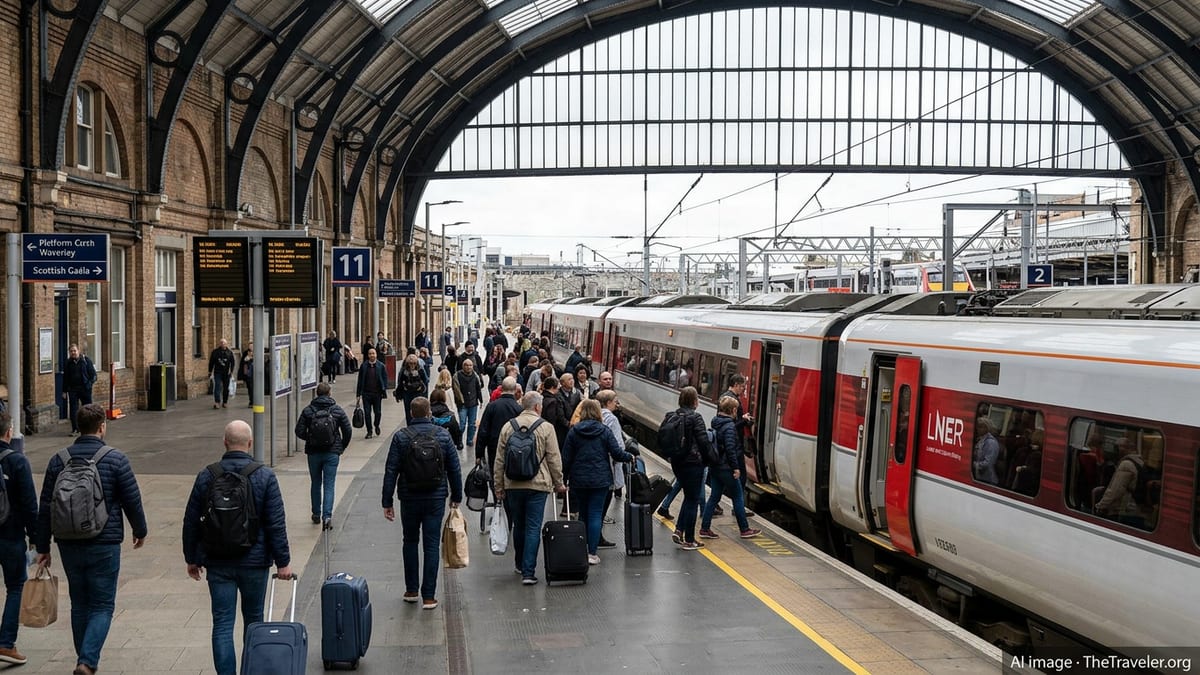
Rising demand meets fragile infrastructure
Recent statistics from European institutions indicate that passenger volumes on the continent’s railways have rebounded strongly since the pandemic, with billions of journeys now made each year. Publicly available data show that rail is gaining importance in national and cross-border travel, helped by new long-distance services and climate-conscious policies designed to shift passengers away from cars and short-haul flights.
At the same time, surveys carried out for the European Commission and regulators suggest that many travellers are encountering a deterioration in day-to-day reliability. One recent Eurobarometer report on passenger rights found that nearly half of rail users experienced at least one disruption in the previous 12 months, such as significant delays, cancellations or missed connections. In some large markets, passengers report that chronic bottlenecks and outdated signalling lead to cascading disruptions across the network.
Industry market reports compiled by networks of independent regulators describe a system under strain. A long period of underinvestment in maintenance in several countries has reduced available capacity and left infrastructure managers struggling to keep up with traffic growth. While public spending on rail is now rising in some states, specialists warn that upgrading tracks, stations and digital control systems will take years, leaving travellers in the meantime to cope with congested lines and frequent engineering works.
Delays, crowding and complex journeys fuel frustration
Passenger experience assessments from national watchdogs in countries such as Germany, France and the United Kingdom point to punctuality and crowding as dominant sources of dissatisfaction. On busy intercity corridors, minor incidents can quickly spill over into long delays because there is little spare capacity on mixed-use lines where high-speed, regional and freight trains share the same tracks. Travellers complain that last-minute platform changes and missed guaranteed connections turn what should be simple journeys into stressful marathons.
Reports compiled by advocacy groups focusing on rail ranking and performance highlight that, even where headline punctuality figures appear stable, the lived experience is often less positive. Many passengers face standing-room-only conditions at peak times, limited luggage space and inconsistent air conditioning or onboard services. In overnight and long-distance markets, the revival of sleeper trains has generated excitement, but rolling stock shortages and infrastructure constraints have led to repeated sell-outs and long waiting lists, especially on popular cross-border routes.
Complex booking systems are another recurring complaint. Comparative studies by transport think tanks find that on many of Europe’s busiest international city pairs, it remains difficult or impossible to purchase a through ticket covering multiple operators in a single transaction. Travellers often have to piece together journeys from separate national websites, with limited protection if connections fail. Analysts argue that this complexity benefits airlines, which typically offer faster, one-stop booking for the same city pairs, even when train travel would be competitive in time and emissions.
Uneven investment widens the gap between countries
Publicly available infrastructure spending figures reveal sharp contrasts between European countries. In nations such as Switzerland and Austria, high levels of sustained investment in track renewal, tunnels and modern signalling have delivered dense timetables and high customer satisfaction. In others, including several larger EU members, rail infrastructure has struggled to keep pace with demand, and recent increases in funding are widely seen as an attempt to catch up after years of underinvestment.
European policy documents and national transport strategies describe an ambitious pipeline of projects, from major new high-speed lines to cross-border schemes such as Rail Baltica. However, audits by oversight bodies have repeatedly warned of cost overruns, delays and governance challenges. In practice, this means that passengers in some regions continue to rely on slow, single-track lines with level crossings and outdated platforms, while flagship projects absorb political attention and financial resources.
Analysts also note growing regional disparities within individual countries. Capital cities and economically strong corridors often benefit from frequent, modern services, while rural and peripheral areas face thinning timetables or even line closures. This imbalance fuels perceptions that rail modernisation is leaving some communities behind, reinforcing a sense of dissatisfaction among residents who see new investment promoted elsewhere but little improvement on their local routes.
Policy ambitions collide with passenger expectations
European climate and transport strategies position rail as a central pillar in meeting emissions targets, with the European Green Deal and related initiatives calling for significant shifts from air and road to rail by the end of this decade. New regulations on the trans-European transport network aim to create a high-speed backbone linking major cities, while updated passenger-rights rules are intended to strengthen protections for travellers affected by disruption.
However, transport economists and environmental organisations warn that these ambitions may be undermined if passenger experience continues to lag behind expectations. Research produced by non-governmental organisations examining ticket prices and service quality finds that on several key routes, trains remain more expensive than flights, especially when booked at short notice, despite their lower environmental impact. Where passengers associate rail with delays, missed connections and complicated booking, they are less likely to accept policy measures that raise the cost of driving or flying.
Industry bodies representing railway and infrastructure companies argue in policy papers that achieving a shift to rail will require long-term, predictable funding focused on maintaining and upgrading existing infrastructure rather than only building new flagship lines. They also highlight the need for further digitalisation, including the rollout of modern signalling systems intended to increase capacity, reduce delays and allow for more flexible timetabling. Until those changes filter through to everyday journeys, public sentiment is likely to remain cautiously sceptical.
Rail renaissance at risk without visible improvements
Across Europe, there are still many examples of popular and well-regarded rail services. High-speed corridors in countries such as Spain and Italy, regional integrated networks in parts of Germany, and cross-border links in the Benelux region show that, where infrastructure and operations are aligned, trains can compete effectively with both road and air. Surveys continue to show that many Europeans value rail for its comfort, city-centre access and lower environmental impact.
Yet the growing mismatch between official narratives of a rail renaissance and the daily experience of disruptions is reshaping public debate. Consumer organisations and passenger associations increasingly call for clear performance targets, more transparent reporting on punctuality and capacity, and easier access to compensation when things go wrong. Commentators warn that, without visible improvements on the ground, political support for large-scale rail funding packages could weaken.
For now, the direction of travel is clear: more Europeans are turning to trains, whether for work, leisure or climate reasons. Whether they remain loyal customers will depend on how quickly infrastructure managers, operators and policymakers can translate ambitious plans into smoother, more reliable journeys on tracks that, in many places, still bear the marks of decades of deferred maintenance.