


More news on this day
London’s direct rail link to mainland Europe is being rebuilt around a denser London–Amsterdam/Rotterdam timetable and long-term plans for new services to Germany and Switzerland, as Eurostar restores and expands its UK–Netherlands corridor while committing billions of euros to a new high-speed fleet.
Get the latest news straight to your inbox!
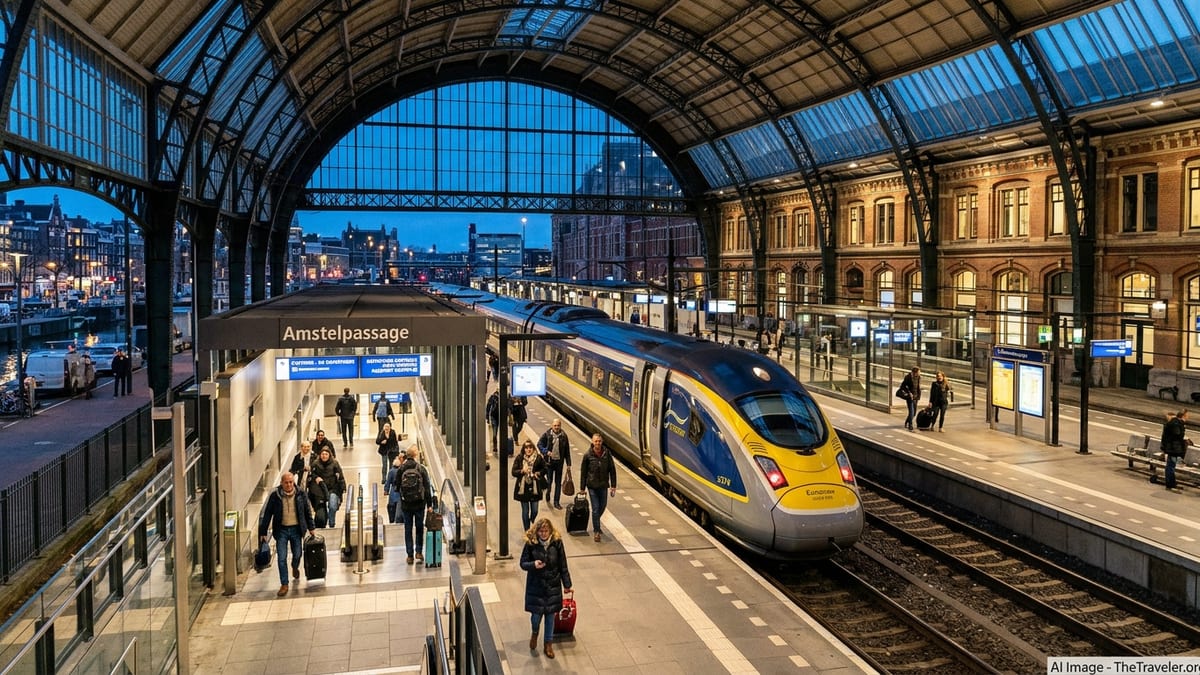
Amsterdam terminal reopening restores direct UK link
Eurostar’s rebuilt presence in the Netherlands began on 10 February 2025, when the new UK Terminal at Amsterdam Centraal opened and direct Amsterdam and Rotterdam to London St Pancras services resumed after an eight-month suspension linked to station works. The terminal, located in the Amstelpassage, reinstated juxtaposed UK border checks so passengers could once again travel from the Dutch capital to London without changing in Brussels.
Initial operations used a transitional timetable. Eurostar and Dutch operator NS confirmed that through late March 2025 the company typically carried around 400 passengers on each Amsterdam to London trip, roughly 10 percent more than under the old, smaller facility that previously capped Amsterdam boarding at about 275 passengers. The restored service also allowed around 160 passengers to board at Rotterdam, taking total capacity per Netherlands to UK train to about 800 seats.
Although works at Amsterdam Centraal meant some further short suspension and retiming periods in 2025, by late spring the basic pattern of through trains between London, Rotterdam and Amsterdam was back in place, re-establishing a rail alternative on one of Europe’s busiest short-haul corridors.
More daily London–Amsterdam trains from December 2025
The clearest immediate boost for travellers is a substantial increase in frequency between London, Rotterdam and Amsterdam. NS International and Eurostar state that from 16 December 2025 the timetable provides five direct trains per day in each direction linking the three cities, up from the three weekday services and two on Saturdays that ran immediately after the February 2025 restart and more than before the terminal rebuilding works.
For passengers this means shorter gaps between departures, more choice of departure times across the day and more total seats in the market. The denser timetable also gives greater flexibility for short trips, such as day-returns between London and Rotterdam, which were harder to plan around the earlier, sparser schedule.
The expansion remains focused on the core London–Brussels–Rotterdam–Amsterdam axis. Despite talk of a broader Eurostar “network,” the company has not reinstated calls at Ebbsfleet International or Ashford International on its UK–Netherlands trains. Travellers in southeast England still need to start at London St Pancras or connect via domestic rail to reach the high-speed service.
New fleet order underpins future Germany and Switzerland links
Eurostar’s 2025 full-year results, published on 2 June 2026, identify the UK–Netherlands market as a major growth driver and confirm a fleet order worth around 2 billion euros for up to 50 new high-speed trains from Alstom. The trains, branded Celestia and based on the Avelia Horizon platform, are due to start entering service from 2031 and are intended to increase capacity and enable longer-range international routes.
In its results announcement and related regulatory filings, Eurostar explicitly links the new fleet to planned services from London to Frankfurt and London to Geneva, as well as routes such as Amsterdam or Brussels to Geneva, in the mid-2030s. These are described as plans and development objectives rather than dated, bookable services, and depend on fleet deliveries, infrastructure capacity and regulatory approvals across multiple countries.
Separately, on 11 May 2026 Eurostar, Swiss Federal Railways (SBB) and SNCF Voyageurs signed a memorandum of understanding to study a potential direct connection between London and Switzerland. The MoU builds on earlier UK–Swiss intergovernmental work but does not itself create a timetable or specify a launch year. Any London–Switzerland train would need to align with the new fleet’s introduction and future network planning.
What travellers can book now, and what remains long term
For the moment, the tangible benefits for travellers are concentrated on the London–Netherlands route. Direct trains between London, Rotterdam and Amsterdam are running with increased capacity out of the new Amsterdam UK Terminal and a published plan for five daily services in each direction from mid-December 2025. These trains can be booked through Eurostar and partner channels using the current timetable.
By contrast, services such as London–Frankfurt, London–Geneva and any through London–Switzerland route remain future possibilities rather than operational lines. They are referenced in company plans, fleet orders and memoranda of understanding, but as of November 2026 there are no confirmed start dates, tickets on sale or detailed timetables for passengers to book.
Travellers considering cross-border rail trips in the coming years should therefore treat Amsterdam and, to a lesser extent, Rotterdam as London’s primary rail gateways to mainland Europe for now. Before booking, it is advisable to check Eurostar’s own timetable and press information for the latest frequencies, any temporary works at Amsterdam Centraal or other stations, and any future announcements that might turn today’s long-term route plans into dated, sellable services.