


More news on this day
Airports across the Schengen area are struggling with long queues and missed flights as the European Union’s new Entry/Exit System for non-EU travelers beds in, raising concerns about how border controls will cope with peak summer traffic.
Get the latest news straight to your inbox!
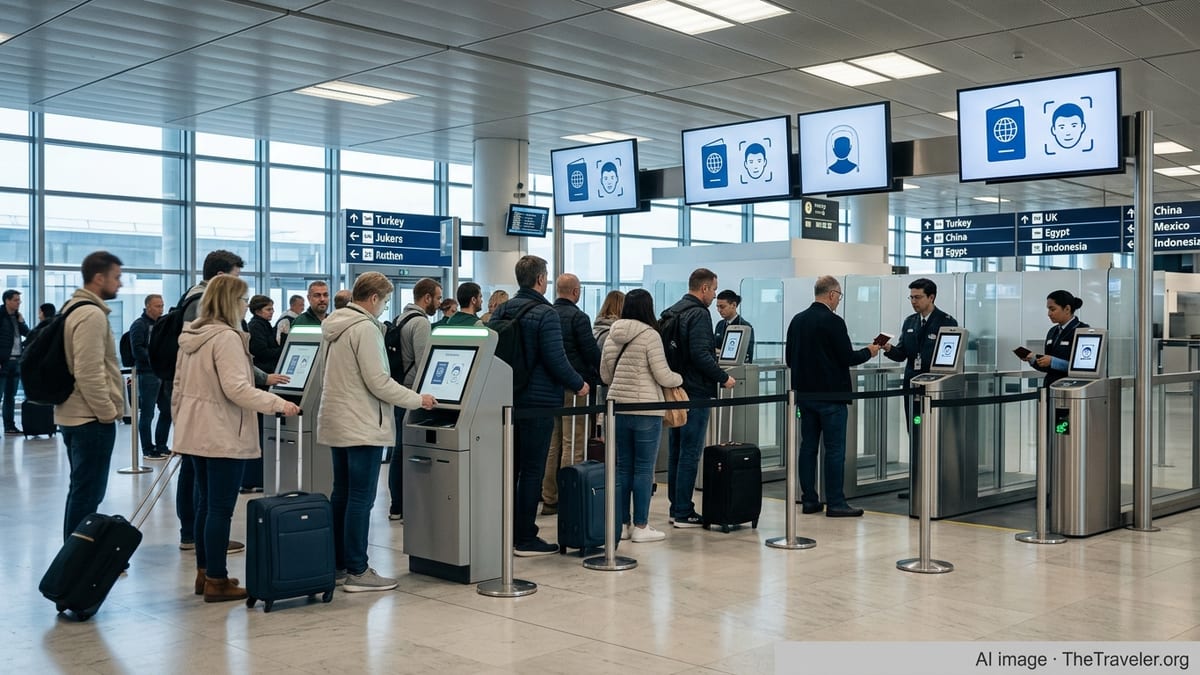
Biometric Borders Now Fully Operational Across Schengen
The EU’s Entry/Exit System, known as EES, is a large-scale digital register that replaces manual passport stamping for most non-EU nationals entering or leaving the Schengen area. It records each traveler’s identity details along with facial images and fingerprints, and logs every crossing of the external border into a central database. Publicly available information indicates that the system entered a phased launch from October 2025 and has been fully operational at all external Schengen border posts since April 2026.
The shift from a simple stamp to full biometric capture is intended to improve security, automate the calculation of permitted stays under the 90-days-in-180 rule, and detect overstays more reliably. EU institutions have presented EES as a cornerstone of a broader digital border architecture that will eventually link up with the planned ETIAS travel authorization later in 2026.
In practice, the change means that first-time EES users must undergo more complex checks at airports, ferry ports and some land crossings. Border staff need to enroll facial and fingerprint data, verify it against the passport and ensure the system records the crossing correctly, which together take longer than a traditional visual inspection and stamp.
Reports of Long Queues, Missed Flights and Strained Staff
Travel-industry coverage and first-hand accounts describe significant delays at several major gateways as EES has moved from pilot phase to daily reality. Reports from France point to waits of up to two hours at Paris Charles de Gaulle, Orly and Nice for non-EU passengers during busy periods, with airline and airport groups warning that without further mitigation queues could stretch to several hours at the height of summer.
Similar problems have been documented at land and sea borders. A recent analysis of traffic at the Port of Dover described cars and coaches backed up for as long as six hours on a late-May holiday weekend as officers completed biometric checks for every non-EU passenger heading into the Schengen zone. Travel media noted that the operation effectively gave British holidaymakers a preview of how the system might affect their journeys once peak season arrives.
Smaller airports have not been spared. Coverage from Italy and Portugal highlights intermittent bottlenecks at regional gateways serving popular coastal and city destinations. Airport staff and passengers have reported malfunctioning kiosks, staffing constraints and confusion among travelers unfamiliar with the new procedures, all of which can quickly turn a short queue into a lengthy line.
These delays are occurring even before the next layer of digital screening is added. The separate ETIAS travel authorization, which will require many visa-exempt visitors to apply online ahead of travel, is expected to come into force later in 2026. Industry briefings suggest that some airlines and tour operators are concerned about the combined effect of EES and ETIAS on connection times and passenger flow.
EU Deploys ‘Flex Mode’ to Ease Airport Pressure
Recognizing the strain on border infrastructure, EU institutions have built additional flexibility into the system’s launch. According to European Parliament and European Commission documentation, member states now have the option to temporarily suspend the capture of fingerprints and facial images when waiting times threaten to breach agreed safety thresholds. Officials refer to this as a derogation or “flex mode” mechanism.
Under this approach, border officers can temporarily revert to manual passport stamping while continuing to record entries and exits electronically. National authorities are required to monitor queue lengths and report on their use of the derogation, which is formally described as a short-term pressure valve rather than a permanent relaxation of biometric requirements.
Some Schengen states, notably those hosting large hub airports or handling significant tourist flows from outside the EU, have lobbied for this flexibility to be available throughout the peak summer months. Public reporting indicates that France, Belgium, Italy and Greece argued that fully rigid implementation risked derailing recovery in the aviation and tourism sectors just as long-haul travel demand was returning to pre-pandemic levels.
Travel-risk analysts note that while flex mode can prevent extreme queues, it may also lead to inconsistencies for passengers. A traveler could, for example, be enrolled biometrically on one trip, then processed manually on a subsequent journey, complicating the calculation of remaining days under Schengen’s short-stay rules if passport stamps and digital records diverge.
Airlines Advise Earlier Airport Arrival for Non-EU Travelers
As delays mount, airlines and travel companies are adjusting their guidance. European media report that some low-cost carriers have urged UK passengers heading to Schengen destinations to arrive at least three hours before departure, citing cases where travelers missed flights after being held in EES-related passport queues. Major network airlines have also begun to lengthen minimum connection times at key European hubs to account for the new procedures.
Corporate travel managers are being advised by specialist consultancies to build in additional buffer time for itineraries involving tight same-day connections, especially when trips begin or end at airports already known for congestion. Business travelers who previously allowed an hour between flights at major hubs are being encouraged to consider longer layovers to reduce the risk of missed meetings or rerouted journeys.
For leisure travelers, the impact is particularly visible at the start and end of holidays. Families arriving on morning bank-holiday flights or weekend departures have posted accounts of standing in line for an hour or more simply to have biometrics captured for the first time. Some governments and airports have responded by publishing checklists that explain who is subject to EES, what documents are required and how the process works in an effort to reduce confusion at the border.
Travel experts suggest that passengers can mitigate some of the disruption by checking whether their airline offers dedicated queues for families or premium customers, ensuring that passports are valid well beyond the intended travel dates, and carrying details of onward journeys to demonstrate compliance with short-stay limits if questioned.
Balancing Security Objectives With a Smooth Travel Experience
Despite the current disruption, EU institutions continue to frame EES as a long-term investment in both security and efficiency. Public communications from the Council and Parliament emphasize that once initial enrollment is complete, repeat travelers should theoretically pass through border controls more quickly as biometric verification replaces manual inspection and stamping.
Travel industry groups broadly acknowledge the rationale behind digital borders but argue that the speed of implementation, combined with staffing gaps in some member states, has left airports and ports underprepared. They point out that even small technical glitches, such as malfunctioning fingerprint scanners, can have an outsized effect when thousands of passengers arrive in short bursts following the landing of widebody aircraft.
For now, the experience of non-EU travelers entering and leaving the Schengen area remains uneven. At some airports, reports indicate that additional staff and clear signage have kept queues manageable, while at others passengers have faced unexpected waits and missed connections. With summer approaching, the effectiveness of flex mode, staffing reinforcements and passenger communication efforts will be closely watched by airlines, tourism boards and travelers alike.
How quickly EES evolves from a source of disruption into a largely invisible piece of travel infrastructure will depend on continued investment in border facilities, training for officers and the smooth integration of the next phase of Europe’s digital border regime when ETIAS comes online.