


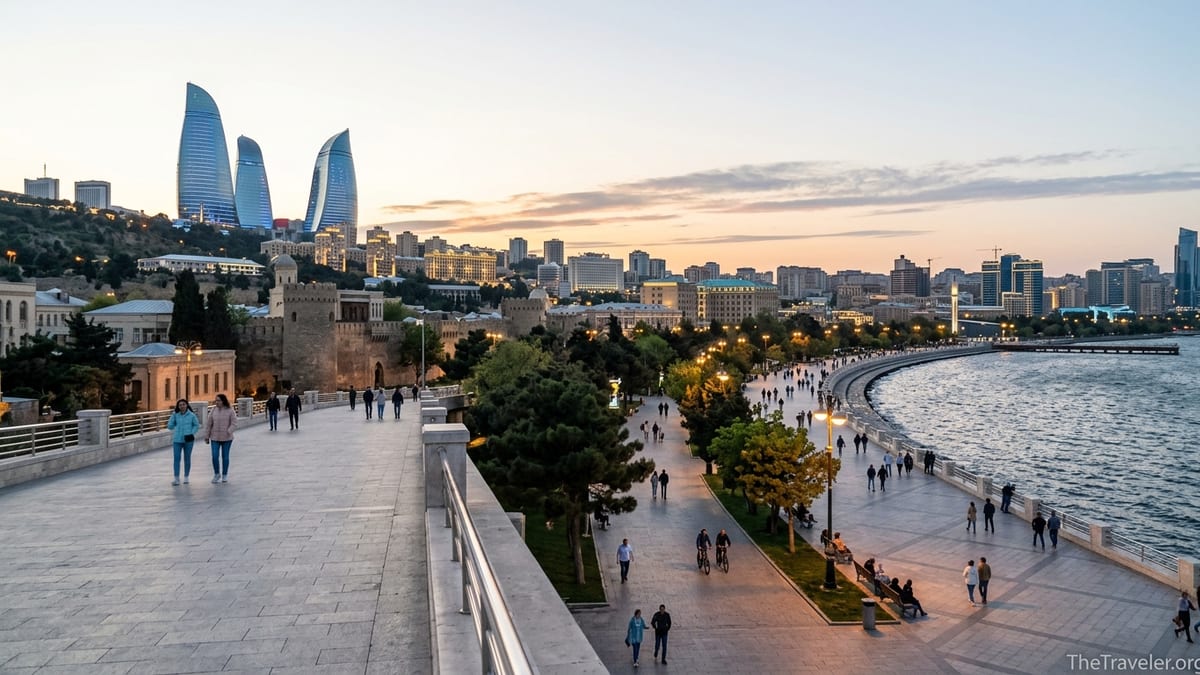
Baku is a city of contrasts: medieval sandstone walls facing a glass-and-steel skyline, tea houses beside rooftop cocktail bars, and a windy Caspian shoreline framed by neon-lit skyscrapers. Before you book your ticket, it helps to understand how Baku actually works today: the best time to visit, how the e-visa system and money work, what neighborhoods suit different travelers, and what to expect from local prices, culture and safety. This guide focuses on real-world details so you can plan a smooth, realistic trip to Azerbaijan’s capital.
Get the latest updates straight to your inbox!
Visas, Entry Rules and Practical Documents
Most short-stay visitors to Azerbaijan enter Baku through Heydar Aliyev International Airport and use the official electronic visa system. The government’s e-visa portal lets many nationalities apply online for a single-entry visa that is typically valid for a stay of up to 30 days. Standard processing is advertised at around three working days, with an urgent option that can be issued within a few hours for an additional fee. The application itself is simple: you fill in an online form, pay the fee by card and receive the visa by email, which you print or keep ready on your phone for immigration officers on arrival.
Visa fees vary slightly by nationality and processing speed, and the government occasionally updates exemptions or special arrangements. For example, at times certain Gulf countries have had limited visa-free entry periods. Because of these changes, it is important to check your nationality on the official e-visa portal and avoid third-party sites that charge additional service fees. If you are transiting through Baku for just a few hours and staying in the international zone of the airport, you generally do not need a visa, but if you want to exit the airport and see the city on a long layover, you will need a proper entry visa.
Upon arrival, your passport is stamped and, if you are staying more than 15 days, you are expected to register your address with the State Migration Service. Most mid-range and higher-end hotels in Baku will do this registration automatically as part of check-in, but with guesthouses or apartment rentals you may need to ask explicitly. Keep your e-visa printout, passport copy and migration registration confirmation together; they may be requested when you leave the country.
Travel insurance is not always checked at the border, but hospitals in Baku usually require payment or proof of coverage up front. A basic policy that covers medical care, evacuation and trip interruption is strongly recommended. If you plan to drive, you must carry an International Driving Permit in addition to your national license, and you will need to purchase local insurance at the border or through a rental agency.
When to Visit and What Weather to Expect
Baku sits on the Absheron Peninsula on the western shore of the Caspian Sea and has a semi-arid climate with strong winds. Summers are hot and dry, with average highs in July often in the high 20s Celsius and peaks edging into the low 30s. Heat on the wide, paved seafront boulevard can feel intense in the afternoon, though evenings are usually comfortable once the sun drops and the wind picks up. If you visit in mid-summer, plan indoor activities in the middle of the day and schedule Old City walks or a visit to the hillside Flame Towers viewpoints in the early morning or after 6 pm.
Winters are relatively mild but can feel colder than the thermometer suggests because of the wind coming off the Caspian. January daytime averages hover just a few degrees above freezing, and light snow or cold rain is possible. Streets in the Old City are still walkable, and cafes remain open, but you will want a warm, windproof jacket, hat and gloves. Winter can be a good time for budget travelers, since hotel prices usually drop outside New Year’s and a few local holidays.
The most popular months for leisure travel are late April through June and September through early November. In late spring and early autumn, daytime temperatures are usually in the high teens to low 20s Celsius, the wind is more manageable, and outdoor terraces along the Baku Boulevard are lively without being overcrowded. These shoulder seasons are ideal for combining urban sightseeing with day trips to mud volcanoes or the fire mountain at Yanar Dağ, since walking at those exposed sites is far more pleasant before or after the peak summer heat.
Wind is an important part of Baku’s personality. The city’s nickname, “City of Winds,” is well earned, and brisk gusts are common at any time of year, especially along the waterfront and on elevated viewpoints near the Flame Towers. Pack layers, including at least one wind-resistant outer layer even if you visit in May or September, and consider a scarf or light hat for evenings on the boulevard or ferries on the Caspian.
Neighborhoods, Sights and How the City is Laid Out
Central Baku clusters around three areas that visitors get to know quickly: the medieval Old City, the downtown business and shopping district, and the waterfront boulevard. The Old City, or Icherisheher, is a UNESCO-listed walled quarter with narrow stone lanes, caravanserais, hammams and two headline monuments: the Maiden Tower and the Palace of the Shirvanshahs. Many first-time visitors stay either just inside the walls, in boutique hotels set in stone townhouses, or just outside near the Icherisheher metro station, so they can walk back into the Old City in the evening when the walls and towers are illuminated.
To the east and north of the Old City lies the modern downtown, including Fountain Square and Nizami Street, a long pedestrian shopping avenue lined with clothing chains, perfumeries and local cafes. This is a good base if you prefer an international-style hotel, easy access to restaurants, and nightlife that runs late on weekends. Walking from Fountain Square to the Old City takes roughly 10 to 15 minutes, and you pass early 20th-century facades and small parks along the way.
Along the waterfront is the Baku Boulevard, a wide, landscaped promenade that stretches for several kilometers. Here you find the distinctive Azerbaijan Carpet Museum, built to resemble a rolled-up carpet, the small Deniz Mall entertainment complex, and views across the bay toward the Flame Towers. In the evening, local families stroll, couples rent bicycles, and street vendors sell ice cream and sunflower seeds. If you choose a hotel facing the boulevard, you will have easy access to sunrise jogs, Caspian boat rides and night-time skyline views, though you may be a short uphill walk from metro stations.
If you plan to attend events at the Heydar Aliyev Center or concerts at the Baku Crystal Hall, consider that both are slightly removed from the Old City. Taxis, ride-hailing apps and buses link these venues to the center in 15 to 25 minutes, depending on traffic. For a quieter residential feel, some travelers opt for guesthouses in the neighborhoods just beyond the Old City walls toward the 28 May district, which offer lower prices and more local cafes while still being one or two metro stops from major sights.
Money, Costs and How Much a Trip Really Costs
Azerbaijan uses the Azerbaijani manat. In everyday practice, 1 US dollar usually converts to roughly 1.6 to 1.8 manats, though you should check the live rate before your trip. Cash is widely used, especially in smaller shops, local bakeries and taxis that you hail on the street, while mid-range and higher-end restaurants, hotels and supermarkets commonly accept major credit cards. ATMs are easy to find around Fountain Square, along Nizami Street and near metro stations, and most accept foreign cards from major networks.
Public transport in Baku is notably affordable. A typical metro or city bus ride paid with the BakıKart transport card costs around 0.40 manats per trip, which is well under one US dollar. The plastic BakıKart itself usually requires a small non-refundable purchase fee, around 2 manats, and can be topped up at ticket machines in metro stations and major bus stops. Disposable paper versions that allow a handful of rides are sometimes available and can make sense for a very short stay, but most visitors staying more than a day find the reloadable plastic card or a phone-based QR solution more practical.
Restaurant prices vary by area, but a simple local lunch of plov (rice with meat), a salad and tea at a modest cafe away from the Old City might cost 8 to 15 manats per person. In tourist-focused restaurants inside Icherisheher, a main course like lamb kebab or grilled fish can run from 15 to 30 manats, with appetizers extra. International restaurants and rooftop bars around Fountain Square typically charge closer to European city prices, especially for imported wine and cocktails. A cup of Azerbaijani black tea in a traditional armudu glass at a tea house may be just 2 or 3 manats, while a cappuccino at a trendy specialty coffee shop will be higher.
Accommodation costs change sharply with season and events. During the Formula 1 Azerbaijan Grand Prix, which usually takes place in spring or early summer, central hotels can double or triple their rates and may sell out months in advance. On a regular week in May or October, a clean mid-range hotel near the Old City might run between 70 and 120 US dollars per night, while simpler guesthouses or apartments further away can be significantly cheaper. In January or February, outside New Year holidays, you may find respectable double rooms under 50 US dollars, especially if you book mid-week.
Getting Around: Metro, Buses, Taxis and Traffic
Baku’s metro is the backbone of public transport and a convenient option for visitors. Stations are easily identified by a purple “M” sign, and the main central stations like 28 May, Sahil and Icherisheher put you close to key sights. Trains usually run every few minutes at peak times and less frequently late in the evening. To use the metro, you tap your BakıKart or scan an approved QR code at the gates. Signage inside stations is increasingly bilingual, with station names in both Azerbaijani and Latin script, though older decorative panels may still use Cyrillic-era styles.
City buses complement the metro and reach areas that trains do not, such as the airport and newer suburban districts. The red BakuBus fleet in particular serves routes that are relevant to visitors, including the H1 airport express that connects Heydar Aliyev International Airport with 28 May station in the city center. This service is usually one of the most economical ways to get into town, with a fare in line with regular bus prices, paid using the same BakıKart system. Buses can be crowded at peak commuting hours, so if you are arriving with large luggage during the evening rush, you might prefer a taxi or pre-booked transfer.
Taxis are plentiful and inexpensive by Western standards, but experiences vary. You can flag purple London-style cabs on the street, use local ride-hailing apps, or ask your hotel to call a trusted driver. Some international app-based services operate in Baku, though availability and payment options change from time to time. It is common for drivers to prefer cash, and card payments through apps can occasionally lead to canceled rides, so having small denominations of cash ready makes things smoother. Before getting into an unmetered taxi, agree a price in manats for your destination; for example, a ride from the Boulevard to the Flame Towers might cost the equivalent of just a few US dollars in normal traffic.
Traffic congestion is a frequent complaint among residents, and at certain times of day central streets near 28 May, Nizami Street and the road up to the Flame Towers can become heavily backed up. If you have tickets for a performance at the Heydar Aliyev Center or an evening reservation in the Old City, allow generous travel time, particularly on Friday and Saturday nights. Pedestrian infrastructure in the core is fairly good, with underpasses at busy intersections and a pleasant promenade along the bay, but outside central districts sidewalks can be uneven and crossings less clearly marked, so take care at night.
Culture, Etiquette and Language Basics
Azerbaijan is a predominantly Muslim country with a strongly secular state and a cosmopolitan capital. In central Baku you will see a mix of traditional and modern dress, from older men in flat caps and women wearing headscarves to young people in European-style streetwear. Visitors are not expected to dress conservatively in most situations, but choosing modest, neat clothing is respectful, especially if you plan to visit mosques or more traditional neighborhoods. For women, covering shoulders and knees is a good guideline outside nightlife venues, and carrying a scarf can be useful for religious sites.
Locals generally appreciate polite behavior and a calm tone. Greetings with a simple “salam” and a handshake are common; close friends and family may kiss on the cheek. In business and formal settings, titles and surnames are used, but with travelers it is usually first names. Hospitality is important in Azerbaijani culture. It is not unusual for a shopkeeper to offer tea while you browse carpets or souvenirs, and in smaller towns you might be invited to a family meal or celebration. Accepting tea is a friendly gesture, though you are not obliged to buy anything in return.
Azerbaijani (Azeri) is the official language, and Russian remains widely understood, especially among older generations. In central Baku, many young people working in hotels, restaurants and tour companies have at least basic English, but you should not assume every taxi driver or small shop owner will be comfortable in English. Learning a few phrases such as “salam” for hello, “təşəkkürlər” or the shorter “çox sağ ol” for thank you, and “xahiş edirəm” for please can go a long way. Menus in tourist areas often have English translations, though these can be quirky; if in doubt, ask staff to show you pictures on their phone or point to dishes at neighboring tables.
Public displays of affection remain somewhat conservative. Holding hands is common, but very overt affection may attract looks, particularly outside the most central nightlife zones. Same-sex couples in particular may wish to be discreet in public, as social attitudes can be more traditional than in Western Europe or North America, even if central Baku feels relatively liberal compared with rural regions. Drinking alcohol is legal and common in restaurants and bars; it is polite, however, to avoid obvious drunkenness in public places or near religious sites.
Safety, Scams and Common-sense Precautions
Baku is generally considered one of the safer big cities in its region, with relatively low rates of violent crime affecting tourists. You will see families walking along the boulevard late into the evening and children playing in small parks even after dark. Police are visible in central areas and around major government buildings, and they may set up occasional checkpoints on roads out of the city. Petty crime still occurs, especially in crowded areas such as markets, busy buses and around Fountain Square on busy weekend nights, so standard precautions apply: keep your wallet and phone in front pockets or zipped bags, and avoid displaying large amounts of cash.
The most common annoyances reported by visitors are mild: taxi overcharging, persistent touts and occasional misunderstandings over bills. Around major tourist spots, a small number of drivers may quote prices in manats that are several times the normal rate. To avoid this, you can check approximate fares in a ride-hailing app, ask your hotel what a typical price should be, or insist that the meter be turned on in licensed cabs. In cafes and restaurants, always review the bill carefully. Some places in the Old City include a clearly marked service charge, while others do not; if service is already listed, there is no expectation to tip heavily on top, though rounding up is appreciated.
Political discussions can be sensitive. It is wise to avoid debating domestic politics or regional conflicts with strangers, particularly in public or on social media while you are in the country. Photography is generally fine in public spaces, but taking close-up pictures of government buildings, military facilities or some oil infrastructure can attract unwanted attention. If a security guard indicates that photography is not allowed, it is best to comply and move on.
As in any city, follow basic urban safety rules at night. Stick to well-lit streets in the center, be cautious if you venture into unfamiliar residential areas, and limit how much you drink if you are out alone. Women travelers commonly report feeling safe walking in central districts, though some experience occasional unsolicited comments. In such cases, ignoring and moving away is usually the most effective response. Emergency services can be reached by dialing local equivalents of 101 for fire, 102 for police and 103 for ambulance, though response times and English proficiency vary.
Food, Drink and Local Specialties
Baku’s food scene blends Azerbaijani home-style cooking, regional Caucasian flavors and global influences. Traditional restaurants often serve plov (rice pilaf) with saffron and dried fruits, lyulya kebab made from minced lamb, dolma stuffed grape leaves, and qutab, thin stuffed pancakes with herbs or minced meat. In the Old City you will find atmospheric restaurants in restored caravanserais serving clay pot stews and oven-baked tandir bread, sometimes accompanied by live mugham music. Prices in these heritage venues are higher than in residential neighborhoods, but still moderate by many European standards.
Seafood is another highlight, thanks to Baku’s position on the Caspian. Local fish such as sturgeon, kutum and others appear grilled or baked, often with lemon and fresh herbs. Simple fish cafes along and just behind the boulevard offer fried or grilled fish with salad and bread at reasonable prices, especially if you move a block back from the most obvious tourist terraces. Street food options include shawarma wraps from small kiosks, pastries filled with meat or cheese, and sweet baklava sold by weight in pastry shops.
Tea culture is central. Instead of coffee-to-go, you will more often see people lingering over black tea served in tulip-shaped glasses, sometimes flavored with lemon or local jams. Many cafes bring a small dish of sugar cubes or sweets with your tea at no extra cost. If you prefer coffee, Baku’s growing number of specialty coffee shops in districts like Fountain Square and around Nizami Street serve espresso-based drinks and pour-overs with imported beans, often with interiors that would not feel out of place in Berlin or Brooklyn.
Alcohol is available in most restaurants, and local wines from regions like Shamakhi and Ganja are increasingly present on menus. Beer is widely consumed, with both local brands and imports on offer. In terms of nightlife, you can find everything from casual pubs with live music to rooftop bars overlooking the Flame Towers, and a few late-night clubs. Dress codes in upscale venues lean toward smart casual. Smoking is still relatively common in some bars and open-air cafes, though smoke-free policies have expanded in recent years, so if this matters to you, ask the host about non-smoking areas.
The Takeaway
Planning a trip to Baku becomes far easier once you understand the city’s practical side. Know that many visitors can obtain a straightforward e-visa, that the weather is shaped as much by wind as by temperature, and that public transport using the BakıKart system keeps local travel inexpensive. Recognize that central neighborhoods each have a distinct feel, from the quiet alleys of the Old City to the lively shops and restaurants of Fountain Square and the wide-open vistas of the boulevard.
Budget-wise, Baku can be adapted to many styles of travel. You can dine in historic caravanserais or pick up affordable street food, sleep in international chain hotels or family-run guesthouses, and choose between taxis, buses and the metro depending on your comfort level. With basic cultural awareness, attention to visa rules and a realistic sense of local prices, you can focus less on logistics and more on what makes Baku compelling: its layered history, dynamic skyline and the hospitality of the people who call it home.
FAQ
Q1. Do I need a visa to visit Baku, and how early should I apply?
Most travelers need an e-visa to enter Azerbaijan for tourism. You can usually apply a few weeks before your trip, but it is wise to complete the online application at least 10 to 15 days before departure to allow for processing delays or corrections.
Q2. What is the best time of year to visit Baku?
The most comfortable months are late April to June and September to early November, when temperatures are mild, the wind is manageable, and outdoor sightseeing is pleasant. Summer can be hot on the streets and winter can feel chilly because of the wind, though both seasons are still workable with the right clothing.
Q3. How much should I budget per day in Baku?
Daily budgets vary, but a mid-range traveler might expect to spend the equivalent of 80 to 150 US dollars per day, including a central hotel, meals at decent restaurants, public transport and some museum tickets. Backpackers who choose simpler lodging and eat mostly at inexpensive local cafes can get by on less, while those seeking upscale dining and private drivers will spend more.
Q4. Is Baku safe for solo travelers and women?
Central Baku is generally safe for solo travelers, including women, and violent crime against tourists is rare. Standard city precautions apply: stay in well-lit areas at night, watch your belongings in crowded places, and use reputable taxis or ride-hailing apps when traveling late. Many women report only occasional unwanted comments, which are best ignored.
Q5. How do I get from the airport to the city center?
The most economical option is usually the airport bus that runs between Heydar Aliyev International Airport and the 28 May area, paid with a BakıKart transport card. Taxis and pre-booked transfers are faster and more comfortable, especially with luggage, and still moderately priced by Western standards, but you should confirm the fare before starting your journey.
Q6. Can I use credit cards everywhere in Baku?
Credit cards are widely accepted in hotels, supermarkets, shopping malls and many mid-range and upscale restaurants. Smaller cafes, local markets and some taxis, especially those hailed on the street, may prefer cash in Azerbaijani manats. Carrying a mix of card and cash is the most practical approach.
Q7. What should I wear when visiting Baku?
In central Baku, smart casual clothing is appropriate, and you will see a mix of styles. Modest dress that covers shoulders and knees is recommended for visits to mosques or more traditional neighborhoods. Because of the city’s wind and changeable conditions, packing layers and at least one windproof jacket is advisable in most seasons.
Q8. Is English widely spoken in Baku?
English is common in international hotels, many restaurants near the Old City and Fountain Square, and among younger people working in tourism. Outside those circles, Azerbaijani and Russian dominate, so having a translation app and learning a few simple phrases can help in taxis, small shops and markets.
Q9. How do I use public transport in Baku?
The metro and many city buses use the BakıKart payment system. You buy a physical card from machines in metro stations or major stops, load credit onto it, and tap at gates or on bus validators for each ride. In some cases, app-based QR codes linked to a digital wallet can also be used instead of a plastic card.
Q10. Are there any cultural customs I should be aware of?
Hospitality is highly valued, so it is polite to accept tea when it is offered in a shop or home if you have time. Removing shoes when entering a private home is common. Public behavior is expected to be respectful, and very loud or confrontational conduct in public spaces is frowned upon. Avoid taking close-up photos of people without permission, especially in markets or religious settings.