


In the South Caucasus, most travelers instinctively gravitate toward the wine bars of Tbilisi or the cafe terraces of Yerevan. Yet on the western shore of the Caspian Sea, Baku has quietly become the region’s most visually surprising and conceptually ambitious city. Walled and medieval at its core, wrapped in Belle Époque facades and topped with glass skyscrapers that glow like fire at night, Baku feels less like a single destination and more like several cities stitched together along a windy seafront. Comparing it with other Caucasus capitals is not about declaring a winner, but about understanding what makes Baku’s version of the region so different, and why it is increasingly worth a dedicated trip rather than a quick stopover.
Get the latest updates straight to your inbox!
A Medieval Core Found Nowhere Else in the Caucasus
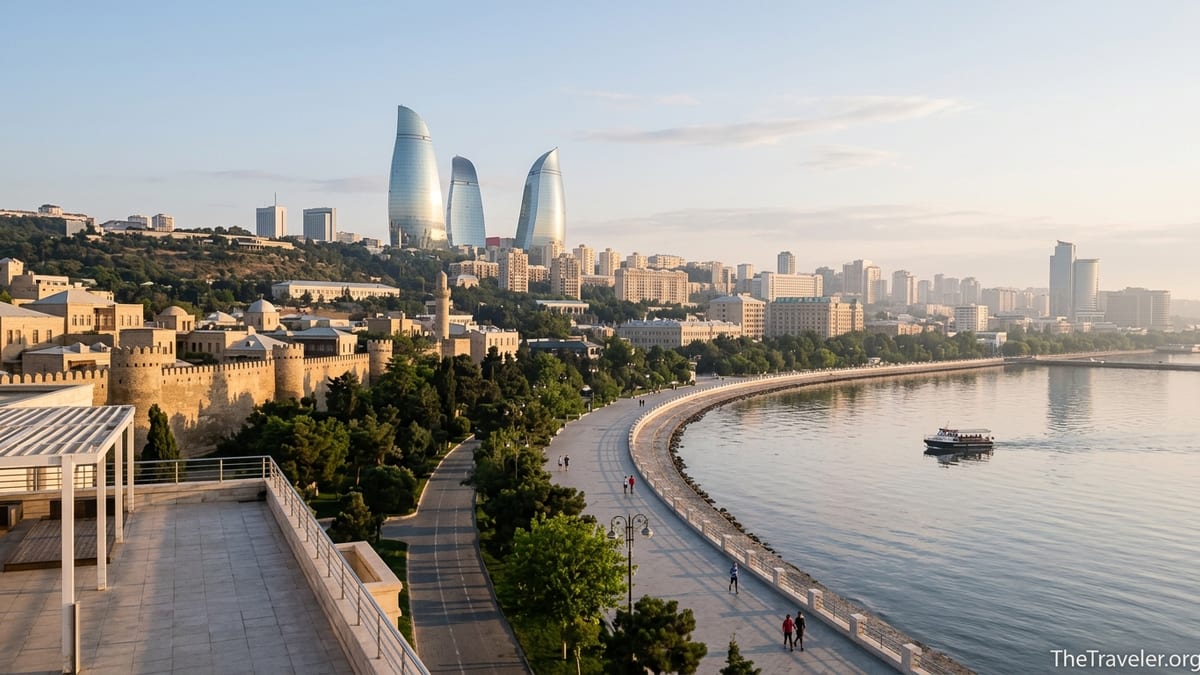
The single most distinctive feature of Baku compared with other Caucasus cities is its fully walled Old City, Icherisheher. Recognized by UNESCO as the Walled City of Baku with the Shirvanshahs’ Palace and Maiden Tower, it is the only surviving medieval city wall and enclosed historic core of this scale in the region. Step through the main gates near the Icherisheher metro station and the mood shifts immediately: polished boulevards give way to narrow stone alleys, caravanserai courtyards and sandstone houses that rise in irregular terraces above the Caspian. While Tbilisi and Yerevan each have atmospheric historic districts, neither offers this compact citadel feeling where the modern city abruptly stops at stone ramparts.
Two monuments anchor this area and underline Baku’s distinct timeline. The Maiden Tower, a cylindrical stone structure about 29 meters high, dominates the eastern side of the Old City and has become the emblem of modern Baku, appearing on banknotes and souvenir bottles of locally produced pomegranate wine. A short, steep climb uphill brings you to the 15th century Palace of the Shirvanshahs, a sandstone complex of halls, courtyards, mausoleums and a small mosque that recalls the days when Baku was a capital of a Persianate khanate tied to the Caspian trade routes. In Tbilisi you might ride a cable car to Narikala Fortress, and in Yerevan you might gaze toward Mount Ararat from Republic Square, but neither offers this combination of intact palace complex and fortified urban fabric all within a five-minute walk.
Even practical moments here feel different. You can sit at Çay Bağı 145, a popular teahouse perched above historic bathhouse domes, order a pot of black tea with lemon and a plate of pakhlava for the price of a couple of coffees in Western Europe, and look directly onto the stone flank of the Maiden Tower. Street vendors in the alley behind sell dried fruits and saffron by weight, and small family-run guesthouses inside the walls might offer double rooms that are often markedly cheaper than comparable guesthouses in Tbilisi’s Old Town or Yerevan’s center. The sense of still-living medieval city, rather than a single preserved street or square, is what gives Baku’s old core its edge in a regional comparison.
Caspian Seafront City Instead of Mountain Valley Capital
Another way Baku stands apart from other Caucasus cities is its relationship with water and topography. While Tbilisi is wrapped around the banks of the Mtkvari River and Yerevan sits on a plateau with mountain horizons, Baku spills gently down the Absheron Peninsula toward the Caspian Sea. The city’s long seafront promenade, usually called Baku Boulevard, stretches for several kilometers and forms an everyday stage for local life that has no direct equivalent in the other capitals. On summer evenings families push strollers, teenagers share cotton candy, and older men play backgammon on park benches while the lights of ferris wheels and amusement rides reflect in the water.
For travelers, this coastal setting changes both the itinerary and the mood. Instead of choosing between different viewpoints in the hills, visitors often start or end their day with a flat, breezy walk along the water. Attractions like the “Mini-Venice” canals, Caspian-side cafes serving grilled fish, and small piers offering short boat rides give Baku a low-key resort atmosphere that you do not find in landlocked Yerevan or the more river-focused Tbilisi. Sea air also softens the city’s climate; summers can be hot, but the frequent “khazri” wind off the Caspian usually keeps evenings more comfortable than inland cities at the same latitude.
The seafront is also where you see the city’s ambition most clearly. The skyline across the bay mixes Soviet-era housing blocks with sharply modern high-rises, luxury hotels and the famous Flame Towers. At night their curved glass surfaces become vast LED screens displaying orange flames, waving flags or abstract patterns that glow above the water. In Tbilisi, the contemporary architecture that travelers often discuss might be the Bridge of Peace or a handful of new hotels, while Yerevan’s center remains dominated by 20th century buildings in pink tuff stone. Baku, by contrast, pivots visually around its seafront skyline, which feels more closely linked to Gulf cities while still very much shaped by the Caspian and the steppe.
Petro-Modern Spectacle: From Flame Towers to the Heydar Aliyev Center
Baku’s oil wealth has reshaped the city more dramatically than any comparable force in Tbilisi or Yerevan, and that investment is visible in its modern architecture and public spaces. The three Flame Towers, roughly 190 meters tall, are the most recognizable example, visible from nearly anywhere in central Baku. By day they resemble sleek blue-glass sails; by night they are transformed into the animated flames that have come to symbolize the city’s connection with ancient fire-worship and modern energy exports. For visitors, seeing the towers light up during a Caspian sunset from the Boulevard or from a rooftop bar near Nizami Street is a specifically Baku experience that other Caucasus capitals simply do not offer.
Further inland, the Heydar Aliyev Center showcases a different side of this petro-modernity. Designed by the late architect Zaha Hadid and opened in the 2010s, the complex is a fluid white structure of sweeping curves that seems to rise directly from the ground without obvious edges. Travelers who have already visited Tbilisi’s more restrained contemporary buildings or Yerevan’s Soviet-modernist landmarks often remark that the Aliyev Center feels closer to cutting-edge cultural venues in the Gulf or East Asia. Exhibitions inside change regularly and range from Azerbaijani cultural history to international art shows, while the surrounding park lawns have become a favorite photo spot for local wedding parties and visiting families alike.
This appetite for spectacle extends to events. Baku has hosted the Formula 1 Azerbaijan Grand Prix on its street circuit since the mid-2010s, with recent races using the same waterfront and downtown roads that tourists stroll the rest of the year. On race weekends, hotel prices near the Boulevard and Old City can spike well above their usual levels, and bars around Fountain Square fill with fans in team jerseys. While Tbilisi and Yerevan have vibrant cultural calendars, from film festivals to wine fairs, F1 is unique to Baku in the region and gives the city a global sports profile that its neighbors do not share.
Layered Cultural Identity and Everyday Experiences
If architecture is the most photographed difference between Baku and other Caucasus cities, daily cultural life is where contrasts become more nuanced. Azerbaijan is a majority-Muslim country with strong Turkic, Persian, Russian and local Caucasian influences, and Baku reflects this blend in ways that feel distinct from Orthodox Christian Georgia or Armenia. The call to prayer is rare in the central districts, but you will notice small mosques tucked among apartment blocks, women in both fashionable European styles and more modest dress, and a café culture where tea often takes precedence over coffee.
Food is one of the most immediate markers of this difference. While Tbilisi is known for khachapuri cheese breads and amber wines, and Yerevan for grilled meats and Armenian brandy, Baku leans into rich plov dishes, dolma wrapped in grape leaves and vegetables, and a wide range of kebabs. In a mid-range restaurant just outside the Old City walls, a traveler might order a plate of lamb kebab, a side salad and fresh bread with dips for a price that still undercuts most Western European capitals. In slightly more upscale spots such as Sumakh or Şirvanşah Muzey Restoranı, traditional recipes are plated in contemporary style, giving visitors a way to experience local cuisine closer to fine dining but at prices that, while higher than in neighborhood grill houses, are often still accessible by European standards.
Language and social interaction present another contrast. Russian and Azerbaijani are commonly heard in Baku, with English spoken at many hotels, museums and central restaurants. In Tbilisi and Yerevan, Georgian and Armenian respectively dominate, with Russian also widely understood. Travelers frequently comment that Baku feels slightly more formal than its neighbors, especially outside the younger bar districts. Locals tend to dress more smartly in the evening, and public behavior can be reserved; public displays of affection, for example, are less common than in Tbilisi’s bohemian neighborhoods. At the same time, solo visitors often report feeling safe walking around central Baku at night, particularly along the Boulevard and main shopping streets, which remain brightly lit and busy.
Prices, Infrastructure and Ease of Getting Around
On a practical level, Baku’s cost of travel and infrastructure differ in specific ways from other Caucasus cities. Broadly speaking, most recent cost-of-living comparisons suggest that both Baku and Tbilisi remain significantly cheaper than the global median, with Baku typically coming out as somewhat more affordable overall, especially for public transportation and everyday groceries. However, accommodation in central Baku near the seafront and Old City often prices slightly higher than equivalent mid-range hotels in central Tbilisi or Yerevan, particularly during major events like the Formula 1 weekend or large conferences.
Public transport is one of Baku’s quiet strengths. The Baku Metro, in operation since the Soviet era and still expanding, moves hundreds of thousands of passengers daily and offers quick, inexpensive rides across the city. Travelers typically use a BakıKart, a rechargeable smart card valid on metro and most buses, which can be topped up at machines in stations. Recently, tech-savvy visitors and locals have also turned to QR-based ticket options offered through local payment apps, allowing them to tap a phone instead of a card at the gates. Compared with Tbilisi’s smaller metro network or Yerevan’s single-line system, Baku’s combination of metro, frequent buses and reasonably priced taxis makes cross-city trips straightforward for visitors.
The city is also relatively easy to navigate for pedestrians within its core tourist zone. The triangle formed by 28 May Street, Fountain Square and the Old City is walkable, and many travelers choose accommodation near one of these hubs to minimize transport time. However, Baku is more spread out than Tbilisi’s compact center or Yerevan’s ringed streets, and strong winds and summer heat can make longer walks tiring. In practice, visitors often mix walking with short taxi rides arranged through local ride-hailing apps, which typically cost less than equivalent rides in Western Europe, though still more than a single metro fare.
Gateway to Fire Temples and Mud Volcanoes
While Tbilisi and Yerevan serve as gateways to the Greater and Lesser Caucasus mountain ranges, Baku opens the door to a different set of landscapes that shape its identity. The Absheron Peninsula and nearby semi-desert plateaus are dotted with gas vents, mud volcanoes and Zoroastrian and Hindu fire temples, phenomena tied to the region’s unique geology and hydrocarbon deposits. These sites, reachable on half or full-day trips from the city, add an otherworldly layer to a Baku itinerary that contrasts with the vineyards of Kakheti or the highland monasteries of Armenia.
One of the most popular excursions is to the Ateshgah Fire Temple, roughly 30 to 40 minutes from central Baku by car. The complex, rebuilt in its current form in the 17th and 18th centuries, was used by Hindu and Zoroastrian pilgrims, who were drawn to the natural gas flames that once burned directly from the ground. Nearby, the “burning mountain” of Yanardag showcases a hillside where a continuous line of flame flickers above a thin seam of natural gas. Travelers who have already visited monasteries in Georgia or Armenia often describe these fire sites as some of the most unusual religious and natural attractions in the wider Caucasus.
Further afield, the Gobustan National Park area combines ancient petroglyphs with fields of bubbling mud volcanoes. Day tours from Baku city center commonly package a stop at the Gobustan rock art, where prehistoric carvings depict hunters and boats, with an off-road detour to low, conical mud volcanoes that gurgle and occasionally spit cool grey mud. The experience is closer to visiting a lunar landscape than a typical hiking trail in the Caucasus highlands. While Georgia excels at alpine trekking and Armenia at volcanic plateaus and canyon monasteries, Baku’s surrounding terrain stays low and strange, making these fire and mud excursions among the city’s most regionally unique selling points.
Comparing Atmosphere: Polished Capital vs Bohemian Neighbors
Perhaps the most intangible but important difference between Baku and its Caucasus peers lies in overall atmosphere. Tbilisi has built a reputation as a creative hub filled with co-working spaces, underground clubs and natural wine bars tucked into historic townhouses. Yerevan, smaller and more intimate, revolves around its cafe-lined squares and late-night promenades, with a strong sense of national history embedded in monuments and museums. Baku, by contrast, feels more like a polished, outward-looking capital that balances heritage with a clear desire to present a modern, sometimes glamorous face to the world.
This is visible in everything from the marble-clad shopping streets around Nizami Street, where international fashion brands sit next to Azerbaijani jewelry shops, to the landscaped parks and fountains that fill central districts. Nightlife clusters in sleek lounges and rooftop bars along the Boulevard and near the business districts, with a smaller but growing alternative scene of live-music venues and more relaxed pubs in side streets. Travelers who seek a gritty, artist-run aesthetic often prefer Tbilisi, but those drawn to waterfront strolls, high-rise views and a sense of being in a capital that wants to impress will find Baku’s personality compelling in a different way.
At the same time, many repeat visitors note that Baku rewards time. The first impression can be of grand boulevards and shiny towers, yet a few days of slower wandering often reveal quieter, more local corners: Soviet-era courtyard blocks where neighbors chat under laundry lines, small bakeries selling tandir bread straight from the oven, or hidden gardens and stairways behind the Old City walls. This layered character mirrors the city’s history as a place at the crossroads of empires and trade routes, but filtered through the lens of a contemporary oil-rich state. It is precisely this combination of global polish and local everyday life that sets Baku apart from its more romantically marketed but less overtly transformed Caucasus counterparts.
The Takeaway
Weighing Baku against other cities in the Caucasus is less about choosing a “better” capital and more about understanding which flavor of the region speaks to you. Tbilisi excels at bohemian hilltown charm and wine-driven social life, and Yerevan at compact, cafe-centered warmth and views toward volcanic landscapes. Baku, uniquely, offers a walled medieval city pressed against a modern waterfront skyline, a cultural identity shaped as much by the Caspian and hydrocarbon wealth as by shared Caucasus history, and access to fire temples and mud volcanoes that feel almost extraterrestrial.
For travelers who value strong contrasts in a single destination, Baku delivers: stone alleys and glass towers, seafront breezes and semi-desert day trips, teahouse rituals and Formula 1 weekends. Its relative affordability, robust public transport and growing hospitality sector make it a practical choice, while its architectural ambition and layered history make it intellectually and visually engaging. In a region blessed with diverse cities, Baku stands out not by mirroring its neighbors but by confidently following its own, unmistakably Caspian path.
FAQ
Q1. How many days should I spend in Baku compared with Tbilisi or Yerevan?
Most travelers find that three full days in Baku is enough to see the Old City, seafront, modern architecture and one or two day trips, while four to five days allows for slower exploration. Tbilisi and Yerevan can also fill three to five days, but Baku’s spread-out modern districts and out-of-town fire and mud volcano sites mean that slightly more time helps you appreciate the contrasts.
Q2. Is Baku more expensive than other Caucasus capitals?
Overall costs in Baku are still lower than in Western Europe, with public transport and food typically good value. Accommodation near the seafront and Old City can be a bit pricier than similar places in central Tbilisi or Yerevan, especially during major events like the Formula 1 Grand Prix, but budget guesthouses and mid-range hotels remain affordable for most visitors.
Q3. Do I need a visa to visit Baku if I am already in Georgia or Armenia?
Visa rules depend on your nationality, but many travelers who can enter Georgia and Armenia visa-free still need an e-visa for Azerbaijan. The process usually involves completing an online application and receiving an electronic approval you present at the border. Always check the latest requirements before planning to cross between the countries.
Q4. Is Baku safe for solo travelers compared with Tbilisi and Yerevan?
Central Baku is generally considered safe, especially along the Boulevard and in main shopping and Old City areas, and many solo travelers report feeling comfortable walking at night. As in any large city, normal precautions apply, such as keeping valuables secure and using licensed taxis or ride-hailing apps. Safety perceptions are similar to those in Tbilisi and Yerevan, though experiences can vary by neighborhood and time of day.
Q5. How easy is it to get around Baku without speaking Azerbaijani or Russian?
In Baku’s main tourist areas, many people working in hotels, restaurants and larger shops speak at least basic English, and metro signs often include Latin script. Ride-hailing apps, translation apps and map services make navigation easier. While knowing a few phrases in Azerbaijani or Russian is useful, language barriers are rarely a major obstacle for visitors.
Q6. What makes Baku’s Old City different from old towns in the rest of the Caucasus?
Baku’s Icherisheher is a fully walled medieval core with intact ramparts, narrow alleys, caravanserais and major sites like the Maiden Tower and Shirvanshahs’ Palace packed into a compact area. Tbilisi and Yerevan have historic districts, but none combine a complete ring of walls, royal palace complex and such immediate contrast with surrounding boulevards and skyscrapers in the same way.
Q7. Can I visit the mud volcanoes and fire temple without a tour?
It is possible but more complicated. Public transport options exist part of the way, but reaching sites like Ateshgah Fire Temple, Yanardag and the Gobustan mud volcano fields usually requires a combination of buses and taxis. Many visitors therefore choose organized tours or private drivers from central Baku, which simplify logistics and are still relatively affordable when shared among a small group.
Q8. How does Baku’s nightlife compare with Tbilisi’s club scene?
Baku’s nightlife leans toward lounges, rooftop bars and waterfront venues, with a smaller underground scene, while Tbilisi is known for more experimental clubs and electronic music. If you prioritize world-famous club culture, Tbilisi may suit you better. If you prefer polished bars with skyline or sea views and a mix of local and international music, Baku offers a distinct alternative.
Q9. Is Baku a good base for exploring the mountains like other Caucasus cities?
Baku itself sits on a relatively flat, windy peninsula by the Caspian rather than in the high Caucasus. While you can take trips to hill towns and resorts in regions like Qabala or Shahdag, these journeys usually take several hours. If daily mountain hikes are your priority, basing yourself in Tbilisi or directly in Georgian mountain towns may be more convenient, while Baku excels for coastal, cultural and semi-desert excursions.
Q10. When is the best time to visit Baku compared with the rest of the region?
Spring and autumn are generally the most pleasant times to visit Baku, with milder temperatures and less intense heat than mid-summer. The city can be windier and cooler along the seafront than inland capitals at the same season. If you are combining Baku with Tbilisi or Yerevan, late April to early June and late September to October often offer a comfortable balance of weather across all three cities.