


Clinging to the side of a limestone canyon just west of Colorado Springs, Cave of the Winds Mountain Park is part historic show cave, part adrenaline park, and part Front Range icon. Whether you are coming for family-friendly cave tours, lantern-lit ghost stories, or cliffside thrill rides, a little advance planning will make your visit smoother, safer, and a lot more fun. Here is everything you need to know before visiting Cave of the Winds.
Where Cave of the Winds Is and How to Get There
Cave of the Winds Mountain Park sits above U.S. Highway 24 on the edge of Manitou Springs, just west of Colorado Springs in southern Colorado. The official address is 100 Cave of the Winds Road, Manitou Springs, but GPS systems sometimes misdirect visitors into town instead of up the canyon. Staff at the park recommend plugging in the intersection of Serpentine Drive and Highway 24 rather than the street address, then following the brown attraction signs up the hill to the entrance. Approaching from Interstate 25, you will exit at 141 for Highway 24 and drive roughly six miles west through the narrowing canyon until you reach the traffic light for Cave of the Winds Road.
If you are not driving, getting there is possible but takes more planning. Public buses run between downtown Colorado Springs and Manitou Springs, dropping you near the historic district, but they do not climb up to the park. Many visitors take a rideshare or taxi from Manitou up the steep Serpentine Drive, which usually costs roughly what you might pay for a short airport transfer in a midsize city. Return rides later in the day can be less reliable, especially on weeknights and outside summer, so it is wise to arrange a pickup time with a local taxi company or be prepared for a downhill walk of around 20 to 30 minutes back to town if you are fit and the weather is good.
Parking at the park itself is free in a hillside lot beside the visitor center. During peak summer afternoons the main lot can fill, and staff may direct you to overflow areas slightly farther from the entrance. RV drivers are asked to park near the bottom of the hill; the park typically provides a small shuttle van to carry people up to the main buildings. Because of the steep grade and tight switchbacks, large rigs should not attempt to drive to the very top on their own.
The approach road climbs quickly above the highway, with sharp curves and drop-offs, and can feel exposed if you are not used to mountain driving. Take it slowly, especially in winter when there may be patches of ice in the shaded bends. In poor weather or if you are uncomfortable with canyon roads, consider letting a confident driver or professional shuttle handle this last stretch.
Understanding Tours, Tickets, and Typical Costs
Cave of the Winds operates as both a show cave and an adventure park, and pricing reflects that mix. While exact numbers change periodically, cave tours are typically priced per person in the range you would expect for a major regional attraction, with family budgets usually running more to the cave experiences than to a single movie outing, but less than a full day at a big theme park. There are separate tickets for cave tours and for outdoor rides, so it helps to decide in advance whether you are there mainly for the cave, the thrills, or both.
The most popular option is the Discovery Tour, a guided walk on built pathways with electric lighting through large chambers and classic formations such as stalactites and flowstone. Tours usually last about 45 minutes and are designed for most ages, including school-age children and older adults who can handle stairs and uneven surfaces. Many visitors pair this with one or two rides outside, like the Wind Walker Challenge Course or the Bat-a-Pult seated zip line, purchasing a bundled package at the ticket counter to save compared with buying everything a la carte.
For something darker and more atmospheric, the Haunted Lantern Tour, sometimes marketed as a limited "Director’s Cut" version, leads small groups into less-developed passageways with only handheld lanterns. Guides mix local history with ghost stories and legends, and the experience feels more like storytelling in the dark than a science lecture. Because of the steep steps, tight areas, and spooky tone, this tour is usually restricted to older children and adults, and it often sells out on summer evenings and around Halloween. Buying tickets a day or more ahead online is strongly recommended if this is your priority.
The most physically demanding option is the Caving 101 or similar introduction-to-caving tour, which typically has age and size minimums and requires crawling, squeezing through narrow passages, and getting dusty. Groups wear helmets and headlamps provided by the park, and group sizes are kept relatively small. Since capacity is limited and guides must be specially trained, these departures are not as frequent as Discovery Tours, and they may not run daily outside peak seasons, so check the park’s schedule before you build your trip around this experience.
Hours vary by season. In winter months such as January and February, the park usually operates with reduced hours roughly from late morning to late afternoon, with the last tour leaving around an hour before closing. In the busier summer season, operating hours expand into the early evening and more tours depart throughout the day. To avoid disappointment, especially during school holidays and summer weekends, plan to purchase tickets online in advance for your preferred time slot and arrive 20 to 30 minutes early to check in and use the restrooms before your tour gathers.
What the Cave Experience Is Really Like
Stepping inside Cave of the Winds feels like entering a different world from the sunny Colorado canyon outside. The air temperature inside the cave remains cool year-round, generally in the low to mid 50s Fahrenheit, which can feel chilly if you arrive straight from a hot July afternoon. The lighting on guided tours is subdued, designed to highlight formations rather than flood the passages, and your eyes will take a few minutes to adjust. Dripping water, quiet echoes, and the muffled voices of other groups become your soundtrack as you move deeper.
On the Discovery Tour, expect a mix of gently sloping walkways, metal stairs, and occasional narrow points where the ceiling dips low. It is not a flat walk; you will climb and descend a number of staircases. A typical family might find that a small child can handle the tour as long as they are comfortable with dark spaces and can stay close to an adult on the steps. Strollers and standard wheelchairs cannot be used inside due to the narrow passages and stairs. If someone in your group has limited mobility, they may choose to relax at the visitor center, which has exhibits, a coffee counter, and views over Williams Canyon.
The Haunted Lantern Tour changes the sensory experience dramatically. With only the warm glow of lanterns, the cave feels more intimate and mysterious. Guides often ask participants to switch off all lights for a few seconds, plunging the group into complete darkness so deep that you cannot see your own hand in front of your face. Stories of early explorers, mining accidents, and alleged hauntings are told in the spaces where those events occurred or are said to have happened. For some visitors this is a highlight of the trip; for others, especially younger children or those prone to anxiety in enclosed spaces, it can be overwhelming.
Caving 101 and similar adventure tours take you away from the paved paths and into off-trail sections where you may be on hands and knees. You will learn how to move safely through tight squeezes, communicate with your group in the dark, and respect delicate cave formations. While these tours are well supervised and not intended to be extreme sports, they do offer a taste of real caving. Expect to get dusty, perhaps bump your knees or elbows, and come away with a stronger sense of how vulnerable the underground environment is.
Throughout all tours, guides usually weave in the geology and history of the cave, explaining how the limestone formed under ancient seas, how water carved the caverns over millions of years, and how late nineteenth-century Coloradans turned this underground curiosity into one of the region’s earliest tourist attractions. Many guides are local college students or outdoor enthusiasts who can also offer practical suggestions for other nearby hikes or viewpoints as you walk.
Weather, Seasons, and the Best Times to Visit
Although the cave interior remains fairly constant in temperature, the experience of getting to and from Cave of the Winds is highly seasonal. Summer in Manitou Springs, particularly from late June through August, brings warm to hot afternoons, occasional thunderstorms, and the heaviest crowds. Mornings generally offer cooler temperatures, lighter traffic on Highway 24, and shorter lines at the ticket counters. If you are traveling with young children or anyone sensitive to heat, a mid-morning tour time is often ideal, leaving the peak afternoon sun for the shaded cave or the air-conditioned visitor center.
Afternoon thunderstorms are a regular pattern along the Front Range in July and August. While the cave itself is a safe refuge from lightning and rain, outdoor rides such as the Wind Walker Challenge Course, Bat-a-Pult, and Terror-dactyl are sometimes paused during storm cells with lightning in the area or high winds funneling through Williams Canyon. It is not unusual for rides to close for an hour or two and then reopen once conditions improve. If thrill rides are a priority, try for a late morning or early afternoon ride session before storms are most likely, or build flexibility into your day so you can wait out any weather delays.
Spring and autumn can be excellent times to visit, with fewer crowds and more comfortable temperatures along the canyon rim. In April and May, snow is still possible at this elevation, but many days are mild and sunny. September often features crisp mornings and golden light on the surrounding slopes, and the park tends to be somewhat quieter on weekdays once local schools are back in session. Weekends in October can become busy again because of fall events and the popularity of haunted-style tours around Halloween.
Winter visits, from roughly November through March, provide a very different mood. Snow on the slopes above the highway and along the approach road can make the park feel like a hidden outpost, and the cave’s steady coolness can actually be warmer than the air outside on the coldest days. However, the steep access road may be slick after snowstorms, and the park sometimes adjusts its daily hours or specific ride availability during severe weather. Before making a special trip in winter, especially if you are driving from Denver or farther, check same-day information from the park to confirm that tours and key activities are operating.
Regardless of the season, mornings usually offer the calmest conditions, while late afternoons may coincide with gusty canyon winds, busier parking lots, and more competition for restaurant tables back in Manitou Springs. Planning your tour early in the day not only reduces crowding but also leaves the rest of your afternoon free for other regional sights like Garden of the Gods or the Manitou Incline.
What to Wear, Bring, and Expect Physically
Because the cave interior stays cool and damp relative to the outside air, clothing choices are important. Most visitors are comfortable with long pants or sturdy jeans and a light to medium-weight top, plus a fleece or sweatshirt that can be tied around the waist if not needed. Even in July, many people who arrive in T-shirts and shorts are glad to have a layer to pull on once the tour descends a few hundred feet into the rock. In winter, consider a warm base layer and a jacket you can unzip as needed; you will be moving, but not at a fast hiking pace.
Footwear matters more than fashion here. Closed-toe shoes with decent grip, such as trail runners, hiking shoes, or sneakers with nonworn soles, are the best choice. The cave pathways can be damp and sometimes muddy, with metal grates and stone steps that become slick under dripping formations. Flip-flops and smooth-soled dress shoes increase the risk of slipping. For outdoor rides, staff may require secure footwear and may ask you to remove anything loose, like sandals that could fall off or high heels that make climbing platforms unsafe.
From a fitness standpoint, most healthy adults and children who can manage a multi-story staircase will be fine on the standard Discovery Tour. You can expect to walk the equivalent of several city blocks with frequent short staircases, often in warm layers. People with heart or respiratory conditions, severe joint problems, or significant claustrophobia should talk with staff at the ticket counter before buying a ticket, as they can describe current route details, recent changes, and possible alternatives. The cave’s thin mountain air at roughly 7,000 feet elevation adds to the physical effort, especially for visitors coming from sea-level cities.
Daypack essentials should include drinking water for before and after your tour, though you will usually be asked not to drink inside the cave to protect formations and keep the pathways dry. Pack a light snack, such as a granola bar or fruit, for after the tour if you are combining the visit with other attractions and may not sit down for a meal immediately. Many visitors appreciate having a compact camera or phone with a good low-light mode, but be prepared for some photos to come out grainy or blurred due to the dim conditions and group movement; this is not a studio-shoot environment. A small hand sanitizer and tissues can be useful, as cavern restrooms are typically located only near the visitor center rather than deep underground.
Finally, consider how children in your group handle dark, noisy, or unfamiliar environments. Bringing a small, child-sized headlamp or flashlight may comfort a nervous child during darker portions of the tour, as long as you use it considerately and follow the guide’s instructions about when it is appropriate to turn extra lights on or off.
Safety, Rules, and Environmental Respect
Cave of the Winds has operated as a show cave for well over a century, and its modern safety protocols reflect both that long experience and contemporary standards. Walkways are fitted with handrails in most steep sections, stairs are solid and well maintained, and guides are trained in emergency procedures. Still, caves present inherent risks, and visitors share responsibility for their own safety and for protecting the fragile underground environment.
The most basic safety rule is to stay with your group and obey your guide’s instructions. In a lit show cave it may be tempting to pause for extra photographs or to explore a side passage that looks interesting, but routes are designed with specific sightlines and safety in mind. Straying from the group not only risks getting disoriented, it can bring you close to delicate speleothems that have taken thousands of years to grow and can be permanently damaged by a single careless touch.
Touching formations is strongly discouraged except where guides explicitly invite you to feel a specific, already damaged feature. The natural oils in skin create dark stains and can stop mineral deposits from forming properly. Even incidental brushing of cave walls can gradually erode surfaces along popular pathways. You may notice that the few formations open for touching are often duller or darker than those behind protective railings; they serve as real-world reminders of how quickly unprotected features can be altered.
Loose items are another important consideration. Phones, sunglasses, hats, and water bottles dropped from stairways or platforms can be difficult or impossible to retrieve, and they add trash to sensitive areas. Before entering, secure small items in zippered pockets or a closed bag, and use wrist straps or lanyards where appropriate. On outdoor rides, staff will usually provide lockers or bins for anything that could fall into the canyon below, from cameras to car keys.
Environmental respect extends beyond the cave walls. The surrounding slopes of Williams Canyon provide habitat for bats, birds of prey, and other wildlife, and the broader Manitou North area has been identified by local conservation groups as sensitive for certain species. Giving animals plenty of space, packing out all litter, and avoiding off-trail scrambling helps the park maintain a balance between tourism and preservation. With increasing attention on diseases that can affect bats, such as white-nose syndrome, you may also encounter advisories about not wearing the same boots or gear into other wild caves after your visit, or about cleaning equipment thoroughly between cave trips.
Making the Most of the Adventure Park and Nearby Attractions
While the cave itself is the historic core of Cave of the Winds, many visitors spend as much time above ground as below. The Wind Walker Challenge Course strings balance beams, rope bridges, and platforms along the cliff edge over Williams Canyon. Participants wear full-body harnesses attached to overhead rails while they navigate elements that rise several stories above the canyon floor. Young children can join on a lower, more contained level if they meet the minimum height and weight requirements, making this a popular choice for adventurous families.
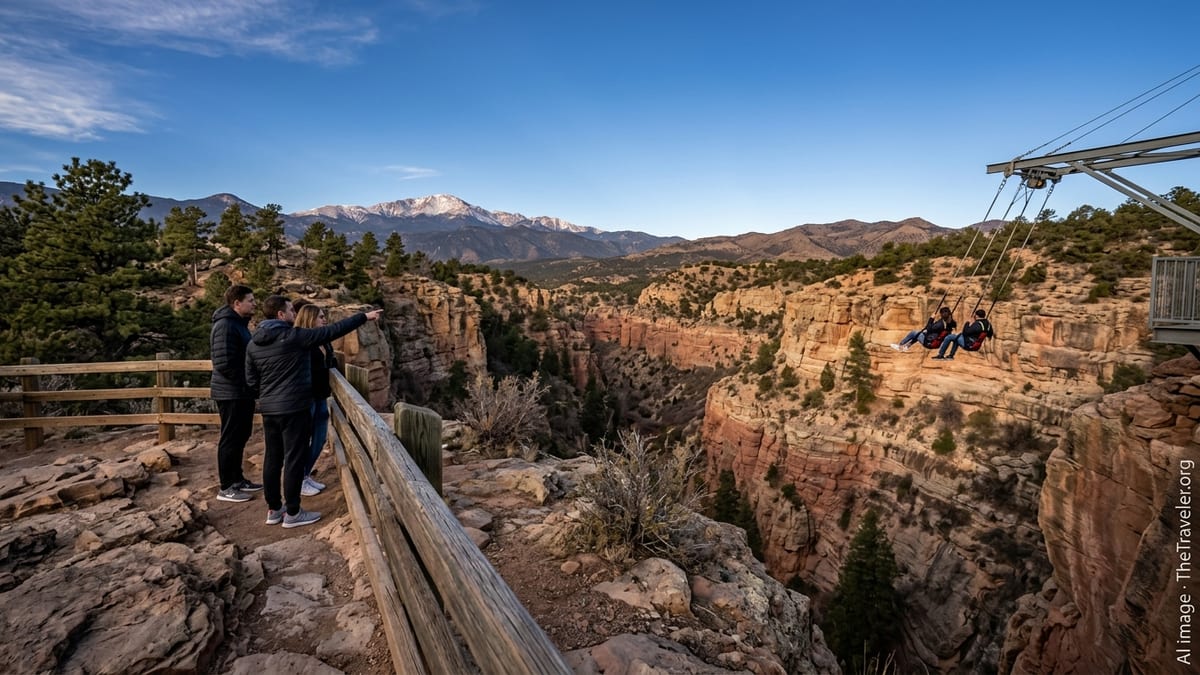
The Bat-a-Pult is a seated zip ride that carries pairs of guests along a steel cable across the canyon and then pulls them back to the loading platform. It delivers a sense of flying above the treetops without the intense drop of a true free-fall ride. Those who crave a stronger adrenaline spike often gravitate to the Terror-dactyl, a ride that launches riders off the cliff edge into a dramatic swing out over the canyon. Height, weight, and health restrictions are more stringent here, and there may be an additional upcharge, so it is worth checking current details at the ticket desk before committing.
Beyond the park itself, Cave of the Winds can anchor a full day in the Manitou Springs and Colorado Springs area. A common itinerary for first-time visitors includes a morning Discovery or Haunted Lantern Tour, lunch in downtown Manitou Springs, and an afternoon walk among the red rock formations of Garden of the Gods, a free city park roughly a 15-minute drive away. Another option pairs the cave with a ride on the Pikes Peak Cog Railway or a drive up the Pikes Peak Highway, giving you both underground and high-alpine perspectives in the same day, as long as you build in time for altitude changes and weather.
Nearby, the Manitou Cliff Dwellings, a reconstructed complex inspired by Ancestral Puebloan architecture, offer a walk-through experience and a small museum. While not an original archaeological site, the attraction provides a hands-on look at cliff-style buildings and appeals to many families with younger children. Rainbow Falls, a small waterfall tucked into the canyon below Cave of the Winds along Serpentine Drive, can be another short side trip in summer months when access is open, providing a contrast of flowing water and graffiti-covered concrete beneath the highway bridge.
Food options at the park itself tend to be simple and snack-focused, such as coffee, ice cream, and grab-and-go items. For full meals, most visitors head down into Manitou Springs or into nearby Colorado Springs, where you will find everything from casual burger joints to breweries and sit-down restaurants. During busy summer weekends, it is wise to plan for a short wait at popular spots, especially on Manitou Avenue and in Old Colorado City.
The Takeaway
Visiting Cave of the Winds is less about ticking off a single attraction and more about experiencing a slice of Colorado’s long relationship with its landscape, from ancient seas that laid down limestone, to nineteenth-century tourists seeking health and spectacle, to today’s families mixing geology lessons with cliffside rides. With thoughtful planning around tickets, timing, clothing, and safety, you can tailor the visit to your group’s comfort level, whether that means a gentle lit tour and a few photos at the canyon rim, or a lantern-lit ghost walk followed by a heart-pounding plunge on the Terror-dactyl.
By understanding how the seasons affect access, recognizing the physical demands of underground walking at altitude, and respecting the fragile cave environment, you help ensure that Cave of the Winds remains both accessible and awe-inspiring for future visitors. Paired with the red rocks of Garden of the Gods, the historic streets of Manitou Springs, and the heights of Pikes Peak, it can be a memorable highlight of any trip along Colorado’s Front Range.
FAQ
Q1. How long does a typical visit to Cave of the Winds take?
A standard Discovery Tour lasts about 45 minutes, but you should plan two to four hours total if you include check-in time, browsing the visitor center, and any outdoor rides.
Q2. Do I need to book tickets in advance?
Advance booking is strongly recommended, especially in summer, on weekends, and for Haunted Lantern or Caving 101 tours, which have limited capacities and often sell out.
Q3. Is Cave of the Winds suitable for young children?
The Discovery Tour is generally suitable for school-age children who can manage stairs and are comfortable in dim spaces. Haunted Lantern and caving tours are better suited to older kids and teens.
Q4. What should I wear inside the cave?
Wear long pants, a light jacket or sweatshirt, and closed-toe shoes with good grip. The cave stays cool and slightly damp year-round, even on hot summer days.
Q5. Can I take photos during the tour?
Yes, photography is usually allowed on standard tours, but flash may be discouraged in some areas and you should avoid blocking walkways or delaying the group to set up shots.
Q6. Is the cave wheelchair accessible?
Because of stairs, narrow passages, and uneven surfaces, the primary cave routes are not wheelchair accessible. The visitor center and some viewpoints outside are accessible and offer canyon views.
Q7. Are there age or health restrictions for the outdoor rides?
Yes. Rides such as the Wind Walker, Bat-a-Pult, and Terror-dactyl have height, weight, and health restrictions, and some are not appropriate for guests with heart, back, or neck problems.
Q8. What is the best time of day to visit?
Mornings usually offer cooler temperatures, lighter crowds, and fewer weather-related ride closures. Late afternoons can be busier and more likely to see thunderstorms in summer.
Q9. Can I combine Cave of the Winds with other nearby attractions in one day?
Yes. Many visitors pair a cave tour with Garden of the Gods, downtown Manitou Springs, or a trip up Pikes Peak, building a full day of varied scenery within a short drive.
Q10. What if I am claustrophobic or afraid of the dark?
If you have mild concerns, talk with staff about the Discovery Tour, which is well lit and passes through relatively open chambers. Those with severe claustrophobia may prefer to enjoy the views and amenities above ground.