


More news on this day
Travelers using the West Coast Main Line between London Euston and the Midlands, North West and Scotland faced severe disruption after a trackside fire in north London brought services on the UK’s busiest inter-city rail route to a near standstill.
Get the latest news straight to your inbox!
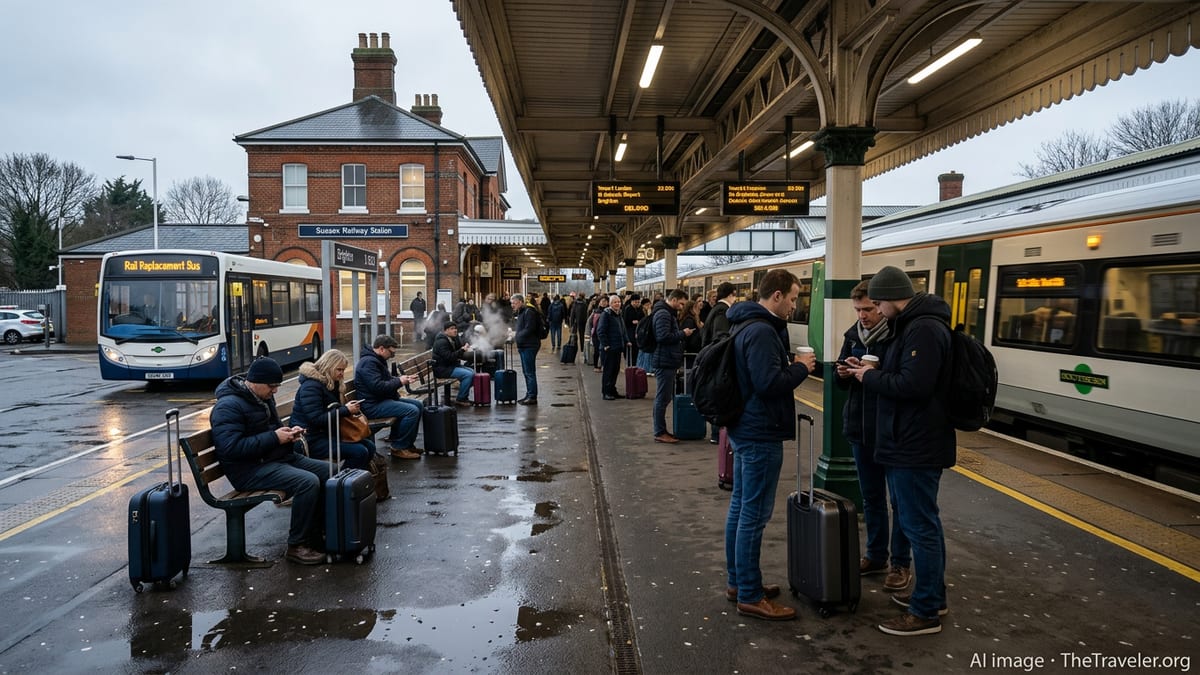
Services halted on key approach to London Euston
The incident occurred on the approaches to London Euston, the southern terminus of the West Coast Main Line, which is regarded in publicly available data as the country’s busiest inter-city corridor. The line handles long-distance Avanti West Coast and Lumo services linking the capital with Birmingham, Manchester, Liverpool, Glasgow and Edinburgh, as well as dense commuter traffic operated by London Northwestern Railway and West Midlands Railway.
Reports from travel information services described a fire close to the tracks in north London, forcing the suspension of train movements while emergency teams dealt with the incident and infrastructure checks were carried out. National passenger information channels warned that all lines between Euston and Watford Junction were affected, creating a bottleneck on the crucial stretch that funnels almost all West Coast Main Line services in and out of the capital.
According to disruption summaries, trains were cancelled, heavily delayed or terminated short of their destinations, with some long-distance services diverted where capacity allowed. Passengers were advised to delay travel, seek alternative routes, or use tickets on other operators, with major disruption expected to last for much of the day.
The incident came shortly after a series of planned engineering closures and upgrade works on the same corridor, underlining the operational vulnerability of a route that routinely runs close to capacity during peak hours.
Knock-on delays across the national rail network
The trackside fire did not only affect journeys into and out of London Euston. Because the West Coast Main Line sits at the heart of the wider national rail timetable, disruption on the approach to the capital quickly rippled northwards through key hubs such as Milton Keynes, Rugby and Crewe.
Timetable data and journey planners showed trains being held outside congestion points, skipping intermediate stops to recover time, or being turned back at major stations to keep some semblance of service running. As sets and crew were displaced from their scheduled diagrams, gaps appeared in both long-distance and regional services, with some late-evening trains removed from the timetable entirely.
Further afield, connections at Scotland’s Central Belt stations and at key interchange points in the Midlands were reported to be unreliable, as trains arriving from England missed onward departures. This had a particular impact on travelers attempting same-day journeys that required multiple changes, including airport transfers and cross-country itineraries.
Publicly available journey-planning tools indicated that residual delays continued well after the fire itself had been brought under control, as signallers and control teams worked trains back into their intended positions and repair crews completed safety inspections on affected infrastructure.
Passengers face overcrowding, diversions and extended journeys
Images and accounts shared on social media platforms showed crowded concourses at London Euston, with departure boards filled with cancellations and “delayed” indicators. Many travelers reported being advised to use alternative London terminals and other main lines, including routes from London Marylebone, London King’s Cross and London St Pancras, in an effort to bypass the affected corridor.
Some inter-city passengers opted to travel via Birmingham Moor Street or other secondary hubs, adding significant time to journeys that would usually be direct. Others sought last-minute coach tickets or car-hire options, leading to delays extending well beyond the railway network itself. With hotel availability in central London already tight on winter weekends and peak weekdays, overnight stays became an unplanned expense for a proportion of those stranded far from home.
Passenger advocacy groups highlighted that, although the incident was caused by an external factor, the disruption again exposed the limited resilience of heavily used routes into major cities. They pointed to recent occasions where separate problems such as trespass incidents, signalling faults or lineside obstructions also triggered widespread delays, arguing that frequent travelers are increasingly building additional contingency time into their itineraries.
Online feedback suggested that information quality varied between operators, with some passengers praising clear real-time updates on mobile apps, while others reported confusion over platform changes and last-minute cancellations once they had already boarded.
Safety checks and repairs before services can fully resume
Network infrastructure managers are required to halt train movements when fire is detected close to the track, particularly where it may affect power systems, signalling cables or structural elements such as bridges and retaining walls. After the blaze in north London, technical teams needed to confirm that rails, sleepers, cable routes and overhead equipment had not suffered heat damage that could compromise safe operation.
Engineering assessments can extend disruption long after an incident is extinguished, especially on a corridor as intensively used as the approach to London Euston. Timetable planners must gradually reintroduce services to avoid sudden congestion, and trains may initially run at reduced speeds through the affected area until permanent repairs are complete.
Recent project updates on the West Coast Main Line highlight ongoing investment in track renewals, drainage improvements and signalling upgrades near Euston and along the corridor toward Milton Keynes. These works are intended to improve long-term reliability and reduce the risk that a single incident, such as a trackside fire or extreme weather, can paralyse the route for extended periods.
However, rail planning documents and previous disruption events indicate that, despite capacity enhancements, the combination of high train frequencies and limited diversionary routes into London means that even short-lived localised problems can cascade into national-scale travel disruption.
What travelers should know before using the route
The latest incident is a reminder for both domestic and international visitors to monitor rail conditions closely when planning journeys that rely on the West Coast Main Line. Industry travel advice recommends checking live departure boards and operator status pages on the day of travel, as well as verifying whether tickets are being accepted on alternative routes during major disruption.
For time-critical trips such as cruise departures, event attendance or airport connections, journey planners suggest building in additional buffer time or considering routing flexibility via other London terminals if tickets and itineraries allow. Travelers holding advance-purchase tickets are often permitted to use earlier or later services when disruption is classified as “major,” but available information shows that conditions can change quickly during evolving incidents.
Tourism businesses along the corridor, including hotels in London, the Midlands and northern cities, are continuing to monitor the impact of repeated rail disruption on visitor confidence. Industry commentary notes that reliable inter-city rail remains central to sustainable travel in the UK, and that restoring trust in key routes like the West Coast Main Line is increasingly important as international arrivals rebound and domestic leisure travel grows.
As services progressively recover following the trackside fire, attention is expected to focus on lessons for future incident response, from lineside vegetation management and infrastructure resilience to real-time passenger communications on one of Europe’s most intensively used inter-city corridors.