


More news on this day
A nationwide FAA ground stop centered on Chicago O’Hare International Airport on Sunday, August 30, 2026, sent delay counts into triple digits as severe thunderstorms rolled across northern Illinois and choked one of the United States’ busiest hubs.
Get the latest news straight to your inbox!
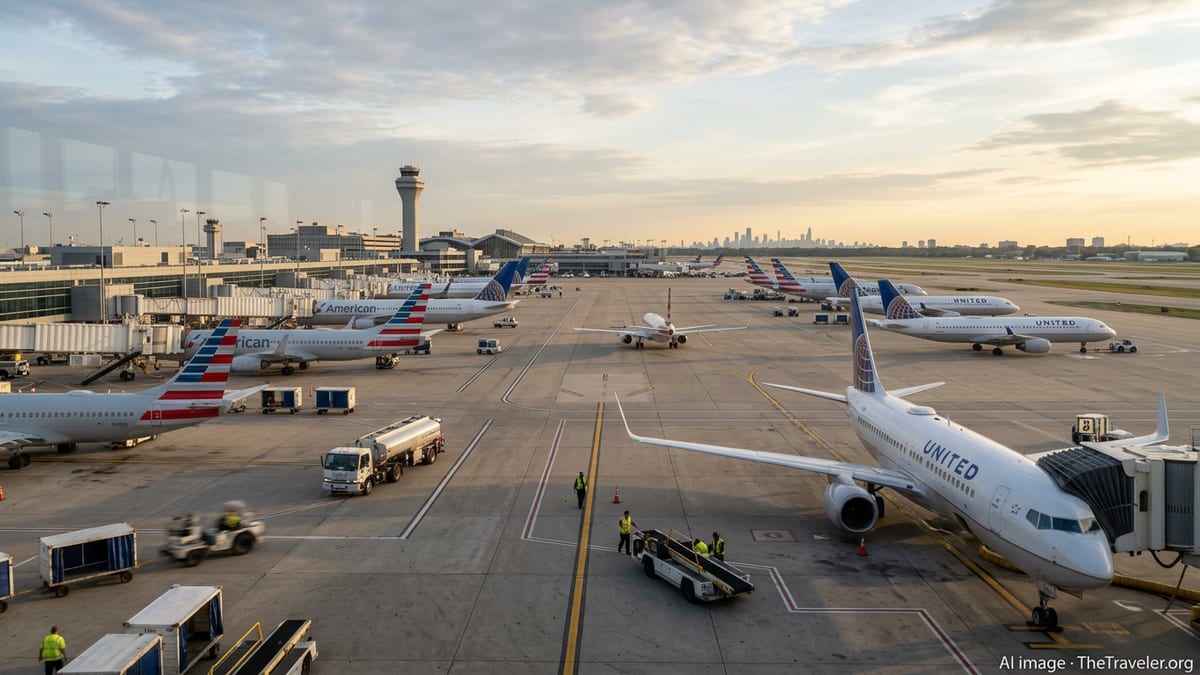
Ground Stop Freezes Traffic Into Key Midwestern Hub
Publicly available operations data shows that the Federal Aviation Administration implemented a coordinated ground stop for Chicago O’Hare International Airport on Sunday morning, temporarily halting many departures bound for the airport from across the country while limiting arrivals to what the airspace and ramp could safely handle. The measure was introduced as fast‑moving storm cells targeted the Chicago region, reducing visibility and triggering volume constraints in surrounding airspace.
Command center summaries for the National Airspace System list Chicago O’Hare under active traffic management programs, with weather and thunderstorms identified as the primary drivers of restrictions. For a portion of the day, O’Hare’s arrival rate and average delay figures were sharply curtailed compared with normal schedules, reflecting the difficulty of maintaining regular operations when convective weather moves directly across key approach paths.
Separate disruption‑tracking tools that ingest FAA feeds show O’Hare’s status shifting to amber for delays late Saturday and into the early hours of Sunday, with the event window extending for roughly three hours. During that period, delays escalated rapidly as inbound aircraft were held on the ground at origin airports and crews waited for clearance to depart toward Chicago.
While ground stops are designed as temporary safety and flow‑management tools, even a relatively short pause at a high‑throughput airport such as O’Hare can have outsized ripple effects as aircraft, crews, and gates fall out of place across multiple regions.
Delays Rapidly Reach Triple Digits
As the ground stop and associated traffic programs took hold, delay counts at O’Hare quickly climbed into triple digits, according to consolidated views of FAA operations information and airline‑tracking dashboards. The volume of affected flights reflects both the scale of the airport’s daily schedule and the tight interdependence between departures and arrivals when thunderstorms constrain capacity.
O’Hare typically supports about 1,500 flights per day to more than 300 destinations worldwide, making it one of the most complex airports in the United States for air traffic managers. Recent performance summaries indicate that during peak summer travel, even routine slowdowns can leave large numbers of flights arriving or departing behind schedule. On days when weather sharply cuts arrival rates, the number of delayed operations can rise quickly as aircraft queue on taxiways or hold at origin airports awaiting clearance.
Real‑time delay dashboards maintained by the Chicago Department of Aviation normally log only modest counts in the early-morning hours, but when national‑level constraints converge with local thunderstorms, hourly tallies can spike. Once triple‑digit delays are recorded, carriers often face cascading disruptions that can persist well beyond the official end time of a ground stop, as displaced passengers, crews, and aircraft slowly cycle back into position.
Travelers connecting through O’Hare are particularly exposed to this kind of event. With a large share of flights operating as links in multi‑segment itineraries, missed connections during a ground stop period can drive further rebookings and same‑day cancellations as carriers work within constrained gate and crew resources.
Weather, Capacity, and Construction Create a Fragile Balance
The latest halt at O’Hare arrives against a backdrop of broader efforts to manage congestion at the airport during the Summer 2026 scheduling season. Federal notices and scheduling orders issued earlier this year highlight concerns that planned operations at O’Hare would exceed what the airfield and surrounding airspace can reliably accommodate through at least late October 2027, particularly during peak hours.
Regulatory documents detailing operating limitations and schedule coordination at O’Hare describe a complex mix of factors weighing on capacity, including ongoing airfield construction, high runway utilization, and challenging terminal layouts. These constraints leave a relatively narrow margin when adverse weather rolls in, increasing the likelihood that traffic management initiatives such as ground delay programs or ground stops will be required to keep operations within safe limits.
At the same time, FAA briefings aimed at pilots characterize O’Hare’s environment as especially demanding, noting simultaneous parallel departures and arrivals on multiple north and south airfields. Under normal conditions, that configuration enables impressive throughput. Under convective weather and reduced visibility, however, controllers may be forced to scale back the number of simultaneous operations, which in turn drives up average delays.
The result is a network in which thunderstorms, even if relatively short‑lived, can significantly disrupt schedules when they coincide with peak departure banks or large waves of inbound traffic, as occurred over the August 30 weekend.
O’Hare’s Recent History of Disruptions
The current episode follows a series of recent high‑impact days at O’Hare in which weather, traffic management initiatives, or special events have led to extended delays and, in some cases, prior ground stops. Advisory logs from mid‑August recorded a collaborative decision‑making ground stop tied to an air show, with cumulative delays averaging close to two hours and maximum individual delays surpassing two hours as well.
Over the broader Summer 2025 period, federal analyses of airport performance show that a significant portion of O’Hare arrivals experienced some level of delay, reinforcing the perception of the airport as particularly vulnerable when schedules are densely packed. Many of the construction and capacity pressures identified in those reports are still present during the current season, with key projects continuing through late 2026.
Independent disruption‑tracking platforms that aggregate live status data have also flagged multiple amber and red events for O’Hare during recent weeks, capturing windows in which the airport’s status toggled between routine operations, moderate delays, and more severe constraints. The latest ground stop stands out because of its national scope and timing, overlaying weekend leisure demand on top of already elevated summer traffic.
For frequent fliers and airline planners alike, the pattern underscores how rapidly conditions at O’Hare can shift from manageable slowdowns to significant network‑wide disruptions once weather and capacity issues intersect.
What Travelers Can Do During Major Ground Stops
For passengers caught in Sunday’s disruption or monitoring future trips through O’Hare, publicly accessible tools can provide early warning when conditions begin to deteriorate. The FAA’s operations status pages list traffic management programs, including ground stops and ground delay programs, for major airports, while the Chicago aviation portal offers a snapshot of hourly delay counts by arrival, departure, and total volume.
Third‑party services that track airport‑level disruption, some of which archive past events, can also help travelers understand whether delays at O’Hare are localized or part of a broader pattern affecting multiple hubs on a given day. These platforms often integrate directly with FAA feeds, flagging when an airport’s status shifts to delay or ground stop categories.
Even with advance information, however, the practical advice remains largely consistent: monitor flight status closely, build additional connection time into itineraries that route through O’Hare during summer thunderstorm season, and be prepared for rebooking if lengthy ground stops push departures beyond crew or curfew limits. Because airline‑specific policies govern rebooking and compensation, passengers are generally encouraged to review carrier‑issued guidance for irregular operations while using public data mainly as context.
Given ongoing construction and the regulatory focus on aligning schedules with realistic capacity levels, observers expect that O’Hare will continue to see aggressive traffic management on the busiest days of the year. When severe weather aligns with those peaks, as it did on August 30, system‑wide ground stops are likely to remain a tool of choice for keeping traffic moving safely, even if that means another round of triple‑digit delays.
FAA National Airspace System Status
FAA Airport Status: Chicago O’Hare (ORD)
AirStatus Live Disruption Events
Operating Limitations at Chicago O’Hare International Airport