


More news on this day
The Federal Aviation Administration has begun limited deployment of a new AI-supported airspace management platform designed to spot emerging congestion and weather disruptions earlier, with the goal of reducing delays and cancellations before they cascade across the national airspace system.
Get the latest news straight to your inbox!
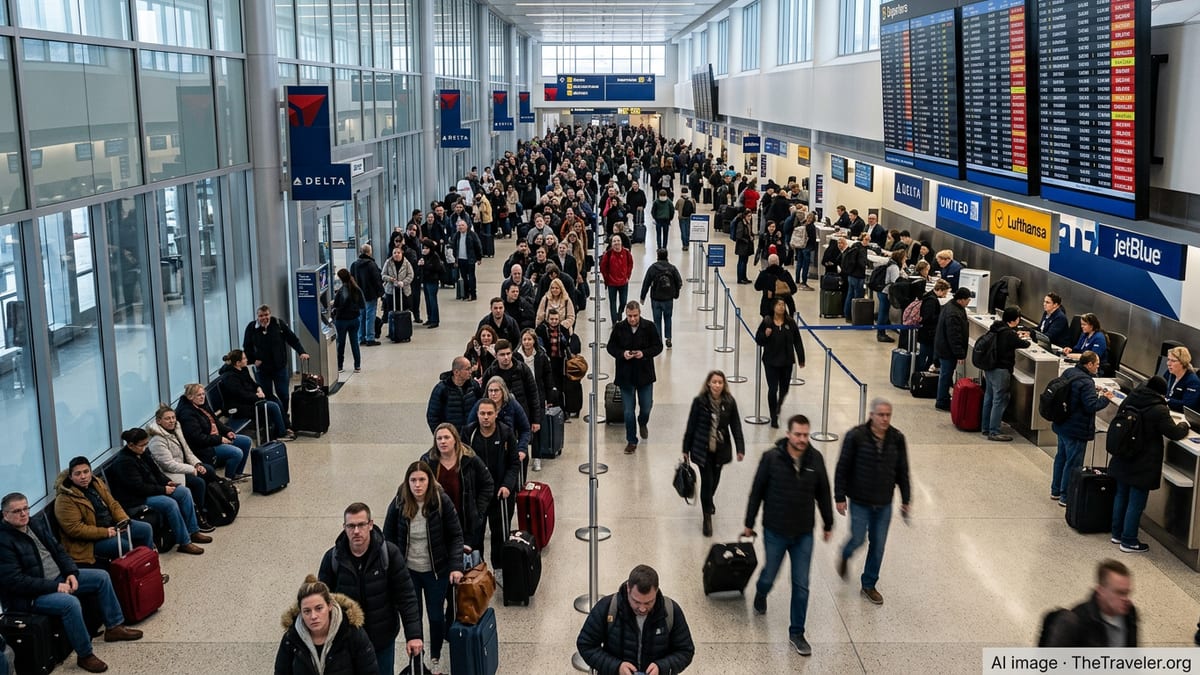
What the FAA just launched, and where it is rolling out first
The new platform is called Strategic Management of Airspace, Routes and Trajectories, abbreviated as SMART. Publicly available information shows it is being introduced first in a limited operational mode in the airspace around Washington, D.C., with plans for a broader expansion to other regions as testing and training continue.
Published coverage describes the initial deployment as focused on the complex, delay-prone corridor that affects major traffic flows along the East Coast. The Washington-area start is also framed as an early proving ground for integrating more predictive decision support into day-of-operations traffic management, where small disruptions can ripple into nationwide delays.
For travelers, the practical significance is less about a single airport procedure change and more about how early the system can flag trouble and support earlier, smaller interventions such as reroutes or revised traffic-management initiatives rather than last-minute holds and extended taxi-outs.
How SMART is supposed to work in day-to-day operations
SMART is described as a centralized platform that pulls together a large number of operational data streams into one view, including weather patterns, flight trajectories, traffic flow indicators, and controller staffing metrics. The core promise is synthesis: turning disparate real-time inputs into a clearer picture of where demand is building beyond capacity and where disruptions are likely to appear next.
According to published descriptions, SMART uses an AI-supported engine to analyze airline schedules alongside constraints such as airport capacity, airspace conditions, and evolving weather. The system is intended to predict traffic flows and identify potential conflicts earlier, helping traffic managers consider options before queues build and delays become harder to unwind.
Coverage also emphasizes that the tool is intended to support, not replace, controller decision-making. In practice, that means the platform can generate recommendations or advisories, but human teams still determine what actions to take and how to sequence them across facilities.
How this fits into broader FAA modernization efforts
SMART is arriving amid a wider FAA push to modernize traffic management technology and shift toward more trajectory-based planning. FAA materials on Trajectory Based Operations describe a framework that treats a flight’s path as a four-dimensional trajectory, including time, and aims to reduce capacity-to-demand imbalances by improving strategic planning.
In that context, SMART can be read as another layer of decision support designed to help the system move from reactive interventions to proactive ones, especially on high-impact disruption days involving convective weather, runway configuration changes, or constrained arrival rates.
Publicly available information also links SMART to the FAA’s replacement of aging traffic management infrastructure, including work around Flow Management Data and Services. That modernization effort is described as using advanced modeling to assimilate flight, weather, and airline data and project congestion hours in advance, an approach that aligns with the predictive goals being highlighted for SMART.
What travelers may notice, and what limitations remain
If the rollout performs as intended, travelers could see fewer extended ground delays and fewer late-stage reroutes that turn routine trips into missed connections, especially during high-volume periods when weather or runway constraints squeeze the system. The expected benefits are incremental but meaningful: earlier identification of pressure points can enable smaller adjustments that prevent larger downstream gridlock.
Still, published coverage includes skepticism that any single planning tool can resolve the most stubborn sources of delay, particularly those that occur after flights are already in the system and exposed to compounding randomness such as late inbound aircraft, gate constraints, and the knock-on effects of multiple airports experiencing the same weather.
SMART is also being introduced alongside ongoing concerns about technology resilience and cybersecurity across government systems. As more air traffic management functions depend on data-rich platforms, the operational payoff increasingly depends on reliable inputs, strong authentication, and continuity planning for outages, since data disruptions can quickly become airspace disruptions.
What comes next for the rollout and the 2028 timeline
The FAA has indicated it plans to expand SMART beyond the Washington, D.C., area as it continues to test the platform, train personnel, and evaluate performance in real operational conditions. Reports indicate the agency is treating the deployment as a gradual scaling effort rather than a sudden nationwide switch.
Published information also frames this as part of a broader modernization schedule stretching through the end of 2028. For travelers, that means the most noticeable improvements, if realized, may arrive in stages: first in select high-complexity airspace, then across additional corridors where delay reductions can have outsized national impact.
In the near term, the key watch point will be whether earlier, AI-supported conflict detection translates into measurable reductions in taxi-outs, airborne holding, and diversion risk during disruption days, without adding new operational friction for airlines and controllers already juggling high workload and tight schedules.