


More news on this day
The U.S. Federal Aviation Administration (FAA) is forecasting the busiest Thanksgiving air travel period in 16 years for 2026, with more than 417,000 flights scheduled nationwide over nine days and peak volumes topping 52,000 flights in a single day, a surge that will test staffing levels, aging technology and recent efforts to prevent another nationwide air traffic outage.
Get the latest news straight to your inbox!
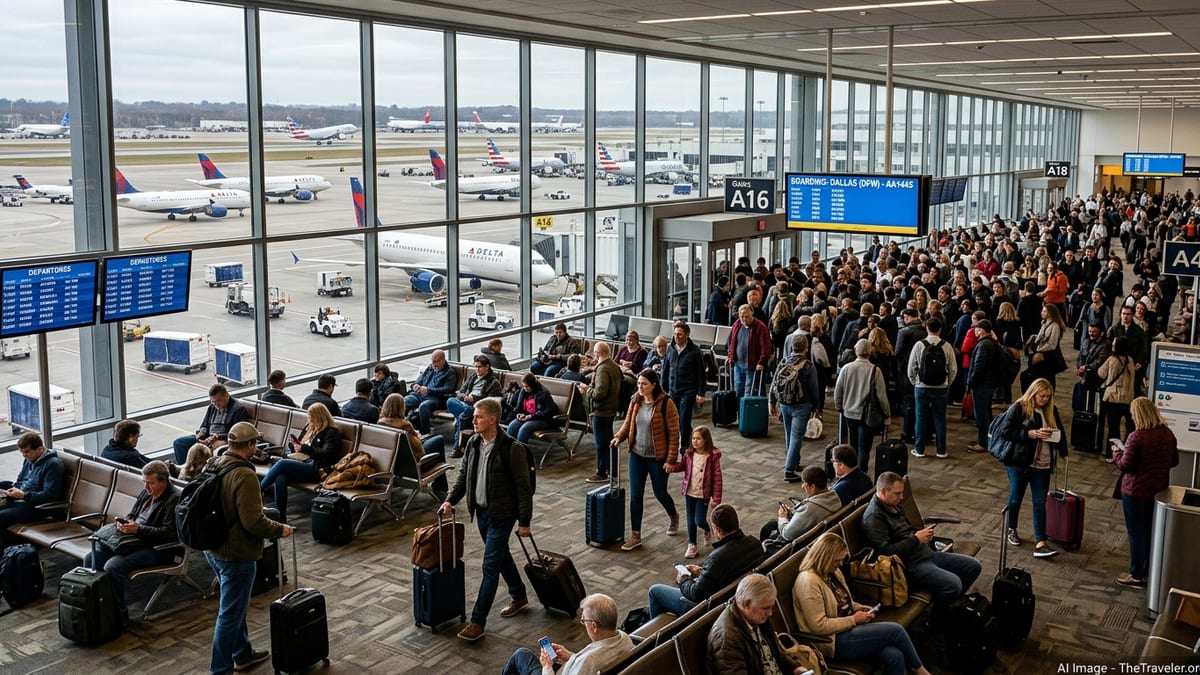
Record forecast and how it compares with previous years
According to a forecast published by the Department of Transportation on November 23, 2026, the FAA expects nearly 418,000 flights to operate between Monday, November 23, and Tuesday, December 1, the nine-day period it uses for Thanksgiving travel statistics. That total slightly exceeds the nearly 410,000 flights recorded over the same period in 2025 and is higher than pre-pandemic levels, making it the busiest Thanksgiving air travel week since at least 2010 by FAA’s count.
The agency projects that Tuesday, November 24, will be the single most active day in U.S. airspace during the holiday window, with more than 52,000 flights scheduled. That figure includes domestic and international passenger services, cargo flights and general aviation operations controlled by the national airspace system. While passenger counts depend on airline booking patterns and aircraft size, Transportation Security Administration projections indicate that screening volumes are also close to recent records, with about 17.6 million passengers expected to pass through airport checkpoints over the core Thanksgiving week.
The current forecast signals a modest year-on-year increase in flight activity but comes in the context of slightly softer passenger predictions from travel organizations such as AAA, which expects total Thanksgiving travel across all modes to be marginally lower than in 2025. For air travelers, the practical effect is that planes are more likely to be operating at or near capacity during peak days, even if overall traveler numbers are not dramatically higher than last year.
White House “Tiger Team” and recent outage concerns
The FAA’s forecast follows a disruptive period for the U.S. aviation system. Earlier in November 2026, a malfunction in the agency’s network triggered a nationwide ground stop that lasted more than four hours, the longest such interruption since 2001. Separate technology issues at Delta Air Lines and at Chicago O’Hare also caused significant delays and cancellations in the weeks leading up to Thanksgiving, heightening public concern about the resilience of air travel infrastructure.
In response, the White House has announced the creation of a “Transportation Technology Transformation Tiger Team,” a group that includes senior officials from the FAA, the Department of Transportation, the Department of Defense and the Office of the Director of National Intelligence. According to a summary released on November 23, the team’s mandate is to identify vulnerabilities in critical aviation systems, improve early detection of anomalies and recommend near-term fixes to reduce the risk of another nationwide ground stop during the holiday period.
The Tiger Team is described by the administration as an intensive, time-limited effort focused on technical reliability rather than a structural overhaul of air traffic control. It meets daily and is reviewing recent outage reports, patch management practices and contingency procedures. While this work is ongoing, officials have emphasized that they cannot guarantee an incident-free holiday, and that the measures now in place are best understood as risk mitigation rather than a complete solution to the underlying technology challenges.
Air traffic control staffing and system modernization
Transportation Secretary Sean P. Duffy and FAA Administrator Bryan Bedford have both highlighted the role of front-line air traffic controllers and technical staff in handling the expected holiday surge. In public statements, they have stressed that controllers and safety specialists are working extended shifts and that additional personnel are being deployed to some of the busiest facilities to manage peak periods, particularly on November 24 and the Sunday after Thanksgiving, historically one of the heaviest return-travel days.
At the same time, the forecast underscores ongoing pressure on an air traffic control system that industry groups and government auditors have described as strained by staffing gaps and aging equipment. Several recent analyses have pointed to persistent controller shortages at high-density facilities, including en route centers that manage traffic along the East Coast and approach controls serving major hubs such as Atlanta and New York. The nationwide ground stop earlier in the month has renewed debate over how quickly the FAA can retire legacy systems and fully implement more modern, satellite-based navigation and digital communications.
The administration has framed the Thanksgiving plan as part of a broader modernization push already under way. The FAA continues to expand use of tools that predict congestion at major airports and along heavily used routes, allowing traffic managers to adjust departure times and reroute aircraft to balance demand across the network. These systems are intended to reduce delays and minimize the need for sudden, large-scale restrictions, but their effectiveness during an extended period of peak demand and unsettled weather will be closely watched by airlines and lawmakers.
Weather outlook and operational risks for travelers
The FAA’s holiday forecast is accompanied by a preliminary weather outlook that identifies several periods and regions where flights are at higher risk of disruption. For Tuesday, November 24, low cloud ceilings are expected to affect parts of the West Coast, particularly along coastal California and the Pacific Northwest, which may require increased spacing between arrivals and departures into busy airports. This can lead to ground delays even when local conditions appear manageable to passengers.
Thunderstorm activity is forecast across Florida and segments of the Gulf Coast on Tuesday and Wednesday, with the potential for convective weather to disrupt traffic flows into major airports such as Miami, Orlando, Tampa, New Orleans and Houston. On Wednesday, a broad rain system is expected to move across the Southeast, including the Atlanta area, before tracking north into the Mid-Atlantic later in the day. Because Atlanta is one of the country’s largest connecting hubs, significant restrictions there can quickly ripple across the national network.
For Thanksgiving Day itself, current forecasts indicate that rain and gusty winds are likely to return to parts of the Northeast, affecting airports from Washington and Baltimore through New York and Boston. Forecasters and aviation officials caution that these projections remain subject to change as the holiday approaches and that localized conditions can vary significantly from the national outlook. Travelers are advised to check their airline’s flight-status tools frequently on the day of travel and to be prepared for gate or departure time changes, particularly when flying through weather-sensitive hubs.
Practical implications and guidance for passengers
With more than 417,000 flights forecast to operate and multiple days of weather-related risk identified, travelers are likely to experience crowded terminals and limited flexibility if disruptions occur, even if overall cancellation rates remain within a typical holiday range. Airlines have indicated that many peak-day flights are close to fully booked, which can make same-day rebooking challenging when schedule disruptions cascade across the network.
Federal agencies and carriers are therefore emphasizing preparation. The Transportation Department and FAA recommend allowing extra time to reach the airport, especially on November 24 and on the Sunday and Monday after Thanksgiving, when passenger screening volumes are expected to be highest. They also urge travelers to use airline mobile apps and sign up for text or email alerts so that schedule changes and gate moves are received as early as possible. For those making tight domestic connections, officials suggest considering slightly longer layovers on peak days, as inbound delays may leave less buffer than usual.
In addition, the FAA is directing passengers to its public airspace status resources for an overview of system-wide constraints, such as ground delay programs and reroutes that can affect large numbers of flights. While these tools are primarily designed for industry users, they can help travelers understand whether a disruption is localized to a single airport or part of a broader national traffic management initiative. This context can be useful when deciding whether to adjust onward ground transport plans or, for those with flexible tickets, whether to move travel to a less congested day.
What to watch as the Thanksgiving travel period unfolds
As the nine-day Thanksgiving window progresses, several indicators will show how well the system is coping with the projected 16-year high in flight activity. These include the proportion of flights departing within 15 minutes of schedule, the number and duration of ground stops or ground delay programs issued by the FAA, and the frequency of technology advisories affecting air traffic control centers or major airports. Airlines and regulators typically review these metrics after the holiday to identify where additional investments or procedural changes are most needed.
For individual travelers, the most immediate questions will be whether their flights operate close to schedule and how quickly they are assisted if disruptions occur. Given the recent network outage and heightened focus on system reliability, the performance of the White House’s Tiger Team and the FAA’s congestion-management tools during this period is likely to shape future policy debates over air traffic control funding and modernization timelines. Any major incident could intensify calls in Congress for accelerated technology upgrades or structural reform of how the national airspace is managed.
In the near term, passengers planning to fly between November 23 and December 1, 2026, should monitor evolving weather forecasts and airline advisories in the days leading up to departure and again on the morning of travel. Those who have not yet finalized their plans may find slightly more breathing room on Thanksgiving Day itself and on less popular travel days such as Friday or Saturday, when schedules are still busy but not at the projected Tuesday and Sunday peaks. Regardless of the specific day chosen, the combination of high volumes, recent technology concerns and variable late-autumn weather means that building extra time into itineraries and remaining flexible will be especially important for this year’s Thanksgiving journeys.