


Naples has a reputation for chaos long before you arrive. Friends warned me about the traffic, the noise, the scooters that seem to appear from nowhere. So when I decided to visit Parco Virgiliano, a panoramic park perched on the Posillipo hill, I expected more of the same, just with a better view. Instead, I found one of the most peaceful corners of the city, a place where the Gulf of Naples and the islands spread out so wide that the usual hurry of southern Italy seemed to fall away.
Get the latest updates straight to your inbox!
Arriving Above the City
My visit to Parco Virgiliano began with a climb. From the waterfront at Mergellina, I boarded the 140 bus toward Capo Posillipo, one of the standard routes locals recommend for reaching the park. The ride took about 25 minutes as we wound up through residential streets, past small bars selling cornetti and espresso for around 1.50 to 2 euros, and glimpses of the sea appearing between apartment blocks. By the time the bus stopped near the end of the line, the sound of the city had dropped several notches.
From the bus stop, it was a short uphill walk, about 10 minutes, along Via Tito Lucrezio Caro. The sidewalks were narrow in places, and I passed kids with school backpacks, an elderly couple with a small dog, and a fruit vendor selling plastic cups of freshly cut pineapple and melon for about 3 euros. There were almost no tourists in sight. This already gave the approach to the park a different feel from the crowds around Spaccanapoli or Piazza del Plebiscito.
The entrance to Parco Virgiliano itself is understated: a wide gate, a modest sign, a glimpse of pine trees beyond. There is no ticket booth, because entry is free. I checked the posted hours at the gate, which indicated a schedule that typically runs from morning until evening, with closing time shifting seasonally around sunset and weather occasionally forcing early closures. It is the kind of place where you do well to confirm hours the same day, especially in winter or on very windy days.
Crossing the threshold, the pavement gave way to wide walkways framed by Mediterranean vegetation. It was early afternoon on a clear day, yet the park felt spacious and quiet. Parents pushed strollers toward the playgrounds, a few joggers passed at a relaxed pace, and somewhere out of sight a dog barked once, then fell silent. It felt as if the noise of Naples had been absorbed by the tufo rock of Posillipo and left behind on the slope below.
Terraces, Vistas and the Geography of Calm
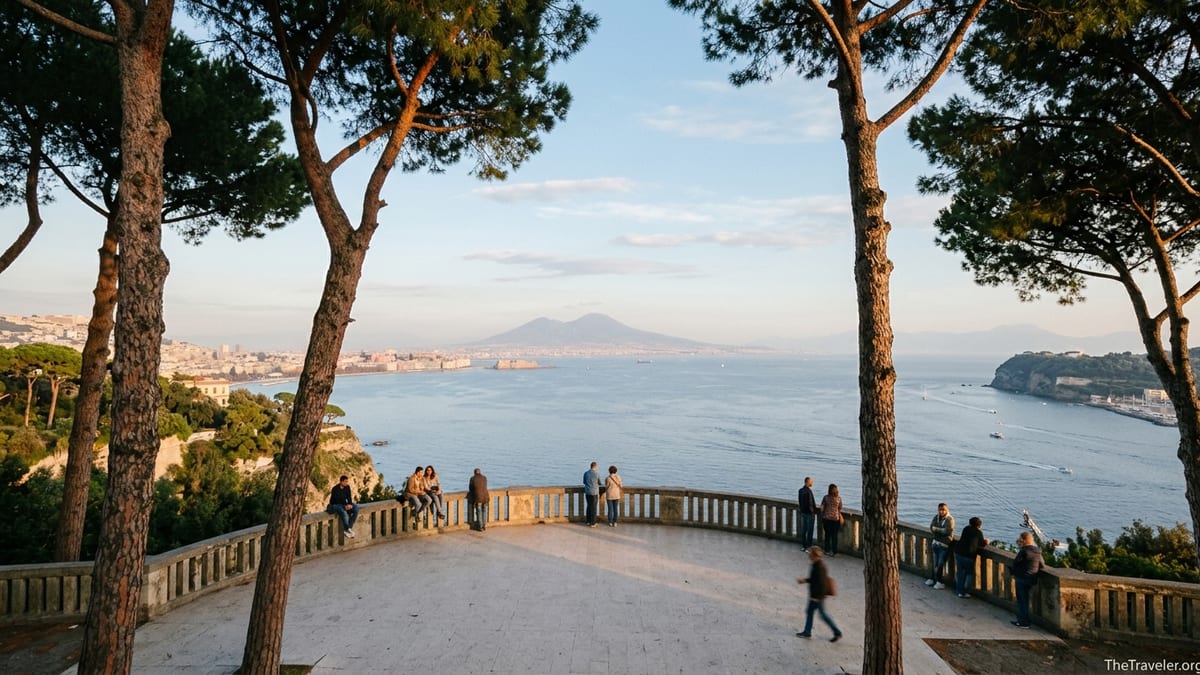
Parco Virgiliano is laid out like a series of balconies over the sea. Following the main path, I reached the first belvedere and stepped out toward the low wall. The view was immediate and wide: the arc of the Gulf of Naples, with Mount Vesuvius rising on the horizon and the city spread along the curve of the bay. Even on a bright day, there was a soft haze that made the buildings fade into a muted patchwork at the water's edge.
Further along, another terrace opened to a different angle. Here I could see the island of Nisida linked to the mainland by a causeway, the former industrial area of Bagnoli, and, further off, the islands of Ischia and Procida. Each terrace in the park faces a slightly different direction, so walking the loop feels like turning slowly in a circle over the coast. One vantage point catches Capri; another frames the Campi Flegrei and Capo Miseno. The result is almost a 360-degree panorama from roughly 150 meters above sea level.
What surprised me most was how these views affected the mood of the place. This is technically still urban Naples, and yet the soundscape at the terraces was made up mostly of wind, scattered conversation in Italian and Neapolitan, and the occasional rattle of a skateboard on pavement. When a group of teenagers arrived with music playing softly from a phone, the space was so wide that their noise dissolved within a few steps.
Sitting on one of the low walls, I watched a local photographer set up a tripod and a mid-range DSLR with a 24–70 mm lens, carefully waiting for a boat to cross a particular slice of water. Nearby, a couple in business clothes shared a takeaway lunch from a local rosticceria, paper-wrapped arancini and crocchè that together probably cost less than 8 euros. The scene felt distinctly Neapolitan but slower and more measured than the streets below.
Walking the Paths and Playgrounds
Leaving the main terrace, I followed one of the secondary paths that slope down along the side of the hill. These walkways are paved but slightly uneven in places, reflecting the park’s age and the natural settlement of the ground. The route passed through clusters of maritime pines, eucalyptus and low Mediterranean shrubs: broom, myrtle, and agave. The scent was a mix of pine resin and sea air that grew stronger as the wind shifted.
Along the way I passed a series of small playgrounds. Some of the equipment was new or recently repainted, while other pieces showed their age: faded plastic slides, metal swings with squeaking chains, patches where grass had given way to packed earth. On a weekday afternoon the playgrounds were lightly used, mostly by local families from the surrounding Posillipo neighborhood. Parents sat on benches chatting while keeping half an eye on their children as they climbed, yelled and then quickly settled into their own games.
The park’s lower sections feel more like a neighborhood green space than a tourist attraction. There are scattered exercise areas where a couple of residents were stretching or doing bodyweight workouts, and a series of quieter corners where benches face the sea without the formality of the main terraces. In one of these spots, a man in his sixties sat reading a newspaper from a local kiosk, occasionally looking up to watch a ferry line trace its way toward Capri.
Maintenance in Parco Virgiliano is a mixed picture. Some sections of the fencing are freshly painted, plant beds trimmed and trash bins emptied; other areas show wear, with cracked pavement and older infrastructure waiting for repair. Yet even with this unevenness, the overall feeling is not neglect so much as lived-in. It looks like a park that belongs to the people who use it every day, rather than a manicured tourist showcase.
Timing the Visit: Light, Weather and Crowds
The timing of the visit matters a great deal at Parco Virgiliano. I arrived in mid-afternoon in early spring, when the sun was still high but already moving toward the west. This meant the terraces facing Vesuvius and the historic center were backlit, while the western-facing viewpoints toward Nisida and the Campi Flegrei enjoyed warm, slanting light. Photographers planning a visit might aim for late afternoon on a clear day when shadows lengthen and the water takes on a metallic blue tone.
Locals often recommend sunset here, and it is easy to see why. As the sun drops toward the islands, the sky behind Ischia and Procida shifts from pale yellow to deep orange, and streetlights begin to appear along the coast below. On the evening of my visit, the park never felt crowded, even as more people arrived to watch the sky change color. There were groups of friends with pizza boxes from nearby takeaways, couples sharing beer or Aperol spritz from small cans, and solo visitors leaning quietly on the railings. No one seemed to be in a hurry to leave.
The park’s opening hours can shift with the seasons and weather. In winter, closing may come relatively early, sometimes by late afternoon, while in the longer days of late spring and summer the park tends to remain open into the evening. Strong wind or storms can lead to temporary closures for safety, especially given the park’s cliffside position. For that reason, travelers are wise to check the same-day schedule with their accommodation host or a local tourism office rather than relying on outdated information.
Temperature and wind also shape the experience. On a still day in summer, the upper promenades can feel hot despite the breeze, so bringing water is sensible, though there are small kiosks and bars within walking distance of the park selling chilled bottles for around 1 to 1.50 euros. In cooler months, the wind from the gulf can be brisk along the exposed terraces, and having an extra layer makes the difference between a quick photo stop and a leisurely, peaceful walk.
Contrasting Chaos: Naples Below, Quiet Above
Part of what made my visit feel so peaceful was the contrast with central Naples earlier in the day. That morning I had walked the length of Via dei Tribunali, dodging scooters, street vendors calling out offers for frittatine di pasta, and visitors crowding in front of famous pizzerias such as Sorbillo and Di Matteo. The energy was invigorating but relentless. By mid-day, I was ready for a change of pace.
Parco Virgiliano delivered exactly that. From the terraces, I could see the urban sprawl of Naples, but it felt remote, as if watching a live painting from a distance rather than standing in its midst. The horn blasts and sirens that shape so much of the city’s soundscape did not reach this height. Instead, the dominant sounds were the rush of wind, the crunch of gravel underfoot, and occasional fragments of conversation about everyday things: school exams, football scores, rising rent.
Even the small scenes of daily life had a calmer rhythm. A mother taught her young child to ride a bike without training wheels on a flat stretch of pavement. An elderly man walked steadily along the main loop, using the benches at each terrace as fixed points to practice interval walking. A group of university students rehearsed lines from a play, their scripts flapping in the breeze as they shifted between Italian and dialect. The park seemed to give all of them the mental space that the dense city streets often cannot.
For visitors, this calm has practical benefits. It is easier to keep an eye on belongings when you are not being jostled, easier to orient yourself with clear landmarks like Vesuvius, Nisida or Capri in view, and easier to let the pace of the day slow. I found myself staying longer than planned simply because there was no pressure to move on. In a travel schedule filled with museums, archaeological sites and restaurant reservations, this unstructured time felt like a luxury.
Practical Tips: Getting There, Costs and Nearby Stops
Reaching Parco Virgiliano is fairly straightforward once you know where it sits. The park stands near the tip of the Posillipo promontory, known as Capo Posillipo. From the city center or the seafront, most visitors use local buses such as the 140 or C21 from Mergellina, or the C31 from the Vomero district, depending on where they are staying. Tickets for city buses typically cost around 1.20 to 1.60 euros if bought in advance at a tobacco shop, slightly more if purchased onboard when that option is available.
There is no admission fee for the park itself, which makes it a valuable addition to an itinerary that might already include paid attractions like the Archaeological Museum, Pompeii or the Naples Underground. The main expenses associated with a visit are transportation and any food or drinks you choose to buy. Some visitors bring snacks or a picnic, picking up takeaway pizza al taglio, panini, or sfogliatelle from bakeries near their accommodation before heading up the hill.
For those arriving by taxi or ride-hailing service, the cost from central areas such as Piazza Garibaldi or the historic center will vary with traffic and time of day, but travelers often report one-way fares in the range of 15 to 25 euros. Drivers may not always recognize the park by name in a foreign pronunciation, so having “Parco Virgiliano, Posillipo” written down can smooth communication.
Combining Parco Virgiliano with nearby experiences makes sense if you have a full day on the western side of the city. Some travelers visit the park in the late afternoon after a morning spent at the Gaiola Underwater Park, the archaeological sites of Pausilypon, or a seaside lunch at one of the restaurants along the Posillipo coast. Others pair a sunset visit with dinner at a nearby trattoria or pizzeria in Posillipo, where outdoor terraces look back toward the same waters seen from the park, but at a lower, more intimate angle.
Mistaken Identities: Virgiliano vs Vergiliano
One practical detail that can confuse visitors is the similarity of names between Parco Virgiliano in Posillipo and the Parco Vergiliano a Piedigrotta, near Mergellina. The latter is a small memorial park known mainly for the tomb associated with the Roman poet Virgil and the grave of Giacomo Leopardi. It sits near the entrance to the ancient Roman tunnel called the Crypta Neapolitana, and its atmosphere is more historical and commemorative than scenic.
Parco Virgiliano in Posillipo, by contrast, is sometimes called the Park of Remembrance but functions primarily as a panoramic terrace park with extensive views over the sea and islands. When asking directions or checking public transport routes, it helps to specify that you are heading to the park in Posillipo rather than the smaller memorial park by Mergellina. Locals themselves occasionally mix the names, so clarifying with “the panoramic park on the hill, with terraces over the gulf” can avoid misunderstandings.
During my stay, I met a couple from northern Europe who had gone first to the Parco Vergiliano a Piedigrotta expecting wide sea views, only to find themselves instead in a shaded, hillside garden centered on tombs and historical plaques. They appreciated the visit, but it did not match what they had seen online. It was only after showing a local a photo that they were redirected to the correct location up on Posillipo.
That mix-up illustrates how easily expectations can misalign with reality in Naples, a city with multiple layers of history and overlapping names. Fortunately, once you reach the right park, there is little risk of confusion. The cliff-edge terraces, the long circuit path, and the open sky over the gulf leave no doubt that you have found the panoramic Virgiliano.
The Takeaway
My visit to Parco Virgiliano felt more peaceful than I expected not because Naples suddenly became quiet, but because the park offered a different way to experience the city. From its height on the Posillipo hill, the usual intensity of Naples is still visible yet held at a distance, turned into a landscape of light, water and islands framed by pines.
For travelers, this park is not about checking off a major monument or posing in front of a single famous viewpoint. It is about giving your itinerary space to breathe. An hour here between more demanding sights can reset your sense of pace; a sunset visit can provide a calm conclusion to a crowded day in Pompeii or the old town. The absence of an entrance fee, the presence of local families, and the wide, open paths all contribute to an atmosphere that feels humane and unhurried.
If you come to Naples expecting nothing but noise and confusion, Parco Virgiliano quietly proves that the city also knows how to pause. The name of the broader Posillipo area stems from an ancient phrase meaning “pause from pain.” Standing on the terraces of this park, with the gulf spread out in all directions and the wind carrying only fragments of city life, you understand why that name still fits. It is a reminder that even in one of Italy’s most intense cities, there is room for stillness above the sea.
FAQ
Q1. Where exactly is Parco Virgiliano in Naples?
Parco Virgiliano is located on the Posillipo hill, near Capo Posillipo in the western part of Naples, set on a cliff-top promontory overlooking the Gulf of Naples.
Q2. How do I get to Parco Virgiliano by public transport?
From the seafront at Mergellina you can take buses such as the 140 or C21 toward Capo Posillipo, then walk about 10 minutes uphill to the park entrance.
Q3. Is there an entrance fee to visit Parco Virgiliano?
No, entrance to Parco Virgiliano is free. You only need to cover transportation and any food or drinks you buy before or after your visit.
Q4. What are the typical opening hours?
The park usually opens in the morning and closes around sunset, with hours shifting seasonally and temporary closures possible in strong wind or bad weather, so same-day local confirmation is recommended.
Q5. What can I see from the viewpoints?
From the terraces you can see Mount Vesuvius, the curve of Naples, the islands of Capri, Ischia and Procida, the Campi Flegrei area, Nisida and the former industrial zone of Bagnoli.
Q6. Is Parco Virgiliano suitable for families with children?
Yes, the park has playgrounds, open paths and benches, and it is popular with local families, though some surfaces are uneven so parents should supervise children closely.
Q7. Are there food and drink options inside the park?
Options directly inside the park are limited and can vary, so many visitors bring snacks or a picnic purchased from bakeries, bars or supermarkets in the surrounding neighborhoods.
Q8. What is the best time of day to visit for views and photos?
Late afternoon and sunset on a clear day are ideal, when the light softens, the islands stand out more clearly and the gulf takes on deeper colors.
Q9. How is Parco Virgiliano different from Parco Vergiliano a Piedigrotta?
Parco Virgiliano in Posillipo is a large panoramic park with sea views, while Parco Vergiliano a Piedigrotta near Mergellina is a smaller memorial park known mainly for the tombs of Virgil and Giacomo Leopardi.
Q10. Is Parco Virgiliano worth visiting if I have only a short time in Naples?
If you have half a day or even a spare couple of hours, Parco Virgiliano offers a peaceful contrast to the busy center and some of the widest views of the Gulf of Naples, making it a strong addition to a short stay.