


Perched on the cliff edge of Posillipo, Parco Virgiliano looks at first glance like just another neighborhood park. Spend even half an hour on its terraces, however, and it becomes clear that this is a very different kind of green space from the grand royal gardens and urban promenades elsewhere in Naples. Here, the drama of the landscape does most of the talking: sea and sky, islands and volcano, the industrial past of Bagnoli and the quiet residential streets of Posillipo all laid out in one sweeping, wind-brushed panorama.
Get the latest updates straight to your inbox!
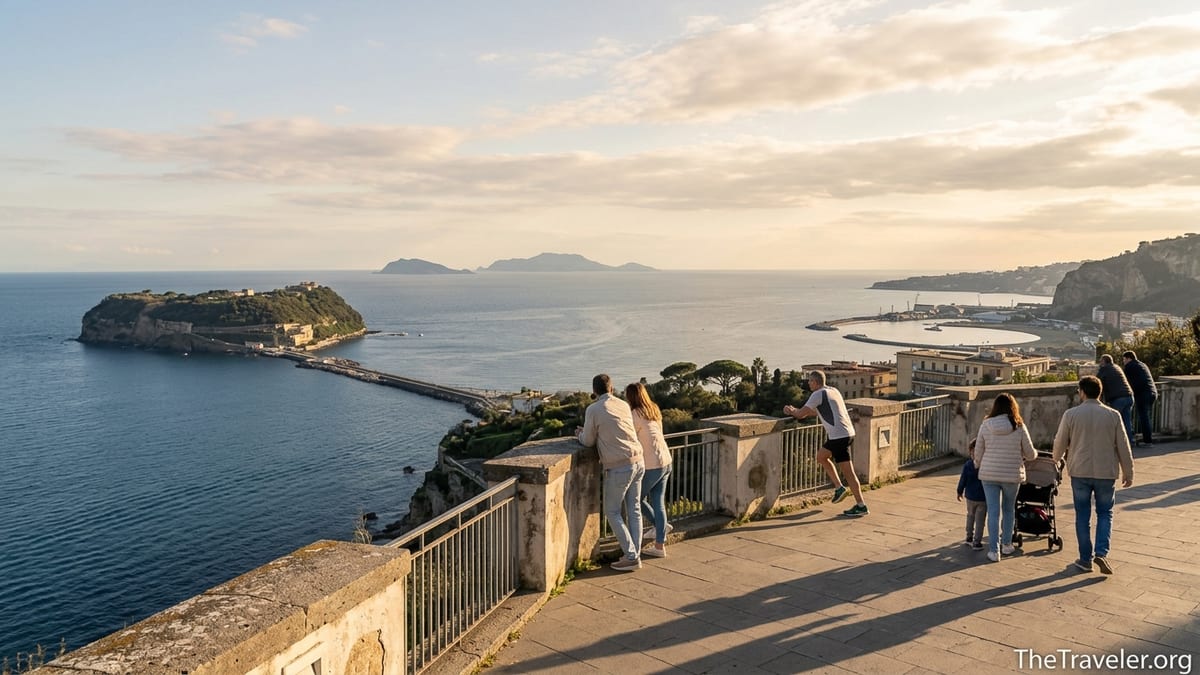
A Cliff-Top Balcony Over Two Gulfs
Most parks in Naples give you a choice: trees or sea. At Parco Virgiliano you get a full 360-degree coastal panorama that no other park in the city can match. Built on the tufa cliffs at the outer end of the Posillipo hill, the park unfolds as a series of belvedere terraces that step down towards the water. From one railing you look straight onto the islands of Nisida and Ischia; move a few meters and Capri appears at the horizon; shift again and the line of the Campi Flegrei coastline and Pozzuoli comes into view. It feels less like a single viewpoint and more like walking along a balcony that wraps around the entire bay.
That breadth of view is precisely what sets it apart from other green spaces. At the Real Bosco di Capodimonte, the focus is on woodland walks and the palace museum; you sense the city and the sea far below, but you rarely see them clearly through the trees. In the Villa Comunale, the sea is close enough to scent the air, yet your gaze stays mostly horizontal along the promenade. Parco Virgiliano is the opposite: it constantly pushes your eyes outward and downward, encouraging you to read the geography of Naples like a live map.
On a clear late afternoon, you can stand at one terrace and trace the skyline from Mount Vesuvius to the Sorrento Peninsula and the Amalfi coast in the far distance. Locals point out landmarks like the former steelworks of Bagnoli, the Roman amphitheater of Pozzuoli, or the little crescent of Gaiola below. Visitors who have already sailed to Capri or taken the Circumflegrea train through the western suburbs often find it fascinating to recognize those places from above, seeing how they fit together in the physical puzzle of the bay.
Weather adds another layer to its uniqueness. The park is open to the wind, and on some days the gusts can be strong enough that you taste salt on your lips as if you were down at the seafront. In summer that breeze can be a relief compared with the heavier air in the historic center. In cooler months you may want a windbreaker or scarf, but you are rewarded with the kind of washed-clean visibility that makes even distant Capri look within reach.
Everyday Naples Rather Than Monumental Grandeur
Many of Naples’ best-known parks began life as royal or aristocratic estates. Capodimonte and the Villa Comunale have avenues designed for carriages, marble statues and ornate fountains that remind you this was once the playground of kings. Parco Virgiliano, inaugurated in the early 1930s as a civic “park of remembrance,” has a different personality. Its design favors practical, human-scale spaces: simple terraces lined with low stone walls, playgrounds tucked between pine trees, and wide central alleys where neighbors stop to chat in the evening.
This everyday character comes through strongest in the way locals use the park. In the late afternoon you might see a grandfather teaching a child to ride a bicycle along the main viale while teenagers lean against the railings sharing snacks from the kiosks. Dog owners loop around the paths chatting, and small birthday parties set up near the playground equipment with plastic tablecloths and homemade cake. Unlike paid attractions or formal gardens, there is no sense of ceremony here. People turn up in running shoes and tracksuits, pushing strollers or carrying grocery bags from nearby streets.
For travelers, this makes Parco Virgiliano an easy place to drop into regular neighborhood life. You are more likely to hear an argument about football than a guided tour commentary. A Sunday morning visit might coincide with joggers doing hill repeats along the inner paths, while parents claim shaded benches to read the paper. Unlike at smaller central parks where tourist traffic can dominate in high season, here the ratio tilts firmly towards locals, especially those from Posillipo, Bagnoli and nearby quarters who treat it as their default open-air living room.
That informality has practical advantages too. Entry is free, currently without any ticketing or reservation system, and you do not have to plan a timed visit as you would for the archaeological park at Pausilypon or the royal palace gardens. You can come for a quick coffee at sunset, a longer mid-morning walk, or an impromptu picnic picked up from a bakery or deli near Mergellina before catching the bus up the hill. The absence of gates around monuments or museum buildings also means you are free to move between viewpoints at your own pace rather than following a prescribed route.
The Most Dramatic Sunset Theater in Naples
At many Naples viewpoints sunset is an event. At Parco Virgiliano it feels like a daily performance with its own regular audience. Because the park faces west over the outer part of the bay, the sun drops behind the profiles of Procida and Ischia, often turning the water into molten orange while the volcanic outlines of the islands and the cape of Miseno go dark. The stepped terraces create a kind of natural amphitheater where people instinctively gather along the railings to watch.
On clear spring and autumn days, you can expect to see groups of friends sitting on the low walls, couples sharing takeaway pizza slices from a nearby pizzeria, and amateur photographers crouched over tripods trying to capture the gradient of color in the sky. Compared with the waterfront promenade at Caracciolo or the viewpoint at Castel Sant’Elmo, the atmosphere is quieter and more residential. There is no intense bar scene or street-performance culture here; instead, you might find one kiosk serving espresso and cold drinks, a child kicking a football, and a few visitors quietly talking in a mix of languages.
Because entrance is free and the park stays open into the evening according to the season, timing a visit is flexible. In summer, locals often arrive later to avoid the heat, sometimes around 7 or 8 pm when the sun is still high but the light is softer. In winter and early spring, arriving an hour before sunset lets you see the gradual shift from bright daylight to the first city lights coming on in Bagnoli and Pozzuoli below. That transition can be more atmospheric than the actual sun drop, especially on slightly hazy days when the sky colours stretch out longer.
Photographers in particular tend to favor Parco Virgiliano because it offers multiple compositions in a single visit. One terrace frames Capri and the Sorrento coast, another focuses on Nisida with its isthmus and the curved line of Coroglio, and yet another overlooks the industrial sites of Bagnoli that have been partially reclaimed. This variety is unusual among Naples parks, which typically give you either a skyline or a garden scene but not several contrasting frames from the same path.
A Network of Terraces Instead of Formal Gardens
While other major parks in Naples impress with lawns, flower beds or historic tree collections, Parco Virgiliano’s standout feature is its architecture of terraces. The main paths are laid out as a circuit, with spurs leading to belvedere platforms of various sizes. Instead of symmetrical parterres or elaborate fountains, you find simple stone parapets, concrete benches and low plantings of Mediterranean shrubs that can handle constant wind and sun.
This design reflects its exposed, cliff-top setting. Maintaining lush lawns would be difficult on porous tufa overlooking the sea, so the greenery is concentrated in hardy pines, tamarisks and other coastal species. For visitors used to English-style parks or the manicured gardens of the Royal Palace, the effect can feel almost stark at first. Yet it is precisely this minimalism that keeps the focus on the landscape rather than on horticulture. Walking from terrace to terrace feels something like exploring the decks of a ship: each turn reveals another fragment of coastline.
Compared with the Real Bosco di Capodimonte, where you can easily get lost on forested paths and forget you are in a city, Parco Virgiliano is compact and legible. Families appreciate that there are clear sightlines between many areas: parents sitting on a bench can often see both the playground and a nearby terrace without moving. Runners like the ability to loop the circuit multiple times, using the terraced ramps as gentle interval training, something that is harder to do in the narrower linear spaces of the Lungomare or the Villa Comunale.
The relative simplicity of the layout also makes it more accessible to visitors who might be overwhelmed by vast estates. You do not need a map or a long list of “must-see” statues to enjoy it. Spending an hour here might mean slowly exploring each terrace, identifying landmarks using a simple paper map of Naples, then grabbing a drink at a kiosk before heading back down the hill. The park’s planners seem to have assumed that the view itself would always be the main attraction, and they designed everything else accordingly.
Family-Friendly Facilities With a Neighborhood Feel
For all its dramatic scenery, Parco Virgiliano functions day-to-day as a family park. Several playground areas with swings and slides are scattered among the trees, and there are open spaces where children can run or kick a ball without interfering with the flow of strollers and joggers. Unlike the compact playgrounds along the Lungomare, these are integrated into the wider landscape, which means that between one ride on the slide and the next, a child might wander a few steps and suddenly see the sea stretching out below.
Basic services such as public toilets, kiosks and drinking fountains are present but not overwhelming. A small open-air amphitheater hosts occasional events, often in summer, from local school performances to small-scale concerts. Travelers who happen to arrive on one of these evenings get a glimpse into the cultural life of the neighborhood, very different from the larger, more formal festivals held in the center of Naples or at the San Carlo Theatre.
Accessibility has improved in recent years. Local and municipal information lists step-free entrances and mentions accessible paths and toilets, although the natural slopes and ramps between terraces still require some planning for visitors with limited mobility. One practical approach for mixed-ability groups is to focus on the upper level of the park, near the main entrance, where there are panoramic viewpoints that do not require tackling steeper sections. Those who feel comfortable can then explore further down the terraced paths while the rest wait at a café table or on a bench.
For visitors with dogs, Parco Virgiliano is one of the more relaxed green spaces in the city. Signs indicate dog-friendly areas, and locals regularly bring pets for evening walks. As always in Naples, practices vary, so travelers who are nervous around off-leash dogs may prefer to stick to the central alleys at busier times. Compared with smaller inner-city squares where space is tight, the park’s open design makes it easier to keep distance if needed.
Contrasts With Other Naples Parks and Green Spaces
Understanding what makes Parco Virgiliano different becomes easier when you compare it directly with other parks you might visit on the same trip. Take the Real Bosco di Capodimonte, for instance. There, the experience is anchored in art and royal history; your day might begin with the museum’s Caravaggio paintings and end with a walk past centuries-old oaks. At Parco Virgiliano, there is no palace or gallery, and the draw is less about the past than about the living, changing landscape of the bay: ships moving, clouds shifting over Vesuvius, new buildings sprouting in distant suburbs.
Villa Comunale, running parallel to the seafront road, offers a different contrast. It is flat, linear, and closely intertwined with the urban fabric of Chiaia. You cross the street and you are among cafés, gelato shops and people dressed for an evening passeggiata. At Parco Virgiliano, once you step through the gates you are largely separated from traffic and shops; the city feels more like a backdrop than an immediate presence. This makes it particularly attractive if you need a break from the sensory intensity of Spaccanapoli or the Spanish Quarter.
Even the smaller parks on nearby hills have distinct characters. The Villa Floridiana in Vomero, for example, is shaded, romantic and framed by an early 19th-century villa, with views focused mostly on the city center and Vesuvius. Parco Virgiliano, by contrast, looks outward to the outer bay and the islands, and its architecture is 20th century, more functional than decorative. If you are spending several days in Naples, combining a morning in Capodimonte, an afternoon in Floridiana and a sunset at Parco Virgiliano can give you a surprisingly complete visual introduction to the city’s geography.
For travelers with limited time, the key distinction is this: if you want to feel inside Naples, among its streets, traffic and architecture, choose one of the central parks. If you want to see Naples in context, as a city clinging to cliffs between volcano and sea, Parco Virgiliano is the place that delivers that big-picture view. It is the park that explains the city’s shape and position in a single glance.
How to Experience Parco Virgiliano Like a Local
Part of what makes Parco Virgiliano special is the way Neapolitans fold it into their routines. To get a taste of that, consider visiting at the times locals favor. Early mornings, especially in spring and autumn, tend to be dominated by runners and dog walkers; the light is soft, the air cooler, and the views of Capri and Procida often at their clearest. Late afternoons and early evenings are more social, with families arriving after school or work and teenagers clustering on favorite corners of the railings.
Reaching the park from central Naples typically involves a short climb. Many visitors take the metro to Mergellina and then catch a local bus that winds up along Via Posillipo towards the park entrance. Others opt for a taxi from the historic center, which, while more expensive, saves time and avoids bus changes. Once you are in Posillipo, it is common to combine the park with a stop at a bar for espresso or a lemon granita, or to pick up a folded slice of margherita or a fried pizza from a local takeaway to eat on a bench overlooking Nisida.
Spending an afternoon here can be simple and low-cost. Because entry is free and there are no required bookings, the main expenses are transport and any food or drinks you choose to buy. Some visitors bring a simple picnic from a supermarket near their accommodation in the center: sliced bread, fresh tomatoes, mozzarella and fruit, plus a bottle of water. Others sample neighborhood bakeries near the bus stops, where you might find savory pastries filled with ricotta and salami or sfogliatelle to eat with a coffee from a kiosk once inside.
If you want to go deeper, you can use the park as a starting point for exploring the wider Posillipo area. After taking in the views, some travelers walk or ride down towards the coast, aiming for the Gaiola area or the remains of Roman villas along the water, while others head instead towards the Pausilypon archaeological park, where ancient tunnels and terraces echo some of the same panoramas in a more historical setting. In each case, Parco Virgiliano works as a modern counterpart to those older sites: a contemporary, lived-in balcony over the same landscape that captivated wealthy Romans two thousand years ago.
The Takeaway
In a city where almost every hill seems to have a viewpoint and every neighborhood a park or square, Parco Virgiliano stands apart by combining a few key qualities seldom found together. It gives you the widest, most layered coastal panorama in Naples, frames it from a network of simple but well-placed terraces, and keeps the tone local and unpretentious, more about everyday life than grand monuments. You come here less to tick off a sight and more to understand how sea, islands, suburbs and volcano all fit around the city.
For travelers, that makes it an ideal complement to the museums and churches of the historic center. A morning amid Baroque altarpieces or underground Roman streets can be followed by an evening at Parco Virgiliano, where the same city spreads out below in miniature against a backdrop of open water. The experience costs little more than the price of your bus fare and a coffee, yet it can leave you with some of the clearest mental images of Naples you will take home. If you are choosing just one park that shows you not only the trees but the whole forest, Parco Virgiliano is the one that does it.
FAQ
Q1. Where exactly is Parco Virgiliano located in Naples? Parco Virgiliano sits at the outer end of the Posillipo hill, in the western part of Naples, above the areas of Bagnoli and Coroglio, overlooking the bay and the islands of Nisida, Procida and Ischia.
Q2. How is Parco Virgiliano different from the Real Bosco di Capodimonte? Capodimonte is a vast former royal hunting park attached to a major art museum and dominated by woodland, while Parco Virgiliano is a smaller, cliff-top civic park built around panoramic terraces with sweeping sea views.
Q3. Is there an entrance fee to visit Parco Virgiliano? As of 2026, entrance to Parco Virgiliano is free, and there is no ticket office or booking system. You simply walk in during opening hours set by the municipality.
Q4. What is the best time of day to visit Parco Virgiliano? Sunset is the most popular, when the sun drops behind Procida and Ischia and the sea glows orange, but early mornings also offer clear views and a quieter atmosphere.
Q5. Can I reach Parco Virgiliano by public transport from the city center? Yes. Many visitors take the metro to Mergellina and then a local bus up Via Posillipo towards the park entrance, or they use a taxi from central neighborhoods like Chiaia or the historic center.
Q6. Are there facilities such as toilets and cafés inside the park? The park offers basic facilities, including public toilets, small kiosks selling drinks and snacks, and several playgrounds, but it does not have large restaurants or extensive commercial areas.
Q7. Is Parco Virgiliano suitable for visitors with limited mobility? The main entrance and some upper paths are relatively level and more accessible, and official information notes step-free access points, but the terraced layout with ramps and slopes means planning is needed for those with reduced mobility.
Q8. Can I bring a picnic to Parco Virgiliano? Yes, informal picnics are common. Locals often bring sandwiches, fruit and drinks to enjoy on benches or low walls, provided they dispose of litter properly and respect park rules.
Q9. How does Parco Virgiliano compare with the seaside Villa Comunale? Villa Comunale is a flat, tree-lined promenade directly beside the seafront road and close to shops and cafés, while Parco Virgiliano is quieter, higher up on the Posillipo cliffs, and focused on wide coastal panoramas rather than a street-level promenade.
Q10. Is Parco Virgiliano a good place for running or light exercise? Yes. Locals use the central avenue and circular paths for jogging, walking and light workouts, taking advantage of the park’s fresh sea breeze and the mix of gentle slopes and level sections.