


From the historic center, Naples feels dense and vertical, all narrow lanes and church domes. Climb to Parco Virgiliano on the Posillipo hill, though, and the city suddenly opens up. Terraces float above sheer tufa cliffs, sea breezes cut through summer heat, and the entire Gulf of Naples stretches away in layers of islands, headlands, and volcanic peaks. For travelers who care about viewpoints as much as museums, this is one of the most rewarding panoramas in the city.
Get the latest updates straight to your inbox!
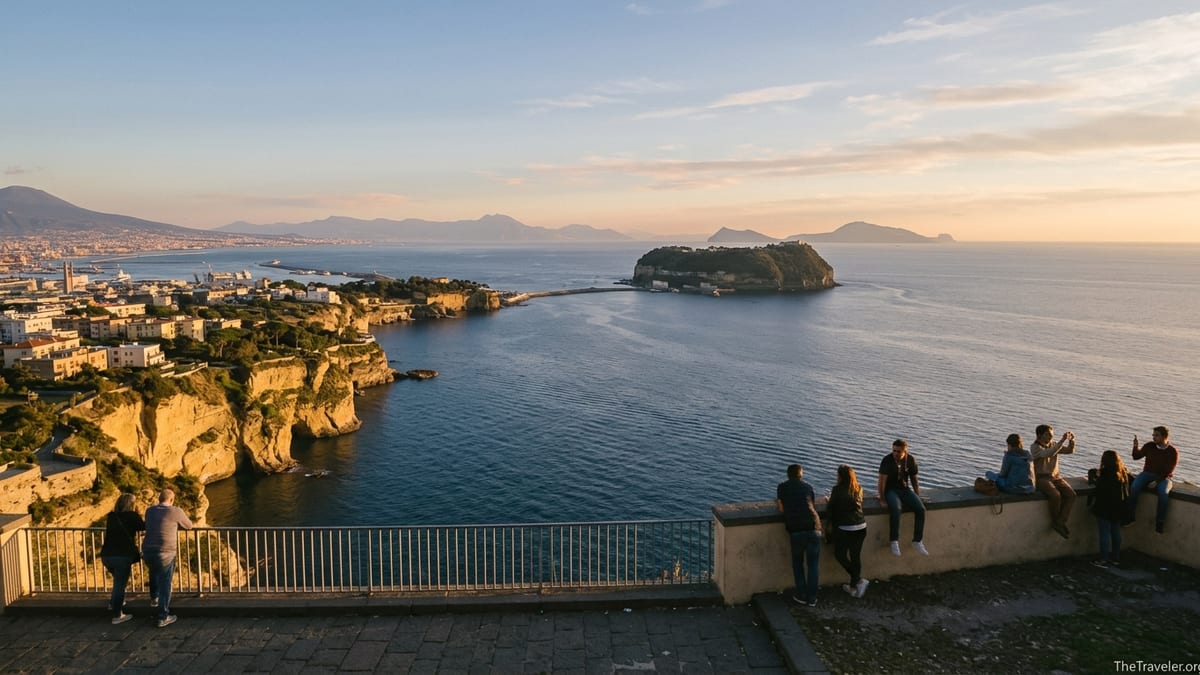
A Hilltop Balcony Over the Entire Gulf of Naples
Parco Virgiliano sits at the western tip of the Posillipo hill, roughly 150 meters above sea level on the Coroglio promontory. Locals sometimes call it the “Parco della Rimembranza,” or Park of Remembrance, but most visitors know it simply as Virgiliano. It is designed as a sequence of terraces that follow the natural curves of the cliff edge, each one framing a different slice of the Gulf of Naples. This layout makes it feel less like a single viewpoint and more like a long, meandering balcony suspended above the sea.
From the main central terrace, you can turn one way to see Mount Vesuvius rising behind the city and turn the other to look across the Bay of Pozzuoli, Agnano and the Phlegraean Fields. On clear winter days, the volcano’s outline is razor sharp and you can pick out the contours of the Sorrentine Peninsula in the distance. In summer, a soft haze hangs over the bay, but the islands stand out clearly, and you often see ferries drawing long white lines across the water as they run between Naples and Ischia or Procida.
Because the park crowns a rocky headland with no higher buildings in front of it, there are virtually no obstacles in the way of the view. Unlike some city viewpoints hemmed in by high-rise apartments or rooftop bars, Parco Virgiliano looks out mostly over low residential streets, cliffs and the open sea. This lack of visual clutter is one reason photographers come here specifically for wide landscape shots of the bay and coastline.
The altitude also brings practical benefits. In July and August, when the centro storico can feel stifling in late afternoon, the park is often several degrees cooler thanks to constant sea breezes. Many Napolitans plan their weekend around an early evening walk to Virgiliano, precisely because they can enjoy a sunset without the heavy, trapped heat you find in the streets below.
Layered Views: Islands, Volcanoes and Roman Ruins in a Single Frame
The quality of a viewpoint is not only about height; it is also about what you can actually see from it. Parco Virgiliano is exceptional because it layers so many distinct elements of the Bay of Naples into one panorama. Looking south, you see Capri’s cliffs and the Sorrentine Peninsula. Shift slightly west and the volcanic islands of Ischia and Procida emerge, with the smaller isle of Nisida sitting closest, linked to the mainland by a narrow causeway.
These are not abstract dots on the horizon. From the western terraces, you can pick out the green slopes of Ischia, the pastel houses of Procida on sunny days and the round volcanic cone of Nisida rising steeply from the sea. At sunset, the islands often become dark silhouettes behind which the sun sinks, throwing bands of orange and pink across the sky. Many travelers who have already seen Naples from Castel Sant’Elmo or the Lungomare are surprised at how completely different the coastline feels when seen from this angle.
Directly below the park, the cliffs drop toward the archaeological areas of Pausilypon and the Gaiola Underwater Park. From the guardrails you can trace the line of the ancient Roman seaside villas that once dotted this coast, imagine imperial estates stretching down to the water, and still see fragments of walls and terraces along the shore. The unusual pale yellow of the tufa rock contrasts with the deep blue of the Tyrrhenian Sea, creating strong visual textures for photographers.
To the east, on days with good visibility, you can follow the coastline from the industrial area of Bagnoli past the port of Naples and along the Vesuvian coast, all the way toward Torre del Greco. From some terraces you also catch a glimpse of the historic center in profile. At night, the line of streetlights around the bay forms a glittering arc beneath the looming shadow of Vesuvius, making Parco Virgiliano one of the most atmospheric places in the city for after-dinner strolls.
Comparing Parco Virgiliano to Other Famous Naples Viewpoints
Naples is not short on viewpoints. Visitors with limited time often head for Castel Sant’Elmo in the Vomero district or stay around the waterfront near Via Partenope. Both are spectacular in their own way, but they offer different visual experiences to Parco Virgiliano. Sant’Elmo looks almost straight down on the historic center, the port and Vesuvius, giving a classic postcard shot of domes, bell towers and apartment blocks packed tightly together.
By contrast, Parco Virgiliano pushes you out to the edge of the city and encourages you to look back from a distance. You do not get the same close-up detail of medieval streets, but you do gain a sense of the entire bay’s shape. It is especially valuable for travelers who have already visited Capri, Procida or the Campi Flegrei and want to see where they fit in relation to Naples. From the terraces, you can mentally plot the ferry routes you used the day before and understand just how large the gulf really is.
Another comparison is the seafront promenade that runs from Santa Lucia to Mergellina. The Lungomare gives you the satisfying perspective of Vesuvius across the water at eye level and is perfect for golden hour walks. What it cannot offer is the multi-directional panorama that Virgiliano provides. From the park you can pivot between islands, crater lakes, cliffs and suburbs in a way that simply is not possible from the largely flat, linear waterfront.
For many photographers and drone operators who visit Naples, the usual routine is to capture the old town from San Martino or Sant’Elmo in the morning, then head to Parco Virgiliano in late afternoon for wide, horizontal compositions of the bay and islands. Travelers who are not carrying serious equipment still benefit from this strategy, since smartphone cameras handle bright daylight well, and sunset at Virgiliano is forgiving even for casual shots.
Sunset, Seasonality and the Park’s Changing Atmosphere
Parco Virgiliano is open daily, with closing times typically around 21:00 on weekdays and a little later on weekend evenings, though hours can be extended in summer. This means sunset visits are usually possible from spring through early autumn, when the sun drops behind Ischia and Procida. The way the light moves across the bay across the year is one of the main reasons locals keep returning.
In winter, skies are often clearer and visibility is at its best. On crisp January days, you can sometimes see the snow-dusted Apennines in the far distance beyond Vesuvius. The air feels sharp, and the colors are more subdued and silvery, which appeals to photographers who prefer a minimalist mood. There are fewer picnics and families then, and the park takes on a contemplative atmosphere. You may share entire terraces with only a handful of dog walkers and runners.
Spring and autumn offer a middle ground. In April and May, wildflowers dot the grassy areas and the terraced paths are busy but not crowded. Schools sometimes bring groups of students here for history and geography lessons because the view serves as a live map of the gulf. In late September and October, the sunsets can be particularly dramatic, with layers of low cloud above Capri catching vivid shades of orange and magenta.
Summer evenings are the most social. Napolitans arrive with gelato from nearby kiosks, sit along the low walls of the terraces, and applaud when the sun disappears behind the islands. Street musicians sometimes set up near the central plaza, and you may see families celebrating birthdays with small picnics on the lawns. Even in these busy periods, the park’s size allows visitors to wander a bit further along the paths and find quieter corners with almost equally good views.
Practical Tips: Getting There and Making the Most of the View
Reaching Parco Virgiliano takes a little planning, which is partly why it remains less visited by short-stay tourists than viewpoints closer to the historic center. The park’s main entrance is on Viale Virgilio in the Posillipo district. From the seafront near Mergellina or Piazza Sannazaro, local buses such as the 140 typically climb the hill toward Posillipo; you then walk the final few minutes uphill along residential streets. The journey from central Naples often takes 40 to 55 minutes each way once you factor in waiting times and traffic, so it is best treated as a half-day or long-evening excursion.
Another common route is to take Metro Line 2 to Campi Flegrei or Mergellina and then transfer to a Posillipo-bound bus, or use ride-hailing or taxis if you are short on time. A metered taxi from around Piazza del Plebiscito to the park usually takes about 20 minutes outside rush hour. Because traffic in Posillipo can be dense in late afternoon, many locals prefer to arrive a little earlier, then slow their pace inside the park while they wait for the sunset light.
There is no entrance fee, which makes Parco Virgiliano one of the most budget-friendly scenic experiences in Naples. That said, refreshments inside the park are limited and may be seasonal. Travelers typically stop at a local bar near the entrance for espresso, water or a sfogliatella before entering, or pick up takeaway pizza slices in Posillipo to eat on the terraces. Comfortable shoes are recommended, since the park’s network of paths and steps encourages gentle wandering rather than a quick in-and-out photo stop.
To make the most of the panoramic potential, many visitors walk a rough loop: starting from the central plaza, they move first to the terraces facing Bagnoli and the Bay of Pozzuoli, continue round toward the platforms with views over Nisida and the islands, then finish at the vantage points that look back toward Vesuvius and the city. This circuit can easily take an hour or more if you stop for photos, and it ensures you experience the full range of vistas the park offers.
A Local Green Space as Well as a Scenic Overlook
Although guidebooks often focus on the panorama, Parco Virgiliano is also a neighborhood park for the people of Posillipo and the broader city. Within its roughly 92,000 square meters you find children’s play areas, a small amphitheater used occasionally for performances, and lawns where families spread blankets on weekends. That everyday use gives the viewpoint a lived-in authenticity that separates it from more tourist-heavy lookouts.
On a typical Sunday, you might see teenagers practicing dance routines near the central square, couples walking dogs along shaded paths, and older residents reading newspapers on benches that face the sea. Because the park is car free once you pass the entrance, it feels safer and more relaxed than viewpoints that require standing near busy roads. Parents let children run more freely, and visitors can lean on railings without the constant background noise of traffic.
The city has recently framed Virgiliano as a “literary park,” installing panels at some of the terraces with excerpts from 18th century travelers who passed through Naples on the Grand Tour. Reading their impressions of the same coastline you are now looking at creates a sense of continuity. It reminds visitors that the appeal of these views is not new; Romans built luxury villas on these very slopes for the same reason, and Enlightenment-era writers described Posillipo as a place where landscape and light could soothe urban anxieties.
This blend of neighborhood green space, historical reflection and expansive scenery makes the park a good choice for travelers who need a mental break from crowded streets and museum lines. You can spend an hour simply watching ferries move in and out of Pozzuoli and listening to the wind in the pines, yet still feel you have engaged deeply with Naples’ geography and history.
Realistic Itineraries: When and How to Fit Parco Virgiliano Into Your Trip
Because Parco Virgiliano sits away from the traditional tourist axis of Spaccanapoli, the Archaeological Museum and the waterfront, it works best for travelers who have at least two full days in Naples and are willing to dedicate part of one afternoon or evening to the Posillipo area. A practical approach is to combine it with a visit to the seafront at Mergellina, perhaps stopping for a seafood lunch there before riding up the hill.
Another real-world pairing is to visit the archaeological area of Pausilypon or the Gaiola Underwater Park in the late morning or early afternoon, then continue up to Virgiliano for sunset. You might, for example, join a guided kayak or glass-bottom boat tour at Gaiola between May and October, explore the submerged Roman structures, then take a bus or taxi up the hill. Seeing the same coves and headlands from water level and then from high above on the same day gives you a layered sense of the coast.
Travelers staying in Posillipo or nearby quarters sometimes adopt Virgiliano as their daily jogging route or dog-walking destination, visiting several times during a weeklong stay. In that case, you can experience how the light and mood shift with weather: hazy mornings when Capri is barely visible, sudden clear days after rain when every contour stands out, or blustery afternoons when whitecaps dot the sea between Nisida and Procida.
If you are short on time, consider whether you prefer close-up urban panoramas or broad coastal ones. Those who mainly want the classic shot of Vesuvius and the old town might prioritize San Martino or Castel Sant’Elmo. Travelers who are particularly drawn to sea and island landscapes, or who are planning side trips to Ischia, Procida or the Phlegraean Fields, tend to find Parco Virgiliano more rewarding and worth the extra transport effort.
The Takeaway
Parco Virgiliano offers some of the best panoramic views in Naples because it combines height, unobstructed horizons and a uniquely rich mix of landmarks within a single sweep of the eye. From its terraces you can read the geography of the entire gulf at a glance: Vesuvius and the historic center to one side, the islands and volcanic headlands of the Phlegraean Fields to the other, with Roman ruins clinging to the cliffs below.
Unlike viewpoints that feel like quick photo stops, Virgiliano functions as a lived-in neighborhood park. Playgrounds, a small amphitheater and shaded walks encourage visitors to linger, while the steady breeze and multiple vantage points reward those who take their time. Whether you arrive with a camera bag and a shot list or simply with a gelato and the desire to sit and watch the sun drop behind Ischia, you will come away with a mental map of Naples and its bay that no postcard can fully capture.
FAQ
Q1. Where exactly is Parco Virgiliano in Naples?
Parco Virgiliano sits on the Posillipo hill at the western edge of the city, above the Coroglio promontory, with its main entrance on Viale Virgilio.
Q2. How do I get to Parco Virgiliano from the historic center?
A common route is to reach Mergellina or Piazza Sannazaro by metro or bus, then take a Posillipo-bound bus such as the 140 and walk the final uphill stretch to the park entrance.
Q3. Is there an entrance fee to visit Parco Virgiliano?
No, entrance to Parco Virgiliano is free, which makes it one of the most affordable panoramic experiences in Naples.
Q4. What are the usual opening hours of the park?
The park is generally open daily, often until around 21:00 on weekdays and later on weekends, with longer hours in summer. Always check current schedules locally, as times can change.
Q5. What can I see from the terraces of Parco Virgiliano?
From the terraces you can see Mount Vesuvius, the city of Naples, the Bay of Pozzuoli, Nisida, Ischia, Procida, Capri, the Sorrentine Peninsula and the cliffs around Pausilypon and Gaiola.
Q6. Is Parco Virgiliano a good place for sunset photography?
Yes. The park faces west over Nisida, Ischia and Procida, so sunsets can be spectacular, especially from late spring to autumn when the sun sets behind the islands.
Q7. Are there facilities such as cafes or toilets inside the park?
Facilities are limited and can be seasonal. It is sensible to use restrooms and buy drinks or snacks at nearby bars in Posillipo before entering, especially in quieter months.
Q8. Is Parco Virgiliano suitable for families with children?
Yes. The park has play areas, open lawns and car free paths, making it popular with local families. Supervision is still important near terrace railings and steps.
Q9. How does Parco Virgiliano compare to Castel Sant’Elmo for views?
Castel Sant’Elmo overlooks the historic center and port at close range, while Parco Virgiliano offers broader coastal and island views. Many visitors enjoy both for their different perspectives.
Q10. Can I visit Parco Virgiliano if I have limited mobility?
Some central areas and terraces are relatively level, but the park overall includes slopes and steps. Visitors with limited mobility may prefer to focus on the main plaza and its nearby viewpoints and should allow extra time.