


Cap Ferrat is usually described with the same handful of adjectives: glamorous, exclusive, eye-wateringly expensive. I arrived expecting a peninsula of superyachts and security gates, a Riviera enclave best admired from afar. What I found instead, over a few quiet days of walks, swims and slow lunches, was a pocket of the French coast that felt more peaceful and human than I ever imagined.
Get the latest updates straight to your inbox!
Arriving With the Wrong Picture in Mind
My first view of Saint-Jean-Cap-Ferrat was from the bus window, the same local Ligne d’Azur service that schoolchildren and supermarket shoppers use. A handful of us stepped off at the Port de Saint-Jean stop, beneath pines that smelled faintly of resin after an early spring shower. It cost me only a few euros to get here from Nice, a humbling contrast to the peninsula’s reputation for being accessible only by chauffeured car.
Instead of a wall of luxury boutiques, the harbor opened up in front of me with a row of modest fishing boats nudged between polished motor yachts. A boulangerie on the corner was doing a brisk trade in croissants and takeaway coffees; a pair of local teenagers in wetsuits wheeled paddleboards down to the water. The atmosphere felt closer to a sleepy coastal village than the jet-set caricature I had pictured on the plane ride over.
I checked into a small three-star hotel a few minutes’ walk from the harbor, paying a rate that, while certainly not cheap for the Riviera, was comparable to a decent room in central Nice. From my balcony, I could see the tiled roofs stepping down toward the port, the masts of boats swaying gently and, beyond them, a flat ribbon of morning sea. It was quiet enough that I could hear church bells from the Saint-Jean-Baptiste church carry across the water.
The surprise was not that there was money here; that is written into every manicured hedge and discreet gate. The surprise was how easily the peninsula revealed a slower pace to anyone willing to arrive without an entourage and simply walk.
First Morning on the Coastal Path
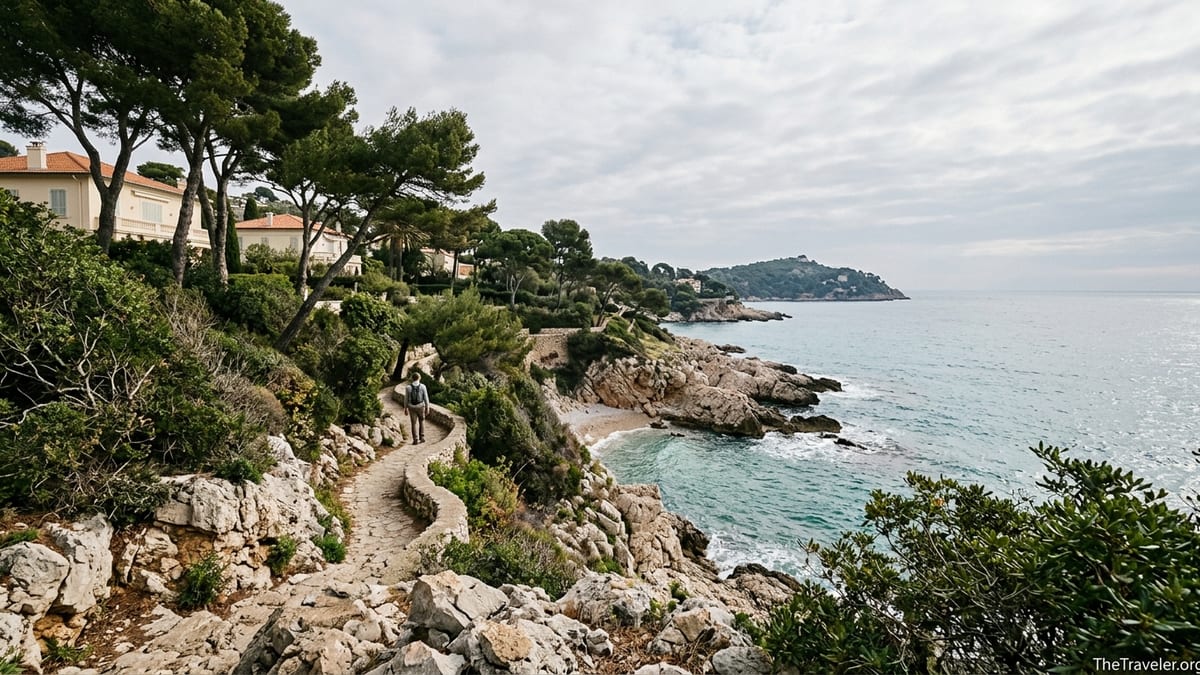
I started my first full day early, hoping to see the famous Cap Ferrat coastal walk before it filled up. I need not have worried. By 8 a.m., the Promenade Maurice Rouvier, which links neighboring Beaulieu-sur-Mer to Saint-Jean-Cap-Ferrat, belonged mostly to dog walkers and joggers. This wide, gently undulating path hugs the shoreline, with low stone walls on one side and villas hidden behind umbrella pines on the other.
The further I walked toward the Pointe Saint-Hospice section, the quieter it became. Here the trail narrows into a more rugged coastal path, with short stone steps and stretches where waves crash just below. A recent local guide describes the full loop around the peninsula as a series of three interconnected walks, but in the hush of the morning it felt like a single, continuous ribbon of solitude, stretching from tiny coves such as Plage des Fossettes to the tip of the cape above the sea.
About halfway to the Saint-Hospice chapel, a small bench faces out toward the open Mediterranean. I sat there for nearly twenty minutes without another person passing by, the only interruptions the sound of swallows and the occasional engine of a small fishing boat heading out toward Villefranche-sur-Mer. Considering that this is one of the most sought-after stretches of coastline in Europe, the sense of space was striking.
At the chapel and the Belgian military cemetery, the view opens dramatically. White crosses line up in precise rows on a slope above the sea, a reminder that this peaceful headland holds its own share of history. The small building of the chapel, cream against the sky, feels almost like a lookout post rather than a religious monument. I lingered, not because there was a checklist of things to see, but because the silence seemed to invite it.
Swimming in Clear Water Without the Frenzy
Later that morning, I followed the path as it curved toward Paloma Beach, long celebrated as one of the Riviera’s loveliest small coves. I expected a frenzy of reservation desks and beach-club theatrics. Instead, in shoulder season, the scene was almost subdued. The private Paloma Beach club, an institution here since the late 1940s, had already set out its neat rows of loungers, but only a handful were occupied by the time I arrived.
I chose the public stretch of pebbles at one end. There were no loud speakers, no jet skis, just the gentle clink of stones as the water pushed and pulled at the shoreline. A local couple in their sixties waded in with practiced nonchalance, barely flinching at the spring chill, while a father helped his young daughter adjust a pair of fluorescent swim goggles.
When I finally slipped into the water, the clarity was startling. Looking down, I could see my own shadow moving over underwater rocks. Across the bay, the terraced buildings of Beaulieu-sur-Mer stacked up under low clouds, but here in the cove the air felt still. I floated on my back, listening to the faint sounds of the beach club’s lunch preparations, more clink of cutlery than party soundtrack.
Later, I did sit down for a coffee at the beach club’s restaurant terrace, curious about its long-time status. Prices reflected the address, but they were not wildly out of step with other Côte d’Azur venues, especially given the view: a semicircle of pine-fringed cliffs, the water shading from pale turquoise at the shore to a deeper cobalt beyond the swimming buoys. More than the branding or the history, it was the unhurried pace of the staff, clearing glasses and re-laying tables with no sense of rush, that left its mark.
The Villa Ephrussi de Rothschild: Grandeur at a Gentle Tempo
No visit to Cap Ferrat feels complete without stepping into the world of the Villa Ephrussi de Rothschild, the pale pink palazzo built in the early 20th century by Béatrice Ephrussi de Rothschild on the narrowest part of the peninsula. Perched between the Bay of Villefranche and the bay of Beaulieu-sur-Mer, it looks, from a distance, like a ship moored in gardens.
Visitors today wander not only through rooms filled with tapestries, porcelains and Old Master paintings, but also through nine themed gardens that cascade around the house. French, Spanish, Florentine, Japanese, exotic, rose and Provençal gardens succeed one another, stitched together by paths and framed vistas. Current visitor information suggests allowing at least two hours, but I easily spent double that, losing track of time between the flower beds and fountains.
Several recent guides point out that the villa is open year-round, with longer opening hours in summer, and that a timed fountain show in the main French garden plays at regular intervals during the day. Knowing this did not lessen the impact of seeing the long ornamental basin spring suddenly into choreographed jets of water, set to classical music that spilled softly over the terraces. Rather than feeling theatrical in a forced way, it added a small sense of ceremony to an already tranquil space.
What surprised me most was how easy it was to find pockets of silence, even with a steady flow of visitors. In the Japanese garden, a wooden pavilion and arched bridge sit beside a small pond where koi drift lazily under overhanging branches. I spent several minutes there alone, listening to the wind rattle bamboo leaves. On a bench in the rose garden, where the baroness’s preferred shade of pink appears in climbing roses and low shrubs, I watched a gardener water newly planted beds with unhurried care. The villa may attract tour buses and wedding planners, but on an ordinary weekday it felt remarkably contemplative.
Simple Meals and Small Human Moments
There is no shortage of high-end dining on and around Cap Ferrat, from the historic Grand-Hôtel du Cap-Ferrat perched dramatically at the tip of the peninsula to upscale tables in nearby Beaulieu and Villefranche. Yet the meals that shaped my impression of the place were decidedly simpler. On my second evening, I skipped the hotel bar and wandered down to the port just before sunset, choosing a small brasserie with a hand-written chalkboard listing the day’s specials.
At a table by the quay, I ordered a bowl of fish soup, thick and rust-colored, served with rouille and croutons. It arrived steaming, and as I ate, a delivery van reversed carefully down the narrow roadway, dropping off crates of vegetables and boxes of provisions to a moored yacht. A crew member in deck shoes chatted with the restaurant owner through the hatch, in the sort of easy, familiar exchange that suggested this was a regular stop.
The next day, after walking the coastal path again in the opposite direction, I stopped at a small café overlooking one of the quieter coves near the Pointe Saint-Hospice. A few recent travelers have recommended this terrace as the perfect place to end the walk, and it was clear why. The tables were mismatched, the parasols slightly faded, but the view over Plage des Fossettes was flawless. I ordered a salade niçoise and a glass of chilled local rosé, watching hikers trickle past below, some pausing to take photos, others simply continuing on without breaking stride.
These were not the kinds of meals that make it into glossy roundups of the Riviera’s most exclusive tables. There were no celebrity sightings, no DJs, no tasting menus. But they were the meals that anchored my experience: unhurried, moderately priced, and framed by the sort of everyday scenes that make a place feel lived-in rather than merely displayed.
Finding Stillness in a Well-Loved Destination
Cap Ferrat is not an undiscovered corner of Europe. The peninsula’s coastal walk features prominently in recent travel advice for the south of France, and the villa appears regularly in lists of must-see Riviera gardens. In high summer, the port fills out, the hotels reach for peak-season rates, and the beaches buzz with a livelier crowd. Yet even in such a well-known spot, I found that pace and perspective matter as much as the address.
Timing helped. Visiting in shoulder season rather than July or August meant cooler temperatures for walking and a noticeable drop in crowds. Morning starts made an even bigger difference. On days when I was out on the path by eight or nine, I counted more seabirds than fellow visitors for long stretches. By midday, when day-trippers arrived from Nice and Monaco, I simply shifted my plans, swapping cliffside walks for a shaded seat in the gardens or a quiet hour with a book on my balcony.
Where I chose to focus my attention also shaped the experience. Instead of fixating on the gated driveways and yacht decks, I found myself drawn to small details: the handwritten notes in the villa’s exhibition rooms, the way light fell through jasmine climbing a wall, the echo of footsteps along the chapel at Saint-Hospice. These were not hidden in any literal sense, but they required a slower gaze than the destination’s more obvious symbols of wealth.
The result was that Cap Ferrat, a place I had almost skipped for fear it would feel too ostentatious, left me with memories of space and quiet. The peninsula’s reputation for exclusivity is not inaccurate, but it is only half the story. For independent travelers willing to walk, to ride the public bus, and to sit on a public patch of pebbles instead of a private lounger, there is an accessible and unexpectedly peaceful side to discover.
The Takeaway
In the end, my visit to Cap Ferrat felt more peaceful than I expected because I allowed it to unfold slowly and at ground level. I arrived on the same bus as local commuters, walked the same coastal paths that generations of residents have used as their promenade, and shared the same public beaches where families spread towels and unpack modest picnics.
There were moments of grandeur, to be sure: standing on the loggia of the Villa Ephrussi de Rothschild, looking out across its formal garden to the sea beyond; glimpsing, through pine branches, the crisp white profile of an iconic hotel where room rates in peak season can outstrip many travelers’ weekly budgets. Yet these highlights were threaded through with a routine that felt almost village-like.
If you come to Cap Ferrat expecting only a showcase of wealth, you may be tempted to measure the experience against that yardstick and find it wanting or overwhelming. But if you come ready to walk, to seek out early mornings and off-season light, and to let small details claim as much importance as the cliché yacht-and-champagne imagery, you may discover a different Riviera: one where the loudest sound is often the sea against the rocks, and where some of the most memorable moments cost little more than the price of a bus ticket and a simple café lunch.
For me, that was the real surprise. Cap Ferrat did not try to impress me. It simply went about its day, and invited me, for a brief spell, to fall into step.
FAQ
Q1. Is Cap Ferrat worth visiting if I am not staying at a luxury hotel?
Yes. While Cap Ferrat has several very high-end properties, the peninsula is threaded with public coastal paths and beaches that anyone can access. You can arrive by inexpensive local bus from Nice or Villefranche-sur-Mer, walk the coastal trail, visit the Villa Ephrussi de Rothschild, and swim at public coves like Paloma Beach’s free section without ever setting foot in a luxury hotel.
Q2. When is the best time of year to experience Cap Ferrat at its most peaceful?
The peninsula is at its busiest in July and August. For a quieter experience, late April to early June and September to early October are ideal. During these shoulder seasons, the coastal paths and beaches are noticeably less crowded, the weather is still mild enough for walking and swimming, and hotel rates tend to be lower than peak summer prices.
Q3. How difficult is the Cap Ferrat coastal walk?
The coastal walk is generally considered moderate rather than strenuous. Sections like the Promenade Maurice Rouvier are wide and relatively flat, suitable for most walkers. The more rugged stretches around the Pointe Saint-Hospice and the tip of the cape involve some stone steps and uneven surfaces, so comfortable walking shoes are essential. You can choose to do only part of the loop if you prefer a shorter outing.
Q4. Can I visit Cap Ferrat as a day trip from Nice?
Yes. Many visitors use Nice as a base and come to Cap Ferrat for the day. Regular local buses run from Nice and stop in nearby towns such as Villefranche-sur-Mer and Beaulieu-sur-Mer, both close to the peninsula. A typical day trip might include a morning coastal walk, an afternoon visit to the Villa Ephrussi de Rothschild, and a swim or early dinner in the port before returning to Nice in the evening.
Q5. Is Cap Ferrat suitable for families with children?
Cap Ferrat can work very well for families. The coastal paths offer manageable walks with plenty of places to stop, and the small coves, particularly around Paloma Beach and the gentler bays on the Beaulieu side, are popular with families in good weather. Do keep a close eye on young children on the more rugged parts of the path, where there are rocks and occasional drops beside the trail.
Q6. Do I need to book tickets in advance for the Villa Ephrussi de Rothschild?
It is possible to buy tickets on arrival at the villa, but during busy periods such as school holidays and summer weekends, advance booking is sensible to avoid queues and ensure entry at your preferred time. Current visitor information for the villa indicates year-round opening with extended hours in summer, and there are sometimes combined tickets or passes available that include nearby attractions.
Q7. Are there budget-friendly places to eat on Cap Ferrat?
While some restaurants on the peninsula are priced for a luxury crowd, there are also more modest options. Simple brasseries and cafés around the port serve reasonably priced dishes such as salads, pasta and fish soup, and bakeries offer sandwiches and pastries that make an easy picnic. Choosing lunch rather than dinner at certain venues, or enjoying a coffee instead of a full meal at famous beach clubs, can also keep costs under control.
Q8. What should I pack for a peaceful few days on Cap Ferrat?
Comfortable walking shoes are essential if you plan to explore the coastal paths. In addition, pack swimwear, a light towel, sunscreen, a hat, and a reusable water bottle for days by the sea. A light jacket or sweater is useful in shoulder seasons when mornings and evenings can be cool. If you plan to visit the villa or nicer restaurants, one smart-casual outfit will be more than adequate.
Q9. Is Cap Ferrat accessible without a car?
Yes. The peninsula is compact and very walkable once you are there. Local buses connect Cap Ferrat to Nice and neighboring towns, and from the main bus stops you can reach the port, beaches and villa on foot. Many visitors find that not having a car encourages a slower, more relaxed rhythm, as they rely on walking and public transport instead of driving and parking.
Q10. How does Cap Ferrat compare to other towns on the French Riviera?
Compared with livelier destinations such as Cannes or Nice, Cap Ferrat feels more residential and reserved, with fewer large hotels and nightlife spots. It lacks the extensive shopping of larger towns but compensates with some of the Riviera’s most beautiful coastal walks and a sense of seclusion. If you value sea views, garden visits and quiet evenings over late-night bars and busy promenades, Cap Ferrat can feel like a welcome contrast.