


More news on this day
Rail passengers faced significant disruption after a fire was reported next to a busy rail line, prompting an emergency response on the ground and the cancellation of multiple train services.
Get the latest news straight to your inbox!
Emergency Response and Immediate Disruption
Reports indicate that emergency crews were deployed to the scene shortly after the fire was first observed alongside the tracks. Initial information from rail operators and local media suggests that services were quickly halted as a precaution while responders assessed the extent of the incident and any potential risk to passing trains.
Trains in both directions were cancelled or held outside the affected stretch while the fire was brought under control. Passengers already on board were advised to expect extended journey times, with some services terminating short of their planned destinations. At stations along the route, public announcements and operator alerts pointed to a fire near the line as the reason for the sudden suspension of services.
By the time the main flames had been contained, residual smoke, damaged lineside equipment and the need for inspections meant that rail traffic could not immediately resume. Operators reported that engineers and safety teams were required to check track, signalling and power systems before any gradual reopening could begin.
Impact on Travel Plans and Local Transport
The suspension of rail services quickly rippled through wider travel plans. Commuters heading to work and leisure travellers moving between regional hubs faced cancellations and diversions, with some being advised to postpone nonessential journeys. Where possible, operators encouraged passengers to consider alternative modes of transport, though options were limited in areas heavily dependent on the rail corridor.
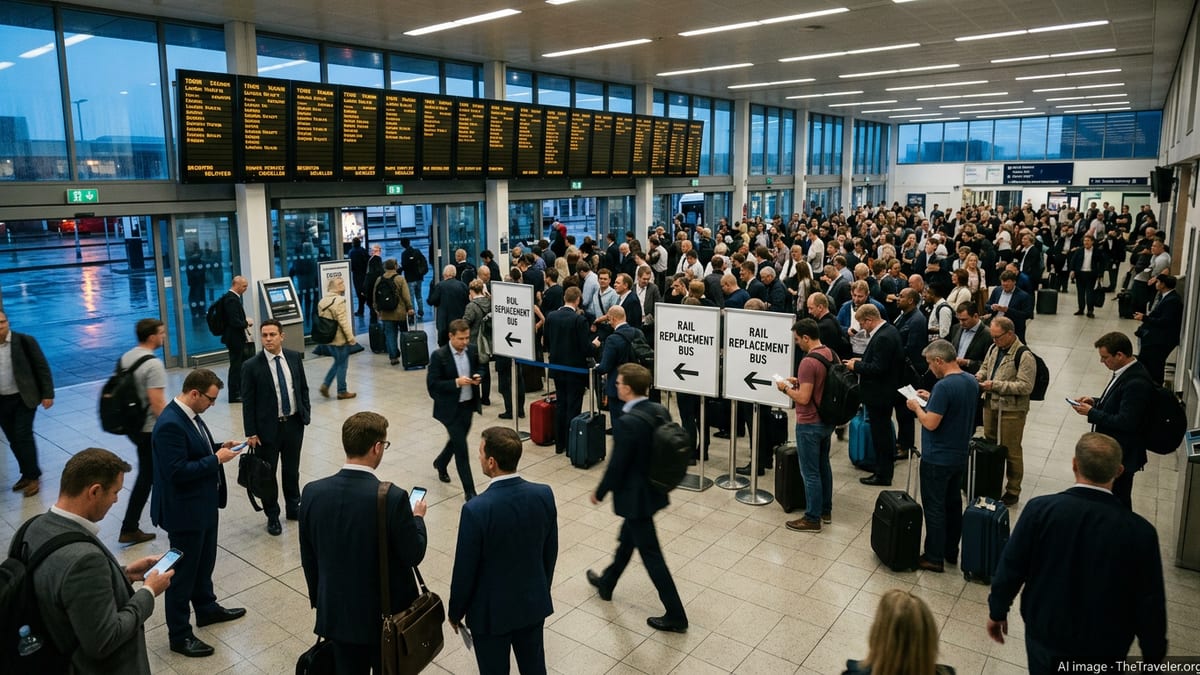
At key interchange stations, the knock-on effect included crowded concourses, queues at information points and pressure on nearby bus and road networks. Local coverage described passengers using ride-hailing services, taxis and private cars to complete journeys, contributing to heavier traffic on roads that parallel the railway.
In previous incidents in the United Kingdom, New Zealand and Italy, fires next to tracks have prompted similar patterns of disruption, with services suspended until fire crews declare the area safe and infrastructure checks are completed. The latest event follows that pattern, illustrating how even a relatively contained fire can cause widespread disorder once it intersects with a high-frequency passenger rail route.
Rail Infrastructure and Safety Precautions
Railway operators typically apply strict safety protocols when any fire is reported in the vicinity of active tracks. Publicly available information from recent cases shows that lines are often closed not only while flames are visible but also during extended cooling and inspection periods. Trackside cabling, signal cabinets, overhead line equipment and communication systems are all vulnerable to heat and smoke damage, any of which can compromise safe operations.
Wildfires, industrial fires adjacent to rail yards and accidental blazes near urban stations have all triggered similar responses in recent months. In several instances, trains were held outside affected sections or turned back, and stations were temporarily evacuated or closed. These actions reflect a precautionary approach designed to eliminate the possibility that a passing train could encounter reduced visibility, warped track, or damaged signalling.
Rail safety bodies frequently highlight that while such shutdowns are highly disruptive, they substantially reduce the risk of more serious incidents. Case studies from North America and Europe show that operators are increasingly willing to cancel or reroute trains when fires threaten key corridors, even where that decision leads to widespread delays and demands for refunds or compensation.
Passenger Experience and Communication Challenges
For travellers, the most immediate impact is often uncertainty. When a fire is reported next to the line, operators must wait for updates from emergency crews and engineering teams before confirming how long the disruption will last. During this window, passengers may receive only limited information, with estimated reopening times repeatedly pushed back as new assessments come in.
Recent events in the United Kingdom, New Zealand and Canada have shown how difficult it can be to maintain clear and timely communication in fast-changing conditions. Passengers have described receiving text alerts and station announcements advising them not to travel, only for partial services to resume later in the day. Others have reported being held on trains for extended periods while control centres decide whether to divert, terminate early or return services to their origin.
Rail operators have been under growing pressure to improve live updates through apps, station displays and social media feeds, particularly during weather-related incidents and lineside fires. Travel industry observers note that when communication is clear and consistent, travellers are better able to make quick decisions about alternative routes, overnight accommodation or rebooking on later services.
Broader Context of Fire-Related Rail Disruptions
The latest fire incident fits into a broader pattern of disruption facing rail networks during peak summer and wildfire seasons. In several regions, hotter and drier conditions have contributed to vegetation fires near tracks, prompting temporary closures and speed restrictions. In other areas, industrial and building fires close to stations or depots have led to evacuations and prolonged shutdowns while structural engineers assess surrounding properties.
Examples from recent weeks include fires reported next to lines in the United Kingdom, a fire near a central station in Auckland that temporarily closed the busy commuter hub, and blazes in North America that forced passenger rail operators to cancel long-distance services where tracks ran close to active wildfire zones. Each case underscores how dependent modern rail operations are on conditions well beyond the immediate rails and sleepers.
For travellers, the practical advice remains consistent. When fires or similar incidents occur near rail lines, published guidance recommends checking live journey planners before departure, allowing additional time for potential diversions, and being prepared for operators to advise against nonessential travel on short notice. As networks continue to adapt to more frequent extreme events, such fire-related disruptions are likely to remain a recurring feature of peak travel seasons.