


Flexjet sits near the top of the private aviation market, promising consistent aircraft, dedicated crews, and a high-touch service model for frequent flyers who want something more predictable than on-demand charter. Before you sign a multimillion-dollar fractional contract or wire six figures for a jet card, it is essential to understand how Flexjet works in practice, what you actually get for your money, and how it compares with other ways of flying private.
Get the latest updates straight to your inbox!
Who Flexjet Is For (and When It Makes Sense)
Flexjet is a fractional jet ownership and private aviation company aimed at travelers who fly often enough that ad hoc charter starts to feel inefficient, but who do not want to own and manage a whole aircraft. In real terms, Flexjet tends to fit individuals, families, and corporations flying roughly 50 to 150 hours per year, often on complex, multi-city itineraries where commercial schedules are inconvenient or unreliable.
Think of a New York based executive team doing twice-monthly trips to Chicago, Dallas, and Miami; or a family splitting time between Los Angeles, Aspen, and Cabo during peak seasons. For this kind of recurring, high-value travel, the appeal of Flexjet is guaranteed aircraft availability with relatively short notice, predictable hourly rates, and a consistent cabin experience that you cannot count on when you shop the open charter market flight by flight.
Flexjet is less ideal for someone who flies private only a handful of times a year, chooses destinations at the last minute, or is purely price-driven. If you mainly charter one-off flights, a brokerage sourcing the lowest available option on each route will usually be cheaper on a per-hour basis. Flexjet is a premium product: you are paying for access, reliability, and a curated fleet, not just a seat on any jet that happens to be available.
It is also important to understand that Flexjet sits within a wider ecosystem of sister companies. According to its program overview, the group also includes on-demand charter, jet card, and aircraft management businesses, which Flexjet can draw on to support its core fractional and lease clients in irregular operations or special situations. This is one reason frequent flyers gravitate to it when they want a long-term relationship rather than a purely transactional provider.
Understanding Flexjet’s Core Programs
Flexjet’s main entry points are fractional ownership, long-term leases, and the Flexjet 25 jet card. At the top of the pyramid sits fractional ownership, where you buy an actual share of an aircraft in Flexjet’s fleet. A typical entry share might be 1/16 of a super midsize jet such as a Praetor 600 or Challenger 3500, which usually equates to about 50 flight hours per year, with higher share sizes available for 75, 100, or more hours.
With fractional ownership, you pay three basic categories of cost: an upfront acquisition price for your share, a fixed monthly management fee, and an occupied hourly rate when you fly. Industry examples suggest that buy-in for a 50-hour share on a super midsize aircraft can be well into seven figures, with monthly management fees often in the mid-five figures and hourly rates in the low-to mid-teens of thousands of dollars depending on aircraft type and region. Travelers are drawn to this structure because the per-hour cost is typically lower than jet cards and charter once you pass a certain usage threshold, and because the program offers guaranteed availability with as little as about 10 to 24 hours’ notice on non-peak days.
Flexjet also offers leases, which look similar to fractional ownership in day-to-day use but without the large capital outlay. Instead of paying millions upfront for a share, you make a security deposit and monthly lease payments for a term that typically runs from about 30 to 60 months. Flexjet’s own explanation of lease economics highlights that you can often add 25-hour blocks of flight time and adjust usage as your travel needs evolve, which suits businesses that want predictable access but may not want to tie up capital in an aircraft asset.
For those not ready for a multi-year commitment, the Flexjet 25 jet card functions as a debit-style product. The official jet card materials describe it as a 25-hour card on specific aircraft categories with an all-inclusive hourly rate that covers pilot fees, standard catering, and other core costs. Independent jet card comparison tables show Flexjet’s 25-hour pricing on midsize and super-midsize aircraft in a rough range from around the high five figures to the low-to mid-six figures, depending on cabin size and region, placing it at the premium end of the market but in line with large competitors. A typical buyer might be a family doing several East Coast to Florida round trips plus a couple of West Coast vacations each year, who wants the security of fixed hourly pricing and guaranteed access, but who is not yet flying enough to justify ownership.
Fleet, Cabins, and the Red Label Service Model
One of Flexjet’s key selling points is its focus on a modern, curated fleet across light, midsize, super midsize, and large-cabin long-range aircraft. Its published fleet list for the United States and Europe highlights types such as the Embraer Phenom 300, Praetor 500 and 600, Bombardier Challenger 350 and 3500, and Gulfstream G450 and G650, alongside helicopters and future aircraft including the Otto Phantom 3500. This spread allows an owner to choose an aircraft roughly matched to their typical mission profile, whether that is short hops up and down the East Coast or nonstop transatlantic flights between New York and London.
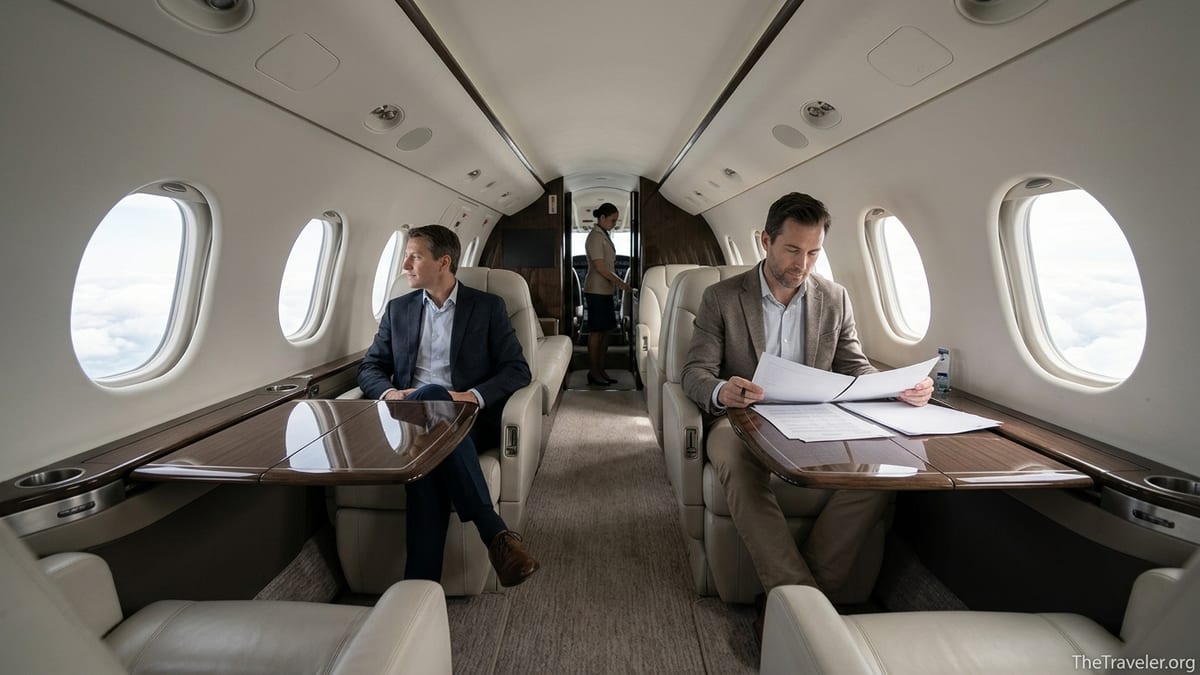
Where Flexjet tries to differentiate itself is in what it calls Red Label by Flexjet. According to the company, Red Label combines three elements: dedicated flight crews assigned to specific aircraft, distinctive LXi cabin interiors, and an elevated in-cabin service ethos. In practice, this can mean that if you hold a share in a Red Label Phenom 300 or Praetor 600, you will often see the same captains and cabin server across many of your trips, cabins furnished with more residential-style materials and layouts, and service rituals tailored to your preferences over time.
Real-world examples include unique interior touches like club seating arrangements, upgraded galley equipment, and customized color palettes that differ from the more standardized look found in many fleet operators. Frequent flyers who move between homes in places such as Greenwich, Palm Beach, and Sun Valley often cite the feeling of “their” aircraft and crew as a primary reason they stay with Flexjet rather than treat private flights as interchangeable commodities.
On long-range missions, Flexjet’s large-cabin aircraft become particularly relevant. A Gulfstream G650 in the fleet can typically handle nonstop flights of roughly 13 to 14 hours, making routes such as Los Angeles to London or New York to Dubai feasible without fuel stops in ordinary conditions. Flexjet’s own transatlantic content emphasizes that its operations on both sides of the Atlantic allow North American owners to continue trips within Europe using locally based aircraft, which can be more efficient than repositioning a US-based jet after a crossing.
What It Really Costs: Examples and Hidden Expense Traps
Because Flexjet structures are bespoke and pricing is confidential, you will not find a public rate card that applies to every traveler. However, third-party data points and buyer anecdotes provide a sense of scale. Recent jet card comparison guides show Flexjet’s 25-hour card pricing for midsize and super midsize aircraft starting in the ballpark of roughly 170,000 dollars and reaching upward of 300,000 dollars depending on cabin class and geographic coverage. That implies approximate all-in hourly rates from the mid-six thousands on smaller jets to well into five figures per hour on large-cabin aircraft, similar to other top-tier fleet programs.
At the fractional level, informal reports from owners and prospective buyers suggest that a 50-hour share on a super midsize aircraft like a Praetor 500 or Challenger 3500 can involve an upfront acquisition or contract value in the low-to mid-seven figures, with monthly management fees that may run in the 20,000 to 30,000 dollars range, and hourly occupied rates in the low teens of thousands of dollars. Large-cabin programs on aircraft such as the Gulfstream G650 often sit considerably higher, with some travelers describing effective all-in rates in the high teens to low twenties per flight hour. These figures shift year by year as aircraft values, fuel prices, and program structures evolve, so use them as directional rather than definitive.
The key is to look beyond headline hourly rates and understand additional cost triggers. Many programs, including Flexjet’s, differentiate between “primary” days and peak or blackout days. On primary days you get your contracted hourly rate and standard minimums. On peak days, surcharges may apply, and the notice period to request flights can be much longer. There can also be repositioning charges if you ask to start or end flights outside what the program defines as your primary service area.
Cabin choice matters, too. A traveler based in Dallas who prefers a Phenom 300 for short regional flights to Houston and New Orleans might see hourly rates in a very different range than a family alternating between New York and Paris on a Gulfstream. In practice, this means you should map your actual flying patterns over the last 12 to 24 months, including average passenger count, city pairs, and seasonality, and then ask Flexjet to model scenarios using those specifics. Comparing that output with charter quotes from a reputable broker for the same itineraries over a year gives you a more realistic sense of whether Flexjet’s premium for guaranteed access is justified in your case.
Availability, Booking Rules, and Operational Realities
One of the strongest reasons travelers choose Flexjet over pure charter is guaranteed availability, but that guarantee comes with rules and fine print. In typical fractional and card structures, owners enjoy guaranteed access to their cabin category or better with a minimum notice period on non-peak days, often in the range of 10 to 24 hours. Anecdotal accounts from Flexjet users describe successfully booking super midsize flights with roughly half a day’s notice for standard business trips, while relying on longer lead times around holidays or major events.
Peak days are the biggest friction point. Around Thanksgiving, Christmas to New Year, and big sporting or trade events, Flexjet, like other operators, publishes a calendar of peak days. On those dates you may face longer booking windows, reduced ability to cancel without penalties, and sometimes limits on how many peak-day trips you can take in a given year. A family accustomed to deciding on a Christmas ski trip at the last minute may find these constraints frustrating if they do not plan ahead.
It is also worth understanding how substitutions work. Flexjet generally reserves the right to provide an aircraft of equal or greater cabin class than the one in your contract. In practice, that can be an upgrade you welcome, such as finding a Praetor 600 arriving instead of a Praetor 500, but it can also mean different baggage capacity or a slightly different cabin layout than you are used to. On rare occasions, if the managed fleet is disrupted by weather or maintenance, Flexjet may source supplemental lift from a vetted third-party operator to honor its guarantee, something that can affect cabin styling even if safety and key amenities remain consistent.
Operationally, Flexjet tends to appeal to travelers who value a concierge-style experience. Owners commonly route all planning through a dedicated account team or owner services desk, which handles everything from slot and permit requests to ground transportation, catering, and coordinating multi-leg itineraries. A law firm coordinating a week-long roadshow across multiple midwestern cities, or a family planning a complex Europe summer itinerary with several stops, might lean heavily on this support in a way that would be difficult to replicate booking each leg individually with different charter operators.
Comparing Flexjet to Alternatives
Before joining Flexjet, it is smart to compare it against at least three alternatives: outright aircraft ownership, pure jet cards from independent providers, and traditional on-demand charter. Whole ownership offers maximum flexibility and can make sense for those flying 200 to 300 hours per year or more, but carrying costs such as crew salaries, hangar fees, insurance, and maintenance can easily exceed several hundred thousand dollars annually. Fractional products like Flexjet’s exist partly to spread those fixed costs across multiple owners while preserving much of the convenience.
Jet cards from independent providers, including those that do not own their own fleets, typically ask for an upfront deposit from around 100,000 dollars to several hundred thousand dollars and in return offer fixed or capped hourly rates for a set number of hours, often 25. Independent analysis of the market shows that all-in hourly pricing for light jets on many cards can start in the high four to low five figures and then climbs across midsize, super midsize, and large-cabin categories. These cards suit travelers who want predictability but are not concerned about flying on a consistent operator or aircraft type. By contrast, Flexjet’s card product is tied directly to its own fleet and service culture, which many travelers see as a quality upgrade.
Traditional charter, booked trip by trip through a broker or directly with operators, generally remains the most flexible and potentially cost-effective path for travelers flying under about 25 to 30 hours per year, or whose destinations vary widely. For example, if you mainly take one annual family vacation from New York to the Caribbean and two or three ad hoc ski trips, a reputable charter broker can often source competitive pricing using different operators each time. However, charter exposes you to market volatility: during peak periods, per-hour rates can spike dramatically, and aircraft availability for last-minute schedules is never guaranteed.
In practice, many high-net-worth individuals and companies end up with a blended solution. A private equity partner might hold a 75-hour Flexjet share for predictable North American business travel while still chartering occasional large-cabin flights for infrequent long-haul family vacations. A corporate flight department might use fractional shares as a supplement to its owned aircraft during particularly busy periods. The key question is not which model is “best” in the abstract, but which combination yields the lowest total cost for the reliability and service level you actually require.
The Takeaway
Joining Flexjet is not a casual travel decision; it is a significant financial and lifestyle commitment that reshapes how you and your team or family move around the world. The company’s strengths lie in its modern fleet, high-touch service model, Red Label cabins with dedicated crews, and a program structure that offers guaranteed access and predictable pricing for those who fly frequently. For travelers logging dozens of hours a year on repeat routes, the upgrade in control, comfort, and convenience over both commercial travel and ad hoc charter can be substantial.
Before you sign, build a detailed picture of your past and projected flying patterns, request precise proposals from Flexjet for the relevant aircraft and regions, and compare those side by side with charter and independent jet card quotes for the same itineraries. Ask tough questions about peak-day rules, notice periods, fuel surcharges, and how Flexjet handles irregular operations. Finally, whenever possible, speak directly with existing owners or cardholders whose travel profile matches yours. If, after that work, the economics and service profile align with your needs, Flexjet can be a powerful tool that effectively turns the world’s runways into extensions of your home and office.
FAQ
Q1. How many flight hours do I need for Flexjet to make sense?
For most travelers, Flexjet begins to make sense around 50 or more hours per year, when the value of guaranteed access, consistent aircraft, and predictable pricing outweighs the higher cost compared with one-off charter. Below that threshold, a reputable charter broker or occasional jet card may be more economical.
Q2. What is the difference between Flexjet’s fractional ownership and a lease?
Fractional ownership involves buying an actual share of an aircraft, with a large upfront payment and potential residual value when you exit. A lease typically requires a security deposit and ongoing lease payments for a fixed term, giving similar access and pricing mechanics without tying up as much capital in the asset itself.
Q3. How much does a Flexjet 25-hour jet card typically cost?
Exact pricing varies by aircraft type and region, but recent market comparisons suggest that a 25-hour Flexjet card on midsize and super midsize jets often falls in a broad range from the high five figures to the low or mid six figures, translating into mid four to low five figure effective hourly costs depending on cabin size.
Q4. Can Flexjet fly me internationally, such as to Europe or the Caribbean?
Yes, Flexjet operates aircraft capable of international missions and highlights both transatlantic capability and established operations in Europe. Large-cabin jets like the Gulfstream G650 usually handle nonstop routes between major US and European cities, while midsize and super midsize aircraft commonly serve the Caribbean, Mexico, and parts of Central and South America.
Q5. What is Red Label by Flexjet, and is it worth paying for?
Red Label is Flexjet’s enhanced service concept that pairs dedicated crews with specific aircraft and features customized LXi cabin interiors and elevated onboard service. For frequent flyers who value a familiar crew and more residential-feeling cabin design, Red Label can meaningfully improve the travel experience, though it often comes at a premium over more standard fleet options.
Q6. How far in advance do I need to book flights with Flexjet?
On non-peak days, Flexjet programs typically guarantee access with relatively short notice, often measured in hours rather than days, especially for fractional and lease owners. Around declared peak days and holidays, booking windows can be significantly longer, and availability is subject to special rules, so planning ahead for major events is essential.
Q7. Are there extra fees on top of the hourly rate?
Flexjet’s published materials emphasize all-inclusive hourly rates for core costs, but you can still encounter extra charges in certain situations, such as flights on peak days, short-leg minimums, de-icing, or repositioning outside the primary service area. It is important to request a full fee schedule and review example trip costings before signing.
Q8. Can I choose a specific aircraft model for my flights?
When you enter a program, you contract for a particular cabin class or aircraft type, such as a Phenom 300, Praetor 500, or Gulfstream G650. Flexjet generally reserves the right to substitute an equal or larger aircraft as needed, so you can request specific models but should expect occasional substitutions based on fleet logistics and maintenance.
Q9. What happens if my Flexjet aircraft has a mechanical issue on the day of travel?
If your scheduled aircraft becomes unavailable due to maintenance or other operational issues, Flexjet will typically provide a replacement aircraft of similar or greater size from its own fleet or, when necessary, from vetted third-party operators. This backup capability is a key part of the value proposition compared with managing a single owned aircraft or relying solely on ad hoc charter.
Q10. How long is a typical Flexjet fractional or lease commitment?
Typical program terms often run from about three to five years, with longer or shorter options depending on the structure and aircraft. After the initial term, fractional owners may have the option to sell their share back based on program terms in effect at the time, while lessees can renegotiate, extend, or exit according to their contract conditions.