


More news on this day
A fresh wave of flight disruptions is sweeping across the United States, with live tracking data showing 61 cancellations and more than 550 delays impacting major hubs in Georgia, Massachusetts, California and other states as travelers confront missed connections, rebookings and overnight stays.
Get the latest news straight to your inbox!
Disruptions Concentrated at Major U.S. Gateways
The latest round of turbulence for air travelers is centered on some of the country’s busiest hubs, where a combination of congestion, weather complications and knock-on schedule issues is producing an uneven but still widespread impact. Data compiled from real-time aviation trackers indicates that the current tally stands at 61 canceled flights and approximately 551 departures and arrivals running late, with the brunt of the disruption clustered at major airports in Georgia, Massachusetts and California.
Atlanta, home to the world-spanning network of Delta Air Lines, is among the facilities seeing elevated cancellations and delays, reflecting how a disruption at a major hub can radiate across connecting routes throughout the Southeast and beyond. In the Northeast, Boston Logan International Airport is also reporting a build-up of late departures and arrivals, a pattern that has become increasingly common during periods of unsettled weather and tight scheduling along the East Coast corridor.
On the West Coast, key California airports are again emerging as pressure points, with San Francisco and Los Angeles both showing clusters of delayed departures affecting domestic and transpacific services. As aircraft and crews cycle through these hubs, a single late inbound flight can cascade into multiple delayed or canceled segments, including red-eye and early-morning services that travelers rely on for time-sensitive trips.
While today’s numbers are modest compared with some of the most severe nationwide meltdowns seen earlier this month, the disruptions remain significant for passengers whose itineraries happen to intersect with the affected flights. Even a relatively small number of cancellations can ripple through already busy terminals, lengthening lines, reducing available seats on later departures and complicating rebooking options.
Delta, United and Partner Carriers Bear the Brunt
Publicly available tracking data and independent aviation analyses suggest that large network airlines are again carrying the heaviest load of operational stress. Delta Air Lines and United Airlines feature prominently among today’s canceled and delayed flights, reflecting their dense schedules at hub airports like Atlanta, Boston, Chicago and major California gateways.
International carriers that coordinate closely with these U.S. giants are also being swept up in the disruption. Flights operated by Air Canada, British Airways, Lufthansa and regional operator Jazz Aviation appear among those experiencing irregular operations, particularly on routes linking the United States to Canada and Europe. These airlines depend heavily on smooth connections through American hubs, meaning that even localized schedule problems can reverberate across the Atlantic and into Canadian networks.
Recent incident patterns at large hubs such as Chicago O’Hare and Washington Dulles, where separate operational snarls have produced dozens of cancellations and hundreds of delays on other days this month, illustrate how sensitive these interconnected systems have become. When a hub carrier encounters a staffing gap, ground-handling bottleneck or unexpected weather constraint, the effect can quickly spread to partner airlines sharing gates, codeshares and connecting passengers.
For travelers booked on international services operated by European or Canadian carriers, this often means long waits at departure airports or enforced overnight stays when missed connections make same-day onward travel impossible. Even when flights are not canceled outright, extended delays can lead to missed meetings, lost vacation time and added accommodation and meal costs.
Weather, Congestion and Tight Schedules Create a Volatile Mix
Aviation analysts point to a familiar blend of triggers behind the latest figures: unsettled regional weather, crowded airspace and tight aircraft utilization. Summer-like patterns in parts of the South and along the Eastern Seaboard are again bringing thunderstorms and low clouds that can slow arrivals and departures, prompting air traffic control programs that space flights farther apart and restrict the rate at which planes can land and take off.
At the same time, major carriers have been operating aggressive schedules that leave limited slack in aircraft and crew rotations. When a single flight is delayed by weather or ground congestion, the late aircraft may then arrive too late to operate its next planned segment on time, forcing dispatchers to juggle airplanes and crews across multiple cities. In some cases, airlines decide to cancel a later leg entirely in order to get aircraft and staff back into position for the following day.
Industry data from recent federal consumer reports highlights how national aviation system constraints, late-arriving aircraft and carrier-related issues collectively account for a substantial share of delays across U.S. airlines. While on-time performance improved in parts of 2025, the early months of 2026 have seen repeated spikes in disruptions whenever storms, staffing shortages or technical issues converge on a key hub.
Observers note that today’s pattern fits a broader trend in which even moderate weather events can have outsized effects on the system. With passenger volumes hovering near or above pre-pandemic levels at many airports and infrastructure upgrades proceeding gradually, there is little room for error once peaks in travel demand coincide with operational hiccups.
Passengers Face Missed Connections and Crowded Rebooking Queues
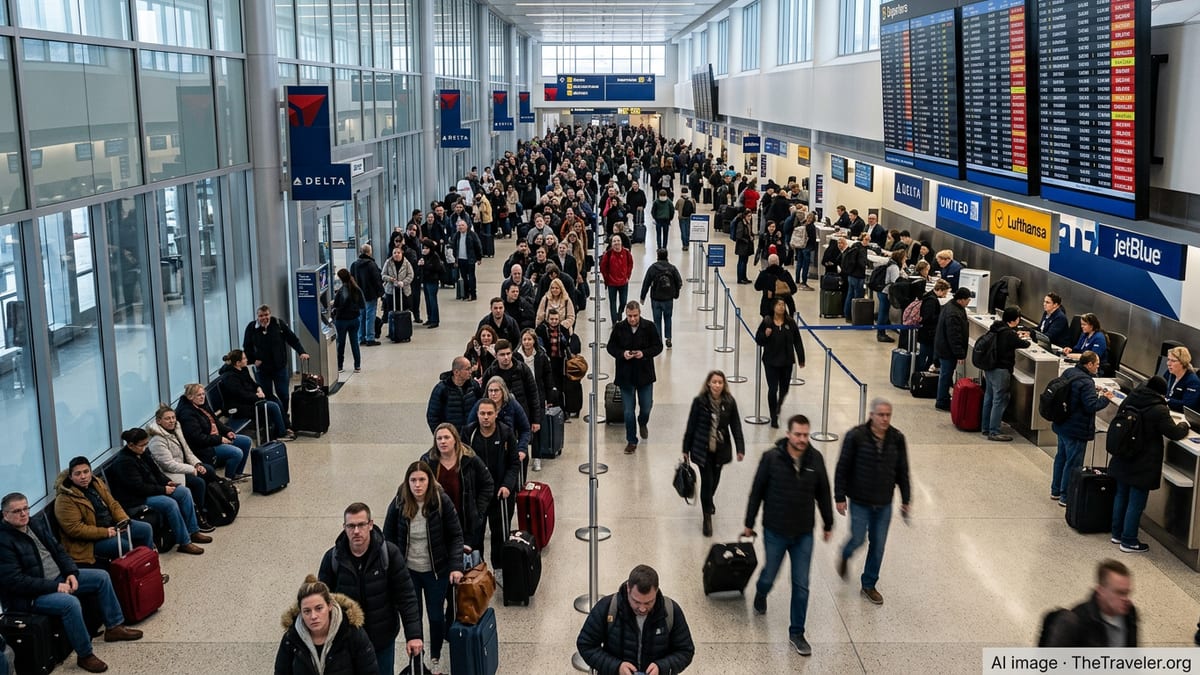
For travelers on the ground, the statistics translate into long lines at customer service counters, crowded gate areas and a scramble for limited rebooking options. Passengers caught by the 61 cancellations reported across the system are often competing for seats on the same handful of later flights, particularly on popular business routes and key transcontinental legs linking hubs in the Northeast, South and West Coast.
Those dealing with delays rather than outright cancellations are facing their own challenges. Missed connections are a recurring theme, especially for travelers who built tight layovers into their itineraries. When an initial leg from a smaller regional airport to a major hub runs late, connecting passengers may arrive just minutes after their onward flight has closed or pushed back from the gate, leaving them dependent on standby lists or next-day departures.
In response, travel advisors commonly suggest building more buffer time into connections, monitoring flight status frequently on airline apps and being prepared with alternative routing ideas when disruption risk is high. For passengers with flexible schedules, shifting to earlier flights on the same day or traveling a day ahead of critical events can significantly reduce the impact of sudden operational issues.
Families and leisure travelers are also feeling the strain, particularly where delays extend into late evening hours. Parents traveling with children face the added challenge of securing food, rest and entertainment in crowded terminals, while older travelers and those with mobility concerns may struggle with repeated gate changes or long waits in security and rebooking lines.
What Today’s Turbulence Signals for the Summer Travel Season
The latest wave of disruptions is sharpening concerns about how the U.S. air travel system will cope with peak summer demand. With schools letting out and tourism building, June historically marks the start of one of the busiest travel windows of the year, and early indications from tracking data and prior weeks’ performance point to a season where even minor operational shocks can quickly translate into widespread passenger inconvenience.
Travel industry observers note that, while today’s count of 61 cancellations and 551 delays is far below the worst-case scenarios seen during major storms or technology failures, it illustrates the fragility of a network operating near capacity. Large hub carriers like Delta and United, together with international partners such as Air Canada, British Airways, Lufthansa and Jazz, are likely to remain under scrutiny as they work to maintain reliability amid high demand.
For now, publicly available dashboards and airport-specific trackers continue to be the best tools for travelers hoping to stay ahead of disruption. By keeping a close eye on conditions at origin and connecting hubs in Georgia, Massachusetts, California and other key states, passengers can make earlier decisions about rerouting, rebooking or adjusting plans before minor delays turn into missed connections.
As the day progresses and airlines work through backlogs, some delays may ease, but analysts caution that crews and aircraft knocked off schedule today can still influence operations on subsequent days. With more stormy weather expected in several regions and terminals already operating at high capacity, the margin for error across the U.S. aviation system remains slim.