


More news on this day
Travelers across South Korea and the United States are facing fresh disruption after a new wave of flight cancellations by Air Seoul, Korean Air and American Airlines left passengers stranded and key routes between Dallas, Seoul, Jeju and Busan suddenly off the boards.
Get the latest news straight to your inbox!
New Wave of Cancellations Hits Major Gateways
Recent days have brought a fresh round of schedule cuts affecting connections between South Korea and the United States, adding to a year already marked by aviation volatility. According to published coverage tracking the disruption, more than a dozen newly canceled flights on Korean Air, Air Seoul and American Airlines have targeted some of the region’s busiest corridors, including services touching Dallas Fort Worth International Airport and Seoul’s main hubs.
The pattern of cancellations has been most visible on routes linking Incheon and Gimpo in the Seoul area with domestic leisure destinations such as Jeju and Busan, as well as on long haul links between Incheon and Dallas Fort Worth. Publicly available flight data for early May indicate days when Dallas–Incheon rotations either did not operate or were significantly retimed, forcing passengers to be shifted onto later departures or alternative transpacific routings.
The disruption comes on top of broader schedule reductions already reshaping the Korean market. Recent business reporting from Seoul highlights that low cost carriers have been trimming hundreds of round trip international services through June, while some domestic sectors remain vulnerable to short notice changes because of weather, aircraft availability and softer demand.
While cancellations on any given day are not unusual, the concentration of affected flights on high demand routes between capital region airports and major tourism and business destinations has amplified the impact. For many travelers, this has translated into unexpectedly long waits at terminals, missed connections and last minute changes in onward plans.
Passengers Stranded from Dallas to Jeju
American Airlines customers connecting through Dallas Fort Worth have reported cancellations and extended delays over the past week, including on services that link the Texas hub with Asia. Travel alerts published by the carrier show ongoing flexibility measures for passengers flying to, from or through Dallas Fort Worth around May 10, reflecting operational challenges that have rippled through the network.
Travelers bound for South Korea from Dallas have faced particular uncertainty where Dallas–Incheon services are involved. Flight tracking platforms show instances in early May in which at least one daily rotation between Dallas and Seoul did not operate as originally scheduled, consistent with anecdotal accounts of last minute cancellations and enforced rebookings. When this coincides with reduced capacity on other transpacific routes, options for same day travel can be limited, leaving passengers waiting in hotels or at the airport for replacement flights.
Inside South Korea, the strain has been most deeply felt on the trunk routes that connect Seoul with Jeju and Busan. These sectors are among the country’s busiest, serving a mix of domestic tourism, business travel and local residents shuttling between the capital and outlying regions. Reports from Jeju International Airport in recent weeks have described departure boards peppered with cancellations and delays, with some days seeing well over one hundred flights affected as bad weather and capacity cuts collide.
For those already en route, the combination of international and domestic disruption has created complex rerouting challenges. Passengers arriving late into Seoul because of upstream cancellations may find that the last flights of the day to Jeju or Busan have already departed, pushing what was intended as a same day connection into an unplanned overnight stay.
Operational Pressures Behind the Disruption
The latest wave of cancellations is unfolding against a backdrop of financial and operational pressure on Asian carriers. Industry reporting from Seoul indicates that surging jet fuel prices, driven in part by geopolitical tensions, have forced budget airlines to slash nearly 900 round trip international flights for the late spring and early summer period. Although these broad cuts are concentrated among low cost carriers, the same market realities are bearing down on full service airlines such as Korean Air.
For Korean Air and its regional affiliate Air Seoul, the environment is especially complex as they adjust networks in the midst of structural change to the Korean aviation landscape. Korean Air is in the process of absorbing Asiana Airlines, a multiyear consolidation that has heightened scrutiny of capacity decisions on key domestic and international routes. Public filings and media coverage have described how the merged operation is rebalancing aircraft and frequencies, which can lead to sharper day to day adjustments when demand falls short of expectations or when aircraft are required elsewhere.
American Airlines is coping with its own constraints at Dallas Fort Worth, the carrier’s largest hub. Analysis of the winter season has shown that storms earlier in the year resulted in thousands of cancellations tied to Dallas operations, leaving crews and aircraft out of position and complicating subsequent schedules. Although conditions in May are more stable than during winter, the lingering effects of tight crew availability and aircraft utilization plans can make the transpacific schedule more vulnerable when new disruptions occur.
In many of the affected markets, aircraft type and range also play a role. Long haul services connecting Dallas and Incheon depend on a narrow subset of widebody aircraft, limiting the ability to substitute planes at short notice. When a mechanical issue or rotation change sidelines one of these aircraft, the knock on effect can stretch across several days of flying, cascading through both North American and Asian networks.
Travelers Confront Rebookings, Vouchers and Limited Options
For passengers, the practical consequences of the cancellations are being felt in rebooking lines and customer service channels. Airline policy documents and publicly accessible guidance emphasize that travelers on affected flights can typically change trips without additional fees or request refunds when services are canceled outright. However, when multiple airlines are trimming schedules on overlapping corridors, finding open seats on alternative departures is not guaranteed.
Recent consumer experiences shared on travel forums underline challenges such as overnight delays at Dallas Fort Worth, missed conferences and family events, and difficulties securing prompt rebooking when flights between Dallas and Seoul are withdrawn at short notice. Some travelers report being rerouted through other U.S. hubs with longer overall journey times, while others have been offered travel on later days in lieu of same day alternatives.
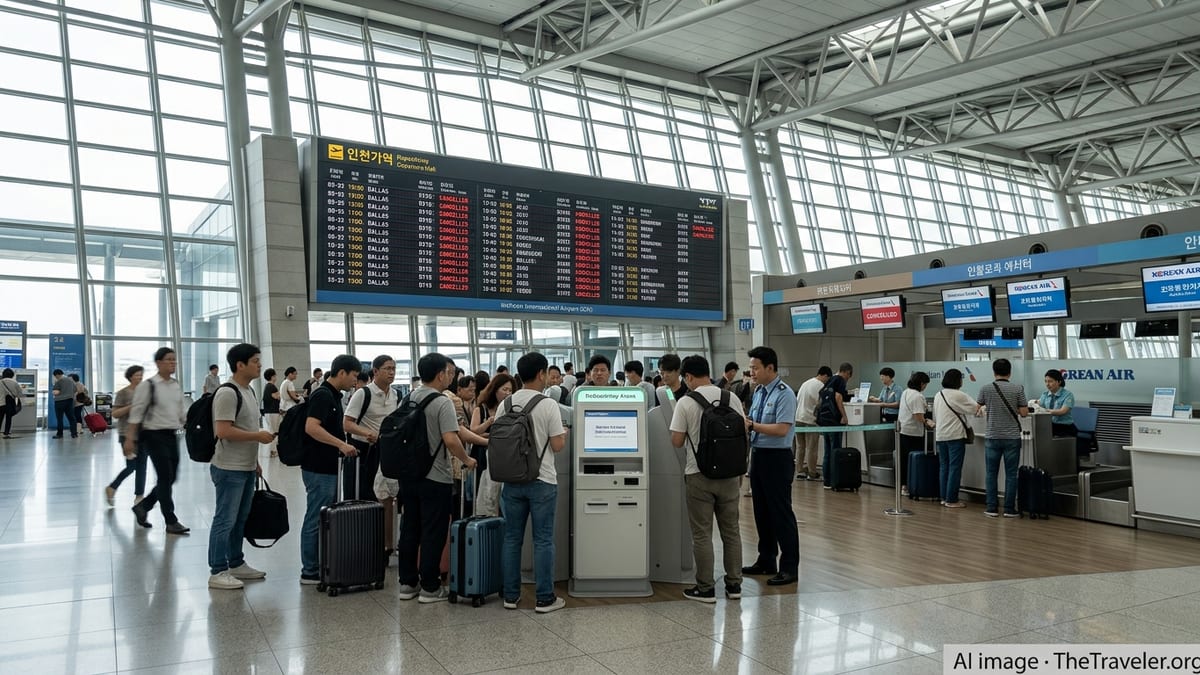
Within South Korea, passengers on disrupted Air Seoul and Korean Air services between Seoul, Busan and Jeju have described queues at service counters as they seek hotel vouchers, meal coupons and new boarding passes. On weather affected days in Jeju, images of departure boards dominated by cancellations have highlighted the strain on local infrastructure as stranded passengers compete for remaining seats on remaining flights or look to ferries and other surface transport as backup options.
Consumer advocates note that the burden often falls disproportionately on leisure travelers and those without elite status, who may have fewer automatic protections or alternative booking channels. Families traveling with children or elderly relatives can face particular hardship when forced into unexpected overnight stays or multi stop reroutings that significantly extend total travel time.
What Comes Next for Key Korea–US Routes
Looking ahead, aviation analysts quoted in Korean business media suggest that volatility around South Korea’s key domestic and international routes is likely to persist into the summer schedule. Carriers are still fine tuning capacity after the pandemic era recovery, while contending with high fuel prices and competitive pressure on fares. In this environment, airlines may opt to cut lightly booked flights earlier rather than operate them at a loss, especially on long haul sectors such as Dallas–Seoul.
For routes connecting Seoul with Jeju and Busan, the combination of seasonal weather and tight aircraft utilization means that short notice changes may remain a feature, even if airlines seek to stabilize timetables. Some observers point to the possibility that as consolidation progresses and as financially weaker carriers scale back, remaining operators could further refine schedules, potentially shifting frequencies away from off peak times.
Travelers planning trips between the United States and South Korea, or onward to Jeju and Busan, are being encouraged by publicly available advisories to monitor itineraries closely in the days before departure. Airlines continue to highlight mobile apps and online tools that provide real time status updates, same day self service rebooking and digital boarding passes, services that can reduce time spent in lines when disruptions cascade across a hub.
For now, the immediate reality for many passengers is continued uncertainty. With Air Seoul, Korean Air and American Airlines all adjusting schedules under pressure, even well traveled corridors linking Dallas, Incheon, Jeju and Busan can no longer be assumed to operate exactly as filed, reinforcing the importance of contingency planning for anyone crossing the Pacific or traversing South Korea’s busiest routes in the weeks ahead.