


More news on this day
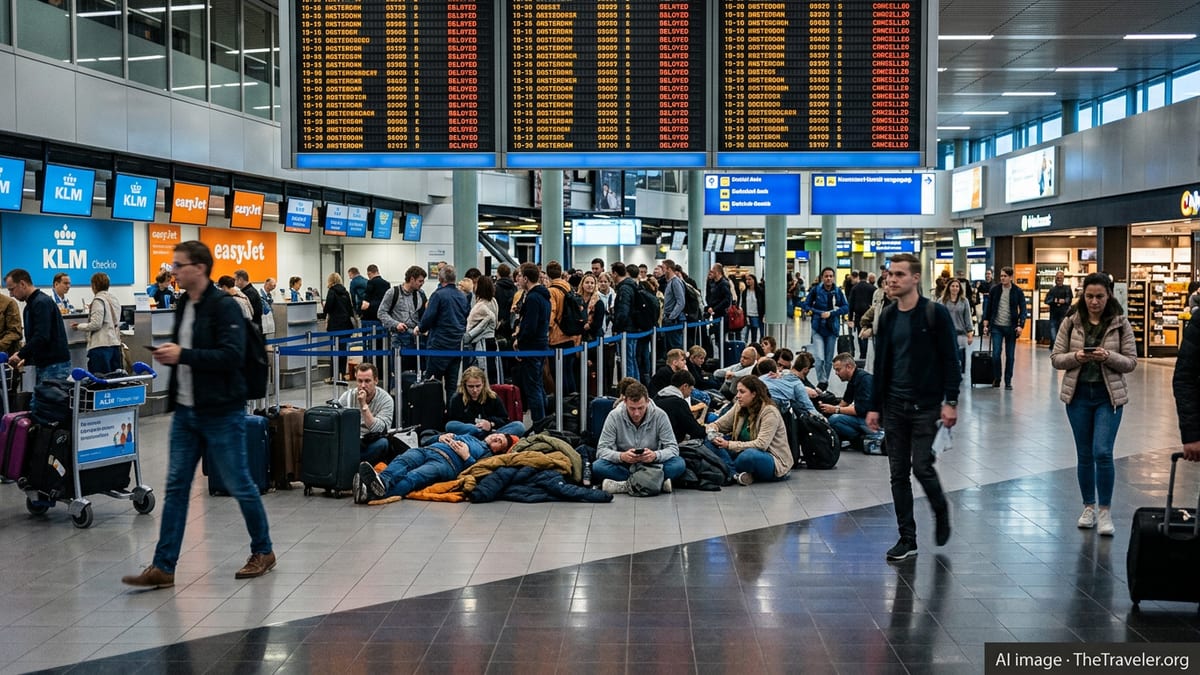
Hundreds of passengers were stranded at Amsterdam Schiphol Airport after a fresh wave of disruption resulted in 407 delays and 26 flight cancellations affecting services on busy routes to London, Rome, Lisbon, Mexico City and Los Angeles.
Get the latest news straight to your inbox!
Major Hub Hit by a New Wave of Disruption
Operational data compiled from real-time flight tracking platforms and passenger-rights services on Saturday indicate that Amsterdam Schiphol, one of Europe’s busiest hubs, experienced one of the highest disruption levels in the region, with more than four hundred delays and over two dozen cancellations recorded in a single operational window. The disturbance primarily affected short and medium haul services within Europe, but also rippled across long haul connections between Europe and North America and Latin America.
Publicly available information shows that flights operated by easyJet, KLM, German Airways and British Airways were among those most affected. Services linking Amsterdam with London, Rome and Lisbon saw repeated schedule changes, extended ground holds and missed slots, while a smaller number of long haul flights to Mexico City and Los Angeles encountered significant delays or were removed from the schedule altogether.
While the precise combination of causes has not been fully detailed in official public statements, reports indicate a mix of operational constraints at the airport and aircraft rotation challenges for individual carriers. Amsterdam Schiphol has faced recurring pressure in recent months, including staffing shortages, weather-related bottlenecks and congestion in air traffic control, factors that can quickly cascade into widespread delays when flight banks are tightly timed.
The latest disruption came at a time of high seasonal demand, magnifying its impact. With many flights operating at or near capacity, the room to rebook affected travelers onto alternative departures was limited, leaving queues at rebooking desks and long waits for assistance inside the terminal.
Airlines Struggle to Reprotect Travelers
According to published coverage from aviation-focused outlets, KLM, easyJet, German Airways and British Airways all activated their standard disruption procedures, including rolling rebookings, automated notifications through airline apps and, in some cases, overnight accommodation for travelers unable to depart the same day. However, the sheer volume of affected passengers at Schiphol meant that many travelers reported long waits before being allocated new itineraries.
Industry data on previous disruption days at Schiphol suggest that when delay and cancellation numbers reach the hundreds, airline network schedules can take days to fully recover. Aircraft and crew may be left out of position across multiple airports, and carriers are sometimes forced to prioritize long haul departures over shorter feeder flights, which can leave passengers originating from nearby European cities particularly exposed to missed connections.
Travel analysts note that Schiphol’s role as a major transfer hub intensifies these challenges. A delayed departure from Amsterdam to London or Rome can cause passengers to miss onward intercontinental services, while a cancellation on a transatlantic or Latin American leg to cities such as Mexico City or Los Angeles creates complex rebooking chains involving multiple partners in airline alliances.
Publicly available guidance from passenger-rights organizations points out that, during such mass disruptions, airline call centers and digital channels tend to experience heavy congestion. Travelers may find it difficult to secure rapid assistance, particularly if they are already in transit and relying on airport Wi-Fi or roaming mobile connections to manage last-minute changes.
Long Queues, Overnight Stays and Frustrated Travelers
Accounts shared across social media platforms and travel forums described long queues stretching through departure halls at Amsterdam Schiphol as stranded travelers waited to speak with airline staff or access self-service rebooking kiosks. Some passengers reported spending much of the day on standby lists for heavily booked flights to London, Rome and Lisbon after their original departures were delayed repeatedly or cancelled outright.
For travelers bound for long haul destinations such as Mexico City and Los Angeles, the disruption often translated into enforced overnight stays. With seat availability on later flights constrained, many passengers were rebooked onto services departing the following day or routed through alternative hubs in Europe or North America. In a number of cases, this extended total journey times by more than twenty-four hours.
Airport operations plans published by industry bodies show that extended disruptions of this kind can strain terminal facilities, from seating and catering outlets to baggage systems and ground transport connections. At times of significant delay accumulation, arriving baggage may be slow to reach carousels, while outbound luggage from rebooked passengers needs to be located and retagged, increasing the risk of mishandled or misrouted bags.
Travelers caught up in the disruption also described difficulties accessing up-to-date information. Departure boards and mobile notifications sometimes lagged behind actual operational decisions, leading to confusion about whether flights were still operating. Passenger advocacy groups routinely encourage travelers to cross-check airline apps, airport information screens and independent flight-tracking services to obtain as complete a picture as possible when schedules start to unravel.
Knock-on Effects Across Europe and Beyond
Amsterdam Schiphol’s status as a core European hub meant that Saturday’s disruption had consequences far beyond the Netherlands. According to publicly available scheduling data, delays and cancellations on outbound flights from Amsterdam led to late arrivals or equipment shortages at destination airports, including London, Rome and Lisbon, compounding congestion across parts of the European network.
Some services returning to Schiphol from key European capitals were themselves delayed because the aircraft designated to operate them departed late from Amsterdam. This kind of rotation-driven disruption can create a so-called domino effect, where a single missed slot or extended ground hold cascades into multiple further delays at other airports later in the day.
On long haul sectors, the impact was felt on both sides of the Atlantic. Flight-tracking records indicate that some services linking Amsterdam with Mexico City and Los Angeles either departed well behind schedule or were cancelled, triggering rebookings across partner networks. Passengers bound for these destinations were in some cases rerouted via other European hubs or asked to travel the following day when additional seats became available.
Aviation analysts observe that, as airlines operate leaner schedules with fewer spare aircraft, the overall system has become more vulnerable to concentrated disruption at major hubs. When a single airport such as Amsterdam sees hundreds of delays in a short period, there are limited options to absorb the shock without causing significant inconvenience to passengers across multiple regions.
What Stranded Passengers Can Do Next
Consumer organizations and passenger-rights advocates generally advise travelers affected by large-scale delays and cancellations at European airports to document every stage of their disruption. Boarding passes, written delay notices, meal receipts, hotel invoices and ground transport tickets can all help support later claims under applicable air passenger protection frameworks.
Publicly available guidance for flights departing from or arriving in the European Union explains that passengers may be entitled to care and assistance, including meals and refreshments, access to communication channels and, where necessary, hotel accommodation. Eligibility for financial compensation depends on the specific cause of the disruption and whether it is considered within the operating carrier’s control.
Experienced travelers caught up in previous disruption events at Amsterdam Schiphol suggest that, wherever possible, passengers should try to manage rebookings through airline apps or websites while simultaneously monitoring airport information screens. In some situations, alternative routings via less congested hubs can significantly reduce overall delay, especially for those headed to long haul destinations like Mexico City or Los Angeles.
For now, operational data indicate that airlines at Schiphol are working to clear backlogs and reposition aircraft and crew, but residual delays are likely to persist while schedules are gradually realigned. Passengers with upcoming departures through Amsterdam in the next twenty-four to forty-eight hours are being advised by publicly accessible travel alerts to monitor flight status closely and allow extra time at the airport in case check-in and security queues remain longer than usual.