


More news on this day
Major airports across Australia and New Zealand are reporting widespread disruption today, with dozens of cancellations and hundreds of delays affecting services operated by Qantas, Jetstar, Virgin Australia, Air New Zealand and other carriers across Sydney, Melbourne, Auckland, Perth, Adelaide and Canberra.
Get the latest news straight to your inbox!
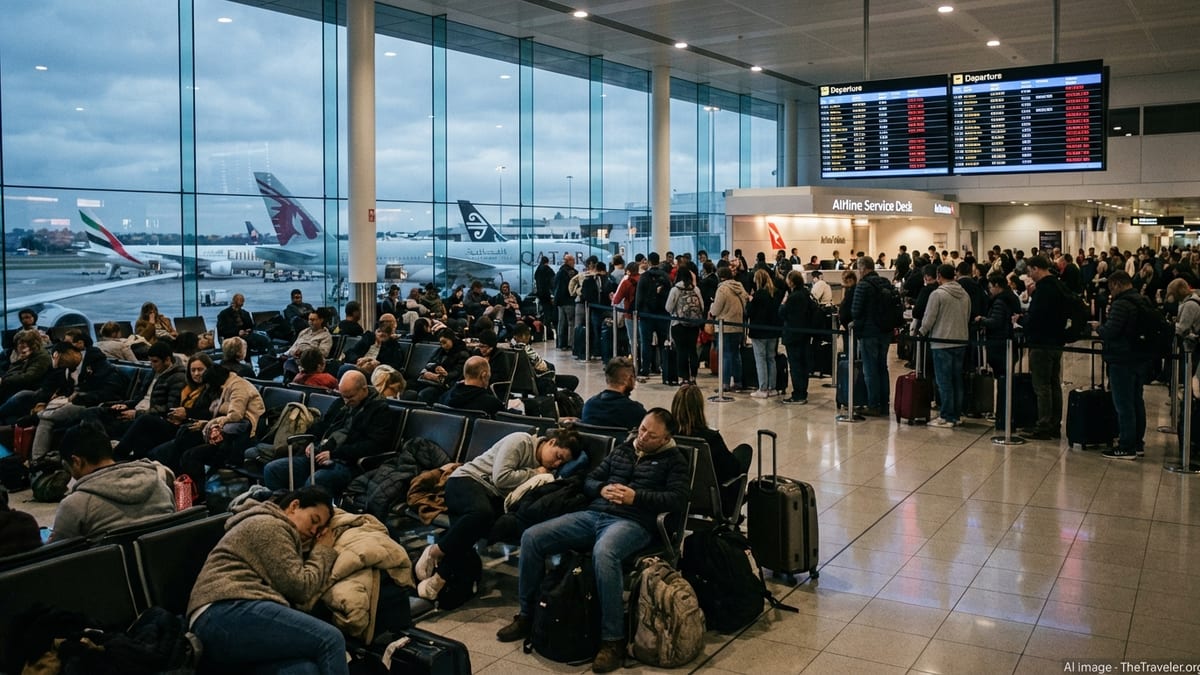
Wave of Cancellations and Delays Across Key Gateways
Operational data and live departure boards indicate an unusually high number of disrupted services on trans-Tasman and domestic routes linking Australia and New Zealand. Across Sydney, Melbourne, Auckland, Perth, Adelaide and Canberra, at least 36 services have been cancelled and more than 300 delayed, affecting business travellers, holidaymakers and connecting long-haul passengers.
The pattern of disruption is broad rather than isolated to a single corridor. Flights between Sydney and Auckland, Melbourne and Adelaide, and services linking Wellington and Australian hubs are among those showing a mix of outright cancellations and rolling delays. In several cases, individual routes that normally operate with multiple daily frequencies are reduced to a skeleton schedule, leaving limited options for same-day rebooking.
Publicly available flight-tracking information suggests that the impact is most visible in peak travel windows, when aircraft rotations are tight and spare capacity is limited. Delays of between 30 minutes and several hours have become common on some services, contributing to a knock-on effect across the wider network as aircraft and crew miss scheduled connections.
While disrupted operations are not unusual in the southern winter, the breadth of today’s issues across both Australian and New Zealand gateways has prompted renewed scrutiny of airline resilience and contingency planning in the region.
Jetstar, Qantas, Virgin and Air New Zealand Under Pressure
The main carriers serving trans-Tasman and domestic routes are all represented in the current wave of disruption. Jetstar, Qantas, Virgin Australia and Air New Zealand operate much of the short and medium haul capacity in and out of Sydney, Melbourne, Auckland, Perth, Adelaide and Canberra, alongside smaller regional and charter operators.
Recent weeks have already seen heightened passenger frustration directed particularly at low-cost and leisure-focused brands such as Jetstar, where travellers have publicly described late-notice cancellations and extended delays at airports including Melbourne and Perth. Similar complaints have been aired about Qantas and Virgin Australia domestic services, especially on heavily trafficked corridors like Sydney to Canberra and Melbourne to Brisbane, which are critical for business travel.
Air New Zealand has also faced ongoing scrutiny of its performance on trans-Tasman services linking Auckland, Wellington and Christchurch with Australian east coast cities. Industry performance reports for the first half of 2026 show that both Australian and New Zealand carriers have been juggling tight schedules and high load factors while working through aircraft maintenance, staffing constraints and volatile winter weather patterns.
Although each airline publishes its own disruption statistics, comparisons with earlier seasons point to a sustained period of elevated cancellations and late arrivals across the region’s short-haul networks, reinforcing concerns about operational headroom during peak demand.
Weather, Staffing and System Strain Cited as Key Factors
Analysis of public aviation data and recent media coverage suggests that no single trigger is responsible for the latest disruptions. Instead, a combination of winter weather, staffing limitations and congested air traffic and airport systems appears to be driving a persistent level of instability on both sides of the Tasman.
Strong fronts, low cloud and high winds are common in July and can quickly disrupt tightly timed operations at Sydney and Melbourne, where runway throughput is already constrained during busy periods. Similar conditions in Auckland and Wellington can force holding patterns, diversions or cancellations that then reverberate through the network, especially on trans-Tasman rotations used to feed onward long-haul flights.
At the same time, airlines across the region continue to report challenges recruiting and retaining flight crew, engineers and ground staff after years of pandemic-related volatility. Even modest staffing gaps can translate into last-minute aircraft swaps, extended turnarounds and missed rotation targets, all of which feed into today’s tally of 36 cancellations and hundreds of delays.
System-wide strain has been evident on other recent high-disruption days, when airport technology outages and baggage-handling issues compounded weather and staffing problems. The current pattern of rolling delays suggests that recovery windows remain narrow, leaving carriers vulnerable when multiple issues arise on the same day.
Impact on Travellers and What Passengers Can Expect
For travellers, the immediate consequence of the disruption is longer journey times and higher uncertainty around connections. Passengers on multi-leg itineraries, particularly those connecting from regional Australian ports through Sydney or Melbourne onto trans-Tasman or long-haul services, are bearing much of the risk as missed connections force same-day rebooking or overnight stays.
Consumer-rights information for both Australia and New Zealand indicates that, while compensation is often limited when disruptions stem from weather or air traffic control issues, airlines are generally expected to assist with rebooking and provide reasonable care such as meals or accommodation when passengers are stranded away from home. Policy details vary by carrier and route, meaning outcomes can differ even for travellers affected by the same weather system or airspace constraint.
Travel advisers are recommending that passengers flying in the current environment allow extra time for connections, monitor airline apps and airport displays frequently, and keep essential items and medications in carry-on bags in case of overnight delays. Those with flexible tickets are being encouraged to consider off-peak departures, which may offer more recovery options if a flight is cancelled or significantly delayed.
With school holidays, sporting events and winter escapes all contributing to strong demand on trans-Tasman and domestic routes, the ripple effects of today’s disruption could be felt for several days as airlines work through backlogs and reposition aircraft and crew.
Operational Resilience Under Fresh Scrutiny
The latest wave of cancellations and delays is prompting renewed debate about how resilient aviation networks in Australia and New Zealand are to predictable seasonal pressures. Industry analysts note that the region’s major hubs have become increasingly busy as international travel continues to grow, yet infrastructure and staffing have not always scaled at the same pace.
Questions are being raised about whether current scheduling strategies, which often prioritise high aircraft utilisation and tight turnarounds, leave too little margin for disruption at key hubs such as Sydney, Melbourne and Auckland. When weather, technology and staffing all pose risks in the same period, the result can be a cascade of late departures and missed slots that is difficult to unwind within a single operating day.
Some observers argue that carriers and airports may need to build greater slack into schedules, diversify crew bases and increase spare aircraft availability to reduce the likelihood that a bad weather system or technical outage will translate into dozens of cancellations and hundreds of delays across the network. Others point out that cost pressures and competitive dynamics make it challenging for operators to hold significant reserve capacity on already thin margins.
For now, travellers moving through Sydney, Melbourne, Auckland, Perth, Adelaide and Canberra are being advised to treat same-day connections with caution and to stay closely informed about their flight status. As airlines, airports and regulators review recent performance data, the handling of today’s 36 cancellations and 367 delays will likely feed into wider discussions about how to future-proof one of the world’s most important and geographically challenging air travel markets.