


Every international visitor to Iceland faces the same first logistical question: how do you get from Keflavik International Airport to downtown Reykjavik, about 50 kilometres away, quickly, comfortably and without overpaying. The drive typically takes around 45 minutes in normal traffic, but the best transfer choice depends heavily on where you are staying, what time you land and how much luggage you have. This guide breaks down each option in practical detail, with real examples and suggestions tailored to Reykjavik’s main hotel areas.
Get the latest updates straight to your inbox!
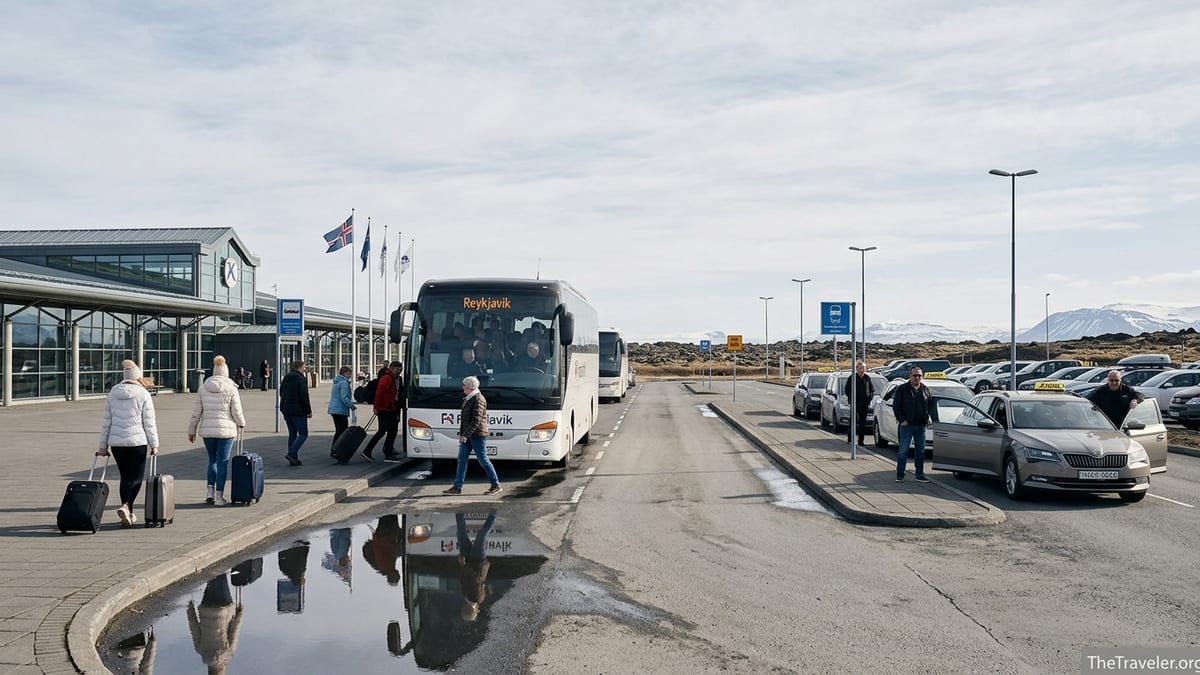
Understanding the 45‑Minute Transfer From Keflavik to Reykjavik
Keflavik International Airport (KEF) handles almost all international flights to Iceland and sits on the Reykjanes Peninsula, roughly 50 kilometres southwest of Reykjavik. With no rail link, every traveller must choose between airport coaches, public buses, taxis, private transfers or rental cars to cover the journey. In typical conditions, driving the main Route 41 highway from the airport to central Reykjavik takes about 40 to 45 minutes; during winter storms or rush hour into the capital region it can be a bit slower.
Most shared airport buses and coaches quote 45 minutes from Keflavik to the main Reykjavik terminal, which matches real‑world experience for visitors arriving on daytime flights. For example, Flybus, one of the largest providers, officially advertises around 45 minutes between KEF and the BSÍ bus terminal in Reykjavik, not including any extra time for hotel drop‑offs within the city. In practice, once you factor in collecting luggage, finding your bus, and possible hotel connections, you should expect roughly 90 minutes from aircraft door to city street.
Timing also depends on how promptly you clear the airport and whether you pre‑book. Many scheduled airport coaches run in connection with arriving flights and wait nearby, so you can usually board within 30 to 45 minutes after landing. Public bus route 55, operated by Strætó, runs less frequently and requires a short walk to an external bus stop, so total door‑to‑door time can be closer to two hours. Taxis and private transfers are fastest once you are in the car, often reaching central Reykjavik in about 40 minutes in light traffic.
For planning, assume a realistic total of 2 hours between scheduled landing and reaching your hotel if you take a shared bus with a city drop‑off. If you are connecting to domestic flights at Reykjavik’s downtown airport or meeting tour departures the same day, leave a buffer of at least 3 hours from scheduled landing to your onward commitment, particularly in winter.
Flybus and Other Airport Coaches: The Workhorse Option
For most first‑time visitors staying in central Reykjavik, the dedicated airport coach services are the most straightforward solution. The best‑known brand is Flybus, which operates frequent buses between Keflavik Airport and the BSÍ bus terminal on the edge of downtown. Buses depart roughly 30 to 60 minutes after each arriving flight and travel time to BSÍ is around 45 minutes in normal conditions. Seats are guaranteed for ticket holders, even if your flight is delayed, which makes this option attractive on busy travel days.
As of 2026, typical one‑way prices for Flybus to BSÍ are in the ballpark of 4,000 Icelandic krona per adult, with slightly higher fares if you book the version that includes drop‑off at selected hotels or the official city bus stops. Children often pay reduced fares, and round‑trip tickets usually come with modest discounts compared to two singles. While exact prices change with fuel and operating costs, Flybus remains considerably cheaper than a taxi for solo travellers or couples, especially when compared with taxi fares that can easily exceed the equivalent of 150 to 200 euros during peak times.
Flybus services stop at BSÍ as the main terminal, but many passengers continue onward via a connecting minibus or coach branded under the same company or a partner service. These connections distribute passengers to a network of official Reykjavik “bus stops” numbered around the city centre, as well as to some larger hotels that still allow direct coach access. It is common, for example, to see drop‑offs at hotels such as Fosshotel Reykjavik near the waterfront, or close to bus stops serving dense accommodation clusters near Laugavegur, the main shopping street. In many cases you will step off at a designated bus stop and walk the last 3 to 7 minutes to your hotel.
Other companies, such as Airport Direct and various shuttle operators, follow a similar model. Many of them run between Keflavik and an in‑city terminal like the Bus Hostel or a similar hub, then feed passengers to city bus stops. When comparing, look at three things: expected travel time including hotel connections, whether your specific accommodation is served directly or via a nearby stop, and the earliest and latest departure times that suit your flight. For most visitors staying in or around central Reykjavik, choosing any of the reputable airport coaches will provide a predictable, mid‑priced transfer with minimal hassle.
Strætó Public Bus 55: Cheapest But With Trade‑offs
Iceland’s public bus network Strætó operates route 55 between Keflavik Airport and the Reykjavik area. This is the budget‑friendliest option for independent travellers who do not mind a slightly longer and less convenient journey. The bus does not stop directly at the main terminal entrance; instead, the stop is a few hundred metres away near the car rental area, signposted from the terminal but not as prominent as the private airport coaches. You will need to walk there with your luggage, which can be mildly challenging in bad weather or on icy surfaces.
Route 55 typically runs every 60 to 120 minutes, depending on the time of day and day of the week, and serves several towns on the Reykjanes Peninsula before reaching the capital region. Some departures continue to BSÍ bus terminal in Reykjavik, while others terminate earlier at Fjörður in Hafnarfjörður, requiring a change to a local city bus like route 1 to reach central Reykjavik. Travel time from the airport to BSÍ with route 55 is normally around 60 to 75 minutes, but can stretch longer if you need to transfer or if traffic is heavy.
Fares on Strætó are significantly lower than dedicated airport coaches, and you pay the regular regional zone price. You can usually pay using Strætó’s Klapp payment system, via card or mobile payment, though exact procedures can change, so checking the latest guidance before travel is wise. A couple landing at noon and planning to stay in a budget hostel near Hlemmur, for example, might choose route 55 to BSÍ and then a short city bus ride or 20‑minute walk to their accommodation, saving enough compared with Flybus to cover a casual dinner.
The main downsides are frequency, comfort and predictability. Route 55 can be busy with local commuters at certain times, and seating is not guaranteed. Luggage space is more limited than on airport coaches, and it is not designed as a door‑to‑door hotel service. If you are arriving late at night or on a tight schedule to join a tour the next morning, the public bus is often not the safest logistical choice. However, for travellers on a strict budget, longer‑term visitors, or those staying near BSÍ or along the route, it is a legitimate and authentic way to reach the city.
Taxis and Private Transfers: Fastest and Most Comfortable
For travellers prioritising comfort, speed or privacy, taxis and pre‑booked private transfers from Keflavik to Reykjavik are the premium choice. The journey by car typically takes 40 to 45 minutes along Route 41 in normal conditions. You step straight from the arrivals hall into your vehicle, place luggage in the boot, and head directly to your accommodation without intermediate stops. For families with tired children, visitors with large ski or camera equipment bags, or groups arriving late at night, this can be worth the extra cost.
Iceland’s taxis are regulated and reputable, but they are undeniably expensive by most international standards. Recent examples shared by travellers and local operators suggest that a daytime taxi ride between Keflavik Airport and downtown Reykjavik for up to four passengers often costs in the region of 20,000 to 25,000 Icelandic krona, sometimes more at night, in winter or on public holidays. Some taxi companies advertise fixed or pre‑booked rates that are slightly lower than metered rides hailed on the spot, particularly if you reserve online in advance and specify your flight details.
Private transfer companies operate similarly to taxis but usually quote fixed prices upfront, with vehicle types ranging from standard sedans to minibuses and luxury SUVs. For example, a pre‑booked private minivan suitable for a family of five might cost somewhat more than a standard taxi but still be cheaper per person than buying five separate Flybus tickets with hotel drop‑off. For groups of friends sharing an apartment near Hallgrímskirkja church, a private transfer becomes cost‑competitive once you are three or four people, especially if you value getting to your door without transfers.
Night‑time arrivals are where private cars shine. If you land close to midnight in winter, when snow or ice can disrupt bus timetables, having a driver waiting in arrivals holding your name sign can remove stress. Similarly, for early‑morning departures from Keflavik, many visitors reverse this logic and book a private transfer from their hotel to the airport, leaving Reykjavik around 3 hours before their flight. While a taxi or private car is unlikely to be the cheapest choice, it offers the most straightforward experience from terminal to pillow.
Where Airport Buses Stop in Reykjavik & How Hotel Areas Work
Since 2017, Reykjavik has restricted large coach traffic in its compact city centre, which means many airport buses cannot stop directly outside smaller hotels or guesthouses. Instead, they use a system of numbered Reykjavik bus stops located around the central district. There are around 15 of these official stops, each within walking distance of clusters of accommodation. For example, travellers staying near Laugavegur, the main shopping street, are commonly directed to bus stops such as “Bus Stop 9 – Snorrabraut” or “Bus Stop 10 – Hlemmur,” from which their hotel might be a 3 to 8 minute walk with luggage.
Large hotels with off‑street coach access or located slightly outside the tightest central zone may still receive direct airport bus drop‑offs. Properties such as Fosshotel Reykjavik or some of the harbor‑area hotels near the Old Harbour sometimes feature on airport bus drop‑off lists, although this can change as city regulations evolve. In those areas, your coach or connecting minibus might stop at the hotel entrance or within a very short walk, which is especially convenient in bad weather or when travelling with multiple suitcases.
At the BSÍ bus terminal, used by Flybus and some other operators, you will find a range of onward options including city buses, taxis, and in some cases hotel connection minibuses branded separately. Travellers staying in residential neighborhoods like Vesturbær west of the centre might take the airport coach only as far as BSÍ, then continue by local bus or taxi for the final 5 to 10 minutes. Similarly, guests heading to accommodations near Kringlan shopping centre or in student districts may need to transfer to the local bus network, where Strætó routes criss‑cross the city.
Understanding your nearest official bus stop before you fly can prevent confusion when you book your ticket. Many airport bus booking engines now allow you to enter your hotel name directly, then automatically assign the correct city bus stop or confirm if hotel‑door drop‑off is available. If your guesthouse is tucked away on a side street off Laugavegur, for instance, you may get an email before arrival advising you to walk from “Bus Stop 7 – Traðarkot” or a similar point, often with a map illustrating the short final stretch on foot.
Best Transfer Options by Accommodation Area
Choosing the best transfer is easier when you think in terms of where you are staying. For the compact downtown core around Laugavegur, Austurvöllur square and the Old Harbour, the dedicated airport coaches with city bus stop connections are usually the sweet spot between cost and convenience. A couple staying at a boutique hotel near Ingólfstorg square, for example, can ride Flybus from the airport, change to a small connection bus at BSÍ, and then walk 4 minutes from their assigned bus stop to reach their front desk, all on a single combined ticket.
If you are staying slightly outside the historic centre, perhaps near Hlemmur at the upper end of Laugavegur or close to the major hotels near the waterfront, your airport bus may still stop directly at your hotel or within one short block. Families checking into larger properties such as chain hotels in the business district often find that Flybus or similar services list their hotel by name as a standard drop‑off, saving them from juggling luggage between buses. In these areas, the marginal benefit of a taxi over an airport coach diminishes unless you arrive very late or have mobility challenges.
For guests in residential neighbourhoods like Vesturbær to the west, or Laugardalur to the east, it is often most efficient to take an airport coach to BSÍ or another terminal, then transfer to a city bus or short taxi ride. A solo traveller staying in a homestay in Laugardalur might take Flybus to BSÍ, ride a Strætó city bus for 10 minutes, then walk 5 minutes to their accommodation, still spending significantly less than a taxi from the airport. On the other hand, a group of four sharing an apartment in Vesturbær may find that splitting a pre‑booked taxi from the airport to their door is only moderately more expensive per person than combining coach and city bus tickets.
If you are spending your first night near Keflavik town rather than Reykjavik, perhaps at a hotel like Park Inn by Radisson or Hotel Keflavik, transfer logic changes again. In that case, you might take a very short taxi ride from the airport, sometimes costing only a fraction of the fare to Reykjavik but still substantial for the distance. Some airport‑area hotels offer shuttles or can pre‑arrange taxis at set prices, which is helpful for very early morning departures. From these hotels, you can either take a direct airport coach into Reykjavik the next day or catch Strætó route 55 from the nearby local bus stops.
Special Situations: Late Arrivals, Early Departures and Blue Lagoon Stops
Many transatlantic flights land at Keflavik early in the morning or late in the evening, which can complicate connections. For early morning arrivals around 06:00 to 08:00, airport coaches are typically running in sync with flights, and you can expect to be in Reykjavik by around 09:00 or earlier, traffic permitting. If your hotel check‑in is later in the day, you might ask the hotel to store your bags so you can immediately explore the city. Some travellers combine the transfer with a breakfast stop at BSÍ or a short detour around the Old Harbour area before heading to their accommodation.
Late‑night arrivals, especially in winter, require more caution. While Flybus and similar services often operate until the last flights of the day, public bus route 55 may have limited or no late‑night service. If your scheduled landing is close to midnight and you experience a weather‑related delay, having a back‑up plan such as a pre‑booked taxi or private transfer can be reassuring. Likewise, if you have a very early flight out of Keflavik, staying your last night at an airport‑area hotel and taking a short taxi to the terminal before dawn can be more relaxing than leaving Reykjavik at 03:00 in uncertain weather.
Another common special case is combining the airport transfer with a visit to the Blue Lagoon, located roughly halfway between Keflavik and Reykjavik. Several companies offer packages where you board a bus at Keflavik, stop at the Blue Lagoon for a pre‑booked bathing session, then continue onwards to Reykjavik. This can be an efficient use of time, especially if you land in the morning and cannot check into your hotel until mid‑afternoon. In this scenario, your total travel time from landing to hotel becomes longer, but your jet‑lag recovery may be much better after a few hours soaking in geothermal waters.
Tour participants should also consider where their tours depart. Many day tours to the Golden Circle or South Coast leave from BSÍ or from the city bus stops system, not from individual hotels. If you are joining such a tour early the morning after you land, it can make sense to stay at a hotel within a short walk of your assigned bus stop. You might, for instance, choose accommodation near Bus Stop 10 at Hlemmur if your tour operator lists that stop for pickup, simplifying both your airport arrival and your tour departure the next day.
The Takeaway
The 45‑minute transfer from Keflavik Airport to Reykjavik is straightforward once you match your transport choice to your accommodation, budget and arrival time. For most visitors staying in or near the compact city centre, dedicated airport coaches like Flybus offer the best balance of cost, comfort and reliability, stopping either at BSÍ or at numbered bus stops within a few minutes’ walk of major hotels and guesthouses. Public bus route 55 serves cost‑conscious travellers ready to accept a longer, less convenient ride, while taxis and private transfers deliver door‑to‑door ease at a premium price that can make sense for groups or late‑night arrivals.
The most important practical step is to confirm in advance where the bus or shuttle will drop you relative to your specific hotel. That single detail determines whether your journey ends with a two‑minute stroll along a well‑lit street or a more awkward search through snow and wind. Build a modest buffer into your timing, especially in winter, and you can treat the first 45 minutes on Icelandic roads not as a hurdle but as the opening chapter of your trip, watching lava fields and distant mountains roll by as you approach the world’s northernmost capital.
FAQ
Q1. How long does it really take to get from Keflavik Airport to central Reykjavik?
In normal conditions, the drive is about 40 to 45 minutes. Once you add time for collecting luggage, finding your bus or taxi and any hotel drop‑offs, most travellers reach their accommodation 60 to 90 minutes after leaving the terminal.
Q2. What is the easiest transfer option for first‑time visitors?
For most first‑time visitors staying in central Reykjavik, an airport coach such as Flybus with hotel or city bus stop drop‑off is the easiest. You follow clear signs in arrivals, staff help direct you to the right bus, and you are delivered close to your accommodation without navigating local buses on day one.
Q3. Are taxis from Keflavik to Reykjavik worth the cost?
Taxis are expensive but can be worth it if you arrive late at night, travel with children or have limited mobility. For solo travellers they are usually far more expensive than coaches, but for three or four people sharing, especially with lots of luggage, the door‑to‑door convenience and time saved can justify the higher fare.
Q4. How do the Reykjavik city bus stops for airport coaches work?
Because large coaches are restricted in the narrow downtown streets, airport buses use numbered Reykjavik bus stops on the edge of the centre. When you book, you choose the stop closest to your hotel and walk the final few minutes. These stops are clearly signed and commonly used for both airport transfers and day tour pickups.
Q5. Is the public Strætó bus 55 a realistic option with luggage?
Yes, but it suits travellers comfortable with local transport. You need to walk to a bus stop a few hundred metres from the terminal, possibly transfer in Hafnarfjörður or at BSÍ, and manage your bags on a regular regional bus without dedicated luggage racks. It is cheaper than coaches but slower and less convenient.
Q6. What is the best transfer if my hotel is near Laugavegur?
If your accommodation is along or just off Laugavegur, an airport coach with city bus stop drop‑off is usually best. You will be assigned a nearby bus stop such as Hlemmur or a central numbered stop, and from there you will typically walk 3 to 7 minutes along well‑lit streets to your hotel or guesthouse.
Q7. How should I handle a very late‑night arrival at Keflavik?
Check that your chosen airport coach runs for your flight’s arrival time and consider a backup. If your scheduled landing is close to midnight or later, a pre‑booked taxi or private transfer provides certainty in case of delays or bad weather, ensuring you still have a ride to Reykjavik even if a bus is missed.
Q8. Can I visit the Blue Lagoon on the way to Reykjavik from the airport?
Yes. Several transfer companies offer routes that stop at the Blue Lagoon between Keflavik and Reykjavik. You pre‑book a lagoon time slot, ride from the airport to the spa, store your luggage, then continue by bus to the city afterward. It is a popular way to use the hours before hotel check‑in.
Q9. Do airport buses drop off at every hotel in Reykjavik?
No. Due to city regulations, many smaller hotels and guesthouses are served via nearby city bus stops rather than direct hotel entrances. Larger hotels with suitable access may still receive direct drop‑offs. Always check the latest stop list for your bus company and confirm the exact point you should select for your accommodation.
Q10. When is it better to stay near Keflavik Airport instead of going into Reykjavik?
Staying near the airport is sensible if you land very late at night with an early flight the next morning, or if winter weather could disrupt early‑morning road travel. In that case, booking a hotel in Keflavik town or near the terminal and using a short taxi or hotel shuttle keeps your schedule safer than a long pre‑dawn transfer to or from Reykjavik.