


More news on this day
Flight operations across the Middle East faced another wave of disruption as airports in Kuwait, Saudi Arabia and the United Arab Emirates recorded at least 441 delayed and 37 cancelled services, unsettling schedules for Akasa Air, Saudia, Airblue, Kuwait Airways, Air Arabia and several other carriers at major hubs in Jeddah, Riyadh, Kuwait City, Dubai and Sharjah.
Get the latest news straight to your inbox!
Dust, Conflict and Capacity Constraints Converge
Published coverage and operational data indicate that the latest disruption sits at the intersection of several ongoing pressures on Middle Eastern aviation. Satellite imagery from May 21 shows a broad dust plume stretching across Saudi Arabia, Kuwait, Iraq and southwestern Iran, degrading visibility and air quality across the region and periodically complicating approach and departure procedures at key airports.
These weather challenges overlay a backdrop of airspace restrictions linked to the wider regional conflict that has periodically reshaped routings and schedules since early 2026. Regulatory advisories in recent months have urged airlines to avoid multiple Middle Eastern airspaces, prompting detours, extended block times and, in some cases, preemptive cancellations on routes linking South Asia, the Gulf and Europe.
At the same time, several airports remain under capacity or operating with constrained infrastructure following earlier security incidents. Kuwait International Airport, for example, continues to manage reduced operating windows and capacity after attacks earlier in the year damaged critical facilities, with publicly available timetables and travel advisories pointing to shortened daily hours and rerouted services via alternative Saudi airports.
The combined effect is a fragile operating environment in which even modest weather or technical disruptions can cascade quickly into large numbers of delays and cancellations, particularly at heavily banked hubs such as Dubai International, Jeddah’s King Abdulaziz International, Riyadh’s King Khalid International and Sharjah International.
Gulf Hubs Struggle to Maintain Punctuality
Data compiled from flight-tracking platforms and airport information boards across the three countries indicate that Jeddah, Riyadh, Kuwait City, Dubai and Sharjah have collectively seen more than 441 delays and 37 cancellations across a rolling 24 to 36 hour period, with the majority concentrated in peak bank times. Many of these affected short and medium haul services that underpin regional connectivity and onward long haul flows.
Reports from regional aviation outlets describe congested departure halls at Dubai and Sharjah as low cost carriers attempted to re-time services and consolidate lightly loaded flights to preserve network integrity. In Saudi Arabia, Jeddah and Riyadh saw multiple waves of rolling delays as aircraft and crews struggled to maintain rotations in the face of longer routings and intermittent weather holds.
Kuwait City, already grappling with infrastructure constraints, appeared particularly vulnerable. Schedules showed clusters of delayed departures pushing into the late afternoon as the airport worked within reduced operating hours. Several services into and out of Kuwait were either rerouted via secondary points in Saudi Arabia or shifted to later operating days, creating knock-on effects for connecting traffic across the Gulf.
Across the three countries, published airport and airline updates pointed to longer minimum connection times and repeated calls for passengers to check flight status before traveling to the airport, underscoring how quickly conditions have been shifting from hour to hour.
Akasa Air, Saudia, Airblue and Kuwait Airways Among Hardest Hit
The disruption has been keenly felt by carriers that rely on dense short haul networks to and from the Gulf. India based Akasa Air, which has expanded rapidly into Kuwait, Saudi Arabia and the United Arab Emirates over the past two years, has already had to temporarily suspend and then carefully restore some services to Jeddah, Riyadh, Kuwait and Gulf points in response to previous waves of airspace and security uncertainty. The latest spike in delays and cancellations has again unsettled its schedules across the region.
Saudi flag carrier Saudia, with major hubs in Jeddah and Riyadh, has been managing rolling adjustments on high frequency routes to regional capitals such as Kuwait City, Dubai and Doha. Earlier schedule data showed the airline suspending or sharply reducing some short haul links, and the newest disruptions appear to be reinforcing that pattern of stop start operations on certain corridors.
Pakistan based Airblue, which operates important labour and visiting friends and relatives traffic flows into Jeddah and Riyadh, has also been swept up in the congestion, with delayed turnarounds in Saudi Arabia feeding into later departures back to Pakistan. The knock on impact has been particularly visible on overnight services, where late arrivals compress ground times and heighten the risk of further slippage.
Kuwait Airways, still operating under infrastructure constraints at its home base, has seen a mix of longer than usual departure delays and select cancellations on flights linking Kuwait City with Jeddah, Riyadh, Dubai and other regional hubs. Low cost player Air Arabia, anchored at Sharjah but deeply intertwined with Dubai’s wider catchment, has faced a similar pattern of targeted cancellations and widespread delays as it juggles aircraft and crew across an already tight schedule.
Knock On Impacts for Passengers and Regional Connectivity
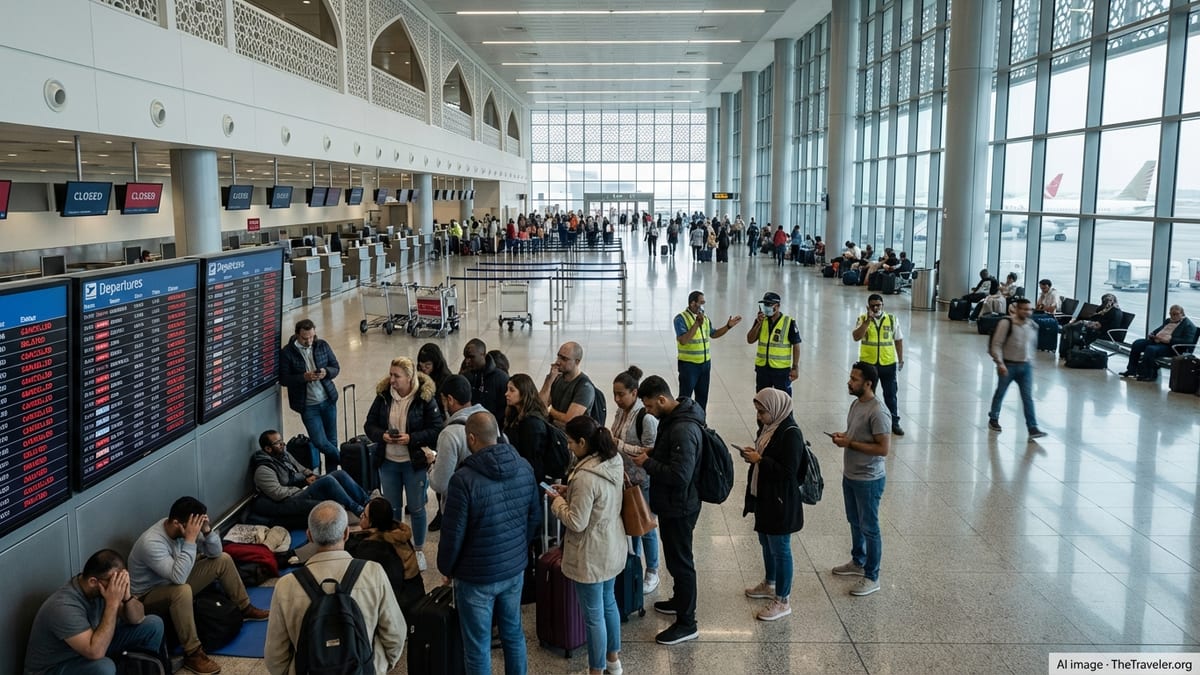
The immediate effect for passengers has been extended waits at airports, missed connections and a surge in rebooking activity on already busy alternative services. Reports from travel industry outlets describe passengers in Jeddah, Riyadh, Dubai and Sharjah facing long lines at transfer desks as airlines sought to reaccommodate travelers on later flights or reroute them via secondary Gulf hubs.
For workers and families traveling between South Asia and the Gulf, where itineraries often involve tight connections and fixed reporting dates, the combination of rolling delays and short notice cancellations has added an extra layer of uncertainty. Travel agencies active on these corridors have been advising clients to build in larger buffers and to consider more flexible ticket options where available.
The disruption is also reverberating through air cargo and belly hold freight operations. Delayed departures and aircraft swaps can lead to offloading of lower priority shipments, which in turn affects supply chains that depend on rapid movements of spare parts, perishables and high value goods between the Gulf, Europe and Asia. Logistics analysts note that repeated short term shocks of this kind can push some shippers to diversify routings away from the most congested hubs, at least temporarily.
Within the region, smaller airports that remain fully operational and less capacity constrained have seen a modest uptick in rerouted flights and additional charter activity, as airlines and charter operators look for ways to bypass the most affected hubs. However, these airports typically lack the scale and connectivity of Dubai, Jeddah, Riyadh or Kuwait City, limiting their ability to absorb large volumes of displaced traffic.
Outlook: Prolonged Period of Fragile Operations
Aviation analysts cited in recent industry coverage suggest that the Gulf and wider Middle East may be entering a prolonged period of fragile operations, where security conditions, weather patterns and infrastructure recovery timelines all interact in unpredictable ways. As long as airspace advisories remain in place and key facilities operate below normal capacity, the risk of further waves of large scale delays and cancellations will remain elevated.
Airlines are responding by trimming some frequencies, adding schedule padding and selectively redeploying capacity to routes that offer more stable operating conditions. While these measures can reduce headline disruption figures over time, they also mean fewer seats on certain high demand routes and potentially higher fares on remaining services.
For travelers, publicly available guidance increasingly emphasizes careful pre trip planning. Monitoring flight status apps, registering for airline notifications, and allowing extra time for connections are all being framed as prudent steps rather than optional precautions for those transiting Jeddah, Riyadh, Kuwait City, Dubai or Sharjah in the coming weeks.
With dust season, geopolitical tensions and infrastructure repairs all likely to continue shaping the regional aviation environment, industry observers indicate that the latest tally of 441 delays and 37 cancellations may be a sign of what could become a recurrent pattern of episodic but significant disruption across the Middle East’s busiest hubs.