


More news on this day
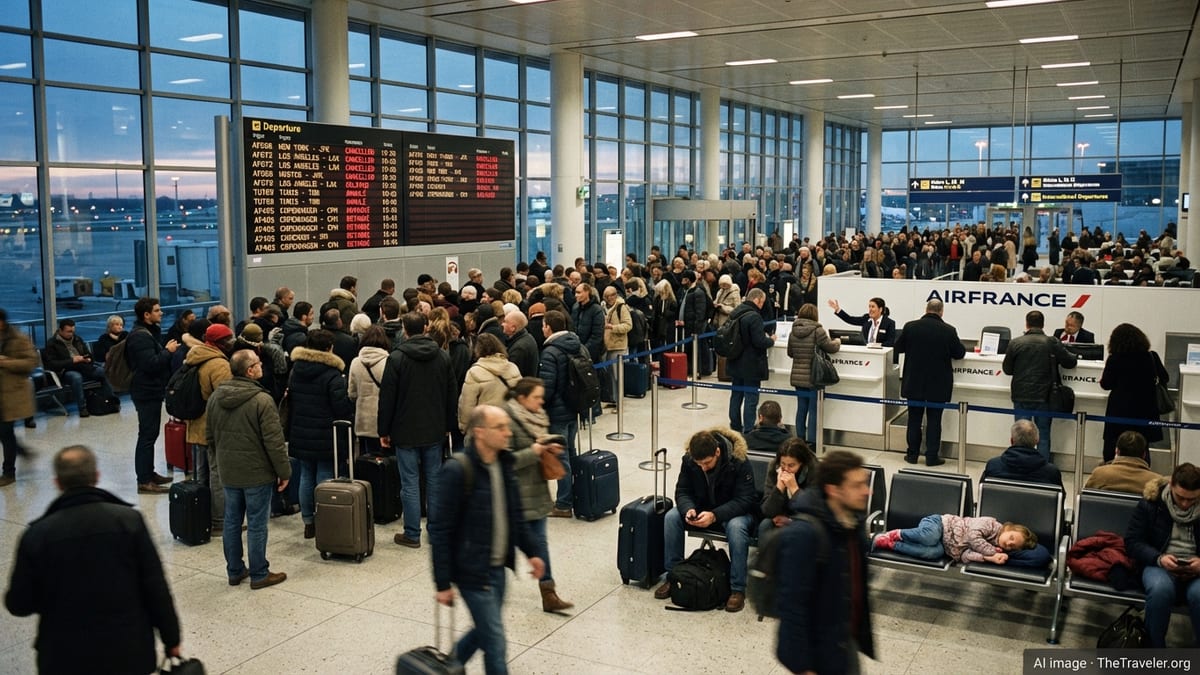
Passengers flying through France face fresh disruption in April 2026, as a cluster of cancellations involving Gulf Air, United Airlines, Lufthansa and other carriers at Paris and Nice leaves travelers stranded and key routes to Bahrain, Tel Aviv, Chicago, Munich and Frankfurt in disarray.
Get the latest news straight to your inbox!
Seven Cancellations Snarl Operations at Paris and Nice
Flight-tracking data and airport departure boards in France indicate that at least seven flights operated by or marketed through Gulf Air, United Airlines and Lufthansa were canceled across Paris Charles de Gaulle, Paris Orly and Nice Côte d’Azur in recent days. The affected services include long haul and regional links that typically feed major hubs in the Middle East, Germany and the United States, amplifying the impact beyond France.
Routes to Bahrain, Tel Aviv, Chicago, Munich and Frankfurt appear among those disrupted, with travelers reporting missed connections and overnight delays as they attempt to rebook. While the absolute number of cancellations is modest compared with systemwide disruptions seen elsewhere in Europe this year, the concentration of affected flights on high‑demand corridors has had an outsized effect on passengers relying on tight transfer windows.
Publicly available airport information suggests that the cancellations in France are part of a broader pattern tied to Middle East airspace restrictions, rolling schedule adjustments and labor tensions at European carriers. As airlines recalibrate their networks day by day, localized cancellations in markets such as Paris and Nice have become a visible symptom of deeper volatility.
Travel analysts note that France’s major airports are already under pressure from earlier winter disruption and shifting long haul patterns. The latest cancellations risk compounding operational strain during a period when carriers are trying to rebuild confidence ahead of the peak summer travel season.
Middle East Conflict and Airspace Closures Ripple Into Europe
The backdrop to the current disruption is the Middle East conflict and associated airspace closures that have triggered thousands of cancellations across the region since late February 2026. Published aviation data and news coverage describe extensive restrictions affecting Iran, Iraq, Israel, Kuwait, Qatar, Bahrain, Syria and the United Arab Emirates, forcing airlines to suspend or reroute services and, in many cases, ground parts of their fleets.
Gulf Air, based in Bahrain, has been among the carriers most directly affected, with Bahrain’s airspace restrictions and fluctuating operational permissions prompting waves of cancellations and ad hoc resumptions. Recent coverage notes that Gulf Air has progressively resumed operations from Bahrain but continues to adjust schedules and is phasing back some routes only gradually. Travelers connecting between France and Bahrain have therefore faced a fragile timetable vulnerable to sudden changes.
Tel Aviv has been particularly exposed to route suspensions from both European and North American airlines, including United and Lufthansa Group carriers. Temporary halts, reduced frequencies and altered routings have all contributed to irregular operations. In this context, each cancellation from Paris or Nice to a hub feeding Tel Aviv or Bahrain represents one more weak link in a heavily stressed network.
Industry observers point out that as long as airspace availability and security assessments remain fluid, European gateways such as Paris and Nice are likely to see intermittent cancellations on routes tied, directly or indirectly, to the Middle East. This is especially true for flights that depend on complex onward connections or overflight permissions that can change with little notice.
Lufthansa Labor Unrest Adds Pressure on German Hubs
The disruption seen on Munich and Frankfurt routes from France is also tied to separate labor issues inside Germany. Recent reports highlight strike actions by Lufthansa pilots and cabin crew in mid April 2026, which have forced the airline to cancel a large share of departures from its primary hubs on selected days. Estimates from aviation-focused outlets suggest that tens of thousands of travelers across Europe have been affected as flights are removed from the schedule or replaced on short notice.
The combination of industrial action in Germany and geopolitical disruption in the Middle East has left Lufthansa with limited flexibility to absorb additional shocks. In some cases, passengers traveling from Paris or Nice to Frankfurt or Munich for onward connections to the Middle East or North America have encountered cancellations of their initial European leg, even when long haul connections remain intact.
Commentary from passenger rights and travel organizations indicates that network carriers are increasingly forced to triage capacity, protecting certain long haul links while trimming regional feeders, especially on days when strike action or crew availability sharply reduces the number of aircraft and staff in service. That dynamic can place regional routes from France to German hubs at higher risk of last‑minute cancellation.
As a result, travelers attempting to reach Chicago, Tel Aviv or Gulf destinations via Frankfurt or Munich from Paris and Nice find themselves exposed to a double layer of uncertainty, with both their European segment and onward flight potentially subject to change.
United and Gulf Air Adjust Long Haul and Codeshare Plans
United Airlines has spent much of early 2026 recalibrating its Middle East strategy in response to regional instability. Public information from airline and travel industry publications indicates that United has temporarily suspended or reduced services to Tel Aviv and Dubai, while maintaining a limited network supported by flexible rebooking and refund policies. This has implications for transatlantic travelers using Paris as a gateway to connect to United’s long haul flights.
Where United cooperates with European partners on itineraries linking France to North America and the Middle East, any upstream change to codeshare or joint venture schedules can cascade into apparent last‑minute cancellations in the French market. Travelers booked on through tickets from Nice or Paris to Chicago, with onward connections toward the Middle East, may find their initial segments modified or removed as carriers seek to consolidate demand on fewer flights.
Gulf Air’s evolving schedule is also playing a direct role in cancellations affecting Bahrain‑bound passengers. Recent accounts from travelers and travel forums describe last minute cancellations on certain Gulf Air services in Europe, including the removal of some flights from German markets and subsequent rebooking of passengers onto other airlines. While such adjustments are often framed as safety driven and operationally necessary, they deepen the sense of unpredictability for those trying to plan journeys from France to Bahrain.
In practical terms, passengers in Paris and Nice whose trips rely on Gulf Air or United for onward connectivity to conflict affected destinations face a patchwork of rerouting and compensation practices, which can vary not only by airline but also by booking channel and ticket type.
Stranded Passengers Face Limited Options and Complex Rights
For those stranded or heavily delayed in France, the immediate challenge is finding alternative routes at short notice. Reports from passenger advocacy groups and travel communities suggest that same day rebooking on comparable itineraries is often difficult when multiple carriers are simultaneously trimming schedules. Hotel availability near airports can also tighten quickly after clusters of cancellations.
European air passenger rights regulations provide a degree of protection, including potential compensation in certain circumstances where cancellations are not directly attributable to extraordinary events such as sudden airspace closures. However, the current crisis blends operational, safety and labor factors, complicating assessments of eligibility. Passengers frequently report long processing times and the need to submit detailed documentation to pursue claims.
Travel specialists advise that affected passengers departing from or arriving in Paris and Nice monitor airline notifications closely, keep copies of all communications and formal cancellation notices, and consider the role of travel insurance for covering incidental costs such as accommodation and meals. Where possible, rebooking through airlines’ digital channels rather than at airport counters may provide quicker access to limited remaining seats.
With the broader geopolitical and labor context still unsettled, the pattern of sporadic cancellations in France is likely to persist in the short term. For travelers heading to or from Bahrain, Tel Aviv, Chicago, Munich and Frankfurt, extra buffer time, flexible tickets and contingency planning are increasingly becoming essential parts of any 2026 itinerary involving Paris or Nice.