


More news on this day
Flights are back in the air across the northeastern United States after a major telecom outage forced ground stops at several of the region’s busiest airports, but the U.S. transportation secretary is warning that disruptions and missed connections could continue to affect travelers for some time.
Get the latest news straight to your inbox!
Ground stops ripple across key Northeast hubs
Published coverage indicates that a damaged telecom line in New Jersey and a failed backup circuit triggered widespread equipment outages for air traffic facilities on Monday, halting or slowing departures at multiple major airports. The disruptions led to ground stops at Newark Liberty International and Philadelphia International, with delays quickly spreading to New York City, Boston and Washington, D.C. as controllers worked with reduced capabilities.
Reports from flight-tracking services show that commercial arrivals into Newark were effectively halted for much of the day, with no commercial flights landing there for several hours. Airlines scrubbed more than 1,000 flights and delayed thousands more across the region as crews, aircraft and passengers were left out of position. The Federal Aviation Administration said operations could only ramp back up once replacement connections were installed and tested.
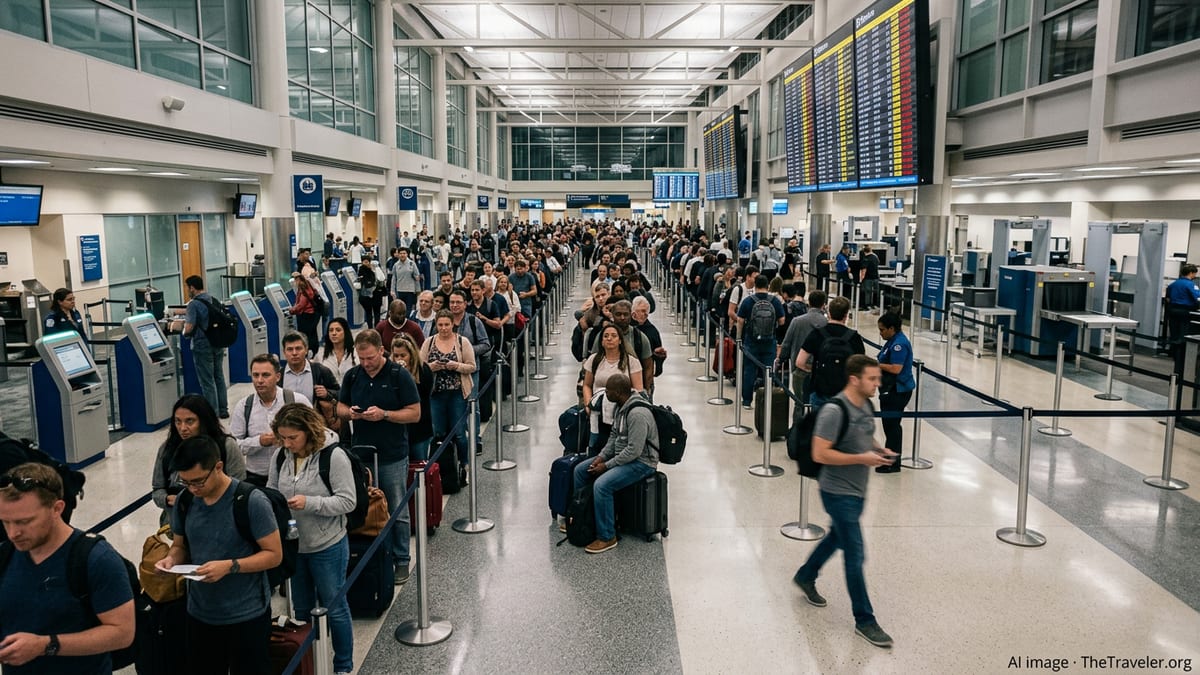
By Monday evening, publicly available information from federal transportation channels indicated that the damaged fiber lines had been repaired and that air traffic operations across the Northeast were resuming. Even as departure queues began to move again, airports continued to report long lines at security checkpoints and crowded gate areas as carriers rebooked stranded travelers.
Regional media reports from cities including Philadelphia and Boston described passengers facing waits that stretched from a few hours to overnight, with some travelers opting to return home and rebook early-morning departures rather than remain in terminals. The uneven recovery at different airports created additional bottlenecks as aircraft waited for new slots into constrained hubs.
Transportation secretary urges flyers to expect ongoing disruption
Transportation Secretary Sean Duffy used social media and broadcast interviews to caution that the return of normal flight schedules would not be immediate. Publicly available posts from the secretary’s official accounts noted that, while telecom lines had been restored and airport operations were resuming, it would take time to clear the backlog of aircraft and crews displaced by the outage.
According to coverage from national and regional outlets, Duffy urged anyone flying on Tuesday and into the week to check directly with their airline before heading to the airport. Schedules remained in flux as carriers adjusted aircraft routings, rotated standby crews into place and worked through clusters of delayed departures that had built up throughout Monday.
The secretary also highlighted the broader vulnerability revealed by the incident, pointing to aging air traffic infrastructure and the need for additional investment in critical communications systems. Public remarks emphasized that a single damaged fiber line, combined with a malfunctioning backup, should not be able to bring such a large segment of the national air network close to a standstill.
Policy-focused commentary in transportation and business publications noted that the outage arrived at a time of elevated scrutiny of airline reliability and federal oversight. While the event originated in ground-based telecom equipment, analysts observed that airlines will again face questions from travelers about customer service policies when disruptions stem from infrastructure outside a carrier’s direct control.
How travelers are being affected this week
On Tuesday, arrivals and departures were moving at major Northeast hubs, but delay statistics compiled by aviation data providers continued to show elevated numbers at airports such as Newark, Philadelphia, Boston Logan and New York’s LaGuardia and JFK. The pattern included longer-than-usual departure queues at peak times and scattered cancellations as aircraft and flight crews remained out of position.
Travel media reports indicate that some passengers have encountered missed connections on transcontinental and transatlantic itineraries, especially where tight layovers were booked through the affected hubs. In several cases, onward flights operated on time but original feeder flights arrived too late for passengers to board, forcing rebooking for later in the day or next morning.
For leisure travelers starting vacations or returning home, the main impact has been lost time and rearranged plans. For business travelers and those connecting to cruises or tours with fixed departure times, the consequences can be more significant, prompting additional accommodation and rebooking costs. Travel advisors quoted across multiple outlets are recommending that those with flexible plans give themselves extra buffer time around important events over the next couple of days.
Passengers driving to airports in the corridor from Washington to Boston have also faced heavier roadway traffic and longer curbside waits as friends and family adjust pickup and drop-off times. Some regional rail services, including Amtrak routes in the Northeast Corridor, have seen increased demand from travelers opting to switch modes rather than wait out extensive flight delays.
What flyers can do if their plans are disrupted
Consumer guidance from federal transportation resources notes that travelers whose flights are canceled have a right to a refund from the airline if they choose not to travel, even when the cause of the cancellation is a third-party outage. This applies to the unused portion of a ticket, as well as to ancillary fees such as seat selection or checked bags, in cases where the associated service was not provided.
In the case of long delays that fall short of outright cancellation, compensation is less clear-cut and depends on airline policy. Industry comparison tools maintained by federal agencies outline carrier commitments for meal vouchers, hotel accommodations and ground transportation during extended disruptions that fall within an airline’s control. Because this week’s problems have been linked to external telecom and air traffic systems, some airlines may invoke clauses that limit their responsibility for additional expenses.
Travel experts interviewed in mainstream outlets recommend that affected passengers document their delay or cancellation details, including screenshots of airline communications and boarding passes. This can assist later when requesting refunds, goodwill gestures such as frequent flier miles, or reimbursement through travel insurance or credit card benefits.
For travelers yet to depart, travel planners are advising the use of airline apps and direct text or email alerts as primary sources of real-time schedule information, rather than relying solely on airport departure boards. In situations where connections are tight through still-recovering hubs, same-day changes to earlier feeder flights can reduce the risk of misconnecting, particularly for long-haul itineraries.
Spotlight on aging infrastructure and future resilience
The outage has renewed attention on the condition of the nation’s air traffic control infrastructure. According to transportation-focused analysis, the incident appears to have originated with an aging circuit at a key facility and a backup system that failed to provide the intended redundancy. The resulting cascade affected multiple major airports that depend on those communications pathways for managing traffic flows.
Federal aviation officials have previously acknowledged the need to modernize hardware and software used in control centers, radar facilities and communications networks. Budget documents and policy discussions cited in recent coverage describe planned investments in new fiber links, enhanced backup routes and more robust monitoring systems designed to detect and isolate failures before they disrupt operations.
The timing of the failure has also spurred debate over how infrastructure projects are coordinated with other work in dense transportation corridors. Reports indicate that the damage to the telecom line occurred during construction activity in New Jersey, raising questions among lawmakers and industry groups about oversight, contingency planning and shared risk between public agencies and private contractors.
For travelers, the episode is a reminder that even on clear-weather days, air traffic can be vulnerable to issues far removed from the runway. Travel industry observers suggest that as modernization projects advance, passengers may see fewer large-scale disruptions linked to single points of failure, but they also note that short-term construction work associated with upgrades can itself create localized delays. Balancing immediate reliability with long-term resilience is likely to remain a central theme in aviation policy debates following this outage.