


Folded between Antibes’ medieval ramparts and the yachts of Port Vauban, Plage de la Gravette is one of the French Riviera’s most atmospheric small beaches. Golden sand, shallow turquoise water and a postcard backdrop of old stone walls make it a favorite stop for travelers who want to combine a swim with a stroll through old town. Before you pack your towel, it pays to understand how this compact city beach works in real life: when it gets crowded, what you should bring, and the little on-the-ground details that can turn a quick dip into a perfect Antibes day.
Get the latest updates straight to your inbox!
Getting Your Bearings: Location, Layout and First Impressions
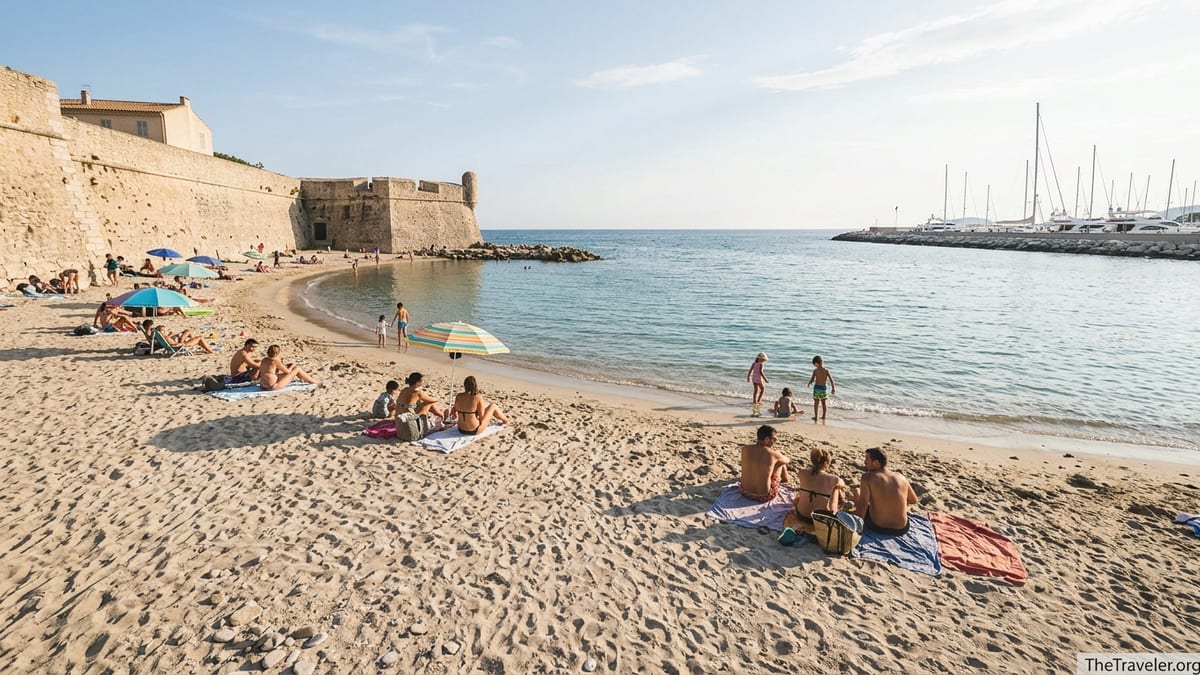
Plage de la Gravette sits directly below the ramparts of Antibes’ old town, between the entrance to Port Vauban and the historic quarter. You reach it via a gated opening in the stone walls along Quai Henri Rambaud, just a few minutes on foot from the covered Provençal market and the Picasso Museum. Many visitors first glimpse the beach from above, looking down from the rampart walkway at the curve of pale sand and the sheltered, almost lagoon-like water.
The beach itself is a small horseshoe-shaped cove, protected by stone breakwaters that keep waves low and the water calm. The sand is relatively fine by Riviera standards, though mixed with small pebbles in places. Behind the sand you have the high stone wall, while in front of you the view opens to the bay, the harbor entrance and, on clear days, the Alps in the distance. The setting feels surprisingly intimate considering you are in the middle of a busy resort town.
Unlike many Côte d’Azur beaches that are carved up between paying beach clubs and small public strips, Plage de la Gravette is entirely public. There are no rows of rented loungers or restaurant decks on the sand, which keeps the atmosphere simple and local. Families from Antibes, students, yacht crew on a break from Port Vauban and visitors who have wandered down from the old streets all share the same space. If you are staying in or near old town, this is the closest and most convenient spot for a quick daily swim.
The gates are an important detail. Local authorities typically close and lock the access gate in the evening, often around 20:00 in summer, and reopen it in the morning. On rough or stormy winter days it may stay locked altogether. If you are planning a sunset picnic on the beach, check the opening hours locally that day rather than assuming it will be accessible at night.
How to Get There and Where to Park
For most travelers, the easiest way to reach Plage de la Gravette is on foot. From Antibes train station, it is about a 10 to 15 minute walk: you follow Avenue de Verdun toward Port Vauban, pass the large Pré-aux-Pêcheurs and Q-Park Pré aux Pêcheurs parking areas, then skirt the harbor toward the old town walls. This is a flat, stroller-friendly walk and is often quicker than trying to navigate local buses in summer traffic.
If you are already in old town, almost anywhere is within a five to ten minute stroll. From the Marché Provençal, for instance, you can simply head toward the sea along Rue Aubernon or Rue de la République, then follow signs for “Plage de la Gravette.” Many people combine a morning of shopping for fruit, cheese and a baguette at the market with an impromptu picnic on Gravette’s sand just before lunchtime.
Arriving by car, parking is where most first-time visitors get caught out. Street parking around old Antibes is extremely limited, heavily controlled and in summer almost always full by late morning. Instead, plan to use one of the paid public car parks around Port Vauban or the edge of the old town. Q-Park Pré aux Pêcheurs, right by the harbor, and Q-Park La Poste on Rue Vauban are two practical examples, with typical short-stay prices starting in the ballpark of a couple of euros for under an hour and rising with length of stay. Exact tariffs change frequently and are clearly displayed at the entrance, so treat any figure you hear in advance as indicative rather than fixed.
From these car parks it is only a few minutes walk to the beach gates. In July and August, it is wise to arrive before 10:00 if you want both a reasonably priced parking space and a decent patch of sand. Later in the day, especially during school holidays and on weekends, queues at the entrance barriers can form and you may circle a while before finding a spot. If your schedule allows, visiting Gravette on a weekday morning in June or September is one of the most relaxed ways to experience it.
Facilities, Services and What You Should Bring
Because Plage de la Gravette is a completely public city beach, facilities are basic but adequate. There are freshwater beach showers just back from the waterline, useful for rinsing off salt and sand before wandering back into the old town. Public toilets are built into the ramparts outside the gate on the left as you exit, which is convenient if you are spending several hours at the beach with children.
In peak season, lifeguards are typically on duty during the main part of the day, usually July and August, with a supervised swimming zone marked by buoys. Exact dates and hours can vary each year, but if the small lifeguard post is staffed and colored flags are flying, you are within an officially monitored area. Outside those months you will often still see locals swimming, but you will not have that extra layer of supervision.
There are no sun loungers or parasols for rent directly on the sand, and no on-beach restaurant service. This is part of Gravette’s charm but also means you need to be self-sufficient. Most people bring a beach towel or lightweight folding mat, and many seasoned visitors also carry a compact travel umbrella or pop-up beach tent. The midday sun is strong from late spring to early autumn, and shaded spots against the wall disappear quickly. For food and drinks, you can either pack a picnic from the supermarkets and bakeries in old town or pick up snacks at small kiosks and cafes just outside the walls near the harbor and along Boulevard d’Aguillon.
If you like to swim in comfort, consider bringing water shoes. While much of the seabed is sandy, there are scattered rocks and occasional patches of gravel, especially just where the water deepens. Families often find that simple neoprene beach shoes from mainstream sports chains make it easier for children to run in and out of the shallows without complaint. A small dry bag is also useful if you want to keep your phone and a bit of cash safe while you go in the water, as there are no lockers on site.
Water Conditions, Safety and Seasonal Factors
The geography of Plage de la Gravette makes it one of the more sheltered swimming spots in Antibes. Stone breakwaters at the mouth of the cove protect it from larger swells, and the gently sloping seabed means the water near the shore is shallow and usually calm. This is precisely why many local families choose it for young children or less confident swimmers. On a typical summer morning, you will see toddlers paddling with inflatable rings close to shore while older kids snorkel along the rocks at the edges of the bay.
Water quality has fluctuated in the past, as at many urban beaches on the Riviera, but in recent seasons there has been notable improvement thanks to upgraded local infrastructure and regular monitoring. French public health authorities update swimming advisories through official channels throughout the summer. In practice, if the beach is open, locals are in the water and no warning signs or red flags are posted, conditions are generally acceptable by typical holiday standards. After very heavy rainfall, it can be worth checking locally whether any temporary advisories are in place.
Jellyfish are another seasonal consideration along this stretch of coast. In some summers, particularly after periods of warm, calm weather, small blooms of jellyfish can drift close to shore. Local lifeguards and town services sometimes put out nets or display notices when this happens, and you may notice many swimmers choosing to wade only in the shallows on those days. Moderate stings are annoying rather than dangerous for most people, but if you are traveling with small children or have a known allergy, it is sensible to carry basic after-sting lotion or ask a pharmacist in town to recommend a suitable product.
General safety is similar to other busy Mediterranean city beaches. Pickpocketing is not rampant but can occur when bags are left open or unattended while everyone in a group swims at the same time. Many regulars adopt simple habits: leaving valuables locked at their accommodation, using a small anti-theft pouch that stays with someone on shore, or taking turns to swim so one adult always stays with the bags. At night the gates are closed and police patrol the port area, so Gravette is not a place where people linger on the sand until the early hours.
When to Go and How to Avoid the Crowds
The experience of Plage de la Gravette changes dramatically between seasons and even between hours of the day. In July and August, particularly in the afternoon, the beach can feel completely packed, with towels touching and almost no free sand between families. Reviews from recent summers often describe the small cove as “overcrowded” during this period. If you are visiting at this time of year and want to enjoy it, timing is everything.
Early morning is the sweet spot in high season. Arriving between 8:00 and 9:00 gives you a chance to claim a place near the water’s edge and enjoy up to two or three relatively peaceful hours before the late-morning rush. Many locals swim or sunbathe early, then leave around lunch when the heat and crowds peak. If you prefer evenings, aim for the late afternoon window before the gate closes, roughly from 17:00 to just before sunset, when families with small children start to pack up but the water is still warm.
Shoulder season, from late May into June and again in September, can be ideal if your schedule is flexible. Air and sea temperatures are usually pleasant, the old town is lively but not yet at its busiest, and you can still find space on the sand late into the morning. In a typical first week of June, for example, you might arrive at 10:30 and still have a reasonably generous patch of beach. In contrast, during an August public holiday weekend, you could find the sand already full by 9:30.
Winter brings a completely different charm. On bright sunny days from November to March, Gravette becomes a relaxed sun trap. The high ramparts often block the wind, and locals use the beach more as an outdoor lounge than a swimming spot. You will see people sitting on the stone ledge or on blankets in their everyday clothes, eating baguette sandwiches, reading newspapers and enjoying the low, warm sun. Hardy swimmers from Antibes dip in the water year-round, so if you travel in the off-season and enjoy cold-water swims, bring a light wetsuit and join them for a quick invigorating plunge.
Who Will Love Plage de la Gravette (and Who Might Not)
Plage de la Gravette is particularly well suited to travelers who value convenience and atmosphere over wide open space. If you are staying in or near old Antibes without a car and want to integrate a daily swim into your sightseeing, it is hard to beat. Parents with young children appreciate the shallow water, protection from waves and the ease of combining the beach with nap-time walks through the pedestrian streets nearby.
Couples and solo travelers often use Gravette as a flexible base: a quick morning swim before coffee at a terrace café around Place Nationale, or a late-afternoon dip after visiting the Picasso Museum. Yacht crew based in Port Vauban frequently drop down to the sand for an hour on break, and students or remote workers living in Antibes may spend part of their lunch hour sitting on the wall overlooking the water. If you enjoy observing everyday local life as much as swimming, this mix of users is part of Gravette’s appeal.
The beach is less well suited to visitors who crave space, quiet and a long seafront stroll. In peak season, the small cove feels busy, and there is no long stretch of sand for beach running or extended walks. If you are imagining an uncrowded, semi-wild bay, you might feel disappointed. In that case, consider using Gravette for one or two short swims and spending your main beach days at larger nearby spots such as Plage de la Salis or the public section of Plage de la Garoupe on Cap d’Antibes, both accessible by a short bus ride or drive.
Accessibility is another factor. Access to Gravette involves a gentle slope and some firm sand, which many visitors with limited mobility can manage, but it is not as barrier-free as some more modern, purpose-built beaches with dedicated ramps, boardwalks and amphibious wheelchairs. If step-free access and structured support are priorities, it can be worth asking your hotel to recommend the most suitable nearby beach and current assistance options, as these can change from one season to the next.
Practical Etiquette, Local Rules and Cultural Nuances
As on all French public beaches, a few simple rules and customs keep things running smoothly. Official signage at the gate indicates that dogs are prohibited in season, and you are unlikely to see pets on the sand during busy months. That said, in winter and at quiet times some locals may bring a dog for a short walk along the waterline, using a bit of common sense when the beach is almost empty. If you are traveling with a dog in summer, plan to use other designated areas rather than Gravette.
Topless sunbathing is generally accepted on many French beaches, but at Gravette the crowd tends to be more family-oriented and modest compared with some longer stretches of coast. You will usually see a mix of standard swimsuits and bikinis, with occasional topless sunbathers, and most people choose something relatively discreet. Swimwear covering more of the body, including modest suits or burkinis, appears increasingly often; attitudes on the ground vary, but recent visitors report that as long as behavior is respectful and you are there to swim, you are unlikely to attract more than the occasional glance.
Smoking is common on Mediterranean beaches, although French municipalities are gradually extending smoke-free zones. You may encounter someone smoking on their towel nearby, so if you are sensitive to smoke, it is worth scanning who is around you before settling. Music via portable speakers is generally tolerated at low volume, but blasting loud playlists in a confined cove like Gravette is frowned upon; the unspoken rule is to keep your sound to your immediate towel radius and use headphones when in doubt.
Food and drink etiquette is straightforward. Picnics are welcome, and many locals bring salads, fruit and baguette sandwiches for lunch. Glass bottles are officially discouraged because of the risk of breakage on the sand, and leaving rubbish behind is heavily frowned on. There are bins at the entrance and along the port; use them even if it means carrying your trash a short distance. Open drunkenness is rare, and you are as likely to see people sipping canned soft drinks or chilled water as beer or wine.
The Takeaway
Plage de la Gravette offers something unusual on a famously polished stretch of coast: a central, fully public, no-frills beach with an undeniably cinematic setting, yet a thoroughly everyday local life running through it. Its proximity to Antibes’ old streets, markets and harbor makes it one of the easiest places to slip a genuine Mediterranean swim into a busy sightseeing itinerary.
Go in with the right expectations and a bit of planning and it will reward you. Accept that in July and August the sand will be crowded and the atmosphere lively rather than tranquil. Bring your own shade, a picnic and simple beach gear, and think of Gravette as a convenient urban cove rather than a spacious resort beach. Time your visits for early mornings or shoulder season if you can.
Used this way, Plage de la Gravette becomes less a box to tick and more a familiar pocket of Antibes life. It is the place where you rinse the market dust off your feet, where your children learn to jump waves in safe shallows, and where you might sit on the wall after a last swim, watching the light fade over the boats of Port Vauban. For many visitors, that combination of ease and atmosphere is exactly what a Riviera holiday is meant to feel like.
FAQ
Q1. Is Plage de la Gravette suitable for young children?
Yes. The bay is sheltered, the water near the shore is shallow and usually calm, and in high summer a supervised swimming area with lifeguards is typically in place.
Q2. Are there toilets and showers at the beach?
Yes. There are basic freshwater showers on the sand and public toilets built into the rampart wall just outside the beach entrance, a short walk from the gate.
Q3. Can I rent sun loungers or umbrellas at Plage de la Gravette?
No. Gravette is a fully public beach without private clubs, so there are no lounger or umbrella rentals. Most visitors bring their own towels and compact shade.
Q4. How crowded does the beach get in summer?
In July and August the small cove can feel very crowded from late morning through the afternoon. Arriving before 9:00 or visiting in June or September is more comfortable.
Q5. Is the beach open at night?
No. The access gates are normally locked in the evening, around early night hours, and reopened in the morning. Exact times can vary, so check locally on the day.
Q6. What is the best way to get there without a car?
The easiest option is to walk from Antibes train station or any part of the old town. The beach is around 10 to 15 minutes on foot from the station along flat streets.
Q7. Is the water clean enough for swimming?
Water quality is regularly monitored and has improved in recent years. When the beach is open and no warning flags are posted, locals commonly swim without concern.
Q8. Are there places to buy food and drinks nearby?
Yes. While there are no restaurants on the sand, you will find cafés, bakeries and small supermarkets a few minutes away in the old town and around the harbor.
Q9. Is Plage de la Gravette accessible in winter?
Often yes, especially on calm, sunny days, though the gate may stay closed during storms. In winter it is more of a quiet sunbathing and walking spot than a busy beach.
Q10. Are there better options nearby if I want more space?
If you prefer a larger beach, consider Plage de la Salis or the public section of Plage de la Garoupe on Cap d’Antibes, both a short bus ride or drive from the old town.