


More news on this day
Passengers traveling through Queen Alia International Airport in Amman, Jordan, faced a difficult travel day after publicly available data showed 21 delayed flights and two cancellations affecting a range of regional and international routes, including services operated by Royal Jordanian, flydubai, Turkish Airlines, Qatar Airways and Emirates.
Get the latest news straight to your inbox!
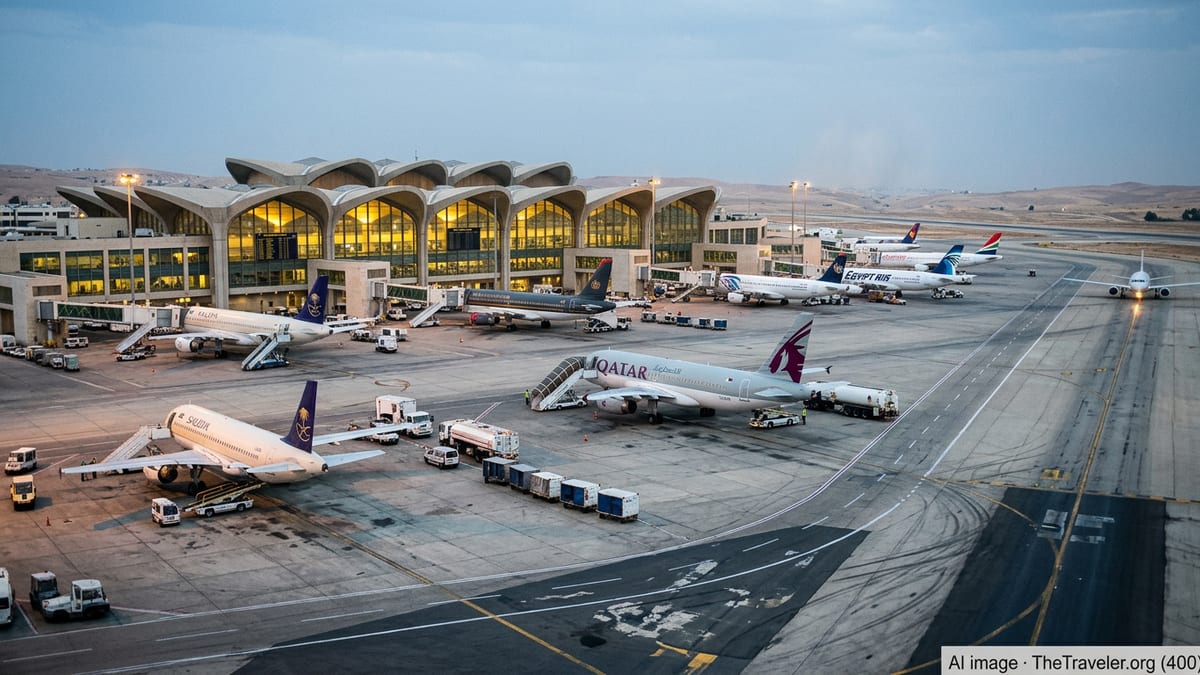
Targeted Disruptions Across Key Middle East and Europe Routes
Reports indicate that the disruption at Queen Alia International Airport centered on some of the airport’s busiest regional corridors, notably flights to Dubai, Doha and Istanbul. Services to major Gulf hubs are critical for both point to point travel and onward long haul connections, meaning even a relatively small number of delayed or canceled flights can have an outsized effect on passenger journeys.
Published coverage of the incident notes that additional routes to Riyadh, London and Paris were also affected, illustrating how operational issues at a single airport can ripple into European networks and beyond. With Royal Jordanian using Amman as its primary hub and Gulf and Turkish carriers feeding large transfer operations from their own bases, irregular operations in Amman can quickly translate into missed connections across Asia, Europe and North America.
The pattern of 21 delayed departures alongside just two cancellations suggests airlines operating at Queen Alia largely opted to keep aircraft and crews in the system, even at the cost of extended turnaround times. For travelers, this likely translated into rolling delays at departure gates, frequent schedule updates and uncertainty around onward connections.
Impact on Major Carriers and Passenger Itineraries
Royal Jordanian, Jordan’s flag carrier and the dominant airline at Queen Alia International Airport, appeared among the most exposed to the disruption due to its extensive schedule from Amman to cities across the Middle East, Europe and North America. When hub operations are affected, even modest delays on early flights can cascade throughout the day as aircraft and crews circulate through tightly timed rotations.
Low cost and hybrid carriers such as flydubai, as well as full service airlines including Turkish Airlines, Qatar Airways and Emirates, were also listed among the affected operators. These airlines typically operate multiple daily frequencies between their hubs and Amman, meaning a delayed departure from Jordan can feed into late arrivals at hubs like Dubai, Doha and Istanbul, where aircraft may then be assigned to additional onward routes.
For passengers, the practical impact depended heavily on itinerary. Travelers ending their journeys in Amman or in a single onward destination often faced several hours of delay, while those with tight connections risked misconnecting and requiring rebooking. Publicly available accounts from recent regional disruption patterns show that even when only a handful of flights are formally canceled, extensive delays can still result in missed meetings, lost vacation time and additional accommodation costs for travelers forced to remain overnight.
Operational and Seasonal Context at Queen Alia
Queen Alia International Airport serves as Jordan’s main international gateway and has seen traffic rebuild in recent years on the back of growing tourism and renewed business travel. As at many regional hubs, flight schedules are concentrated around morning and late evening banks designed to maximize connections, which can heighten the impact when irregular operations occur during peak periods.
Industry data for the broader Middle East region in mid 2026 points to generally resilient airport operations, but with pockets of intermittent delay tied to capacity constraints, aircraft rotation challenges and busy summer demand. Logistics bulletins and regional aviation updates have repeatedly noted that airports across the Gulf and Levant remain operational while still experiencing occasional schedule adjustments and congestion during peak hours.
Within this context, a single day in which more than twenty flights at Queen Alia are recorded as delayed stands out as a notable operational event, even if total cancellations remain limited. The disruption underscores how tight scheduling, high load factors and complex international routings can leave little margin when minor issues accumulate.
Guidance for Travelers Using Amman as a Gateway
For travelers planning to transit through Amman in the coming weeks, publicly available patterns from similar operational days suggest several practical steps can help manage risk. Building longer connection windows between flights can provide a buffer when an inbound service experiences moderate delay, particularly for itineraries connecting onto long haul departures from Gulf or European hubs.
Passenger advisories and airline communications across the region consistently emphasize the value of monitoring flight status through official airline channels and airport information boards, rather than relying solely on static itinerary documents. Realtime updates are increasingly delivered via mobile apps and SMS messages, which can help travelers adjust plans quickly if departure times shift or a cancellation occurs.
Travel insurance policies that cover delays and missed connections may also provide some financial protection when disruptions escalate. Coverage terms vary, but many products offer compensation for extended delays, overnight stays or rebooking costs once a specified threshold is reached, which can be particularly relevant when a sequence of delays results in a missed onward flight.
Broader Regional Reliability and Outlook
Despite the disruption recorded at Queen Alia International Airport, publicly available flight tracking data and recent traveler reports continue to describe overall operations in Amman as relatively stable. While specific days have seen clusters of delays, the airport remains fully operational, and most airlines continue to run their published schedules to and from Jordan.
More broadly, hub carriers in Dubai, Doha and Istanbul have maintained extensive global networks in mid 2026, even as they manage seasonal peaks in passenger demand and occasional weather or air traffic control constraints in other parts of their systems. The incident in Amman appears at this stage to be a localized operational challenge, rather than a sign of systemic disruption to regional air transport.
For travelers, the key takeaway from the latest day of delays at Queen Alia is the importance of preparation and flexibility when flying through busy international hubs. As traffic continues to rise across the Middle East, even airports with strong reliability records can experience days of concentrated disruption that test airline contingency plans and passenger patience alike.