


More news on this day
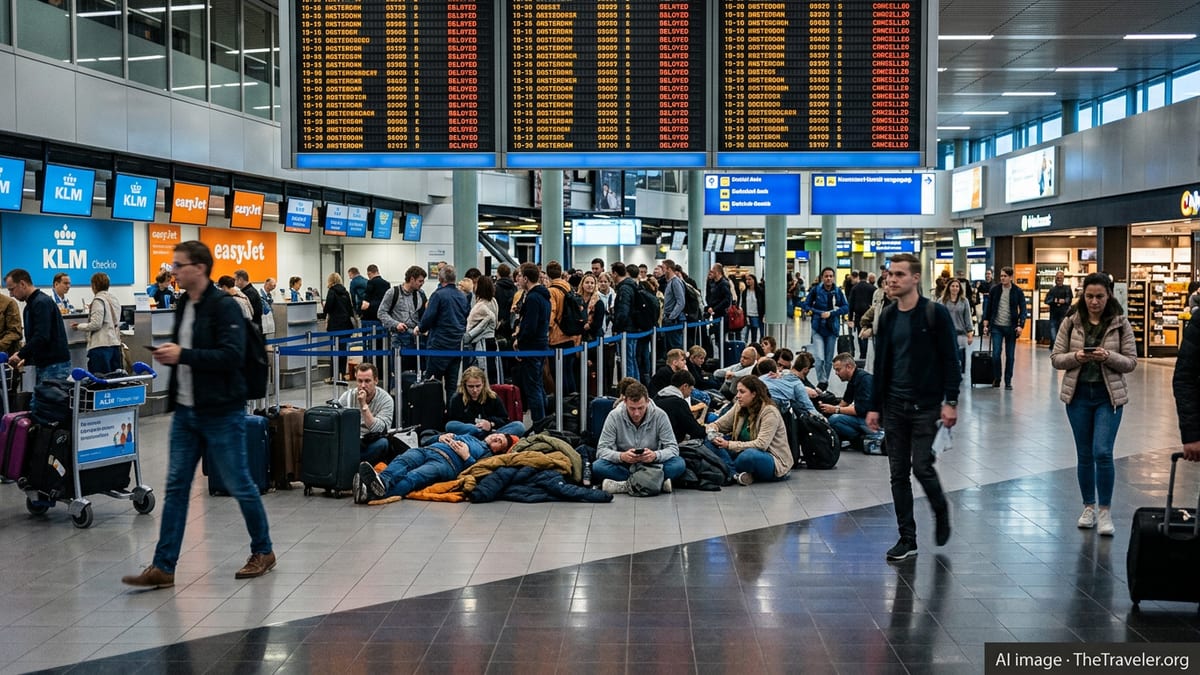
Hundreds of travelers were left stranded at Amsterdam Schiphol Airport in the Netherlands after operational data showed 432 flights delayed and 32 canceled in a single day, disrupting a wide range of domestic, European, and long haul services operated by KLM, Delta Air Lines, British Airways, Lufthansa, Emirates, and other global carriers.
Get the latest news straight to your inbox!
Major Hub Grinds to a Near Standstill
Amsterdam Schiphol, one of Europe’s busiest aviation hubs, experienced severe schedule disruption as delays and cancellations rippled across its departure and arrival banks. Publicly available flight-tracking data and industry reports indicate that 432 flights were delayed and 32 canceled, affecting both point-to-point services and connecting itineraries across the airport’s extensive network.
The interruption hit at the height of a busy travel period, amplifying the impact on passengers heading to and from major destinations such as London, New York, Paris, Dubai, Frankfurt, Singapore, and Toronto. With Schiphol serving as a key transfer point for transatlantic and intercontinental journeys, the disruption extended well beyond the Netherlands to airports throughout Europe, North America, the Middle East, and Asia.
Operations at large hubs are highly interdependent, and even short-lived problems can quickly escalate into widespread delays. Once early rotations slip out of their scheduled slots, aircraft and crews may not be in the correct locations for subsequent flights, leading to a cascade of missed connections, aircraft swaps, and last-minute schedule changes.
On the day of the disruption, images and accounts shared on public platforms showed busy terminal halls, with passengers clustered around departure boards and service counters as they sought updated information and alternative travel plans.
Multiple Global Airlines Affected
The wave of delays and cancellations affected a broad mix of airlines using Schiphol as either a primary hub, a focus city, or a key destination. Flag carrier KLM bore a sizable portion of the disruption because of its extensive short haul and long haul network from Amsterdam, but international partners and competitors were also swept up in the turbulence.
Published coverage highlights interruptions to flights operated by Delta Air Lines, British Airways, Lufthansa, Emirates, and several other European and intercontinental carriers. Services on heavily traveled city pairs, including Amsterdam to London, New York, Paris, Dubai, Frankfurt, and beyond, saw aircraft held at gates or on the apron awaiting new departure slots, while some rotations were dropped from the schedule altogether.
For many airlines, tight aircraft utilization means there is limited buffer in the system. When one flight is severely delayed, the same aircraft may no longer be available for its subsequent sector, forcing schedule reshuffles or cancellations. As multiple carriers contend for limited runway and air traffic capacity in the same time window, the scope of disruption can broaden rapidly.
Carrier coordination within alliances and joint ventures can offer some flexibility, allowing passengers to be rebooked on partner flights where seats are available. However, reports from recent disruption events at Schiphol suggest that spare capacity during peak periods is often limited, leaving many travelers with lengthy waits for the next available departure.
Stranded Passengers Face Long Queues and Missed Connections
The immediate human impact of 432 delayed and 32 canceled flights was visible inside Schiphol’s terminals. Travelers reported long lines at airline service desks, automated kiosks, and baggage counters as they attempted to rebook onward journeys, reclaim luggage, or secure hotel vouchers and meal support where applicable.
Missed connections were a major issue, particularly for passengers traveling between Europe and long haul destinations in North America, the Middle East, and Asia. Once a feeder flight into Amsterdam arrived late, connecting travelers often found their onward departure already boarding, closed, or canceled, forcing them onto later flights and, in some cases, requiring overnight stays.
Families and business travelers alike faced extended waits in seating areas and food courts, with some passengers documenting crowded gate areas and busy airport hotels. With hotel rooms near the airport quickly filling up, late-arriving travelers in past disruption episodes have sometimes been directed to accommodation further from the terminal, adding to journey times and logistical complexity.
In addition to schedule uncertainty, baggage handling can become strained during large scale disruption. Bags may be offloaded from missed connections and temporarily stored, while retagging and rerouting luggage for rebooked passengers can take time, increasing the risk of delayed or misdirected baggage on subsequent flights.
Passenger Rights and Practical Steps for Travelers
The situation at Schiphol highlights the importance for passengers of understanding their rights and the practical measures that can reduce the impact of sudden disruption. Publicly available information on European passenger protection rules explains that travelers whose flights are significantly delayed or canceled may, in certain circumstances, be entitled to assistance such as meals, refreshments, hotel accommodation, and transport between the airport and their lodging.
Eligibility for financial compensation usually depends on factors such as the length of delay, the route, and whether the disruption falls within the airline’s control. For example, technical issues or internal operational problems may trigger compensation obligations, while severe weather or air traffic control restrictions are often categorized as extraordinary circumstances, where compensation may not apply even though care and assistance still can.
Travel rights organizations and consumer platforms consistently advise passengers to retain boarding passes, booking confirmations, and receipts for expenses such as meals, hotels, and ground transport when caught in major disruption. These documents can be essential when making claims through airlines, travel insurers, or specialized claims services after the journey.
Experts also emphasize the value of proactive monitoring. Keeping a close eye on airline apps, airport information boards, and communication from travel providers can help passengers react more quickly to gate changes, rolling delays, or sudden cancellations, and may improve the chances of securing earlier rebooking options before seats are taken.
Ongoing Vulnerability at Europe’s Busiest Airports
The latest disruption at Amsterdam Schiphol comes against a broader backdrop of recurring delays and cancellations across Europe’s major aviation hubs. Recent months have seen multiple days where weather systems, staffing constraints, air traffic control restrictions, or technical issues have led to hundreds or even thousands of flight disruptions across the continent.
Schiphol’s extensive role as both an origin and connecting airport means that disturbances there can quickly reverberate through airline networks, from regional European routes to long haul flights linking multiple continents. When aircraft and crew rotations are knocked out of sequence, the effects can be felt for days as carriers work to restore schedules.
Industry observers note that as demand for air travel remains strong, networks are often operating close to capacity, particularly during peak travel seasons. This leaves limited room for recovery when a major operational event occurs, whether it is a ground handling issue, a system outage, or deteriorating weather that reduces runway throughput.
For travelers planning itineraries that route through major hubs like Amsterdam, Frankfurt, London, or Paris, the Schiphol episode serves as a reminder of the benefits of allowing additional connection time, traveling with flexible tickets where possible, and maintaining contingency plans in case of extended delays or cancellations.