


More news on this day
Travelers moving through Mexico City’s two main airports on May 24 faced mounting delays and cancellations, as at least 55 flights were reported delayed and 8 canceled across Mexico City International Airport and Felipe Ángeles International Airport, disrupting busy domestic and international routes operated by Aeroméxico, Volaris, VivaAerobus and other carriers.
Get the latest news straight to your inbox!
Operational Strain Hits Mexico City’s Air Network
Mexico City International Airport, officially known as Licenciado Benito Juárez International Airport, remained the primary flashpoint for disruptions, with a series of knock-on delays rippling through already congested schedules. Publicly available airport and airline data for Sunday showed multiple departures and arrivals running behind schedule as airlines struggled to turn aircraft around during one of the busier late-May travel weekends.
Published coverage and live flight tracking tools indicated that the delays affected a mix of short-haul and medium-haul services, many of them linking the capital with major Mexican hubs such as Cancún and Guadalajara, as well as international cities in North and Central America. Several carriers appeared to hold departures on the ground while awaiting connecting passengers and aircraft, a pattern that contributed to a chain reaction of late operations throughout the day.
Felipe Ángeles International Airport at Santa Lucía, which serves as the capital region’s second major passenger gateway, also registered delays and isolated cancellations, underscoring the wider strain on Mexico City’s air network. While operations there were lighter than at Benito Juárez, the combined effect across both airports was enough to upend travel plans for hundreds of passengers.
Observers of the Mexican aviation market note that Mexico City’s dual-airport system already operates close to its practical capacity during peak periods, leaving limited margin to absorb schedule disruptions once they begin to accumulate. That structural tightness appeared to be on display as delays at one facility quickly echoed through the other.
Domestic Routes to Beach and Business Hubs Affected
The bulk of the disruptions centered on heavily trafficked domestic routes linking the capital with leisure and business destinations. Flights to and from Cancún, one of Mexico’s busiest resort gateways, experienced notable schedule deviations, with some services departing or arriving significantly behind their planned times. Connections to Guadalajara, another critical node in the national network, also saw slower-than-normal operations.
Publicly available information from airline timetables and status pages showed that Aeroméxico, Volaris and VivaAerobus all had delayed services on Sunday, particularly on trunk routes that typically operate at high load factors. These delays created additional pressure on airport resources such as gates and ground handling teams, as late-arriving aircraft compressed turnaround windows for subsequent departures.
Secondary domestic markets were not immune. Routes connecting Mexico City with regional centers in the Yucatán Peninsula, the Bajío industrial corridor and the country’s northern border region showed sporadic delays as airlines attempted to rebalance aircraft rotations. In several cases, same-aircraft sequencing meant that a late arrival from one city translated directly into a delayed departure to another.
Travel advisories issued by airlines in recent months have consistently highlighted how weather variations, airspace congestion and maintenance requirements can combine to disrupt operations, especially on high-frequency domestic routes. Sunday’s pattern of delays in and out of Mexico City appeared to mirror those broader regional challenges.
International Connections Experience Knock-On Delays
While domestic services bore the brunt of the disruption, a number of international flights also encountered delays as the day progressed. Published data from global flight tracking platforms showed Mexico City departures to several major North American and Central American destinations departing behind schedule or arriving later than planned, as late inbound aircraft and congestion at gates created bottlenecks.
For connecting passengers, the ripple effects were especially acute. Mexico City functions as a key transfer hub for travelers linking regional Mexican cities with long-haul services to the United States, Canada, South America and Europe. When short-haul feeder flights arrive late, airlines can face difficult choices between protecting onward connections for some passengers and maintaining schedule integrity for others.
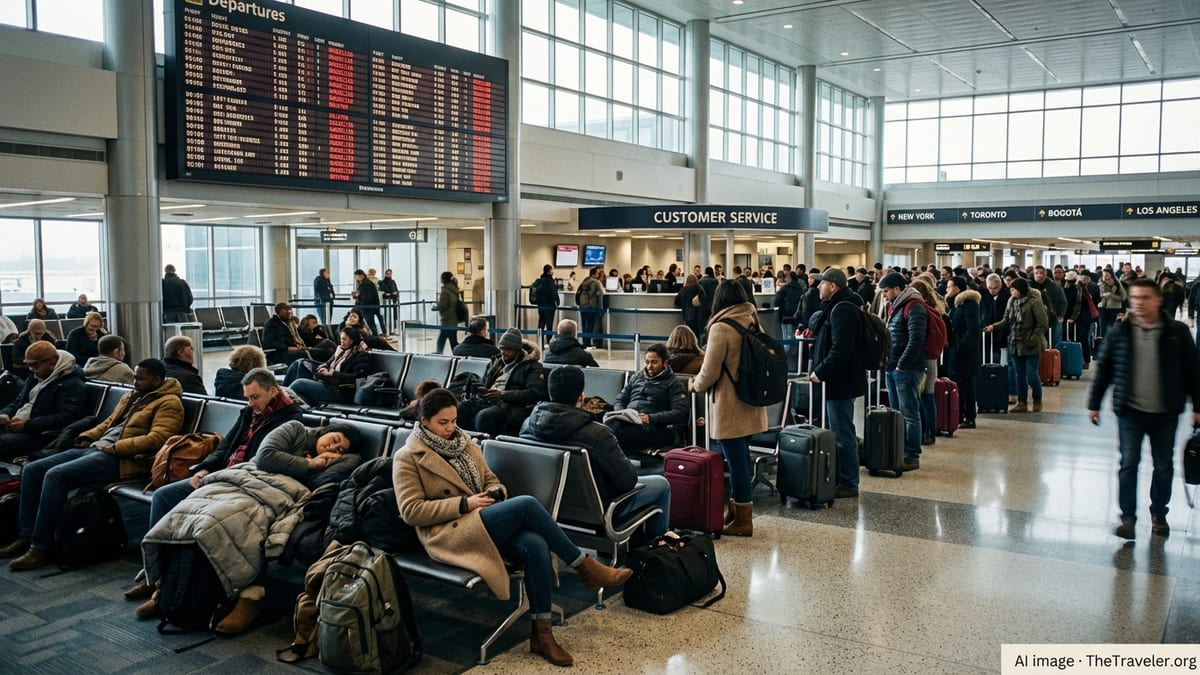
Although only a handful of international flights were formally canceled, the cumulative impact of rolling delays meant that many travelers faced missed connections, extended layovers and, in some cases, same-day rebooking challenges. Publicly available information from consumer forums and social media highlighted long lines at customer service counters and crowded boarding areas as passengers sought alternative routings.
Analysts note that Mexico City’s position as a connecting hub means that even relatively small clusters of delays on domestic sectors can magnify quickly into more visible disruptions on international routes, particularly during peak weekend travel windows.
Ground Transport and Airport Services Add to Passenger Frustration
The strain on flight operations coincided with pressure on ground transport links and airport services in the capital region. Recent notices indicated that the Aerotrén shuttle connecting the two terminals at Benito Juárez was scheduled for maintenance-related suspension over the same weekend, requiring travelers to rely on alternative ground connections between terminals. This added extra time and uncertainty for those attempting to make tight connections between domestic and international flights.
In parallel, the growing role of Felipe Ángeles International Airport has increased demand on public and private transport serving the Santa Lucía facility. Travelers reported longer-than-expected transfer times between central Mexico City and the new airport, particularly during peak traffic hours, which further narrowed the margin for error when flights were delayed or gate changes were announced at short notice.
Within the terminals, high passenger volumes intensified queues at security checkpoints, airline counters and immigration desks. Observers noted that, under such conditions, even modest operational hiccups can translate into visible congestion and heightened frustration as travelers attempt to navigate unfamiliar layouts or adjust plans on the fly.
Mexico City’s airport operators have been working on long-term capacity and modernization projects designed to ease these bottlenecks, but many of those initiatives remain in planning or early implementation phases. In the near term, passengers continue to face the reality of navigating busy facilities where schedule resilience is limited during peak travel periods.
What Travelers Should Expect in the Coming Days
Based on current patterns and recent experience at Mexico City’s airports, travel watchers expect that schedules could remain sensitive to disruption in the short term, particularly if adverse weather, airspace congestion or aircraft rotation issues persist. As of Sunday evening, most airlines were attempting to recover their operations by adjusting departure times, swapping aircraft and consolidating lightly booked services where possible.
Consumer guidance from airlines and aviation agencies consistently encourages passengers traveling through Mexico City to monitor their flight status frequently on the day of departure and to allow extra time at the airport, especially when connecting between terminals or between the city’s two airports. Travelers with complex itineraries, tight layovers or checked baggage are often advised to build in a larger buffer than the minimum connection time printed on their tickets.
Passenger rights frameworks in Mexico and in key international markets provide for compensation or assistance in certain circumstances, particularly when significant delays or cancellations are within the control of the carrier. However, the applicability of those protections can vary based on the cause of disruption and the ticket type, prompting consumer advocates to urge travelers to review fare rules and keep records of delays, expenses and communications.
As airlines such as Aeroméxico, Volaris and VivaAerobus continue to expand networks anchored on Mexico City, operational reliability at both Benito Juárez and Felipe Ángeles remains a critical factor for the country’s broader tourism and business travel outlook. The latest wave of delays and cancellations reinforces how quickly strain at a single hub can reverberate across domestic and international routes for an entire day’s worth of flying.