


More news on this day
Thousands of travelers across the Gulf are grappling with abrupt cancellations and rolling delays after Flydubai, Air Arabia, and Kuwait Airways suspended at least 18 flights serving Dubai, Sharjah, and Kuwait City, exacerbating an already fragile regional air travel network.
Get the latest news straight to your inbox!
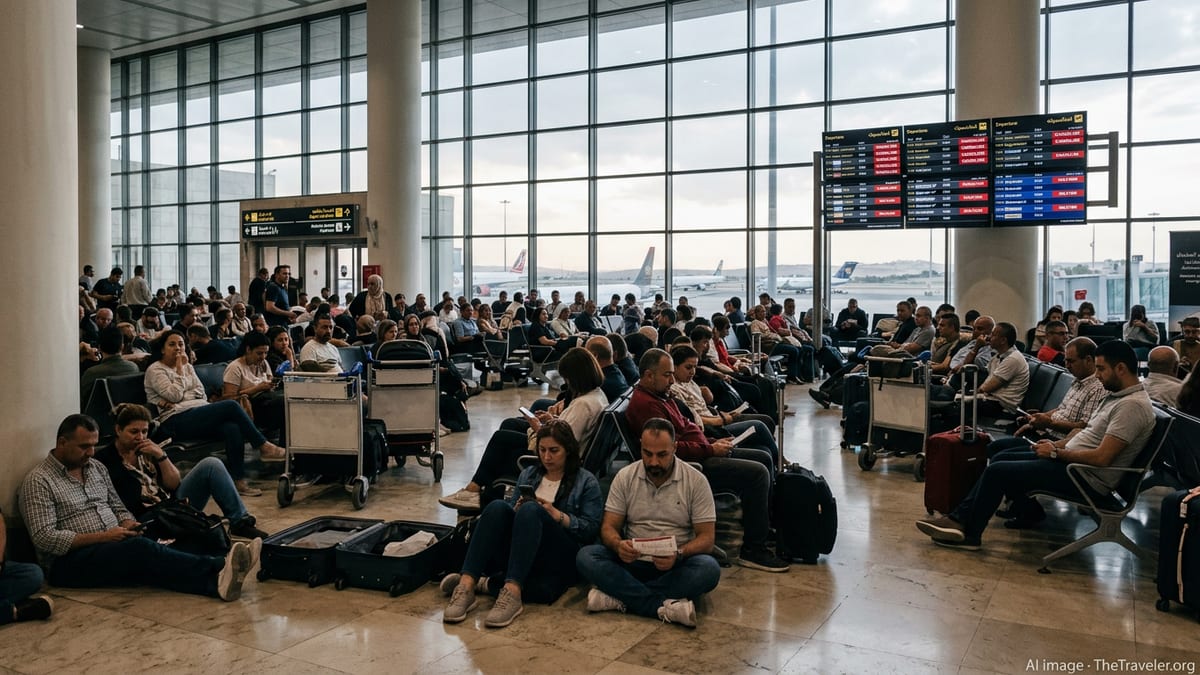
Wave of Cancellations Hits Key Middle East Gateways
Publicly available flight-tracking data and regional media coverage indicate that a fresh round of suspensions has affected a cluster of services operated by Flydubai, Air Arabia, and Kuwait Airways on routes linking major Gulf hubs with destinations in Europe, South Asia, and the wider Middle East. At least 18 flights across the three carriers have been withdrawn from schedules or subject to prolonged delays within a short window, disrupting itineraries for passengers traveling through Dubai International Airport, Sharjah International Airport, and Kuwait International Airport.
The disruptions come against the backdrop of a volatile operating environment, with airspace restrictions, elevated security alerts, and earlier missile and drone incidents still reverberating through airline planning. While some Gulf airports, including Dubai and Kuwait City, have progressively reopened after earlier shutdowns, they continue to operate on constrained capacity, leaving little margin to absorb additional schedule shocks.
For travelers, the result has been a patchwork of last-minute emails, app notifications, and airport display changes that can convert a routine connection into an overnight stranding. Many of the affected flights appear to have been pulled within 24 to 48 hours of departure, limiting the ability of passengers to rebook at reasonable fares on competing carriers.
Flydubai, the Dubai-based low-cost carrier, has been running a reduced schedule out of Dubai International, according to published timetables and airport advisories. The selective suspensions have tended to focus on secondary regional routes and certain South Asian and European links, where demand remains high but operational risks are more difficult to mitigate under current conditions.
Sharjah and Dubai Struggle With Congestion and Rolling Delays
Dubai International Airport, the busiest international hub in the world, has already endured several rounds of disruption in recent months, including temporary suspensions following regional security incidents and isolated drone-related activity near airport infrastructure. Even short shutdowns can trigger cascading delays as airlines juggle aircraft rotations, crew duty limits, and international curfews.
Flight status boards and online trackers show that Flydubai and other carriers have intermittently consolidated or canceled services, especially during evening peaks, to keep overall operations stable. Passengers on affected flights have reported long queues at transfer desks, limited availability of alternative same-day departures, and difficulty securing hotel accommodation when disruptions stretch into the night.
Sharjah International Airport, home base for Air Arabia, has also faced pressure as it attempts to balance its role as a low-cost gateway with the realities of constrained airspace and regional rerouting. Travelers have highlighted sudden cancellations and schedule changes on Air Arabia routes linking Sharjah with South and Southeast Asia, as well as North Africa, leaving some transit passengers stranded in the terminal for extended periods while they search for rerouting options.
In several instances, public posts on social platforms describe passengers being shifted onto later Air Arabia flights or advised to seek partial refunds or credit vouchers when rebooking on other airlines proved too costly. Such experiences underscore how even a relatively small number of canceled flights can ripple through a tightly timed network, particularly at airports that serve as budget transfer hubs.
Kuwait City Catches Up After Earlier Airspace Closures
Kuwait International Airport has been recovering from earlier airspace closures linked to the wider regional conflict, which forced a temporary halt to scheduled passenger services and led local carriers to rely on alternative airports in neighboring Saudi Arabia for limited operations. As Kuwait’s airspace has gradually reopened, Kuwait Airways has been working to rebuild its network, announcing resumptions on multiple long-haul and regional routes.
Yet the process has been uneven. Kuwait Airways’ online schedule and recent traveler accounts suggest that certain flights remain suspended or subject to late structural changes, including some India and Europe services that would typically carry large volumes of transfer traffic. The latest set of 18 suspended and delayed flights appears to include Kuwait Airways departures that were either removed from sale or taken off the departure board close to the travel date, leaving passengers without seamless onward connections.
Reports from Kuwait City describe crowded customer service counters, with travelers seeking clarity on whether tickets would be revalidated for later dates or refunded outright. Some passengers with existing bookings have noted that prospective flights simply disappeared from online search results while still showing as “active” in booking confirmations, adding to confusion over the status of upcoming journeys.
The combined effect is a stop-start recovery for Kuwait’s role as a regional connector. While core trunk routes to major Gulf and select Asian destinations have resumed, intermittent suspensions and rolling schedule changes on secondary services continue to complicate travel planning, particularly for those relying on Kuwait as a transit point between South Asia, the Levant, and Europe.
Stranded Travelers Face Limited Options and Patchy Support
The latest wave of cancellations highlights how dependent passengers remain on the flexibility and communication practices of individual airlines. Travelers stranded in Dubai, Sharjah, and Kuwait City report widely differing experiences in obtaining rebooking assistance, hotel accommodation, and meal vouchers when flights are delayed for many hours or canceled outright.
In online forums, customers of Flydubai and Air Arabia have described difficulty reaching call centers and inconsistencies in how ground staff apply airline policies on rerouting and refunds. Some travelers have reported successful re-accommodation on later departures or alternative routes, while others say they were directed to self-manage rebooking at their own expense, relying on travel insurance or credit card protections to recover costs.
For Kuwait Airways passengers, the picture appears similarly mixed. Public posts suggest that some travelers received options to move to later dates without change fees, whereas others struggled to obtain clear written confirmation of their rights when forward segments had vanished from schedules. The varying experiences reflect differences in fare types, point of sale, and whether tickets were booked directly or via third-party agents.
Consumer advocates and travel specialists note that the complex jurisdictional environment across Gulf states makes it harder for passengers to rely on a single, predictable framework for compensation and care. Unlike regions with uniform passenger rights regimes, travelers in the Middle East often must navigate airline-specific policies, insurance clauses, and local regulations that can change quickly in response to security developments.
What Travelers Should Watch in the Coming Days
Industry bulletins and corporate travel advisories emphasize that airspace and capacity constraints across parts of the Middle East are likely to persist in the near term. Analysts point out that even as additional corridors reopen, air traffic control congestion and crew positioning challenges will continue to expose airlines to short-notice schedule changes, especially on thinner routes operated a few times per week.
Travelers planning to transit through Dubai, Sharjah, or Kuwait City in the coming days are being urged by many travel management firms and risk consultants to monitor itineraries closely, enabling app notifications for schedule changes and checking flight status repeatedly in the 24 hours before departure. Flexible tickets, generous change policies, and comprehensive travel insurance are being framed as key tools for minimizing out-of-pocket losses when cancellations occur.
Observers also note that airlines may continue to prioritize repatriation and essential travel as they fine-tune schedules, particularly if further security alerts or infrastructure constraints arise. For passengers, that may translate into last-minute aircraft swaps, downgauging, or further consolidations of services as carriers work to align capacity with operational realities.
While Flydubai, Air Arabia, and Kuwait Airways have all signaled intentions through timetables and public statements to restore more of their pre-disruption networks, the latest round of 18 suspended and heavily delayed flights underscores how fragile that recovery remains. For now, travelers across the region are being advised to build in extra time, contingency plans, and a measure of patience when routing through these pivotal Gulf hubs.