

More news on this day
Travel across Argentina and between Buenos Aires and Brazil faced fresh disruption in early June 2026, as low cost airline Flybondi canceled five flights out of Buenos Aires Jorge Newbery Airport, affecting passengers on some of the country’s busiest domestic and regional routes.
Get the latest news straight to your inbox!
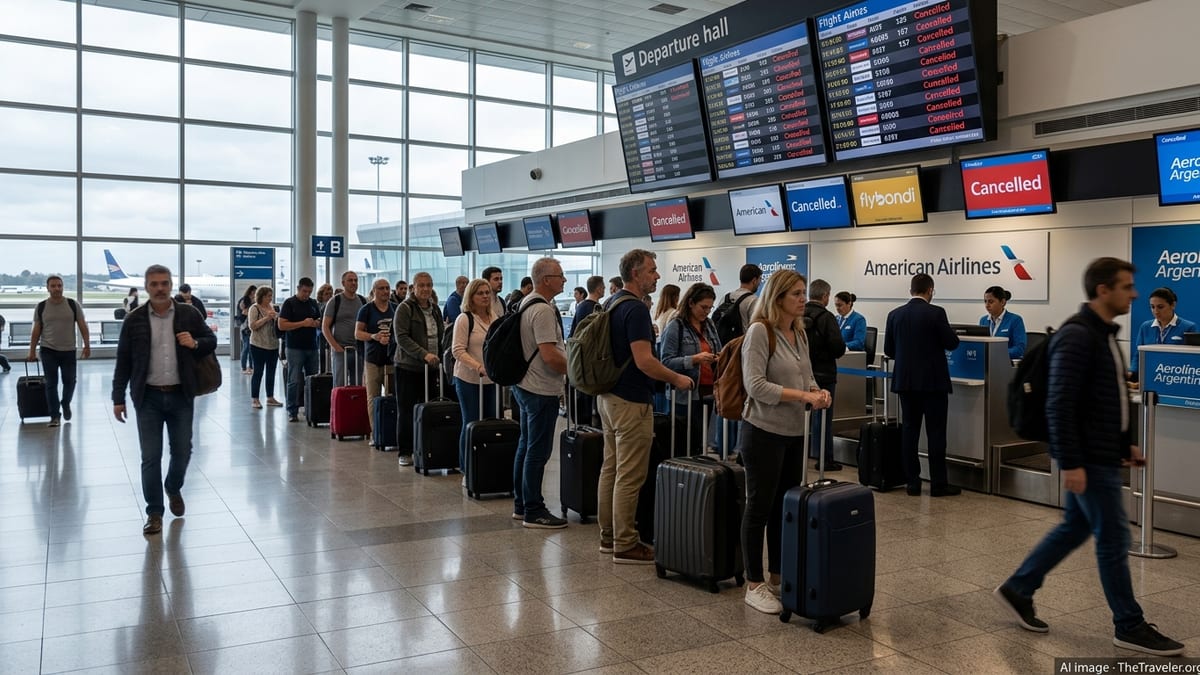
Cluster of Cancellations at Jorge Newbery in Early June
Publicly available flight-tracking and compensation-eligibility data show that on June 5, 2026, at least five Flybondi services linked to Buenos Aires Jorge Newbery Airport were marked as canceled, triggering knock-on effects across the network. Routes impacted included services between the capital and major leisure and business destinations such as San Carlos de Bariloche, Puerto Madryn and Comodoro Rivadavia, as well as connections to key Patagonian gateways.
The cancellations occurred during a busy early-winter travel period in Argentina, when domestic tourism and regional business travel remain robust and aircraft utilization is typically high. With Flybondi using Aeroparque Jorge Newbery as one of its principal bases, the removal of several rotations from the day’s schedule led to aircraft and crew imbalances that rippled through later departures.
Reports from regional travel media and operational tracking platforms indicate that the affected flights were spread across the midday and afternoon waves, a period when Aeroparque normally handles dense traffic to Patagonia, the Atlantic coast and neighboring countries. As a result, passengers faced a combination of outright cancellations, rebookings on later services and, in some cases, diversions to or from Buenos Aires Ezeiza International Airport.
While exact passenger counts for the five Flybondi flights have not been disclosed, typical seating configurations on the carrier’s Boeing 737-800 aircraft suggest that hundreds of travelers may have been directly impacted, with further disruption for those on onward connections within Argentina and to Brazil.
Wider Operational Strains and a History of Disruptions
The latest cancellations come against a backdrop of heightened scrutiny of Flybondi’s operational reliability. Local business and aviation coverage in Argentina has highlighted that the airline has been operating with a significantly reduced fleet in recent weeks, reportedly down to only a handful of active aircraft while it works through maintenance and financial challenges.
Consultancy data cited in regional outlets indicate that between June 2025 and May 2026, Flybondi registered thousands of cancellations across its network, affecting several hundred thousand passengers. Additional reporting in early June 2026 pointed to more than 200 cancellations and numerous delays in the first months of the year alone, underscoring the scale of disruption travelers have faced when relying on the ultra low cost carrier.
Consumer forums and social media posts have amplified individual stories of last-minute cancellations, schedule changes and difficulties securing refunds or alternative transport. While such accounts are anecdotal, they align with the pattern of irregular operations documented by flight-status aggregators and local news sites tracking airline performance at Argentine airports.
The June 5 Aeroparque incident therefore fits into a broader trend rather than an isolated operational hiccup. For many travelers in Argentina and neighboring countries, Flybondi’s aggressively priced tickets have increasingly required a trade-off with reliability and post-sales support.
Impact on Argentina–Brazil Connectivity
Although the five canceled flights at Aeroparque primarily affected domestic sectors, the disruption quickly spilled into cross-border travel, particularly on routes linking Buenos Aires with Brazilian cities. Flybondi markets several connections between Argentina and Brazil, and operational problems at its main base can make it harder to position aircraft for regional services out of both Aeroparque and Ezeiza.
Flight-status data for early June 2026 show that Flybondi services between Buenos Aires and Rio de Janeiro’s Galeão Airport continued to operate on surrounding days, but public information also points to schedule adjustments and a tighter overall program following the domestic disruptions. Because many travelers combine internal Argentine legs with same-day or next-day departures to Brazil, missed Aeroparque flights can mean lost beach holidays, delayed business meetings or the need to purchase last-minute tickets on competing carriers.
The strain on Argentina–Brazil connectivity has been compounded by Flybondi’s earlier decision to cancel its Puerto Iguazú–Lima route in early June 2026. That move, reported by regional aviation outlets, reduced onward options for northern Argentina and redirected additional flows through Buenos Aires and Brazilian hubs. Taken together with the Aeroparque cancellations, the changes highlight how operational instability at one low cost airline can reverberate along some of South America’s most popular multi-country itineraries.
For Brazilian visitors heading to Patagonia or Argentine travelers connecting to Rio de Janeiro and other Brazilian destinations, the June disruptions represent one more variable in an already complex planning landscape marked by currency volatility and shifting airline schedules.
Knock-on Effects for Jorge Newbery and Competing Carriers
Jorge Newbery Airport itself has been under pressure in June 2026. Separate reporting by travel and aviation outlets noted that on June 9, Aeroparque recorded more than 40 delays and several cancellations affecting both the national flag carrier and multiple low cost operators. The earlier Flybondi cancellations contributed to an atmosphere of uncertainty for passengers using the centrally located Buenos Aires hub.
When one airline experiences repeated irregular operations at a constrained urban airport like Aeroparque, other carriers can also feel the impact. Slot-controlled infrastructure, limited taxiway capacity and tightly sequenced rotations mean that late-arriving or grounded aircraft may force air traffic managers to reshuffle departure banks, potentially delaying flights on rival airlines even when their own fleets are operating normally.
According to published coverage from aviation trade publications and local business media, airline associations in Argentina have raised concerns during 2026 about the cumulative effect of schedule disruptions and upcoming infrastructure works at Jorge Newbery. Industry groups have warned that heavy-handed closures or poorly coordinated maintenance windows could aggravate an already fragile balance between capacity and demand at the airport.
In this context, Flybondi’s five canceled flights in early June are seen not only as a customer-service issue for the carrier but also as another stress point in a system that is expected to handle high volumes of domestic and regional traffic throughout the southern winter.
What Travelers Should Expect in June 2026
For passengers planning June 2026 trips involving Buenos Aires and Brazil, the Aeroparque cancellations serve as a reminder to build flexibility into itineraries. Travel advisors quoted in broader coverage of Jorge Newbery operations have been encouraging customers to allow longer connection windows, consider travel insurance with strong disruption clauses and, where budgets permit, select fares that allow for changes without prohibitive penalties.
Publicly available guidance from passenger-rights organizations and government consumer agencies in the region notes that travelers whose flights are canceled may be entitled to rerouting, refunds or compensation, depending on the circumstances and applicable legislation. However, recent passenger reports regarding Flybondi suggest that obtaining these remedies can take time and persistence, particularly when customer-service channels are overloaded during major disruption events.
Given Flybondi’s current operating environment, with a smaller active fleet and a history of cancellations over the past year, travelers may wish to monitor flight status closely in the days leading up to departure and have contingency plans in place. Options can include identifying alternative same-day flights on other airlines, understanding surface-transport choices between Buenos Aires airports and central districts, and keeping essential bookings such as hotel nights and tours on flexible terms.
As June progresses, observers across the Argentine and Brazilian travel sectors will be watching how Flybondi manages its schedules at Jorge Newbery and on cross-border routes. The handling of the five canceled flights in early June 2026 is likely to influence perceptions of the airline among both local travelers and international visitors weighing cost savings against operational reliability.