


Ljubljana Joze Pucnik Airport may be small by European standards, but it is the main international gateway to Slovenia and often the first impression travelers get of the country. Located near the village of Brnik, about 26 kilometers north of Ljubljana’s center, it handled close to 1.3 million passengers in 2023 and continues to grow as more airlines add routes. If you are flying through Slovenia soon, understanding how this airport works before you land can save you time, money, and stress.
Get the latest updates straight to your inbox!
Getting Your Bearings: Where You Are Landing
Joze Pucnik Airport, sometimes still called Brnik Airport, sits in a rural valley backed by low hills and views toward the Julian Alps. It is Slovenia’s largest airport and the only major international gateway, serving flights mainly from European hubs such as Frankfurt, Munich, Zurich, London, Istanbul and Dubai, with seasonal services to holiday destinations. In practice, this means most long haul travelers connect through a larger hub and then arrive here on a short European leg.
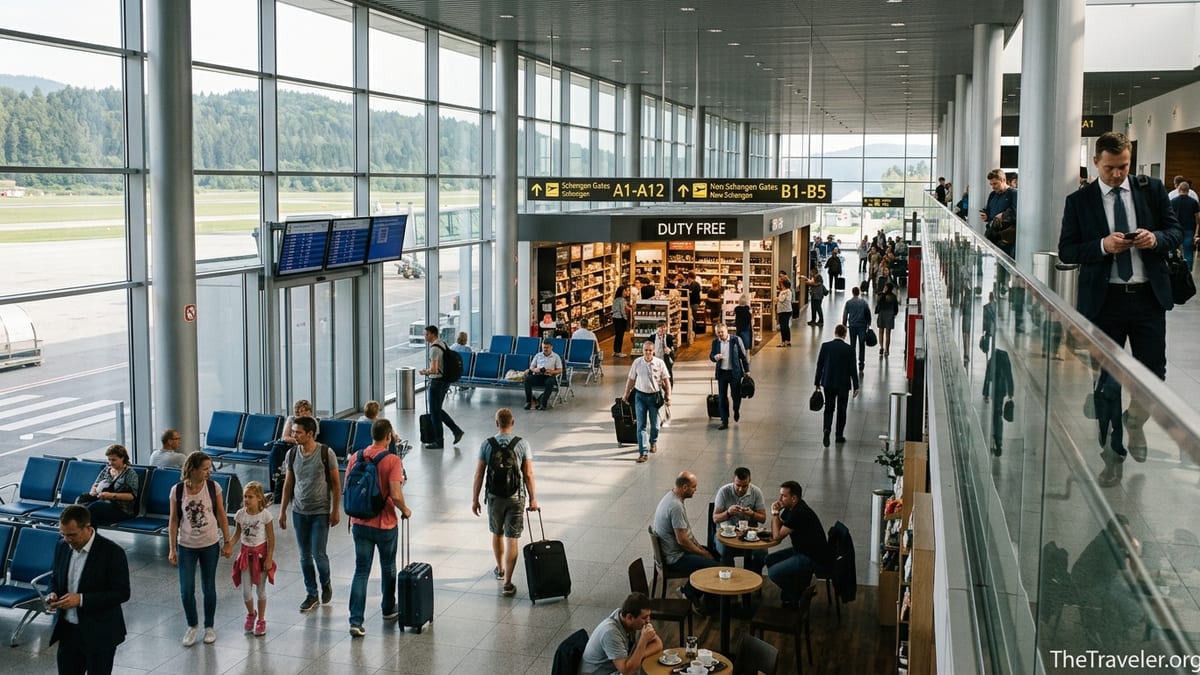
The airport has a compact layout. The older building has been joined by a modern terminal that opened in 2021, giving the airport more space and a noticeably updated feel compared to many airports of similar size. You will typically disembark via a jet bridge or short walk across the apron and follow clear bilingual signage in Slovene and English through to passport control and baggage reclaim. Because there is only one main passenger complex, it is hard to get seriously lost.
Air traffic at Ljubljana is still modest compared with regional giants like Vienna or Venice, which works in the traveler’s favor. Outside a few peak periods in summer and early mornings, queues for security and passport control are often short. Many regular travelers report that from arriving at the terminal door to sitting at the gate can take as little as 15 to 30 minutes in quiet periods, which is a contrast to the hour or more you might plan for at larger hubs.
The setting is also a reminder that you have arrived in a small, outdoors focused country. On clear days you may glimpse forest and fields from the terminal windows, and the drive into town passes through villages like Zgornji Brnik and open countryside before urban Ljubljana begins. This rural context means there is no metro or rail line, and planning your onward ground transport matters more than at big city airports.
Terminals, Arrivals Flow and Border Controls
The new passenger terminal, sometimes labeled Terminal A, was designed to separate Schengen and non Schengen traffic and to increase the hourly capacity of departures. For you as a traveler, the main impact is in the border control area. If you arrive from another Schengen country, your experience is often as simple as walking straight toward baggage reclaim and customs with no passport check beyond any random controls. Flights from Germany or France, for example, usually feel like domestic arrivals.
Arrivals from outside the Schengen zone, such as flights from the United Kingdom, Turkey or the United Arab Emirates, pass through a straightforward passport control. In most cases there are only a few flights arriving at similar times, so lines tend to be short compared with major hubs. Officers are used to tourists heading for Ljubljana, Bled or the Soča Valley, and routine questions focus on accommodation and length of stay rather than detailed interviews.
Baggage reclaim is housed in a single hall with a small number of carousels. Because the airport handles relatively few widebody aircraft, luggage delivery is usually quick. On a typical summer evening arrival from Frankfurt, for example, checked bags can start appearing within about 10 to 15 minutes of reaching the carousel. Trolleys are available and the distance from reclaim to the public arrivals hall is short and step free, which is reassuring if you are traveling with skis or bulky hiking gear.
Customs formalities are minimal for most visitors. After collecting bags you walk past the standard green and red channels and emerge directly into the arrivals hall. There is no systematic baggage screening at this point, although random checks are possible. Once you are in the arrivals hall, you will see car rental desks, an information counter, ATMs, and exits to the forecourt where buses, shuttles and taxis wait.
Shops, Food and Services in a Small Airport
Ljubljana Airport’s new terminal includes more than a thousand square meters of retail and dining space, but expectations should be calibrated: this is a small regional airport rather than a shopping destination. You will find a duty free store with a strong focus on Slovenian products. Typical displays include local wines from regions like Goriška Brda, honey and pumpkin seed oil, and chocolate from Slovenian brands alongside international cosmetics and spirits.
Food options are limited but adequate for a short stay. Landside, there is usually at least one café bar where you can grab a coffee and a simple sandwich or pastry after you exit customs, useful if you need a quick bite while waiting for a bus or shuttle. Airside in departures, smaller cafés serve snacks, salads and drinks at prices roughly comparable to other European airports. For example, an espresso may cost around 2 to 3 euros and a simple panini somewhere in the 5 to 8 euro range, though prices change over time.
Services include a small business lounge used by some full service airlines and available to priority passengers and card holders, car rental counters for companies such as Avantcar, Europcar, Hertz and Sixt, and a tourist information point with brochures for Ljubljana, Bled and other destinations. Basic conveniences like free Wi Fi, restrooms including accessible facilities, baby changing tables and ATMs are available in both the public and secure areas.
Because the terminal is compact, you will not find the variety of specialized services available at big hubs. For example, there is no large supermarket or extensive electronics store, and spa or nap pod style facilities are absent. If you need a local SIM card, check ahead with your mobile provider for roaming packages, since on the ground you may only find a limited selection of prepaid SIMs at small kiosks or have to wait until you reach the city center.
Getting from the Airport to Ljubljana and Beyond
The airport is about 26 kilometers from central Ljubljana. In light traffic, the drive along the A2 motorway takes roughly 25 to 30 minutes, but at rush hour or in winter conditions it can be slower. Planning how you will cover this last stretch is one of the most important tasks before you land, because unlike some European capitals there is no rail or metro link and late night public transport is limited.
The most affordable option is the public bus service operated by Arriva on route 28 between the airport and Ljubljana’s main bus station near the railway station. Buses run throughout the day, typically every 30 to 60 minutes, with more frequent departures at peak times. The ride takes around 45 to 60 minutes because the route stops in several villages on the way. Tickets are bought directly from the driver in cash or by contactless payment, and recent traveler reports suggest a one way fare in the low single digit euro range per person.
There are also shared shuttle vans run by private companies that connect the airport with Ljubljana and popular destinations like Bled, Kranj or even cross border locations in Italy and Croatia. These shuttles are often prebooked online, and prices can be attractive if you are traveling solo and flexible on timing. For example, prebooked transfer services sometimes advertise shared rides from the airport to a Ljubljana city center hotel for around 10 to 15 euros per person, with the driver meeting you in the arrivals hall and dropping you at your accommodation rather than a station.
Taxis and ride hailing are the quickest but potentially most expensive choices. Official taxis wait outside the terminal, but visitor anecdotes repeatedly mention high prices for rides hailed from the airport rank, with some travelers reporting charges of 50 to 60 euros to central Ljubljana. By contrast, arranging a reputable city taxi company or ride hailing service in advance from the city to the airport can cost significantly less. If you must take a taxi from the airport, ask for an estimated price before you get in, ensure the meter is switched on, and be prepared to walk away if the driver refuses. For longer trips, such as going directly to Lake Bled or Kranjska Gora, it often makes sense to prebook a private transfer at a fixed price.
Money, Language and Practical Basics
Slovenia uses the euro, and almost all payments at the airport and in Ljubljana can be made by card. Major cards such as Visa and Mastercard are widely accepted in shops, cafés and by shuttle companies. Nevertheless, carrying a small amount of cash is wise for bus tickets bought from the driver or for small purchases in rural areas. ATMs from Slovenian banks are located in the arrivals hall and landside concourse, though as usual you should pay attention to any extra fees when withdrawing with foreign cards.
Slovene is the official language, but airport staff, shuttle drivers and taxi dispatchers generally have at least basic English, and many speak it fluently. Announcements inside the terminal are typically made in Slovene and English, and sometimes German, depending on the airline. Written information on screens and signboards follows the same pattern. Travelers who speak Italian or German often find that these languages are also understood, especially among older Slovenians, but you can comfortably navigate the airport in English alone.
Power sockets in Slovenia are the standard European type C and F, with 230 volt supply. If you are arriving from the United Kingdom, North America or other non Europlug regions, bring a compatible adapter for your devices. If you forget, small travel adapters may occasionally be found in airport shops, but the selection is not guaranteed, and prices will usually be higher than in city stores.
Mobile connectivity is generally strong, with 4G and growing 5G coverage. Many visitors roam under EU regulations if they have a SIM from another European Union country, meaning they can use data at domestic rates. Travelers from outside the EU should check roaming costs beforehand and consider buying a local SIM in Ljubljana. Free Wi Fi is available in the terminal, typically requiring a simple registration or acceptance of terms, and speeds are adequate for messaging, email and basic navigation downloads.
Connecting Flights, Car Rentals and Driving from LJU
Ljubljana is not a major transfer hub, but some travelers do connect here between regional flights, for example from a Balkan destination to a Western European hub operated by different airlines. With the airport’s modest size, minimum connection times are usually generous. If both flights are on a single ticket with through checked luggage, a layover of 60 to 90 minutes is often sufficient in practice, although you should always follow the airline’s recommended minimums.
Self connections on separate tickets are riskier, because Ljubljana’s flight schedule can be thin in winter and weather in the Alps occasionally causes delays. If you are planning to land from, say, London mid afternoon and catch a separate ticket bus or train to Croatia the same evening, build in a buffer of several hours. The small scale of the airport helps once you are on the ground, but it cannot protect you from late inbound aircraft or ground holds at the departure airport.
Car rental is a popular choice for exploring Slovenia, particularly if you intend to visit Lake Bled, Bohinj, the Soča Valley or the wine regions. Rental desks are situated in the arrivals hall, and most international brands operate here through local franchises. It is wise to book ahead, especially in July and August or around major events, as the fleet is limited compared with bigger airports. As an example, a compact manual car in high season might cost somewhere in the range of 40 to 70 euros per day before extras, depending on demand, while shoulder season rates are often lower.
Driving from the airport is straightforward. You exit via local roads and quickly join the A2 motorway toward Ljubljana. To use Slovenian motorways you need an electronic vignette, which is usually included in the price of rental cars registered in Slovenia. If you are driving your own vehicle from neighboring countries, ensure you purchase the vignette online or at a fuel station before using motorways. From the airport you can also head north toward Kranj and on to Austria, or west toward Jesenice for access to Bled, Bohinj and the Julian Alps, making the airport a convenient starting point for a broader road trip.
Seasonal Crowds, Weather and Timing Your Journey
Passenger numbers at Ljubljana have been rising steadily since travel restarted after the pandemic, with traffic still concentrated in a few key waves. Summer sees the highest volumes, driven by holidaymakers heading to Alpine lakes and coastal resorts, as well as Slovenians returning home. During July and August, early morning departures to major hubs and late afternoon arrivals can feel noticeably busier than shoulder season flights in May or October.
Despite this, the airport rarely reaches the stressful atmosphere of overloaded mega hubs. Security screening is modern and generally efficient, and many frequent users report that arriving 90 minutes before a short haul flight is often adequate when traveling with hand luggage only. That said, if you are flying in peak holiday periods, on a Monday morning, or have bags to check, arriving 2 hours before departure is a safer standard, particularly if you still need to return a rental car or purchase a bus ticket.
Weather can influence your experience, especially in winter. The airport’s location in a continental climate means cold temperatures, fog and occasional snow between November and March. Fog in particular can delay flights or require diversions to nearby airports, such as Venice or Zagreb, when visibility drops below minima. If you are traveling in midwinter and have tight onward connections, consider this risk and avoid last minute same day plans that cannot be easily changed.
Arriving after dark has separate considerations. Public buses run only until the evening, often with the last departures to Ljubljana in the early night. If your flight lands late, you may have no bus option and need to rely on a prebooked shuttle or taxi. In practice, many travelers landing after 21:00 either arrange a private transfer well in advance or, if they are comfortable driving, pick up a rental car and drive straight to their accommodation in Ljubljana or Bled.
The Takeaway
Ljubljana Joze Pucnik Airport offers a friendly and relatively low stress entry point to Slovenia. Its size, modern terminal and straightforward layout mean you can usually get through arrivals fast, pick up a rental car or hop on a bus without navigating long corridors or endless duty free. At the same time, it lacks some of the services and transport options you might take for granted at big European hubs, so a bit of preparation goes a long way.
Before you land, think through how you will get to your final destination, whether that is a hotel in Ljubljana’s old town, a lakeside guesthouse in Bled or a mountain lodge in Kranjska Gora. Check the latest bus times, compare shared shuttle options, and if you expect to use a taxi, research reputable companies and rough price ranges. Make sure you carry a working card, a little cash in euros, and any adapters or SIM arrangements you need.
Approach Ljubljana Airport as a small but efficient gateway rather than an attraction in its own right. If you do, the experience of flying through Slovenia will likely be smooth: quick processing on arrival, minimal walking, and a scenic drive into a compact capital that sits within easy reach of mountains, lakes and coast. With the logistics handled, you can focus your energy where it matters most, on exploring one of Europe’s most quietly rewarding countries.
FAQ
Q1. How far is Ljubljana Joze Pucnik Airport from the city center?
The airport is about 26 kilometers north of central Ljubljana, and the drive by car or taxi usually takes around 25 to 30 minutes in normal traffic.
Q2. What is the cheapest way to get from Ljubljana Airport to downtown?
The public Arriva bus on route 28 is typically the cheapest option, with a one way ticket in the low single digit euro range and a travel time of 45 to 60 minutes.
Q3. Are taxis from the airport expensive?
Official taxis waiting at the terminal can be significantly more expensive than city cabs, with some visitors reporting fares above 50 euros, so it is wise to ask the price in advance or prebook a reputable service.
Q4. Is English widely spoken at Ljubljana Airport?
Yes, most airport staff and many drivers speak good English, and signage and announcements are routinely provided in Slovene and English, which makes navigation straightforward for international visitors.
Q5. How early should I arrive at Ljubljana Airport before my flight?
For most short haul flights, arriving about 2 hours before departure is usually sufficient, although frequent travelers sometimes manage with 90 minutes when not checking bags and traveling outside peak times.
Q6. Can I rent a car directly at Ljubljana Airport?
Yes, several international and local rental companies have desks in the arrivals hall, and many travelers book in advance to secure better rates and guarantee availability in busy summer months.
Q7. Is there a train or metro connection from the airport to Ljubljana?
No, there is currently no rail or metro link, so travelers choose between bus, shuttle, taxi, ride hailing services or renting a car to reach the city and other destinations.
Q8. Does the airport have good Wi Fi and mobile coverage?
The terminal offers free Wi Fi suitable for typical travel tasks, and mobile coverage with 4G and growing 5G is generally strong, especially for SIM cards from European networks.
Q9. Where can I buy food or drinks at the airport?
There are small cafés and bars both before and after security that serve coffee, soft drinks, snacks and light meals, along with a duty free shop that sells packaged food and drinks.
Q10. Is Ljubljana Airport a good base for reaching places like Bled or the Alps?
Yes, the airport lies conveniently between Ljubljana and the Alpine region, so with a rental car, taxi or shuttle you can reach Lake Bled or mountain resorts in roughly 30 to 60 minutes, depending on your exact destination.