


More news on this day
France is moving into full implementation of the European Union’s new Entry/Exit System, joining Spain, Italy, Greece, Germany, the Netherlands, Belgium, Switzerland, Austria, Portugal and other Schengen states in a fundamental shift to biometric border controls that is already triggering delay warnings for United Kingdom travellers ahead of the peak holiday season.
Get the latest news straight to your inbox!
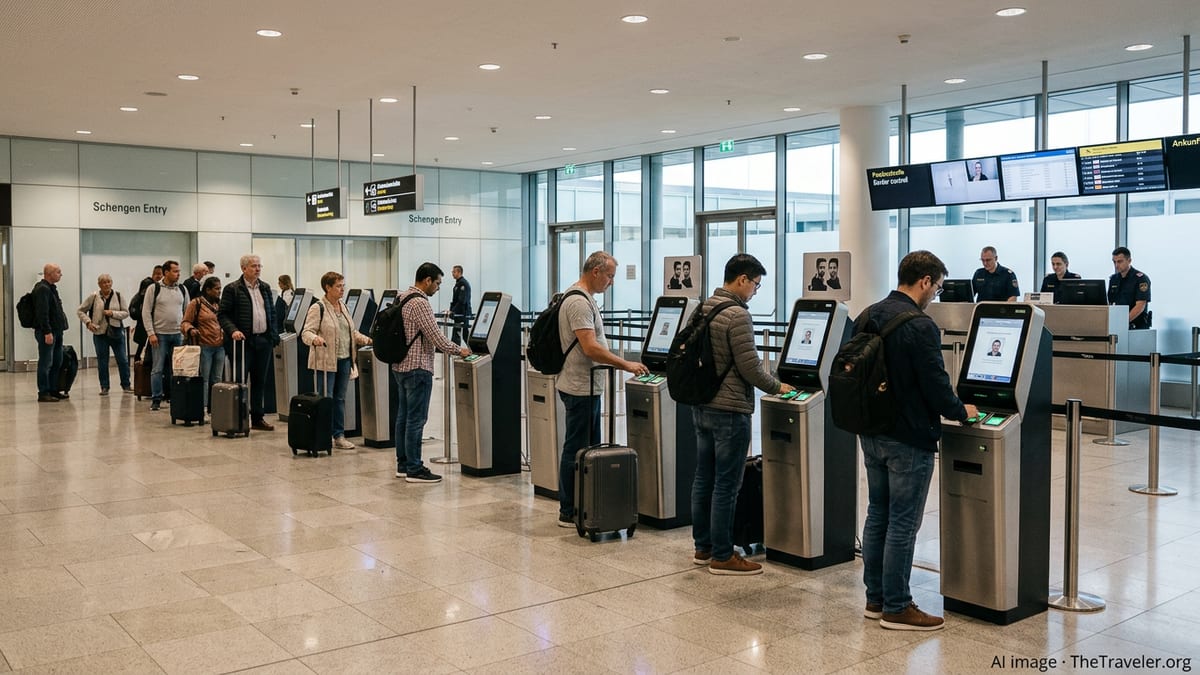
New EU Entry/Exit System Reshapes Travel To Schengen
The Entry/Exit System, or EES, is a large-scale EU database designed to record the movements of non-EU and non-Schengen short-stay visitors entering and leaving the bloc. Instead of relying on manual passport stamps, the system automatically logs biographic data, biometric identifiers and the exact time and place of each crossing at external borders.
According to publicly available EU information, EES applies to travellers from visa-exempt countries such as the United Kingdom and the United States, as well as to visitors who require a short-stay visa. Long-stay residents, holders of national residence permits and certain categories such as overseas territories visas remain outside the core system, meaning their passports will not be registered in the same way.
The European Commission has described EES as part of a wider “smart borders” package intended to tighten external border management while facilitating legitimate travel. By digitising entry and exit records, the system is expected to make it easier to spot overstays, detect multiple identities and improve the exchange of information among national authorities behind the scenes.
For ordinary travellers, the most visible change is the requirement, at first registration, to provide biometric data in addition to presenting a passport. This typically involves a facial image capture and, for most adults and older children, the collection of fingerprints on specialised scanners.
France Rolls Out Biometric Kiosks And Pre‑Registration
France, which controls several of the busiest gateways between the UK and continental Europe, has been among the most closely watched countries in the EES rollout. Public information from French government portals indicates that the country has progressively introduced new infrastructure at airports, seaports and international rail terminals serving external borders of the Schengen area.
French authorities describe a two-step process. Travellers first use self-service kiosks or pre-registration devices to scan their passports and enter basic details, then proceed to a staffed checkpoint where border officers complete verification and capture biometrics if needed. The data is uploaded to the central EES database and reused for subsequent trips within the system’s retention period, which reduces the amount of information that needs to be re-entered on later visits.
Guidance aimed at visitors to France notes that the country is deploying EES pre-registration devices at major international airports, including hubs used by long-haul flights from the UK and North America. Passengers are instructed to have a biometric passport ready, follow on-screen prompts for facial imaging and, where required, place four fingers on a scanner to record fingerprints.
France also participates in the broader EU communication effort around EES, directing passengers to official European information portals for details on how the system works, who it affects and how it connects with the forthcoming European Travel Information and Authorisation System, or ETIAS, due to become mandatory for many visa-exempt nationals from late 2026.
Spain, Italy, Greece And Others Move To Full Digital Borders
Beyond France, widely reported developments show Spain, Italy, Greece, Germany, the Netherlands, Belgium, Switzerland, Austria and Portugal all advancing with EES deployment at their external borders. These countries collectively account for a significant share of Europe’s tourism arrivals, especially from the UK, and their adoption of biometric controls is central to the system’s impact on holiday travel.
In southern Europe, media coverage has highlighted new EES equipment in place at busy holiday airports serving Spain’s Mediterranean coast and islands, Greece’s resort destinations and Portugal’s Algarve region. Airports have installed banks of automated kiosks and redesigned queuing areas to cope with the additional processing steps required for first-time EES registrations.
In central and northern Europe, the Netherlands, Belgium, Germany, Switzerland and Austria are integrating EES into existing automated border control infrastructure. Some airports are extending e-gate eligibility to more non-EU nationals with biometric passports, relying on the new database in the background while passengers interact primarily with self-service lanes.
While most attention has focused on air travel, ferry ports and certain land crossings are also shifting to EES-based checks. This is particularly relevant for routes linking the UK with France, Belgium and the Netherlands, where juxtaposed border controls mean EU checks often take place before departure from British soil.
UK Travellers Face Biometric Queues And Holiday Delay Warnings
Since the UK’s departure from the EU, British citizens have been treated as third-country nationals for Schengen purposes, making them fully subject to EES when entering or leaving participating states for short stays. This status means UK travellers must register their biometric data the first time they cross an external Schengen border after the system becomes operational on their route.
Reports from early phases of the rollout describe lengthy queues at some European airports and ports as staff and passengers adapt to the new procedures. Travel-focused outlets have documented instances of holidaymakers missing flights due to slower-than-expected processing and unfamiliarity with kiosks, particularly when large groups arrive simultaneously or technical issues occur.
Airlines and ferry operators serving the UK market have responded with updated guidance, advising passengers to arrive earlier than usual to allow extra time for border formalities. One prominent low-cost carrier publicly recommended that British passengers travelling to the Schengen area plan to reach the airport at least three hours before departure, citing disruption linked to biometric registration.
Parliamentary and government briefing papers in the UK similarly flag the risk of congestion at key pinch points including the Port of Dover, the Eurotunnel terminal at Folkestone and London’s international rail stations. Because French exit checks for Schengen are carried out before boarding at these sites, any slowdown due to EES can translate directly into tailbacks and timetable pressures on the British side.
Mitigation Measures And What Travellers Can Do Now
EU institutions and national governments have acknowledged the operational challenges involved in switching to a biometric, database-driven system across dozens of busy border crossing points. Publicly available European Commission material notes that EES is being introduced on a progressive basis, allowing for temporary adjustments, partial suspensions at overloaded checkpoints and technical fine-tuning during the first months of operation.
France and several other Schengen members are promoting pre-registration and self-service options as a way to reduce the burden on manual booths. Travellers who have already been enrolled in EES once can often use automated gates more quickly on subsequent trips, turning an initially longer process into a relatively streamlined experience over time.
For UK holidaymakers planning trips to France, Spain, Italy, Greece, Germany, the Netherlands, Belgium, Switzerland, Austria, Portugal and other Schengen destinations, the practical advice emerging from airlines, airports and official guidance is consistent. Passengers are encouraged to check the latest instructions from carriers, allow additional time at departure points, ensure passports are valid and biometric, and be prepared to follow on-screen directions at new kiosks.
Travel industry analysts suggest that, after an initial adjustment period marked by queues and occasional disruption, EES could eventually lead to more predictable border processing and clearer records of time spent in the Schengen zone. For now, though, UK travellers heading to Europe for summer holidays are being warned to build extra flexibility into their plans as the continent’s new digital border regime beds in.