


More news on this day
France is moving from pilot projects to real-world deployment of battery-powered regional trains in 2026, using large-scale retrofits of existing diesel fleets to decarbonize secondary rail lines while sidestepping the multibillion-euro price tag of full overhead electrification.
Get the latest news straight to your inbox!
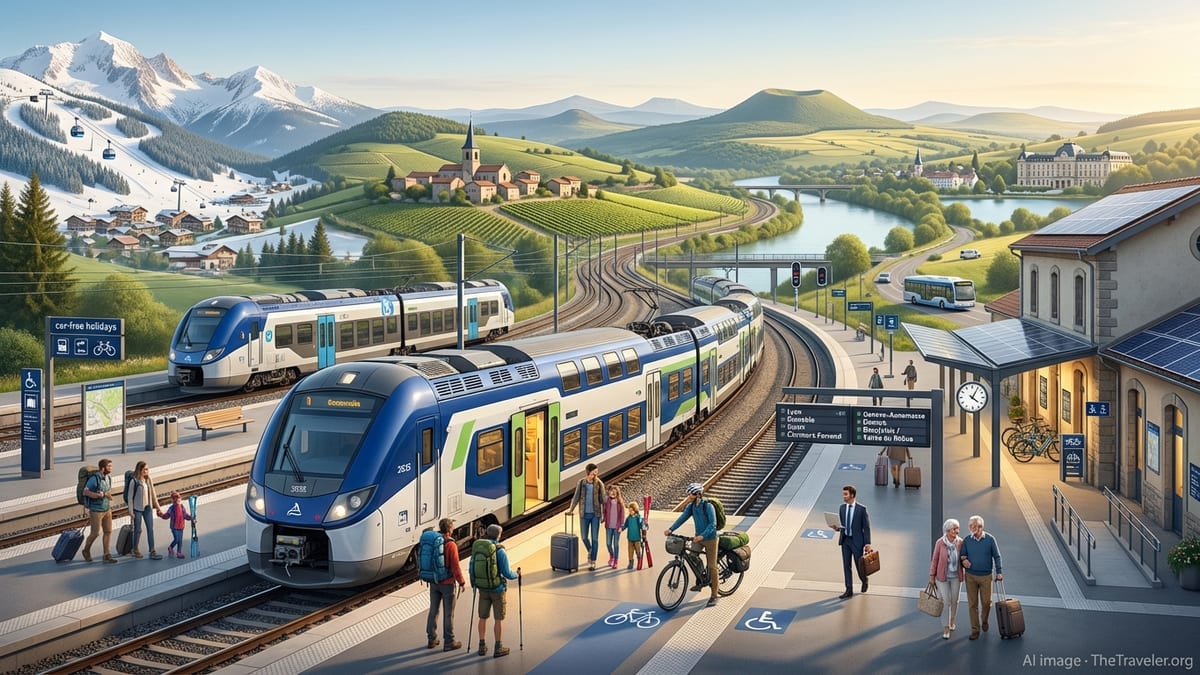
From Prototype to Revenue Service in Occitanie and the Sud Region
After several years of testing, France’s first battery-powered regional trains entered regular passenger service at the end of August 2026. According to published coverage and company announcements, two converted TER trains now operate on non-electrified stretches in Occitanie, notably on the Nîmes–Vauvert line, and in the Sud Region on the Avignon–Carpentras route. These trains run as conventional electric units under catenary where it exists and switch to onboard batteries on unelectrified segments, offering a seamless ride to passengers while eliminating local diesel exhaust.
Information from Alstom, which supplies the rolling stock, indicates that the entry into service forms part of a national program worth about 41 million euros, co-financed by five regions together with SNCF Voyageurs. Each participating region has contributed trains from its existing Autorail à Grande Capacité (AGC) fleet to be converted into battery-equipped units, rather than purchasing entirely new rolling stock.
Reports on the launch in the Gard department describe the technology as a step change for rural and peri-urban mobility, allowing regional operators to maintain direct services over mixed networks without waiting for catenary upgrades. The battery trains are being introduced on routes short enough to be covered on a single charge, with recharging carried out while running under existing overhead lines and during layovers.
Smart Retrofits Versus Costly Electrification
Publicly available information from SNCF and its partners shows that the core of France’s strategy lies in retrofitting. Instead of installing new catenary on low-traffic lines, which can cost millions of euros per double-track kilometer once civil works, substations and clearances are included, SNCF and Alstom have focused on replacing diesel engines in existing bi-mode AGC trains with lithium traction batteries. This approach essentially turns a large portion of the regional fleet into dual-mode electric trains that carry their own energy onto non-electrified sections.
Technical documents and earlier trial reports indicate that three AGC trainsets have already been converted from bi-mode (overhead line and diesel) to fully electric bi-mode (overhead line and battery), with successful tests performed at Alstom’s plant in Crespin, on dedicated test tracks and on the national network. Regulatory safety clearance was granted in April 2026, clearing the way for commercial operations later in the year.
Sector reports on rail decarbonization suggest that widespread retrofits of this type could avoid the need to electrify large swaths of secondary lines that see relatively few trains per day. On such routes, the fixed cost of installing and maintaining overhead lines can outweigh the benefits, whereas adding batteries to the rolling stock concentrates investment in mobile assets that can be redeployed as demand patterns change.
Billions in Potential Savings on France’s ‘Small Lines’
France’s rail network still includes thousands of kilometers of non-electrified “small lines,” many of them used by regional TER services. Studies referenced by SNCF show that a large majority of services under roughly 80 kilometers in length could be operated by battery trains that charge on electrified sections or at terminal stations, significantly reducing the amount of new infrastructure required. Only the longest or steepest routes would need targeted investments in charging points or partial electrification.
European research on rail energy systems has highlighted the cost gap between full catenary electrification and rolling-stock-based solutions such as batteries or hydrogen, particularly on routes with lower train frequencies. When these findings are combined with SNCF’s internal assessments, the resulting scenario points to potential savings in the order of billions of euros over the coming decade, as France can prioritize upgrading main corridors while using battery trains to decarbonize branches and rural spurs.
Financial filings from SNCF Group underline that battery, hybrid and hydrogen trains are being evaluated together as part of the company’s 2023–2032 strategic plan. The emergence of commercially tested battery TER units in 2026 strengthens the case for directing a greater share of investment toward smart retrofits instead of large-scale civil works, particularly where traffic is relatively light but politically sensitive, such as lines serving small towns and tourist destinations.
Part of a Broader Rail Decarbonization Strategy
The battery train rollout fits within a wider effort to “green” French rail, which already benefits from a relatively low-carbon electricity mix. Policy papers and parliamentary documents describe a rail decarbonization pathway built on several complementary pillars: modernizing existing electric fleets, introducing hybrid and battery retrofits for regional trains, and selectively deploying hydrogen trains on lines where charging infrastructure is more complex to install.
Earlier years saw the introduction of hybrid TER units that combine conventional electric traction with onboard energy storage, as well as trials using biofuels in remaining diesel services. Battery conversions are presented as the next step, allowing entire routes to operate without direct fossil fuel combustion. French regions such as Occitanie have positioned themselves as test beds, experimenting with hybrid, battery and hydrogen technologies side by side to determine the most effective mix for their territories.
Nationally, France has stated objectives to phase out diesel traction on regional passenger services in the 2030s. Rolling out battery trains in commercial service in 2026 sends a market signal that the technology has moved beyond demonstration status, aligning rolling stock renewal cycles with climate targets while attempting to keep overall system costs under control.
What Comes Next for France’s Battery Train Program
While the first converted TER units are now carrying passengers, the broader program is still in its early stages. Alstom’s green traction portfolio documentation indicates that battery-electric multiple units are being considered both for new-build trains and for further retrofits of existing fleets, potentially including additional AGC sets and other regional platforms. The OPTER midlife renovation program, which covers roughly 40 percent of the TER fleet, provides a natural window to integrate such upgrades as trains undergo scheduled overhauls.
Future decisions will likely hinge on operational experience gathered over the next two to three years, particularly regarding battery performance, charging strategies, and maintenance costs. Data from the first routes in Occitanie and the Sud Region will help determine how far the concept can be scaled to other French regions and whether similar approaches could be exported to neighboring European networks facing comparable challenges on secondary lines.
Analysts tracking the program note that the retrofit model relies on continued advances in battery energy density and declining unit costs. However, the early deployment in 2026 already demonstrates a distinct trend: rather than waiting for every kilometer of track to be wired, French regional operators are starting to solve the decarbonization puzzle train by train, using batteries to bridge the gaps and reshaping investment priorities across the rail system.
Alstom – Entry into service of first battery-powered regional trains in France
SNCF – TER à batteries project overview
SNCF – Cost-effective electrification of low-frequency lines
Alstom – Green traction solutions for non-electrified railways