


Frankfurt Airport is one of Europe’s busiest hubs and, for many long-haul travelers, their first point of entry into the European Union. That combination of scale and border formalities can feel daunting, especially at peak times when security and passport queues snake through the terminal. With a bit of preparation and a clear picture of how security screening, passport control, and customs actually work at Frankfurt, you can move through the airport with far less stress and avoid common pitfalls that catch out first-time visitors.
Get the latest updates straight to your inbox!
How Frankfurt Airport Is Laid Out and Why It Matters
Frankfurt Airport has three main passenger terminals: the long-established Terminal 1, Terminal 2, and the newer Terminal 3, which is gradually taking over some long-haul and leisure traffic. Terminal 1 is the home base for Lufthansa and most Star Alliance airlines, while Terminal 2 is used by carriers such as Delta, Emirates, and many non-alliance airlines. Terminal 3 currently handles a smaller but growing set of flights, mainly long-haul and low-cost operations. Knowing which terminal you are using helps you anticipate how security, passport control, and customs will play out, because procedures and technology can differ slightly between them.
Imagine a morning arrival from Chicago with Lufthansa into Terminal 1, connecting to a short flight to Rome. After disembarking, you follow signs for “Transit” and “Non-Schengen to Schengen” and are funneled to passport control first, then directly into the Schengen departures area without re-clearing security. By contrast, a late-night arrival from Dubai on Emirates into Terminal 2, with a connection to another non-Schengen destination such as São Paulo, may route you along secure corridors where you stay airside and, depending on your origin and gate, either bypass security or undergo a quick rescreening. The airport is designed so that security, border control, and customs are placed in different sequences depending on whether you are arriving, departing, or simply connecting.
Customs only ever comes at the end of your journey in Frankfurt, and only if Frankfurt is your first point of entry into the EU or your final destination. If you are just transiting and your bags are checked through, you will not see customs at all. That is why two passengers from New York to Athens via Frankfurt can have completely different experiences: the one continuing to Athens passes straight from passport control to the next gate, while the one ending their trip in Frankfurt will pass passport control, collect their luggage, and then choose either the green or red customs exit before stepping into the arrivals hall.
Security Screening: Liquids, Laptops, and New CT Scanners
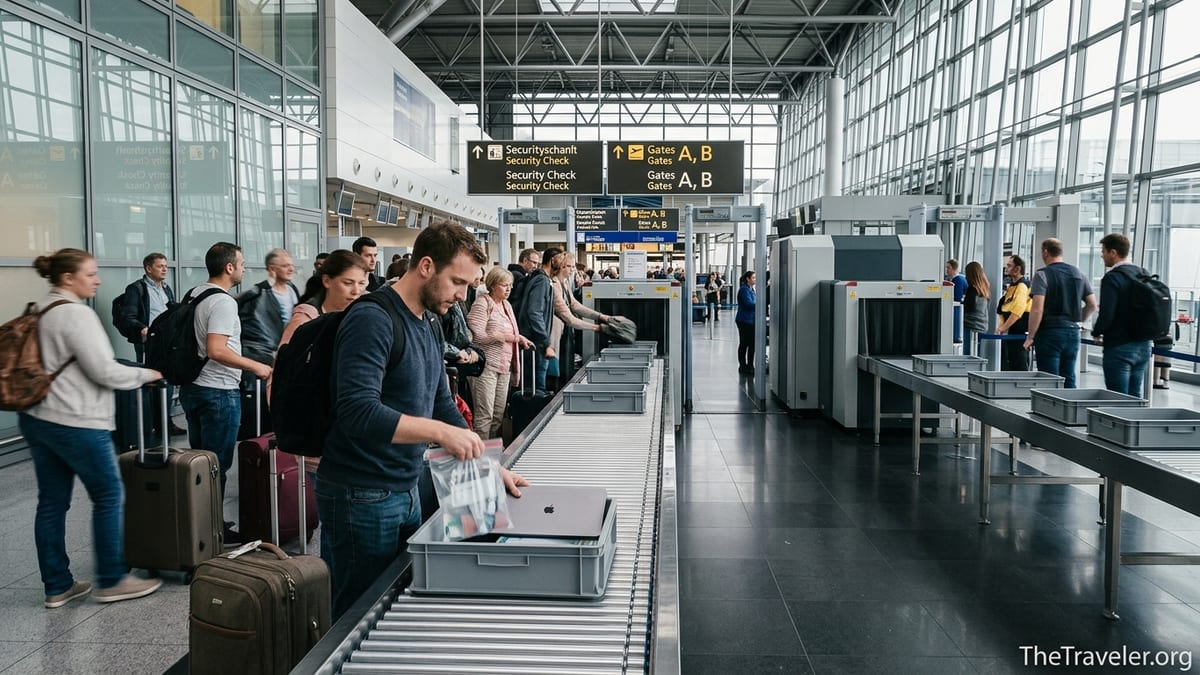
Security screening at Frankfurt Airport is carried out at the terminal level rather than at each gate. In practical terms, that means you go through one main checkpoint for your concourse, then you are free to move around the departure area. In Terminal 1, some checkpoints have already been upgraded with modern computed tomography, or CT, scanners, while others still use more traditional X-ray machines. Terminal 3 has been set up with CT scanners across all standard security checkpoints, which has a noticeable impact on how you prepare your hand luggage.
At the time of writing, most CT lanes allow passengers to leave electronics and liquids inside their cabin bags. For example, at a CT-equipped checkpoint in Terminal 3, you can keep your 13-inch laptop, tablet, and camera in your backpack, and you can carry liquids up to around 2 liters total in standard containers, provided they are for personal use. That said, in older lanes in Terminal 1 or in smaller checkpoints that have not yet been upgraded, the classic 100-milliliter-in-a-one-liter-transparent-bag rule still applies. If your Frankfurt departure is from Terminal 1 and you are unsure which security lane you will encounter, it is safer to pack with the traditional EU security rules in mind: small liquid containers under 100 milliliters, all fitting in a resealable one-liter bag, and electronics ready to remove.
In real terms, that means a traveler flying United Airlines from Newark to Frankfurt with a same-day Lufthansa connection to Berlin might have two very different experiences. On the outbound from Germany, if they depart from a CT-equipped area, their 500-milliliter bottle of water purchased before security will be allowed through, and they will keep their laptop inside a tightly packed carry-on. If they end up in a traditional lane, staff will ask them to throw away that bottle and present their liquids bag separately, plus remove laptops and larger devices. Airport announcements and staff at the queuing area usually indicate whether you are in a CT lane, but the safest approach is to pre-pack for older rules and treat the CT lanes as a welcome convenience rather than a guarantee.
Wait times at Frankfurt security can fluctuate sharply by day and time. Early weekday mornings, especially Mondays and Fridays between about 6 and 9 a.m., are busy with business travelers, while weekend mornings in school holiday periods see large family groups and long-haul leisure flights. A 20-minute queue at a quiet time can easily stretch to 40 minutes or more during a bank holiday getaway. Frankfurt now offers a free lane-reservation product for some Terminal 1 checkpoints, which lets you pre-book a 15-minute time window, cutting down on uncertainty. Even if you use such a service, aim to arrive at the airport at least 2.5 hours before a European flight and around 3 hours before a long-haul departure, especially if you need to check baggage.
Transit Scenarios: When You Re-clear Security and When You Don’t
For connecting passengers, one of the most confusing aspects of Frankfurt is whether you must go through security again. The answer depends on three basic factors: where you are arriving from, where you are heading, and whether you are changing terminals. If you are connecting from a Schengen-area city such as Paris, Vienna, or Madrid to another Schengen destination and both flights use Terminal 1, you typically do not need to pass security again. You simply walk from your arrival gate to the next departure gate, staying within the secure area.
Things become more nuanced with non-Schengen and intercontinental flights. For example, if you arrive from the United States at a non-Schengen pier of Terminal 1 and continue to another non-Schengen destination such as Cairo or Singapore, you will often remain within a sterile non-Schengen zone and simply move to your next gate without any additional checks. However, if you arrive from a country whose security screening is not recognized under the EU’s one-stop security arrangements, you may be channeled through a dedicated transfer security checkpoint before entering the departure area. A passenger flying from Nairobi to Frankfurt and then onward to Toronto may therefore face a short additional security line even though they never leave the airside area.
Transfers between terminals almost always involve a new security check. A traveler arriving from Seoul with Korean Air into Terminal 2 and connecting to a Lufthansa flight in Terminal 1 will follow the signs for “Transfer, Terminal 1,” ride the SkyLine people mover, and be deposited near a shared transfer security checkpoint in Terminal 1. There, they will go through the usual screening of bags and person before entering the departure area. If your itinerary involves changing terminals in Frankfurt, factor in at least 45 minutes purely for walking, waiting, and clearing security, on top of whatever you need for passport control.
A helpful rule of thumb: if you stay in the same terminal and move from Schengen to Schengen or from recognized non-Schengen origins to non-Schengen, security re-checks are less likely. If you are changing terminals or switching between Schengen and non-Schengen zones, be prepared for either passport control only, or passport control plus security. Airlines usually build these patterns into minimum connection times; a 55-minute intra-Schengen connection within Terminal 1 can be reasonable, while a first-time visitor changing from an intercontinental arrival in Terminal 2 to a Schengen departure in Terminal 1 is more comfortable with at least 90 minutes.
Passport Control: EasyPASS, EES, and Queue Realities
Because Frankfurt is a major entry point into the Schengen area, passport control can be a bottleneck, especially during the morning wave of arrivals from North America and the Middle East. Symptoms are familiar to frequent travelers: long lines of non-EU passengers snaking through the hall, electronic gates flashing red when a document fails to scan, and periodic announcements calling some passengers forward to protect tight connections. The key to a smoother experience lies in knowing which line you can use and what documents to have ready before you reach the booth or gate.
Citizens of the European Union, the European Economic Area, and Switzerland with biometric passports can normally use the EasyPASS automated e-gates. The system is straightforward: you approach the gate, place your passport photo page on the scanner, step forward when the gate opens, and look at the camera while the system checks your face against the passport chip. If all is in order, the second gate opens and you are through in under a minute. Many regular travelers report that, even during peak times, EasyPASS queues move quickly compared with manual EU lanes, which can be useful when several early-morning flights from London, Amsterdam, and Vienna land within minutes of each other.
For non-EU citizens, the picture is more varied. Some nationalities, including citizens of the United States, United Kingdom, South Korea, Taiwan, and Hong Kong, can register for a program that allows them to use EasyPASS under certain conditions. Registration is typically done at the airport with the German Federal Police, and once completed, future entries can be made through the automated gates instead of the standard manual booths. In practice, this can turn a 35- to 45-minute wait in the general non-EU line into a 5- to 10-minute process, especially during busy summer travel. However, registration desks are not open 24 hours a day, and eligibility rules can change, so it is worth verifying details with the Federal Police information pages shortly before travel.
All other non-EU travelers, including tourists from countries like India, Brazil, or South Africa, must use the staffed passport booths. During the busiest peaks, anecdotal reports from recent travelers mention waits of up to an hour, though more typical times range between 15 and 40 minutes. Having your passport open to the photo page, landing card or visa documents ready if applicable, and removing hats or headphones before you reach the counter can shave a few seconds off each interaction, which makes a real difference when hundreds of passengers are being processed. If you have a tight connection, staff at the edge of the lines can sometimes direct you to a priority lane when you show your onward boarding pass.
Looking ahead, travelers should also be aware of the European Union’s Entry/Exit System for non-EU nationals, which is being introduced in stages at Frankfurt and other major airports. Once fully operational, first-time non-EU visitors to the Schengen area will need to provide fingerprints and a facial image, in addition to the usual passport details, at a self-service kiosk or at the counter. Subsequent entries will be faster but will still rely on the biometric record created during that first registration. For travelers connecting through Frankfurt between two non-Schengen flights, this typically will not apply; but if Frankfurt is your first point of entry into the Schengen area, plan extra time for these formalities.
Customs on Arrival: Green and Red Channels Explained
Customs at Frankfurt Airport sits just beyond baggage claim. Once you pick up your checked luggage, you will see two main exits: a green channel indicating “Nothing to Declare” and a red channel for “Goods to Declare.” Which one you choose depends on where you are arriving from and what you are carrying. If you are arriving from another EU country and your purchases are for personal use, customs checks are minimal and you can usually walk through the green channel without issue, though officers may still conduct spot checks or ask questions about cash or restricted items.
Arriving from outside the EU is more involved because duty-free allowances and restrictions come into play. For example, a traveler landing in Frankfurt from New York with a single bottle of whiskey, some clothes, and an ordinary laptop is well within the typical duty-free allowances and can exit via the green channel. By contrast, someone flying in from Dubai with several high-end smartphones intended for resale and luxury watches worth several thousand euros is expected to declare those goods at the red channel, where customs officials will assess duties and taxes. For non-alcohol, non-tobacco items carried in luggage, the duty-free value allowance for air travelers arriving from non-EU countries is roughly in the low hundreds of euros per person; values above that threshold may attract duties or require proof that items are for personal use.
Alcohol and tobacco have specific quantity-based allowances. As an illustration, a typical adult arriving from a non-EU country can usually bring a combination such as one liter of spirits over 22 percent alcohol, plus two liters of fortified or sparkling wine, along with a limited number of cigarettes or cigars, without paying duty. Bringing in three full cases of wine from South Africa or a stack of duty-free cigarette cartons from Turkey will almost certainly push you beyond personal-use limits and may trigger questions or additional charges if discovered. These allowances apply per person, and travelers under 17 years of age generally have no alcohol or tobacco allowance at all.
Cash and high-value instruments are another area where Frankfurt customs can be strict. Anyone entering or leaving the EU through Germany while carrying 10,000 euros or more in cash, or the equivalent in other currencies and certain negotiable instruments, must submit a cash declaration to customs. That does not mean you pay tax on the amount; it simply allows authorities to track large flows of money. A traveler carrying 15,000 U.S. dollars in cash for a car purchase in Germany, for example, is expected to fill out the declaration form at the red channel. Failing to do so can result in fines, and in serious cases, criminal proceedings. If you are carrying large amounts of cash, aim to have documentation such as purchase contracts or bank withdrawal slips readily accessible.
Practical Tips for a Smoother Experience
Beyond understanding the formal rules, a few practical habits go a long way at Frankfurt Airport. The first is to pack your cabin baggage as if you will face traditional security screening, even if the terminal you are using is mostly fitted with CT scanners. Put liquids into small containers and group them in a transparent resealable bag, keep power banks and laptops easily accessible near the top of your bag, and avoid throwing loose metal items like keys and coins into multiple pockets. In a real-world example, a traveler with a single neatly packed backpack can pass through security in under five minutes, while another with multiple overstuffed tote bags may be pulled aside for additional checks and repacking.
Secondly, manage your timing with local patterns in mind. Rush hours on the road into the airport often coincide with peak departure banks. If you are catching an early Lufthansa flight to a European hub from Terminal 1 on a Monday morning, consider that the roads from downtown Frankfurt and the regional trains will be busy with commuters. A traveler leaving a central hotel at 7 a.m. for a 9 a.m. flight may find themselves stuck in traffic or waiting on crowded S-Bahn trains, arriving at the terminal with barely an hour to spare. Leaving 30 to 45 minutes earlier can transform the experience from a panicked dash through security to a relaxed coffee near the gate.
Finally, build slack into your connections if you are unfamiliar with Frankfurt or traveling with children, reduced mobility, or large amounts of luggage. For a first-time visitor arriving from Toronto and connecting onward to Prague, a 55-minute connection might be technically valid but extremely stressful. A 90-minute or two-hour window allows for a slower pace through passport control, bathroom stops, and time to re-check the gate screens in case of last-minute changes. If you do end up with a tight connection due to a delayed inbound flight, do not hesitate to speak to ground staff at the end of the jet bridge; they can sometimes issue express-lane passes for security or passport control, or arrange for rebooking if the onward flight cannot be held.
The Takeaway
Frankfurt Airport’s size and its role as a major Schengen border crossing mean that security checks, passport control, and customs are central to the experience of traveling through the hub. Yet once you understand how the terminals are laid out, what technology is in use at different security checkpoints, and how EU and German rules apply to your passport and your luggage, the process becomes more predictable. Whether you are stepping off a long overnight flight from the United States, changing planes on your way to Asia, or arriving home to Germany from a weekend in London, small preparations such as packing for traditional security rules, arriving early, and knowing your customs allowances make a tangible difference.
In practical terms, plan to arrive early for departures, expect passport control to be the main bottleneck for non-EU entrants during morning waves, and treat customs seriously if you are carrying significant valuables, alcohol, tobacco, or cash. With those points in mind, Frankfurt Airport becomes less of a maze and more of a well-organized gateway: busy, sometimes crowded, but ultimately manageable and increasingly supported by technology such as CT scanners and automated border gates. A bit of homework before you travel replaces uncertainty with confidence when you step into the terminal.
FAQ
Q1. Do I need to take out liquids and laptops at Frankfurt Airport security?
In Terminal 3 and some upgraded lanes in Terminal 1, modern CT scanners often allow liquids and electronics to stay in your bag. However, because not all checkpoints are upgraded yet, it is safest to pack according to the classic EU rule: liquids in containers of up to 100 milliliters inside a one-liter transparent bag, and laptops ready to be removed if staff request it.
Q2. How early should I arrive at Frankfurt Airport before my flight?
For European flights, aim to be at the terminal about 2 to 2.5 hours before departure, and for long-haul flights, around 3 hours. During peak seasons such as summer holidays or Christmas, or on busy weekday mornings, consider adding another 30 minutes, especially if you need to check baggage or are unfamiliar with the airport layout.
Q3. Will I go through security again if I am just connecting through Frankfurt?
It depends on your specific routing. Many Schengen-to-Schengen connections in the same terminal do not require another security check. Non-Schengen transfers or changes between Terminal 1 and Terminal 2 often involve a brief re-screening. When in doubt, assume you may have to pass through security and allow extra time in your connection.
Q4. Can I use automated passport control (EasyPASS) at Frankfurt as a non-EU citizen?
Some non-EU nationals, including citizens of countries such as the United States and United Kingdom, can register for a program that lets them use EasyPASS. Registration is done with the German Federal Police at the airport and typically requires a biometric passport. Once enrolled, you can usually use the automated gates instead of the regular non-EU line, which may significantly reduce waiting time.
Q5. How long does passport control usually take at Frankfurt Airport?
Waiting times vary widely. EU and Schengen passengers using EasyPASS can often clear passport control in a few minutes. Non-EU passengers in the regular lines may spend anywhere from 15 to 45 minutes in queues, and during the busiest arrival peaks from North America and the Middle East, waits of up to an hour are possible. Allow generous time if you have a connection.
Q6. Where does customs fit into the process when I arrive in Frankfurt?
Customs comes after baggage claim. First, you go through passport control. Then you collect your checked luggage. As you exit the baggage hall, you choose either the green channel (nothing to declare) or the red channel (goods to declare). If Frankfurt is just a transit point and your bags are checked through to your final destination, you will not go through customs in Frankfurt.
Q7. What can I bring into Germany duty-free when arriving from outside the EU?
Exact limits depend on the type of goods, but as a general guide, travelers can bring in modest quantities of alcohol and tobacco, plus other goods up to a value of several hundred euros, for personal use without paying duty. Large quantities of alcohol or cigarettes, multiple high-value electronics intended for resale, or goods far above typical value allowances must be declared at the red channel and may incur taxes or duties.
Q8. Do I have to declare cash when entering or leaving Germany via Frankfurt?
Yes, if you are carrying 10,000 euros or more in cash or the equivalent in other currencies and certain negotiable instruments. In that case, you must make a written declaration to customs, usually at the red channel. There is no tax on the amount itself, but failing to declare can result in fines and further investigation.
Q9. What happens if security at Frankfurt confiscates an item from my hand luggage?
If an item is not allowed through security, and there is enough time before your flight, staff may advise you to place it in checked luggage, hand it to someone seeing you off, or return it to your car. At some checkpoints, prohibited but non-dangerous items can be stored for a fee at designated baggage storage counters for later collection or shipment, although this is not guaranteed for every object or itinerary.
Q10. Is Frankfurt Airport a difficult place to connect for first-time visitors?
Frankfurt is large and can feel hectic, but it is manageable with a bit of preparation. Clear signage in English and German guides you between gates, security, passport control, and customs. If you study your terminal and gate area in advance, build ample time into your itinerary, and follow staff instructions, even a first-time visitor can make connections smoothly, including those that involve border formalities.