


When your debit card stops working at a Bangkok ATM or your hostel in Mexico insists on cash only, a service like MoneyGram can feel like a lifeline. With hundreds of thousands of locations worldwide and the promise of near-instant transfers, it is one of the biggest names in global remittances. But should you trust MoneyGram for sending travel money internationally, or are you better off with banks, fintech apps, or prepaid cards?
Get the latest updates straight to your inbox!
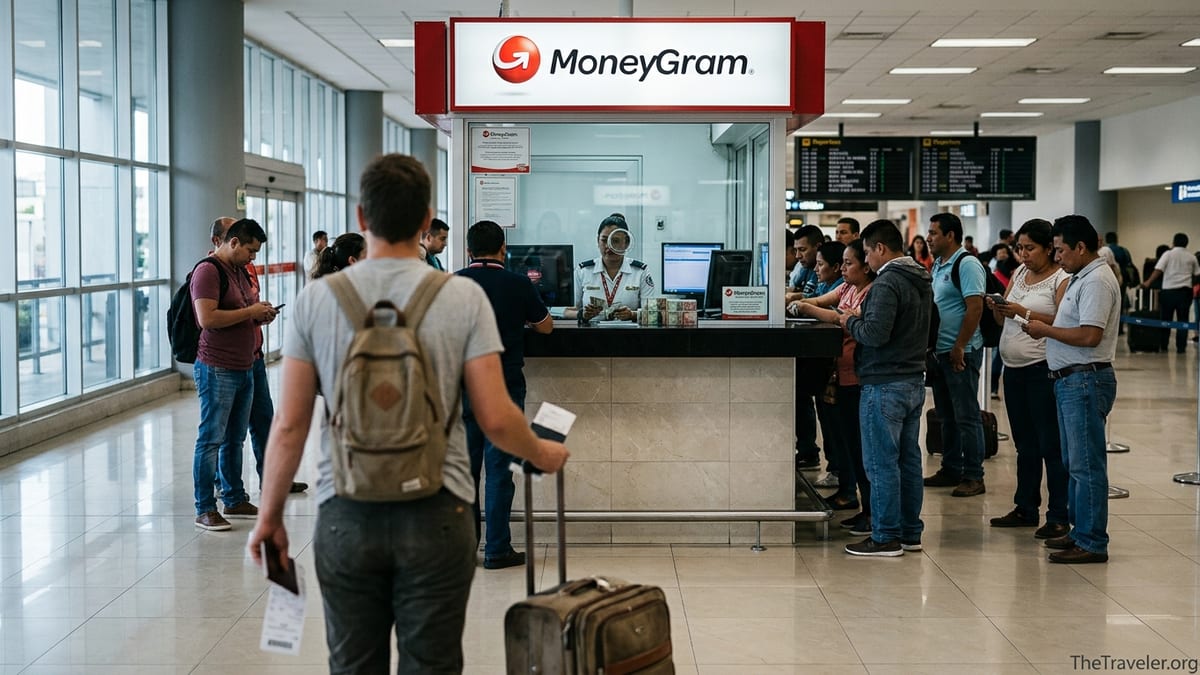
What MoneyGram Actually Is and How Travelers Use It
MoneyGram is a global money transfer company that lets you send funds for cash pickup, bank deposit, debit card deposit, or mobile wallet in many countries. The company is registered in the United States as a money services business and holds state money transmitter licenses, which means it is supervised for anti-money-laundering and consumer protection purposes in every state it operates in. In plain terms, MoneyGram is a long-standing, regulated player, not an informal or underground service.
For travelers, MoneyGram usually enters the picture when traditional banking breaks down. A typical example: a U.S. traveler in Lima finds that their bank card is repeatedly declined at local ATMs. A family member in Chicago can use the MoneyGram app to send 300 dollars, paying with a debit card. Within minutes, the traveler walks into a participating pharmacy in Miraflores, presents their passport and the reference number, and walks out with cash in Peruvian soles.
Another common use case is self-funding along the way. A backpacker moving overland from Croatia to Albania might send money to themselves for pickup in Tirana instead of carrying large amounts of cash across multiple borders. The same applies in destinations with limited card acceptance, such as smaller guesthouses in rural Morocco or street markets in parts of Southeast Asia. In these situations, the ability to convert digital dollars into local cash fast is the core appeal.
MoneyGram’s network is also increasingly used behind the scenes. Crypto exchanges, digital wallets, and neobanks partner with MoneyGram so their users can cash out balances at local agent locations. This means that even when you think you are “just cashing out from an app,” you may actually be using the MoneyGram network at the last mile.
Safety, Regulation, and the Risk of Scams
From a pure operational standpoint, MoneyGram is generally safe to use. In the United States, MoneyGram Payment Systems is registered with the Financial Crimes Enforcement Network as a money services business and holds state licenses listed publicly in its help center. These licenses impose requirements such as customer identification, transaction monitoring, and error resolution procedures designed to protect consumers and reduce fraud.
However, MoneyGram has faced regulatory scrutiny. The Consumer Financial Protection Bureau and the New York Attorney General filed a lawsuit in 2022, later amended in 2025, alleging that MoneyGram mishandled error disputes and did not always follow disclosure rules for international remittances. While the case is still part of an ongoing enforcement history and does not mean every transfer is unsafe, it highlights that even large, regulated brands can fall short of best practices and that travelers should keep documentation of every transaction.
The bigger real-world risk for travelers is not that MoneyGram itself will “steal” your money, but that scammers weaponize its speed and global reach. Fraudsters frequently demand payment via money transfer companies because once cash is picked up abroad, it is extremely hard to recover. Rental apartment scams, fake tour agencies, and online marketplace fraud sometimes ask victims to “prove funds” by sending a MoneyGram transfer to a friend and sharing the receipt. Once the scammer has the reference number and enough details, they may be able to collect the money.
Consider a traveler booking a long-term room in Lisbon through a classifieds site. The “landlord” insists that the deposit must be paid via MoneyGram to “hold the room,” promising a refund if anything goes wrong. This is a red flag. MoneyGram themselves repeatedly warn that you should only send money to people you know and trust. For legitimate travel expenses such as hotel bills, tours, or car rentals, safer payment methods like credit cards provide far better protection and chargeback rights.
Fees, Exchange Rates, and Real-World Cost Examples
When you send money with MoneyGram, your total cost has two main components: a transfer fee and the exchange rate used to convert your currency into the recipient’s. MoneyGram explains in its own materials that the fee depends on factors such as destination country, send amount, payment method, and payout method, and that the exchange rate varies depending on timing and corridor. You see the fee and estimated payout amount before confirming, but like most remittance providers, the rate typically includes a markup over the mid-market rate.
In practice, this means a traveler might pay quite different prices depending on how they use the service. As a rough example, a U.S. traveler sending 200 dollars from New York to Mexico for cash pickup might see a visible fee of under 10 dollars when paying with a bank account, while paying by credit card could cost significantly more. On top of that, rather than receiving the full mid-market peso equivalent, the recipient might get an exchange rate that is a few percent less favorable, effectively adding another hidden cost.
Independent comparisons by consumer-focused fintechs have observed that, across many corridors, MoneyGram’s combination of fees and rate markup can be more expensive than online-only specialists. One analysis of money transfers from the United States to Europe, for example, showed that while a promotional fee might appear low, the exchange rate margin could mean the recipient receives noticeably fewer euros than through a low-cost competitor. This is why serious travelers and expatriates often compare providers before sending larger amounts such as semester-long rent or tuition.
Costs are not limited to transfers. If you use a MoneyGram-branded debit card linked to a U.S. account at an international ATM, the company’s own help center notes that you can be charged a 3 percent foreign transaction fee plus a flat 3 dollar fee per withdrawal, on top of any ATM operator charges and currency conversion spread. In a real scenario, a traveler withdrawing the equivalent of 100 dollars in cash from an overseas ATM could easily lose 8 to 10 dollars to combined fees and rate margin, which adds up quickly on a long trip.
Speed, Reliability, and What Can Go Wrong on the Road
Speed is one of MoneyGram’s biggest selling points. For many routes, especially popular ones like United States to Mexico, the Philippines, or India, MoneyGram advertises that cash pickup or bank deposit can happen within minutes, subject to agent hours and compliance checks. Travelers often report that when things go smoothly, the transfer can be picked up almost immediately, which can be a lifesaver if you are stranded without working cards.
However, the reality on the road can be more nuanced. Transfers may be delayed or canceled if MoneyGram’s risk systems flag them for additional review, or if there is a mismatch in the recipient’s name or identification documents. Consumer complaint databases and anecdotal reports show recurring themes such as funds being “in process” for several days, agents declining to pay out larger transfers in cash, or senders struggling to get clear answers from customer service when something goes wrong.
Real-world traveler stories from forums illustrate the friction. A visitor in Tokyo who had sent themselves cash reported that several listed MoneyGram locations were either closed, had stopped offering the service, or could not process the payout amount. In another example from New York City, a newcomer trying to collect over 500 dollars was advised by locals to call ahead because many smaller agents have low cash limits and may not be able to pay larger transfers in a single visit.
Agent reliability varies significantly by country and neighborhood. A MoneyGram location might be a major supermarket chain, a post office, or a bank branch in one city, and a small corner shop in another. System outages, local holidays, and limited float at small agents can all affect your ability to collect funds, particularly outside major urban centers. For a traveler heading into remote areas, relying solely on a single pending MoneyGram transfer can be risky; withdrawing some extra cash and carrying at least one backup card is usually wiser.
How MoneyGram Compares With Other Travel Money Options
When deciding whether to trust MoneyGram for travel money, it helps to compare it with realistic alternatives you might use on the same trip. For many travelers from the United States, the default is a no-foreign-transaction-fee debit card from an online bank paired with a travel credit card. These cards typically let you withdraw local currency at ATMs using near-mid-market rates set by Visa or Mastercard, with minimal markup. If your card works reliably and ATM access is good, this is often cheaper and more convenient than a money transfer.
On the other hand, there are clear scenarios where MoneyGram or a similar service still makes sense. In destinations where your U.S. bank consistently blocks ATM withdrawals, or where local ATMs are scarce or unreliable, a transfer for cash pickup at a big-city agent can be a practical solution. This is particularly true in parts of West and Central Africa, some Pacific islands, and rural areas where international card networks are not widely accepted but money transfer agents are common.
Fintech multi-currency accounts also compete directly with MoneyGram. Services that let you hold balances in euros, pounds, or local currencies, then spend with a physical card, may offer lower exchange rate markups and fewer fixed fees, especially for repeated small transactions like cafe bills or metro tickets. However, these digital accounts still do not cover every country, and they cannot always solve the “I need physical cash now in a remote town” problem that MoneyGram agents can address.
Ultimately, MoneyGram is best viewed as one tool in a broader travel money toolkit. It may not beat the cheapest online transfer service or the most competitive bank card for every scenario, but its sheer global footprint and cash-based payouts give it a niche that can be extremely valuable when other options fail. The key question is not just “Is MoneyGram trustworthy?” but “Is MoneyGram the right tool for this particular job, at this particular moment on my trip?”
Practical Tips If You Decide to Use MoneyGram Abroad
If you choose to rely on MoneyGram during your travels, approaching it with a few practical safeguards can significantly reduce stress. First, double-check the exact spelling of the recipient’s name so that it matches their government-issued ID. Something as simple as reversing first and last names or omitting a middle name can lead an agent to reject the payout, especially in countries with strict know-your-customer rules. Always keep the reference number, send receipt, and a photo of your ID safely stored, both on your phone and in a secure cloud backup.
Second, verify agent locations and capabilities before you send a large transfer. Use MoneyGram’s location search to identify agents that explicitly support receiving, then call ahead if possible to confirm they are open and able to disburse the amount you plan to collect. Travelers in cities from Tashkent to Tokyo have reported outdated or inaccurate listings, so treating the online directory as a starting point rather than a guarantee can prevent nasty surprises after a long bus ride or taxi trip.
Third, run a quick price comparison. Even five minutes spent checking how much your recipient would get using a low-cost online transfer competitor or your bank’s own remittance service can be revealing. In some corridors, MoneyGram’s promotional offers may be competitive; in others, the combination of fee and exchange rate spread may be noticeably higher. For larger sums like paying a semester of rent in Berlin or settling a medical bill in Bangkok, these differences can exceed the cost of a flight segment.
Finally, treat MoneyGram transfers as cash: irreversible and risky for disputed purchases. Do not use the service to pay strangers for future services such as apartment rentals, job placements, or visa assistance. For those, a credit card or a card-backed payment platform with strong dispute rights is far safer. Reserve MoneyGram for emergencies, for sending money to trusted family or close friends, or for self-pickup when you simply need to transform digital funds into local cash quickly and have confirmed a reliable agent location.
The Takeaway
MoneyGram is a large, long-established, and regulated money transfer company with a vast global network. For travelers caught without working cards, facing cash-only situations, or needing to get money to trusted contacts abroad, it can be a genuine lifeline. Used carefully, it generally works as advertised: funds travel quickly across borders and can often be collected within minutes at an agent that might be just around the corner from a bus station or market.
At the same time, MoneyGram is not the cheapest or most consumer-friendly option in every scenario. Its pricing bundles visible fees with exchange rate margins that can add up, its agents vary in reliability, and its regulatory history includes allegations of weak error resolution controls. For travel money, relying on MoneyGram as your primary strategy can be more expensive and less predictable than a well-chosen combination of bank cards and modern fintech tools.
The most balanced approach is to treat MoneyGram as a backup plan rather than your main travel wallet. Keep a no-foreign-transaction-fee debit or credit card, consider a multi-currency account for regular spending, carry some starter cash in widely accepted currencies like U.S. dollars or euros, and reserve MoneyGram for the moments when everything else fails. In that role, and with sensible precautions, trusting MoneyGram can make sense for many international travelers.
FAQ
Q1. Is MoneyGram safe to use for international travel money?
MoneyGram is a regulated money transfer company that generally operates safely, but you should still use it cautiously, keep receipts, and avoid sending money to strangers.
Q2. How long does a MoneyGram transfer usually take while I am abroad?
Many transfers for cash pickup or bank deposit arrive within minutes, but delays can occur due to compliance checks, agent hours, or system issues, so do not wait until the last second.
Q3. Are MoneyGram’s fees high compared with other options?
MoneyGram’s visible fees can be moderate, but when you factor in exchange rate markups it is often more expensive than online-only transfer services or competitive bank cards.
Q4. Can I pick up MoneyGram transfers almost anywhere in the world?
MoneyGram has several hundred thousand agent locations worldwide, but coverage and agent reliability vary by country and city, so always confirm a specific pickup location before sending.
Q5. What happens if my MoneyGram transfer is delayed or canceled during my trip?
If a transfer is delayed or canceled, you may need to contact customer support and possibly your bank for a refund, which can take days, so having backup payment methods is crucial.
Q6. Is it a good idea to pay for hotels or rentals with MoneyGram?
Generally no. You should avoid using MoneyGram to pay strangers for future services, such as rentals or tours, because transfers are difficult to reverse and scams are common.
Q7. How can I reduce costs when using MoneyGram as a traveler?
You can often lower costs by sending larger transfers less frequently, paying from a bank account instead of a credit card, and comparing MoneyGram’s total payout against alternative providers.
Q8. What identification do I need to collect a MoneyGram transfer abroad?
You usually need a valid government-issued photo ID that matches the name on the transfer plus the reference number, and some countries may require additional local identification.
Q9. Is MoneyGram better than using ATMs with my debit card?
For routine travel spending, low-fee debit and credit cards at ATMs are usually cheaper and more convenient, while MoneyGram is better reserved for emergencies or cash-only situations.
Q10. Should I rely on MoneyGram as my main travel money plan?
No. It is safer and usually cheaper to rely on cards and other tools, and treat MoneyGram as a backup option when other payment methods fail or you urgently need local cash.