


More news on this day
Multiple freight train cars left the tracks near Monmouth, scattering railcars along the right of way, disrupting service through the area and renewing attention on freight rail safety in the rural Midwest.
Get the latest news straight to your inbox!
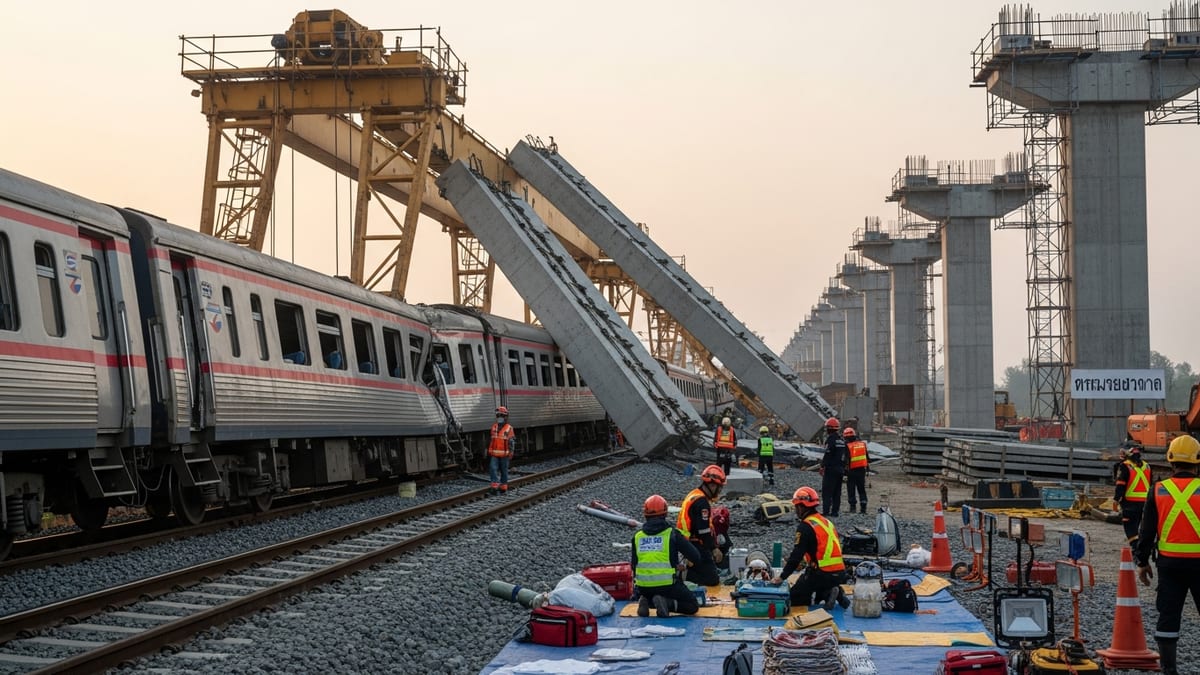
Derailment leaves several freight cars on the ground
Initial reports indicate that a freight consist traveling near Monmouth derailed, leaving multiple railcars off the tracks and lying on their sides or at sharp angles along the rail bed. Images shared by local and regional outlets show several cars on the ground adjacent to the main line, with ballast disturbed and track segments visibly out of alignment.
Publicly available information suggests the incident occurred on a freight corridor that routinely carries mixed cargo through the region. Early descriptions of the scene refer to a jumble of covered hoppers and other freight cars, some leaning against one another, others fully detached from the rails.
There were no immediate indications of a large fire or major plume of smoke at the site, a detail that typically signals the presence of highly flammable cargo. As of the latest updates, there were no widely reported serious injuries, though a full accounting of crew status and any impacts on nearby residents was still being compiled.
Rail traffic through the immediate area was halted while rail personnel began assessing damage to the track structure and equipment. Nearby grade crossings were closed to vehicle traffic as responders established a perimeter around the affected stretch of line.
Cargo, track damage and environmental checks
Coverage from regional news outlets and rail-industry observers indicates that the derailed consist was believed to be carrying general freight rather than a unit train of a single commodity. Visual assessments of the scene point to grain or similar bulk cargo in some of the affected cars, though an official commodity list had not yet been released.
Cleanup activity typically begins with containment and inspection, and that pattern appeared to be emerging near Monmouth. Rail crews and contracted responders focused first on stabilizing cars that had tipped or come to rest close to embankments, then on checking for any fuel leaks from locomotives or hazardous leaks from individual railcars.
Environmental checks are standard after derailments that involve locomotives or tank cars, even when no obvious spill is visible from a distance. According to published coverage of similar incidents in the Midwest, teams generally sample nearby soil and drainage ditches for signs of contamination and may deploy absorbent booms if fuel or lubricants reach standing water.
In addition to the visible damage to rolling stock, the derailment near Monmouth is expected to require replacement of sections of rail, ties and ballast. Heavy equipment is typically brought in to remove damaged cars, after which track technicians can realign or rebuild the affected segment.
Service disruptions on a key regional corridor
The affected line near Monmouth is part of a broader freight network that connects agricultural and manufacturing centers with larger distribution hubs. Even a localized derailment can have a ripple effect on freight schedules, forcing dispatchers to reroute trains or hold them short of the damaged segment.
According to publicly available timetables and freight routing maps, the corridor handles a mix of manifest trains and bulk shipments that support grain elevators, industrial customers and interchanges with other major railroads. With several cars on the ground, that flow was interrupted while crews worked to clear the right of way and conduct inspections.
Rail watchers noted on social platforms that trains were being staged at sidings outside the immediate area, a common contingency while investigators and maintenance teams occupy the main line. Some freight may be detoured to parallel routes where capacity exists, though this can add hours to transit times.
Passenger rail impacts appeared limited, as the Monmouth-area line is primarily a freight corridor. However, disruptions on freight routes can indirectly affect passenger operations elsewhere when freight trains are re-slotted onto shared tracks to bypass an outage.
Early focus on possible causes
While the precise cause of the Monmouth-area derailment remained under review, publicly available records from federal rail regulators and past accident reports outline several common factors that are typically examined. These include track conditions, wheel and axle integrity, train handling, and any prior slow orders or maintenance alerts on the segment.
Investigators often start with a detailed survey of the first point where wheels left the rail, looking for broken rail, damaged fasteners, tie deterioration or evidence of heat or stress on the steel. They also examine the condition of the first car or locomotive to derail, including wheel flanges and brake components.
Recent high-profile derailments elsewhere in the United States have drawn attention to both mechanical failures and track defects as contributing factors. According to published analyses of those cases, issues such as internal rail flaws, worn components or problems with train makeup can combine with speed and track geometry to trigger a derailment.
Data from the train’s onboard recording systems, along with dispatch logs, are typically reviewed to reconstruct speed, braking and other operational details leading up to the event. Any maintenance records for the affected stretch of track and equipment are also typically scrutinized as part of the broader inquiry.
Derailment renews debate over rail safety and investment
The Monmouth derailment adds to a series of rail incidents across North America that have kept freight safety in the public eye. Even when derailments do not involve hazardous materials or mass casualties, they can cause sizable economic losses, traffic disruptions and concern among communities along major corridors.
Transportation safety advocates frequently point to derailments like this one as evidence of the need for sustained investment in track maintenance, upgraded signaling and more advanced wayside detection systems that can spot trouble before a car leaves the rail. Industry groups, for their part, often highlight overall improvements in safety metrics over recent decades while acknowledging that high-profile incidents shape public perception.
For residents and businesses near Monmouth, the immediate questions center on how quickly the route can be reopened safely, and whether any long-term changes will follow. Publicly available information suggests that railroads typically undertake additional inspections along nearby segments after a significant derailment, looking for similar conditions that might pose a risk.
Once the line is restored, attention is likely to shift to the findings of the eventual investigation and any corrective actions or recommendations that emerge. For travelers and shippers who rely on the Midwestern rail network, the incident serves as another reminder of the complexity and vulnerability of the infrastructure that moves goods across the country.