


Menton sits at the last curve of the French Riviera before Italy, a small town that feels like a crossroads between Provence and Liguria. Planning a trip here is not just about picking a hotel on the seafront. It is about timing your visit around the Lemon Festival if you want winter color, knowing which beach has softer sand underfoot, and understanding how to fit gardens, Old Town and side trips into a few relaxed days. With some advance planning, you can see Menton’s best without rushing past what makes it special.
Get the latest updates straight to your inbox!
Choosing the Best Time to Visit Menton
Your first big decision is timing. Menton has a mild climate, so you can visit year-round, but the experience changes a lot by season. From June to early September, the town feels like a classic Riviera resort, with warm sea temperatures, crowded Plage des Sablettes and busy terraces around the Old Port. Expect afternoon highs around the high 20s Celsius and evening promenades along the waterfront. If you are coming primarily for sunbathing and swimming, late June or early September is often the sweet spot, when the sea is warm but schools in much of Europe are not yet on full summer break or have just gone back.
Winter brings a different atmosphere. From mid February to around 1 March 2026, Menton hosts the 92nd Fête du Citron, or Lemon Festival, turning the Biovès gardens and the Promenade du Soleil into a surreal landscape of citrus sculptures and parades. Hotel prices rise, especially for weekends during the Golden Fruit Corsos, but you gain the once-a-year experience of seeing floats covered in lemons and oranges roll past the waterfront. If you are considering a February trip anywhere on the Riviera, it is worth coordinating dates so you can see Menton’s festival along with Nice Carnival.
Spring and autumn suit travelers who want gardens, gentle walking and fewer crowds. Menton’s famous gardens such as Jardin Serre de la Madone and Val Rahmeh are particularly lush in April and May, and again in late September and October. Daytime temperatures are comfortable for climbing the Old Town steps to the Basilica of Saint Michel or taking coastal walks toward Roquebrune Cap Martin. Prices for mid range hotels are often lower than in July and August, and you are more likely to find last minute availability in small guesthouses.
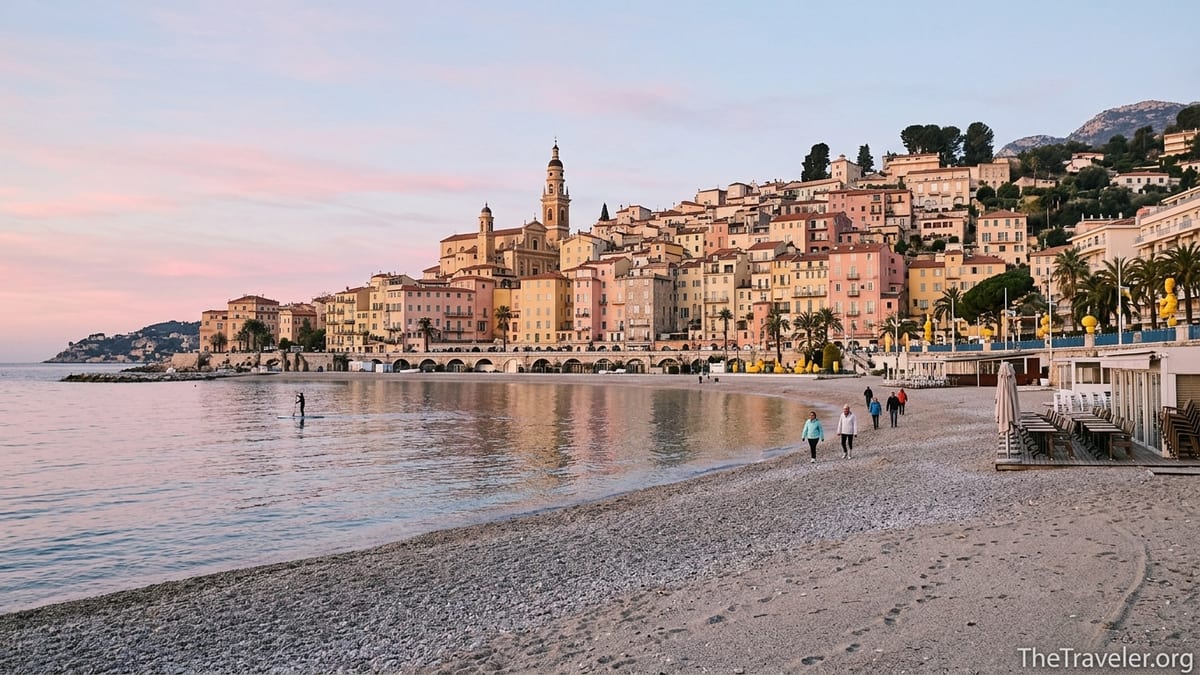
When you decide your dates, also think practically about daylight and local rhythms. In high summer, people swim early and late, avoiding the midday sun; in winter, terraces fill at lunchtime when the sun is highest. If your goal is photography, dawn and late afternoon light are especially beautiful from the Sablettes side, when the pastel Old Town facades catch the sun and glow above the bay.
Getting to Menton and Moving Around
Menton is easy to fold into a wider French or Italian itinerary once you understand the transport options. The nearest major airport is Nice Côte d’Azur. From there, many visitors take the local TER train from Nice Ville station toward Ventimiglia and get off at Menton or Menton Garavan. A recent traveler report put the one way price at about 8 to 9 euros per adult in 2026, with the ride taking roughly 40 minutes along a very scenic coastal line. Trains usually run at least twice an hour during the day, but it is wise to check the current schedule a few days before you arrive and allow extra time if you are connecting from a flight.
Budget conscious travelers often consider the regional bus. The Zou line that replaced the old 100 service runs between Nice and Menton via Monaco and Roquebrune. A PDF schedule published in spring 2025 shows departures about every 20 minutes during much of the day, with a lower fare than the train for those not using passes. Because the bus can be slowed by traffic around Monaco, it is sensible for day trips when you are not in a hurry, rather than tight airport connections. From the airport itself, an express bus line 80 currently links the terminals to Menton without changing in central Nice, but departure times are more limited, so check ahead before relying on it late in the day.
If you expect to bounce up and down the coast, consider local passes. In 2025 and 2026, the Pass Sud Azur Explore has been promoted as a way to get unlimited use of regional trains, trams and buses across the Alpes Maritimes, including Nice, Cannes, Antibes, Monaco and Menton. Prices and conditions change, but a recent discussion among residents mentioned that the pass often pays off if you plan multiple coastal day trips over several days. Buying such a pass at the start of your stay in Nice can simplify your onward journey to Menton and keep you flexible if you decide spontaneously to spend a day in Ventimiglia across the Italian border.
Once in Menton, you will likely walk most places. The Old Town, seafront and main gardens around the center sit within a compact area. Local buses run up the hills and into surrounding villages such as Sainte Agnès, one of the highest coastal villages in Europe, which makes a memorable half day excursion for its views and medieval streets. Taxis and ride hailing can be limited late at night so if you stay in a hilltop hotel or guesthouse, plan your evenings so you are not stranded after the last bus.
Choosing Where to Stay in Menton
Where you sleep in Menton shapes how you experience the town. If this is your first visit and you want postcard views, staying near Plage des Sablettes on the Old Town side puts you at the heart of the scenery that fills guidebooks. Mid range hotels and apartment rentals here look across the bay toward the curve of pastel houses and the basilica tower, and you can be on the beach within minutes. In high season, the esplanade can be lively late into the evening; if you are sensitive to noise, look for accommodations on a side street or higher floor.
Along the Promenade du Soleil, toward the casino, you find more classic seafront hotels, including brands such as Best Western Premier with balconies directly over the pebbly beaches. This section suits visitors who like to wake up, cross the road and swim. It is also convenient if you want an easy flat walk to the train station for day trips. Expect slightly more traffic noise here, especially in summer, but sunrise views of the sea can be unforgettable on clear days.
Travelers who want a quieter base can look toward Garavan, the eastern side near the Italian border. Hotels and guesthouses here are often tucked into gardens or set on small hills. Staying in Garavan puts you close to the Val Rahmeh botanical garden and makes it easy to cross into Italy for a lunch in Ventimiglia while keeping Menton as your overnight home. Families and those staying a week or more often choose self catering apartments in this area to gain more space and the option to cook with produce from the covered market.
When comparing prices, remember to factor in seasonal swings. During the Lemon Festival, even simple two star properties in central Menton can book out and rates may double compared with an ordinary week in January. In peak July and early August, beach front rooms command a premium, while November and early December are often the most economical times to stay, aside from holiday weekends. Checking a few booking platforms for different months on the same property can give you a realistic sense of how far your budget will go at different times of year.
Must See Highlights: Old Town, Sea and Gardens
A well planned Menton itinerary combines three main elements: the Old Town, the sea and the gardens. Start with the Old Town, which rises in layers above the Old Port. Climbing the stepped streets up to the Basilica of Saint Michel gives you views across the harbor toward Italy and down over the patterned stone square in front of the church. On the way, you pass narrow alleyways with laundry hanging from balconies and small local shops that still sell Menton lemon products and olive oil. Give yourself at least half a day here to wander without a rigid list, stopping for an espresso in a shaded square or a slice of socca, the chickpea pancake common along the Riviera.
At sea level, Plage des Sablettes is the most photographed beach in town. Official local information and recent beach guides describe it as a wide, gently curving bay at the foot of the Old Town, with fine shingle and calm water that is usually suitable for families. Just behind the beach, the Esplanade des Sablettes has been redesigned as a broad pedestrian area with restaurants and ice cream shops. In high season, you can rent a sunbed and umbrella at beach clubs such as Sablettes Beach Club, or simply lay a towel on the public stretch. Bring water shoes if you have sensitive feet, as even the finer gravel can feel sharp compared with sand.
For many visitors, Menton’s gardens are what elevate it beyond neighboring resorts. Jardin Serre de la Madone, created in the 1920s by Lawrence Johnston, lies inland on the slopes above town and spreads over several hectares, with terraced plantings, shaded paths and rare species from subtropical regions. It feels quiet and contemplative, especially outside peak hours. Closer to the sea, the Val Rahmeh botanical garden, managed as a botanical institute, showcases exotic plants thriving in Menton’s unusually mild microclimate. Entry fees for each garden are generally modest, often under 15 euros per adult, and the experience rewards anyone with an interest in plants, photography or simply peaceful environments.
Art lovers should not skip the Bastion museum, dedicated to Jean Cocteau, which occupies a small fort at the edge of the harbor. Although the more recent Cocteau museum building has been closed for structural reasons in recent years, the Bastion site still exhibits the artist’s work in an atmospheric stone setting. Combining a visit here with a stroll along the waterfront and a coffee at one of the harbor side cafes makes for a pleasant couple of hours between beach time and the golden light of late afternoon.
Experiencing the Lemon Festival Without the Stress
If you plan your trip to coincide with the Fête du Citron, it is worth understanding how the event works so you can enjoy the spectacle without feeling overwhelmed. In 2026, the festival is scheduled from 14 February to 1 March, with key events such as the Golden Fruit Corsos on selected Sundays in the afternoon and illuminated night parades and garden displays during the week. The Biovès gardens in the town center host towering citrus sculptures built with hundreds of thousands of lemons and oranges, arranged around a different theme each year. Visitors pay a separate entry fee to walk among these structures, which often open in the late morning and stay accessible into the evening on certain days.
Parade tickets are typically sold in categories, ranging from standing areas along the Promenade du Soleil to numbered grandstand seats. In recent editions, grandstand tickets for the major Sunday Corsos have often cost several tens of euros per adult, while simple standing access remained more affordable. Because weekends during the festival are busy with tour groups and visitors from Nice and Monaco, booking tickets online as soon as they are released is strongly recommended, especially if you want guaranteed seating for children or older relatives.
To avoid crowds, consider arriving in Menton on a weekday during the festival and exploring early in the day. For example, you might walk through the citrus displays as soon as they open, then retreat to the gardens of Val Rahmeh or Serre de la Madone while the promenade fills. In the late afternoon, you can return to town for an early dinner before attending a night parade or simply enjoying the atmosphere from a cafe terrace. If you stay outside Menton, plan your journey back carefully, as late evening trains and buses can be very busy after the main events finish.
Even if you are not a festival person, do not completely write off Menton in February. Outside of parade times, the town still functions as usual. You can sit on Plage des Sablettes in a light jacket, wander through nearly empty side streets and enjoy sunny winter lunches on terraces where restaurants feature dishes scented with local lemons. Just be prepared for some streets and parts of the promenade to close temporarily around major events, and for accommodation prices to be higher than in a typical winter week.
Building a Flexible Itinerary Around Menton
Menton works well as both a base and a stopover. For a first visit, a three night stay gives you enough time to see the town without rushing and to fit in one or two short excursions. A simple structure might be to devote your arrival afternoon to the seafront and the Bastion Cocteau museum, then spend your first full day exploring the Old Town and Basilica of Saint Michel, with a long lunch in one of the streets behind the harbor. On your second full day, you could choose between a garden focused day, pairing Serre de la Madone and Val Rahmeh, or a hiking day up to Sainte Agnès for wide sea views and a contrasting mountain village atmosphere.
Because Menton sits close to Italy and Monaco, many visitors use it as a quieter base and take day trips outward. A morning TER train east takes less than 15 minutes to reach Ventimiglia across the border, where Friday markets attract day trippers looking for Italian food products, leather goods and clothing. Alternatively, heading west by train or bus brings you to Monaco in about 10 to 20 minutes, where you can visit the Oceanographic Museum or the old town on the Rock, then return to Menton for dinner. The key is not to stack too many side trips back to back, or you will risk barely seeing Menton itself.
If your stay is longer, you can stretch your radius. With the same Pass Sud Azur Explore or point to point TER tickets, you could plan a day in Nice to stroll the Promenade des Anglais and the Old Town, or in Antibes to walk the old ramparts. Returning in the evening to Menton’s calmer streets can feel like a relief compared with those busier hubs. On very hot days, consider structuring your timetable so you do the bulk of your walking in the morning, rest or swim through the early afternoon and keep indoor sights or shaded gardens for the brightest hours.
The benefit of a flexible plan is that you can respond to the weather. If you wake to an overcast sky, it might be the perfect moment to visit Serre de la Madone, where soft light brings out leaf textures, or to take the train to Monaco’s museums. A brilliantly clear day with little wind may be better spent entirely on Plage des Sablettes, with only a break for an ice cream or a short climb into the Old Town at sunset.
Food, Markets and Local Lemon Flavors
Eating well in Menton does not require an extravagant budget, but it helps to understand the local rhythm. The covered market near the Old Port opens in the morning and is at its liveliest between about 8 and 11. Here you can buy ripe tomatoes, olives, socca slices from stalls and of course Menton lemons when in season. Many travelers staying in apartments stop here first thing in the morning to stock up on fruit, cheese and charcuterie, then assemble simple lunches to eat on their balcony or at the beach.
Restaurant wise, the seafront is lined with brasseries serving classics such as moules frites, grilled fish and pasta with seafood, often with menus of the day that include a starter and main around a mid range price point. For more character, stroll a few streets inland toward the Old Town, where smaller bistros serve dishes that reflect Menton’s position between France and Italy. You might find ravioli filled with local herbs, pissaladière onion tart or fish dressed with lemon and olive oil from the surrounding hills. Ask what is local and seasonal instead of relying on picture menus.
Lemon flavored products are everywhere, but quality varies. Shops around the Old Town sell limoncello, lemon jam, candied peel and biscuits. When possible, look for mentions of Citron de Menton, an official protected indication that refers to lemons grown in the designated zone around the town. In practice, not every product on sale comes from these trees, but some producers are proud to highlight the difference. For a concrete example, a small jar of artisanal Menton lemon marmalade might cost several euros more than a generic lemon spread, but the flavor will likely be more intense and less sugary.
For treats on a hot afternoon, gelato stands along the Sablettes esplanade offer lemon and citrus sorbets, which taste particularly good after a swim. Coffee culture follows a typical French pattern; many locals stand at the bar for a quick espresso, which is usually cheaper than sitting at an outdoor table. If you are watching your budget, remember that having your morning coffee and pastry at the counter instead of on the terrace can save several euros a day over a weeklong stay.
The Takeaway
Planning a trip to Menton without missing the highlights means making a few key decisions early and leaving space for the town’s slower rhythms. Choose your season based on whether you want summer beaches, winter festivals or quiet garden walks. Decide if Menton will be your base or a brief stop, and sketch an itinerary that balances Old Town exploration, time by the sea and at least one or two garden visits.
Build your transport strategy around the reliable Nice to Menton rail line, regional buses and, if useful, a coastal pass, so you can move confidently between towns without losing hours to logistics. Think carefully about where you stay, from Sablettes views to Garavan calm, and watch how prices shift between February’s Lemon Festival, the height of summer and shoulder seasons.
Most of all, remember that Menton’s charm lies in the details you notice when you are not rushing. It might be the way morning light hits the basilica steps, the scent of lemon trees in a sheltered garden or a plate of simple grilled fish eaten with your feet still sandy from the beach. With thoughtful planning and a flexible approach, you can leave feeling that you have not only checked off Menton’s highlights but actually lived a little of its gentle daily life.
FAQ
Q1. How many days do I need in Menton to see the main highlights?
Most travelers feel that two full days plus the arrival evening are enough to see the Old Town, enjoy the beach and visit at least one major garden. If you also want day trips to Monaco or Ventimiglia, plan on three to four nights so you can explore without rushing.
Q2. Is it better to stay in Menton or in Nice and visit on a day trip?
If you want nightlife, a huge choice of restaurants and museums, basing in Nice and day tripping to Menton works well. If you prefer a calmer atmosphere, easy beach access and walking everywhere, staying in Menton itself is more relaxing. Many visitors combine both, starting with a few nights in Nice then finishing with quieter days in Menton.
Q3. How do I get from Nice Airport to Menton without renting a car?
You can take the tram or bus from the airport to Nice Ville station, then the TER train to Menton or Menton Garavan, which usually costs under 10 euros each way and takes around 40 minutes. Alternatively, an express regional bus currently links the airport and Menton directly at limited times, useful if the schedule matches your flight.
Q4. Are Menton’s beaches sandy or pebbly?
Plage des Sablettes, the main beach at the foot of the Old Town, has relatively fine shingle and feels softer underfoot than the larger pebbles found on beaches in Nice. Other Menton beaches, such as those closer to the casino, are more pebbly. Many regular visitors bring or buy inexpensive water shoes to make swimming more comfortable.
Q5. When is the Lemon Festival in Menton and do I need tickets in advance?
In 2026 the Fête du Citron runs from 14 February to 1 March, with Sunday afternoon Corsos and some evening events. Entry to the citrus displays in the Biovès gardens and to parades is ticketed. Because weekends often sell out, especially for grandstand seating, it is wise to buy tickets as soon as they become available if the festival is the focus of your trip.
Q6. Is Menton a good destination for families with children?
Menton suits families who enjoy simple beach time, gentle swimming and walks rather than theme parks. Plage des Sablettes offers calm water, and the mostly pedestrian esplanade behind it is practical for strollers. If you visit during the Lemon Festival, children usually enjoy the bright citrus sculptures and parades, but crowds can be dense, so plan extra time and pick calmer time slots for garden visits.
Q7. Do I need to speak French or is English widely understood?
In hotels, many restaurants and tourist sites, staff usually speak at least some English, and menus are often bilingual. However, a few basic French phrases for greetings, ordering and thanking people go a long way, especially in smaller shops and markets. Given Menton’s proximity to Italy, you also occasionally hear Italian used between locals and visitors.
Q8. Is Menton expensive compared with other Riviera towns?
Menton is generally a little less expensive than nearby Monaco or the most fashionable parts of Nice and Cannes, especially for accommodation and casual dining. You can control costs by choosing an apartment with a kitchen, eating at the covered market or bakeries for some meals and using regional trains and buses instead of taxis. Festival periods and peak August weeks are the priciest times.
Q9. What should I pack for a trip to Menton?
In summer, bring light clothing, a hat, high factor sunscreen, a refillable water bottle and water shoes for the beach. For spring and autumn, add a light jacket and layers for cooler evenings. In winter, especially during the Lemon Festival, a warm coat, scarf and closed shoes are useful for standing at parades, even on sunny days. Year round, comfortable walking shoes are essential for the Old Town steps and garden paths.
Q10. Is Menton safe to walk around at night?
Menton is generally considered a safe and calm town, and many visitors feel comfortable walking along the seafront or through central streets in the evening. As in any destination, it is sensible to keep valuables discreet, stick to well lit areas and be cautious around the train station late at night. If you stay in a hilltop neighborhood, check bus times back up to your accommodation so you are not faced with a steep climb in the dark.