


Few travel dilemmas feel as luxurious as choosing between the French Riviera and Italy’s Amalfi Coast. Both deliver sun-drenched coves, glamorous seafront promenades, and pastel towns spilling toward the Mediterranean. Yet on the ground they feel very different: one is built for easy, efficient roaming, the other for slow, romantic immersion. Which one fits your travel style better right now, with real budgets, real logistics, and limited vacation days to spend?
Get the latest updates straight to your inbox!
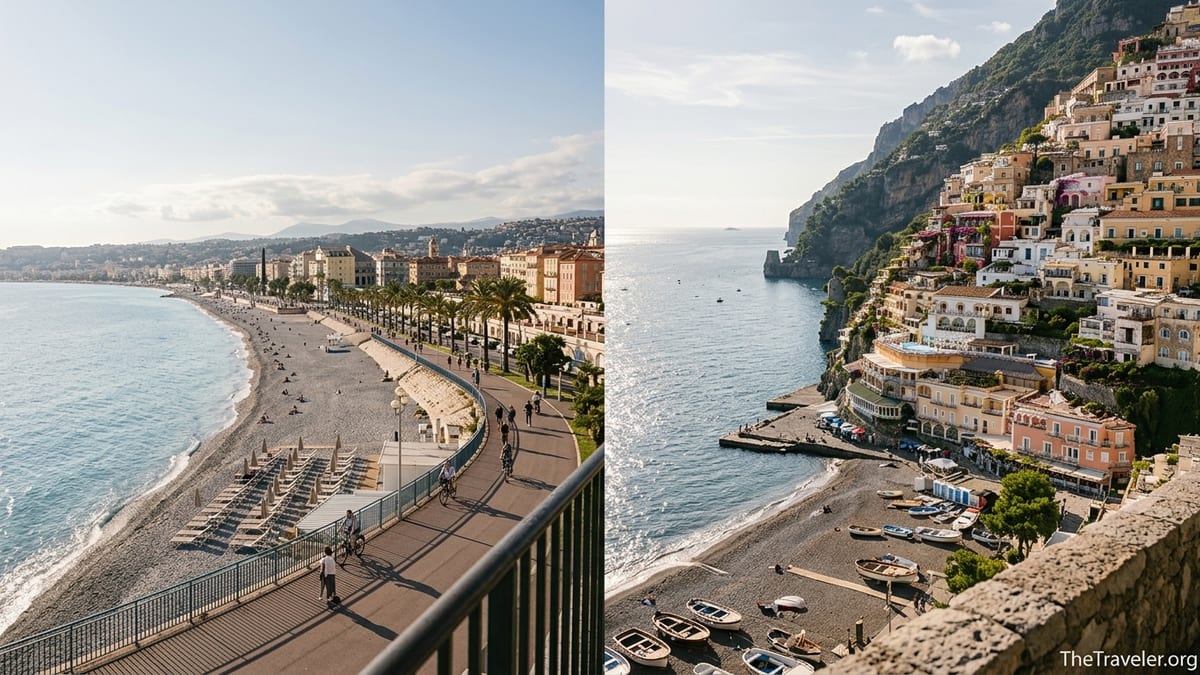
Overall Vibe: Glamorous Riviera vs Romantic Clifftops
The French Riviera, or Côte d’Azur, feels like a string of distinct coastal cities and towns stitched together by a very efficient rail line. In a single long weekend based in Nice, you can have breakfast on the Promenade des Anglais, lunch by the marina in Antibes, sunset drinks on the sand in Cannes, and a late-night stroll past the casino facades of Monaco. The mood is cosmopolitan and energetic, especially in bigger hubs like Nice and Cannes, with plenty of shops, rooftop bars, museums, and nightlife that stays busy well past midnight.
The Amalfi Coast, by contrast, feels intimate and vertical. Towns like Positano, Amalfi and Ravello are carved into cliffs, with steep staircases taking the place of city blocks. You are more likely to start your day with a cappuccino on a terrace watching fishing boats, then board a ferry across a turquoise bay to another town for a long lunch. There is nightlife, especially in Positano and Amalfi, but most evenings lean toward long dinners, limoncello, and early nights rather than club hopping.
In practice, the French Riviera suits travelers who enjoy a city-meets-sea atmosphere: museum visits in the morning, shopping and café culture by afternoon, and bars or live music in the evening. The Amalfi Coast is better if you want a slower, more romantic escape: scenic hikes like the Path of the Gods, lazy boat days to hidden coves, and long views from hotel terraces that make you forget what time it is.
If you imagine yourself changing outfits for a film festival red-carpet screening or a night at the Monte-Carlo Casino, the Riviera fits that fantasy. If you picture arriving at a tiny pebble beach by boat, climbing stone steps to a candlelit restaurant, and hearing church bells echo off the cliffs, the Amalfi Coast will feel like the trip you have been dreaming about.
Getting There and Getting Around
Access and local transport are where the French Riviera pulls clearly ahead for most travelers. Nice is a major international airport with frequent connections from across Europe and regular flights from hubs like London, Paris and many German cities. From Paris, high-speed TGV trains typically link to Nice in roughly 5.5 to 6 hours on direct services, and there is also an overnight Intercités de nuit train on some dates for those who prefer to sleep while they travel.
Once you arrive, the coastal train line is a game changer. Regional TER trains run along the coastline, connecting Nice, Villefranche-sur-Mer, Antibes, Cannes and Monaco with frequent departures, often every 15 to 30 minutes in daytime for short hops. A typical second-class ticket between Nice and Antibes or Nice and Monaco can cost only a few euros, making it realistic to base yourself in one town and day-trip widely without renting a car. Many visitors simply buy tickets as they go, tapping in and out for spontaneous detours.
The Amalfi Coast requires more steps. Most international flights land in Rome or Naples. From Rome, many travelers take a high-speed Frecciarossa or Italo train to Naples in about 1 hour 10 minutes, then connect onward. From Naples, you can reach Sorrento by regional Circumvesuviana train or a newer Campania Express service, often for under 10 euros, in roughly 1 to 1.5 hours. Sorrento and Salerno function as main gateways: from there, buses and seasonal ferries reach Positano, Amalfi and smaller villages.
However, once you are actually on the Amalfi Coast, getting around is slower and more unpredictable. The SS163 coastal road is famously scenic but also narrow, winding and subject to heavy traffic in high season. Public SITA buses are inexpensive, but in June through September you should expect queues at stops, standing room only, and delays. Many travelers turn to ferries between towns like Positano and Amalfi instead. A typical one-way ferry can cost around 10 euros per person for a short hop, which is pricier than buses but faster and far more pleasant on a clear day.
Costs on the Ground: How Far Your Budget Goes
Neither destination is cheap in peak season, but your money stretches differently in each place. On the French Riviera, you will find a broader price spectrum, especially in larger cities like Nice. In shoulder months such as April or late October, it is still possible to find central three-star hotels in Nice from around 120 to 180 euros per night for a double room, with air conditioning and walking-distance access to the beach. Simple studio apartments booked well in advance can run in a similar range for two people.
Once you move into top-tier areas like the Croisette in Cannes or seafront addresses in Saint-Jean-Cap-Ferrat, nightly rates for five-star hotels can pass 400 to 600 euros easily, particularly in July and August or during big events like the Cannes Film Festival and Monaco Grand Prix. Upscale beach clubs often charge separate fees for sun loungers, food and drinks. It is not unusual to pay 25 to 40 euros for a sunbed for the day at a popular private beach in Cannes or Saint-Tropez, plus lunch and cocktails on top.
On the Amalfi Coast, mid-range accommodation pushes upward more quickly, especially in the most sought-after cliffside towns. Recent traveler comparisons show typical three-star doubles in Sorrento in the 120 to 180 euro range in spring, while similar-quality rooms in Positano climb far higher, often 250 to 380 euros or more per night in the same period, with a premium for sea views and terrace access. In peak summer, many first-time visitors are surprised to see even modest rooms in Positano or Amalfi listed for 400 euros or above, especially with a pool or elevator access that avoids the steepest climbs.
One practical strategy many travelers use is to split nights: two nights splurge in Positano for the full postcard experience, then three or four nights in Sorrento, where prices are noticeably lower and you still have frequent ferries and buses. A couple that stays entirely on the coast might easily spend 700 to 1,000 euros more over a week compared with a base in Sorrento or Salerno, simply due to nightly rates and dining markups in the smallest, most popular villages.
Beaches, Water & Outdoor Experiences
The French Riviera’s beaches vary more than many first-time visitors expect. In Nice and much of the central Riviera, beaches are mostly pebble, which means crystal-clear water but a need for sturdy sandals. Private beach clubs lay out loungers on platforms or smooth rock, while public sections are free if you bring your own towel. Move toward Cannes, Juan-les-Pins or Menton and you will find more sandy stretches where families build sandcastles and children can wade in more easily.
The Riviera is ideal for travelers who want to pair beach days with other active options. You might spend one morning hiking the coastal path around Cap d’Antibes, another afternoon taking a boat excursion out of Villefranche-sur-Mer, and another day discovering hilltop villages like Èze or Saint-Paul-de-Vence. Diving, stand-up paddleboarding, and coastal kayaking are widely offered, particularly from larger resort towns.
The Amalfi Coast’s coastline is steeper and more dramatic, so beaches are often tiny coves of pebbles or dark sand wedged between cliffs rather than broad, sweeping bays. In Positano, the main Spiaggia Grande can feel crowded and glamorous at once, with neatly lined sun loungers and fashionable bars at the back of the beach. Smaller coves like Fornillo Beach, reachable by a cliffside path, offer a quieter feel but still use paid sunbed setups during high season.
One of Amalfi’s biggest draws is being on the water rather than just beside it. Many visitors book a small boat with skipper to explore sea caves, hidden inlets and swimming spots that are impossible to reach by land. Private half-day boat trips for two to four people often start in the low hundreds of euros and go up significantly with larger boats or luxury add-ons. Hikes like the Path of the Gods reward those willing to climb; in return you get sweeping ridge views over terraced lemon groves and villages clinging to cliffs. If outdoor time for you means dramatic views and boat days rather than long sandy beaches, Amalfi may win.
Cuisine, Culture & Everyday Atmosphere
Culinarily, both coasts lean heavily on seafood, fresh produce and local wine, but the culture around them feels distinct. On the French Riviera, you will find bistros serving Provençal dishes like ratatouille, salade niçoise and socca, alongside Italian pizza, sushi bars, vegan cafés and Michelin-starred tasting menus. Nice in particular has a strong local food culture: small neighborhood spots in areas like the Old Town serve daily specials chalked on boards, and you can grab a slice of pissaladière or a paper cone of socca from a takeaway window for just a few euros.
On the Amalfi Coast, menus are shorter and more regionally focused. Expect simple grilled fish, lemon-scented pastas, fresh mozzarella, and desserts layered with local citrus. In a family-run trattoria up the hill in Ravello or Praiano, a plate of pasta alle vongole and a glass of house white wine will often be priced lower than a similar meal right on Positano’s waterfront, where you pay for the view as much as the food. Street-level options like takeaway pizza slices, panini or gelato provide budget-friendly snacks between long, multi-course dinners.
Culturally, the French Riviera offers more in the way of museums, galleries and formal attractions. In a single day in Nice you can visit the Marc Chagall National Museum, catch an exhibition at the Museum of Modern and Contemporary Art, and still be back on the seafront in time for a sunset swim. Cannes and Monaco add film, motorsport and high-end shopping to the mix. This density of attractions is ideal if you like to have a rainy-day backup plan not dependent on the beach.
The Amalfi Coast’s “culture” is more in the streets and churches than in big museums. Towns like Amalfi have historic cathedrals and quiet cloisters, and there are archaeological wonders like Pompeii and Herculaneum reachable on day trips from Sorrento or Salerno. However, most people are there for the landscape, food and ambiance rather than galleries. If your perfect day alternates between historic sites and the sea, base yourself in Sorrento and mix coastal villages with a day at Pompeii or a ferry to Capri’s Blue Grotto.
Best Bases for Different Travel Styles
On the French Riviera, your choice of base can dramatically shape your experience. Nice is often the most practical hub: its airport, main train station and frequent local trains make day trips in either direction straightforward. A couple staying in a mid-range hotel near the Old Town can easily spend four or five nights there without needing a rental car. From Nice you can reach Antibes, Cannes, Monaco, Menton and hilltop villages by train or bus, then return in the evening to a wide choice of restaurants and nightlife.
If you prefer something smaller and more resort-like, Antibes and Villefranche-sur-Mer are popular alternatives. Antibes has a charming old town and a working marina, while Villefranche is prized for its sheltered bay and colorful waterfront houses. Budget-conscious travelers sometimes look at inland places like Grasse or Vence, where accommodation prices are lower, then drive or bus down to the coast. Just remember that being away from the main train line means slower, more car-dependent days.
On the Amalfi side, Sorrento has emerged as the pragmatic base for many visitors. It sits at the intersection of trains from Naples, ferries to Capri, and buses and boats toward the Amalfi villages. Because it is larger and flatter than Positano or Amalfi, it offers more mid-range hotels and apartments at prices that can be 30 to 60 euros per night cheaper than equivalent rooms perched on the cliffs. From Sorrento, travelers routinely day-trip to Capri, Positano, Amalfi and Pompeii without changing hotels.
Travelers seeking the pure “postcard” experience still gravitate toward Positano and, to a lesser extent, Amalfi and Ravello. These towns require more walking up and down steep staircases and often involve porters carrying luggage up dozens of steps from the dock. Yet for honeymooners or couples on once-in-a-decade trips, waking up to a balcony view over Positano’s stacked pastel houses or Ravello’s sweeping terraces can justify the extra cost and effort.
Seasonality, Crowds & Trip Length
Both coasts are highly seasonal, and timing your trip affects not just prices but the overall feel. On the French Riviera, July and August are peak beach months with crowded promenades and high hotel rates, especially during major events. However, shoulder seasons from late April to June and September to early October often strike the best balance: the sea is swimmable, most beach clubs are open, and you are less likely to face sold-out trains or fully booked restaurants. Winter is mild, and while it is not classic beach weather, city-sea hubs like Nice remain lively year-round.
The Amalfi Coast’s main season runs roughly from April to October, with ferries and many hotels in smaller villages shutting down in winter. Late May and June, plus September, are particularly in demand because the sea is warm but the highest summer heat and humidity have not fully arrived. By July and August, crowds swell considerably, and the combination of heat and climbing endless stairs can be taxing. Prices for accommodation and boat tours are at their annual peak, so budget travelers often aim for shoulder periods.
In terms of trip length, the French Riviera works well even for shorter breaks. Thanks to direct flights and high-speed trains, a three- or four-night stay in Nice gives enough time to sample several towns without feeling rushed. The Amalfi Coast generally rewards a slightly longer stay, especially if you are connecting via Rome or Naples. Many travelers find that five to seven nights allows a mix of base days in Sorrento or Positano plus boat excursions, a Capri day trip, and at least one outing to Pompeii or a cliffside hike.
If you are choosing with limited vacation days, ask yourself how many travel legs you want. A Paris to Nice high-speed train and a short local transfer gets you to the Riviera with minimal stress. Reaching the Amalfi Coast often means a flight, a long-distance train to Naples, then at least one more train, ferry or private transfer. For some travelers, the payoff is worth the extra logistics. For others, the simplicity of rolling your suitcase off a train directly into a seaside city is decisive.
Which Coast Fits Your Travel Personality?
Think of the French Riviera as a good match for urban explorers, solo travelers and groups of friends who want structure and flexibility. If you like wandering markets in the morning, riding a train 20 minutes to a new town for lunch, and finishing the day with rooftop cocktails, this region makes that easy. The straightforward public transport means you can travel confidently without a car, and it is particularly forgiving for a first trip to Europe or for those who are nervous drivers.
The Amalfi Coast is more suited to slow travelers, couples and small groups willing to trade some convenience for atmosphere. It is not as simple to “collect” towns in a day via train, but that is part of the charm. If you envision choosing one scenic base, booking a couple of boat days, and spending long hours on terraces overlooking the sea, Amalfi will likely resonate more. It is also an excellent choice if you want to combine a few days of coastal romance with time in Rome, Naples or the archaeological sites of Campania.
From a personality standpoint, people who thrive on energy, options and easy mobility often favor the French Riviera. Those who prioritize romance, views and a sense of being tucked away in a landscape unlike everyday life tend to prefer the Amalfi Coast. Plenty of frequent travelers visit both and then return repeatedly to one coast that feels “like them.” When you imagine your evenings, do you see yourself strolling a busy promenade with buskers and gelato stands, or climbing lantern-lit staircases back to a tiny inn where the same family has run the kitchen for generations?
There is no wrong answer, but there is usually a better first answer for you. If in doubt, you might focus on language comfort, flight options and budget. Travelers who speak some French, are flying into Paris, and want to avoid connecting through multiple Italian trains might choose the Riviera first. Those fascinated by Italian food, history and the idea of pairing Pompeii or Capri with their beach trip may decide Amalfi deserves the extra travel effort.
The Takeaway
Choosing between the French Riviera and the Amalfi Coast is less about which coastline is more beautiful and more about how you like to travel. The Riviera offers urban energy, excellent public transport and a wider range of prices and activities, making it ideal for shorter trips, first-time visitors and those who want to see several towns without a car. Amalfi leans into romance, dramatic landscapes and slower rhythms, best enjoyed with a bit more time and a willingness to climb stairs, ride ferries and linger on terraces.
If your ideal escape looks like museum mornings, spontaneous train rides to neighboring towns, and people-watching from café terraces before a late-night tram back to your hotel, start with the French Riviera. If you picture cliffside sunsets, boat days, days punctuated by espresso and gelato, and evenings that end on a balcony over the sea, the Amalfi Coast will likely feel like the more unforgettable choice.
For many travelers, the long-term solution is simple: visit both, at different moments in life. Perhaps a lively group trip or solo adventure on the Riviera now, then a slower Amalfi stay for a future anniversary or milestone. Whichever you choose first, planning with realistic expectations about costs, crowds and logistics will help ensure your Mediterranean escape matches the dream you had in mind.
FAQ
Q1. Which destination is better for a first-time trip to Europe, the French Riviera or the Amalfi Coast?
For a first trip, the French Riviera is usually easier. Nice has a major airport, direct high-speed trains from Paris, and a coastal rail network that makes day trips simple without a car. The Amalfi Coast is more logistically involved, often requiring connections through Naples plus buses or ferries, which can feel stressful if you are still getting used to European transport.
Q2. Is the Amalfi Coast really more romantic than the French Riviera?
Many couples do find the Amalfi Coast more romantic because of its dramatic cliffs, smaller villages and balcony views over the sea. A candlelit dinner on a terrace in Positano or Ravello feels very secluded. That said, the French Riviera can also be romantic, especially in places like Villefranche-sur-Mer or Antibes, where you can dine by the harbor and stroll quiet lanes away from the larger city crowds.
Q3. Which coast is cheaper for accommodation and daily expenses?
Overall, you tend to get more accommodation for your money on the French Riviera, especially in bigger hubs like Nice or Antibes where there is more supply. On the Amalfi Coast, cliffside towns such as Positano and Amalfi command a premium, with similar-quality rooms often costing significantly more than in Sorrento or Nice. Daily expenses like coffee or a simple meal can be similar, but location and view heavily influence prices in both regions.
Q4. Do I need a car on the French Riviera or the Amalfi Coast?
You do not need a car on the French Riviera and many travelers prefer to avoid driving. The coastal train and local buses cover most popular spots, and parking in cities can be expensive. On the Amalfi Coast, a car can be more of a burden than a benefit in peak season because of narrow roads, limited parking and traffic. Most visitors rely on buses, ferries and organized transfers instead, especially between April and October.
Q5. How many days should I plan for each destination?
The French Riviera works well for anything from a long weekend to a week. With three or four nights in Nice, you can visit several nearby towns. The Amalfi Coast generally benefits from at least five nights, particularly if you also want to see Capri or Pompeii. This allows a mix of slower coastal days and a couple of outings without feeling rushed by transfers and ferry schedules.
Q6. Which is better for families with children?
Families often find the French Riviera easier. Towns like Nice, Antibes and Menton have accessible waterfronts, playgrounds, more sandy or gently sloping beaches, and convenient train or tram connections for strollers. The Amalfi Coast can be wonderful for families who are comfortable with stairs and ferries, but steep streets, busy roads and small beaches may be tiring with very young children or lots of luggage.
Q7. Is it realistic to visit both the French Riviera and the Amalfi Coast on one trip?
It is possible but usually best reserved for longer itineraries. Combining both on a 10- to 14-day trip works if you accept several travel days for flights or long-distance trains. On shorter vacations, you may spend too much time in transit. Most travelers are happier choosing one coast per trip, then planning the other as a future destination to enjoy fully on its own.
Q8. Which destination is better for solo travelers?
Solo travelers often favor the French Riviera because of its reliable transport, walkable city centers and wide range of cafés and bars where it feels natural to dine alone. Nice, in particular, has many hostels and mid-range hotels that attract solo visitors. The Amalfi Coast can be wonderful solo if you enjoy quiet hikes, reading on terraces and boat trips, but limited nightlife in smaller villages may feel isolating for some people.
Q9. What is the best time of year to avoid crowds but still enjoy good weather?
For the French Riviera, late April to early June and late September to mid-October are usually ideal, with mild temperatures and fewer crowds than peak summer. On the Amalfi Coast, late April, May and late September are often best, when most ferries and hotels are operating but before or after the July and August surge. Weather can vary year to year, so planning with some flexibility is wise.
Q10. I love both art museums and scenic hikes. Which destination should I choose?
If you strongly prioritize art museums, the French Riviera offers more: Nice, Antibes and other towns have notable collections and galleries that you can combine with coastal walks. If you lean more toward scenic hikes with some historical sites, the Amalfi Coast and nearby Campania region shine, thanks to trails like the Path of the Gods and day trips to Pompeii. In both cases you can mix culture and nature, but the balance tilts toward formal museums on the Riviera and landscape-focused experiences on Amalfi.