


On a map, the French Riviera looks like one long, unbroken strip of sunshine and sea. In reality, traveling from Nice to Cannes to Antibes to Menton felt less like moving along a single coastline and more like changing countries every 20 minutes. The biggest surprise of my trip was not the blue of the water or the glamour of the yachts, but how wildly different each town felt once I stepped off the train and started walking its streets.
Get the latest updates straight to your inbox!
One Coastline, Many Characters
Before visiting, I imagined the French Riviera as a glamorous blur of palm trees, private beach clubs, and linen shirts. The reality began to shift as soon as I boarded the regional TER train that hugs the sea between Cannes and Ventimiglia. In less than an hour, the same line carried me past the grand cityscape of Nice, the fortified old town of Antibes, the postcard bay of Villefranche sur Mer, and the mellow pastels of Menton. Distances are short here, often less than 30 minutes apart by train, yet the feeling on the ground changes dramatically from town to town.
What makes the contrast so striking is that many practical details are similar. The same blue and white TER trains run up and down the coast, tickets often costing under 8 euros for hops like Nice to Cannes or Nice to Menton when bought at the station machines. The Mediterranean light is the same, the sea the same improbable shade of turquoise. But as you walk away from the platforms, the pace of life, the soundscape, the architecture, and even the way people dress shift in subtle ways that add up to completely different travel experiences.
It was only after a week of day trips, hopping off at different stops and lingering in side streets, that I understood why travelers argue so passionately about basing themselves in Nice, Antibes, or somewhere smaller. You are not just picking a place to sleep. You are choosing a personality to live with for a few days.
Nice: Big-City Riviera With Real-Life Grit
Nice was my base and my first surprise. I knew it was the fifth-largest city in France and the unofficial capital of the Riviera, but I still expected a polished resort town. Instead, Nice felt like a real city that happens to spill onto a spectacular bay. The iconic Promenade des Anglais stretches for several miles along the water, a wide ribbon shared by joggers, families with strollers, cyclists and beachgoers shuffling in pebbles. Behind it, a mix of Belle Époque facades, modern tram lines, and dense apartment blocks reminded me more of a Mediterranean metropolis than a resort bubble.
The contrast within Nice itself is already sharp. In Vieux Nice, the old town, lanes are so narrow you can touch both sides with outstretched arms. In the morning, scooters weave past stalls of tomatoes, figs and fresh flowers at Cours Saleya. By night, the same streets fill with crowds ordering socca and glasses of rosé at tightly packed terraces. A 10 minute walk away, on avenue Jean Médecin, the mood flips to mainstream urban: chain stores, a modern tram gliding down the middle, locals rushing with shopping bags. Turn toward the port and you find a quieter, more residential neighborhood where colorful townhouses look down on working boats, ferries and sleek yachts side by side.
What struck me most was that Nice did not bend itself entirely around visitors. On weekday mornings, I was as likely to stand in line behind office workers at a boulangerie on rue de France as behind tourists. The tram network and bike lanes make sense for daily life as much as for sightseeing. In summer, you might still find a spot on the public beach if you are patient, or you can rent a lounger at a private beach club where a day bed might run from around 25 to 40 euros, depending on the location and season. It feels convenient but rarely cocooned. If you want a base with museums, nightlife, varied neighborhoods and easy transport, Nice delivers. If you are imagining a sleepy seaside escape, it may feel much more intense than expected.
Antibes: Walled Old Town and Laid Back Harbourside Life
Twenty minutes west of Nice by train, Antibes felt like an exhale. Stepping out of the station, the first thing you see is the curve of Port Vauban, one of the largest marinas in the Mediterranean. Masses of masts crowd the water, from modest sailing boats to superyachts so large they appear to have their own floors and terraces. Yet the atmosphere here is very different from Cannes, which shares the same reputation for glamour. In Antibes, boat crews cycle past with bags of groceries, and locals cut across the quays on their way to errands.
Inside the old town, Antibes feels almost small-scale compared with Nice. Stone walls and narrow streets enclose a compact maze that you can cross in 10 or 15 minutes. The covered Marché Provençal, open most mornings, immediately shifted my sense of the place. Stalls overflowed with goat cheeses, bunches of basil, tapenade, olives and sun-dried tomatoes, but the language around me was largely French. I watched a restaurant owner choose vegetables for the day, greeting several vendors by name. When I ordered a paper cone of strawberries, the stallholder asked what I was doing that afternoon and suggested a quieter stretch of ramparts where I could eat them overlooking the sea.
The beaches in and around Antibes provided another contrast with Nice. Instead of sloping banks of rounded pebbles, the main town beaches like Plage de la Gravette and Plage du Ponteil offer sheltered coves of sand, shallow and friendly for swimmers who prefer an easier entry into the water. The town is not immune to crowds, especially in July and August, but its rhythm feels gentler. Evenings tend to revolve around simple pleasures: a glass of wine in a small square, a stroll up to the old fort, or a sunset walk along the ramparts. Where Nice made me feel energized, Antibes invited me to slow down.
Cannes: Polished Promenade and Event-Town Energy
Continue another 10 minutes west on the same train line and Cannes announces itself before you even leave the platform. Directly across the road from the station rise big-name boutiques, hotel facades and a steady stream of taxis. Walking down to the waterfront, I arrived on the Boulevard de la Croisette, which runs parallel to a string of sandy beaches and some of the Riviera’s most famous luxury hotels. Even outside the film festival period, there is a sense that the town is ready to host an event at any time.
The surface-level experience of Cannes can feel almost theatrical. On a sunny afternoon, the beach clubs set out neat rows of loungers and parasols. Prices for a front-row lounger on La Croisette can easily exceed 50 euros per day in high season, especially at big-name hotels with private stretches of sand. Sports cars cruise slowly past storefronts displaying designer handbags and watches. Between the long quay of the Vieux Port and the gleaming yachts farther east, it can be hard to remember that this is still a functioning town rather than a stage set.
Yet if you climb the hill into Le Suquet, the old quarter above the port, a different Cannes comes into view. Here, steep cobbled alleys lead to a small church and viewpoints over the bay and the islands of Lérins offshore. The houses are older, the restaurants a little more intimate, and the crowds thinner. Walking these streets at dusk, I could finally imagine the modest fishing village that existed long before the Palais des Festivals. Still, the overall personality of Cannes is polished and outward-facing, ideal for travelers who enjoy waterfront glamour, shopping, and a sense of occasion.
Villefranche sur Mer: Storybook Bay Between Cliffs and Sea
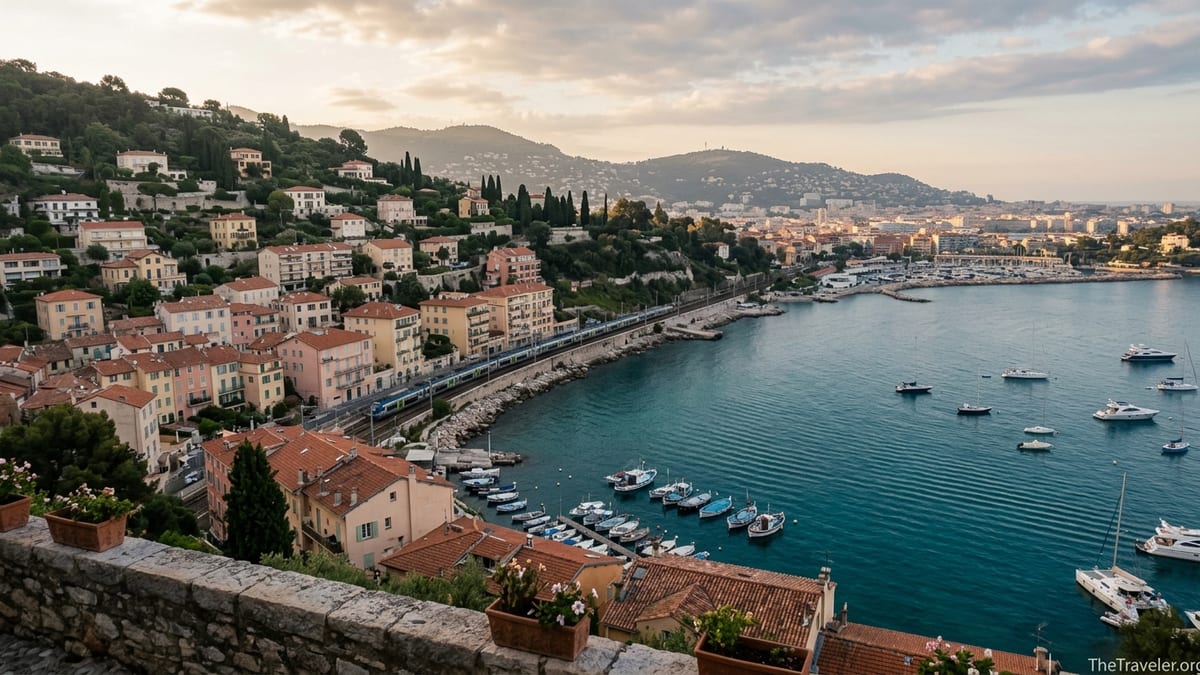
Heading east from Nice, the train plunges into tunnels and suddenly reveals one of the most beautiful curves of the Riviera: the bay of Villefranche sur Mer. The station platform sits almost at water level. Within minutes of stepping off the train, I was standing on a narrow strip of beach with pastel houses stacked above me and steep green hills rising behind them. Cruise ship tenders shuttled passengers to and from a ship anchored in the deep natural harbor, but on shore the town felt surprisingly intimate.
Villefranche is small enough that you can walk nearly everything in a morning. A few streets back from the seafront, I wandered into vaulted lanes that felt almost tunnel-like, a reminder that this was once a fortified harbor. Laundry hung from high windows, and a cat dozed on a doorstep, unbothered by the occasional group of visitors following a guide with a parasol. At lunchtime, café terraces along the waterfront filled with people sharing grilled fish and carafes of wine, all facing the bay as if it were an outdoor theater.
The mood here is shaped by geography. The town feels cocooned between sea and cliffs, with the railway running just above the beach and the main road high on the hillside. Even though the bay regularly hosts large visiting ships, evenings felt quiet once the sun moved behind the hills. Compared with Nice or Cannes, nightlife is limited, and shopping revolves around a handful of small boutiques and grocery stores. For travelers, Villefranche works best as a serene base or a day trip focused on swimming, lingering lunches and short, steep walks to viewpoints rather than packed itineraries.
Menton: The Gentle Border Town With a Garden Soul
Farther east, almost at the Italian border, Menton felt like the Riviera winding down into a softer register. When my train pulled into Menton in late afternoon, the platform was lined with palm trees and there was a noticeable calm compared with Nice. The old town rises in tiers above the water, crowned by baroque church towers. At street level, pastel facades with peeling shutters looked more Ligurian than French, and I started to hear Italian spoken almost as often as French at café tables.
Menton’s personality is often summed up by its nickname, the Pearl of France, but what I noticed first was its slower pace. Along the seafront promenade, locals walked small dogs and stopped to chat on benches. Beach clubs exist, but prices for loungers and simple seaside lunches tended to be a little lower than in Cannes or central Nice, reflecting the town’s slightly less high-profile status. Parts of the beach are pebbly, others more sandy, and the water felt slightly warmer, helped by Menton’s famously mild microclimate.
The town’s love of plants gives it another layer of identity. Menton is known for its gardens and for a lemon festival that usually brightens late winter with elaborate citrus sculptures. Even outside festival season, I felt that gentle, almost botanical side of the town in everyday details: potted lemon trees in courtyards, climbing plants on staircases, and the way hills behind the town seemed lush rather than rugged. Compared with Cannes’ spotlight energy or Nice’s urban bustle, Menton felt like a place designed for reading on a balcony, taking cross-border day trips to small Italian resorts, and staying a little longer than planned.
How the Differences Shape Your Trip
Experiencing these towns back to back made clear that the biggest decision on the French Riviera is not which sights to tick off, but what kind of daily life you want to drop into. In Nice, mornings might begin with a brisk walk or run along the Promenade des Anglais, weaving around locals commuting by bike, followed by a coffee in a busy square like Place Garibaldi before hopping a tram. In Antibes, you might start the day shopping for picnic supplies at the covered market, then wander down to a sheltered sandy beach with your bag of olives, cheese and bread.
The same is true at night. A Friday evening in Cannes might involve dressing up, reserving a table at a seafront restaurant on La Croisette, then taking a late walk to admire illuminated yachts in Port Canto. In Villefranche, the equivalent could be a simple dinner of grilled sea bream at a harbor-side bistro, followed by an unhurried stroll along the bay as the lights of passing trains trace the hillside. In Menton, an evening might end with a gelato on the promenade, with people out late but in smaller numbers, the mood more neighborhood than spectacle.
Practicalities also feel different. Nice’s larger size means more hotel options across budget ranges and better late-night public transport, but also more traffic and noise. Antibes and Villefranche often have a more limited selection of accommodations near the center, with prices that climb quickly in peak summer due to their smaller scale. Cannes can be noticeably more expensive around major events, when even simple rooms fill with delegates. Menton, a bit farther from the busiest stretch of coast, may reward travelers willing to travel slightly longer on the train with slightly more affordable stays and a calmer streetscape.
Choosing the Right Town for You
By the end of my trip, I realized that choosing a base on the French Riviera is a matter of matching town personality to travel style. If you want museums, varied dining, nightlife and the feeling of being in a genuine city that happens to front a famous bay, Nice is the natural choice. You can visit the Matisse or Chagall museums, shop along avenue Jean Médecin, catch a tram late in the evening and still be within a short walk of the sea. It suits travelers who enjoy energy and do not mind some urban grit mixed in with their views.
If your ideal Riviera day centers on a sandy beach, a historic center you can cross in 10 minutes, and evenings that end early, Antibes is hard to beat. You can swim at Plage de la Gravette, stroll the ramparts, and still be back at your hotel within a few minutes. Those who care more about polished promenades and the option to splurge on high-end shopping, glamorous beach clubs or event-driven trips might feel more at home in Cannes, especially during shoulder seasons when the town is busy but not overwhelming.
Travelers seeking a village feel without giving up easy access to Nice and Monaco might gravitate to Villefranche sur Mer, accepting steeper hills and fewer services in exchange for a storybook bay. Menton suits those who like gentler temperatures, cross-border excursions into Italy, and a garden-scented, slightly old-fashioned atmosphere. The good news is that, thanks to the frequent regional trains that run along the coast throughout the day, choosing one town as a base does not lock you out of the others. You can sleep in one personality and day-trip into several more.
The Takeaway
The surprise of the French Riviera is not that it is beautiful, but that such different worlds exist so close together. In less than an hour by train, you can travel from the city buzz of Nice to the fortified calm of Antibes, the event-town polish of Cannes, the pocket-sized bay of Villefranche and the gentle border town of Menton, all without ever losing sight of the sea. The water, light and architecture tie the coast together, but the daily rhythms and atmospheres remain distinctly local.
If you arrive expecting one generic Riviera, you may feel disoriented at first. Pay attention to the details instead: who is in line with you at the bakery, how late the streets stay lively, whether shop signs lean more French or Italian, how easy it is to find a quiet bench with a view. These clues reveal the character of each town far more than any postcard image. Let them guide where you linger, where you return, and where you choose to drop your bags the next time you come back.
In the end, that was my biggest discovery. The French Riviera is not one destination but a chain of distinct places, each with its own voice carried on the same sea breeze. The joy of traveling here lies in listening closely enough to hear the differences.
FAQ
Q1. Is it realistic to visit several French Riviera towns in one day?
Yes, as long as you focus on nearby stops. For example, you can easily combine Nice, Villefranche sur Mer and Menton in a single day using regional trains, but you will only have time for brief walks, a swim and a meal in each place rather than in depth sightseeing.
Q2. Where is the best place to base myself without a car?
Nice is the most practical base without a car because it offers frequent regional trains, a tram network, a major bus hub and the largest range of accommodation. From Nice, direct trains run to Cannes, Antibes, Villefranche sur Mer and Menton, making day trips straightforward.
Q3. Which town is best if I want sandy beaches instead of pebbles?
Antibes and Cannes are the strongest choices if soft sand is a priority. Antibes has sheltered town beaches like Plage de la Gravette, while Cannes offers long sandy stretches along La Croisette, although some sections are operated by private beach clubs with paid loungers.
Q4. Is Cannes worth visiting outside the film festival?
Yes. Outside the festival period, Cannes still offers a polished seafront, sandy beaches, shopping and a pleasant old quarter in Le Suquet. It feels busy but more relaxed, and hotel prices are generally lower than during major events, which can make the town more accessible.
Q5. How expensive are beach clubs on the French Riviera?
Prices vary widely by town and location, but you can expect to pay roughly from the mid 20 euro range for a lounger on a quieter stretch of coast to upward of 50 euros per day at high profile clubs along La Croisette in Cannes or prime spots in central Nice during peak season.
Q6. Which town feels the most relaxed for older travelers or families?
Menton and Antibes are particularly good options. Menton combines a gentle seafront, a slower pace and easy walks, while Antibes offers a compact old town, sheltered sandy beaches and a slightly calmer atmosphere than larger Nice or event focused Cannes.
Q7. Is it better to stay in a smaller town like Villefranche sur Mer or in Nice?
It depends on your priorities. Villefranche offers a village atmosphere and a stunning bay but limited nightlife and services. Nice provides more dining, cultural options and late running transport. Many travelers choose Nice for convenience and visit Villefranche as a day trip.
Q8. Do I need to rent a car to explore the French Riviera properly?
No. The coastal section between Cannes and Menton is well served by frequent TER trains and local buses, which are often more convenient than driving and parking in busy town centers. A car can help for inland villages, but it is not essential for the main Riviera towns.
Q9. Which town has the strongest Italian influence?
Menton shows the clearest Italian influence, both in its pastel architecture and in everyday life, thanks to its location close to the border. You are likely to hear Italian spoken, see Italian products in shops and find it easy to make quick day trips across into Liguria.
Q10. How many days should I plan for a first trip to the French Riviera?
Four to five full days are enough to base yourself in one town, such as Nice or Antibes, and make two or three day trips to nearby places like Cannes, Villefranche sur Mer and Menton. With a week, you can explore at a slower pace and get a better feel for each town’s personality.