


More news on this day
Renewed missile and drone attacks on Riyadh and the wider Gulf region in October and November 2026, including a deadly strike on King Khalid International Airport, are prolonging flight cancellations and diversions across Middle East air corridors, with some airlines already extending schedule changes and safety advisories into early 2027.
Get the latest news straight to your inbox!
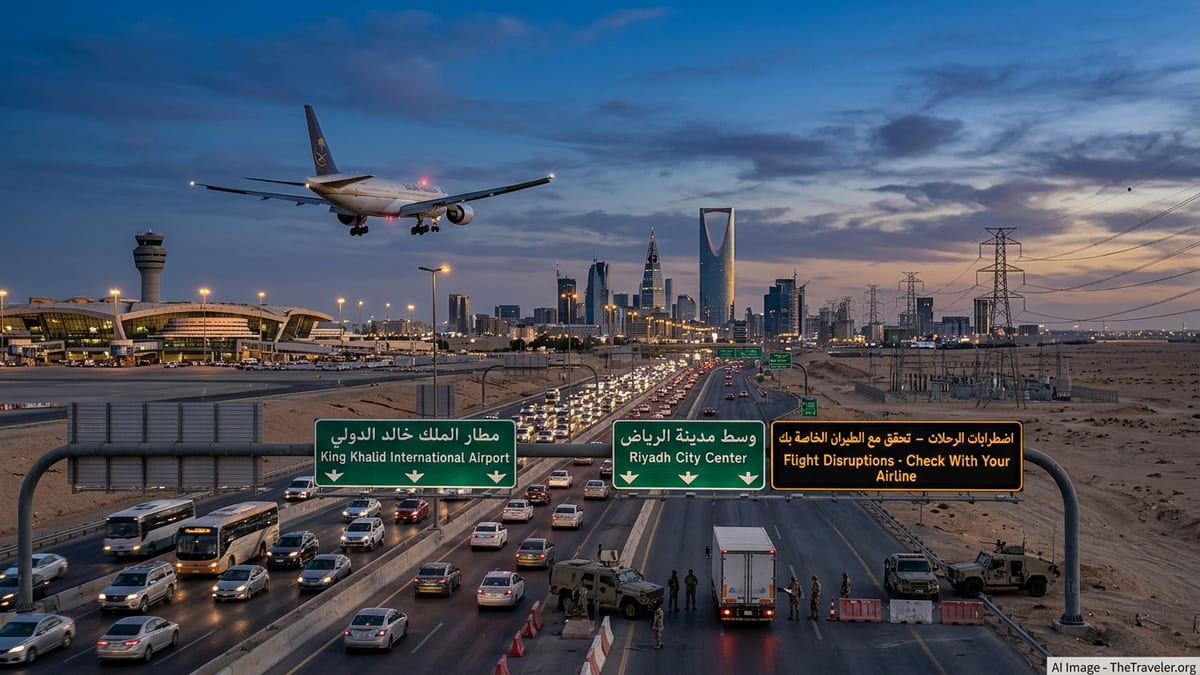
Where recent attacks have occurred and how they affect aviation
The sharpest disruption traces back to the October 10 2026 missile strike on Riyadh’s King Khalid International Airport, which Saudi authorities and multiple independent reports say killed at least 12 people and injured more than 300, damaging airport facilities and triggering the temporary suspension of most international flights to the capital.
Saudi and coalition officials have since reported further projectile activity around Riyadh, including interceptions in the weeks that followed the October airport strike, while regional risk bulletins describe sporadic missile and drone incidents targeting infrastructure and populated areas in and around the capital.
Attacks have not been limited to strictly aviation targets. Security updates circulated to shipping and energy companies in November highlight attempted and successful drone and missile strikes against tankers and other vessels in the Persian Gulf and adjacent waters, contributing to a wider perception of insecurity along a corridor that is central to both global energy exports and the long-haul flight paths that connect Europe, Asia and Africa.
On November 20 2026, Yemen’s Houthi movement publicly urged airlines to avoid Saudi airspace, stating that the kingdom as a whole should be considered within their operational area and warning of additional strikes after the October attack on Riyadh’s main airport.
Yemeni government submissions to the United Nations earlier in the autumn, together with commercial security briefings, also point to continuing Houthi efforts to develop capabilities that could threaten aircraft near the Bab el Mandeb strait and over parts of the Red Sea and Gulf of Aden, reinforcing long-standing concerns about that busy chokepoint for both shipping and overflights.
How regulators and governments have updated airspace guidance
In response to the deteriorating security picture, aviation regulators have tightened conflict-zone guidance on parts of the Middle East, including Saudi and Gulf airspace, and have extended some measures into early 2027.
The European Union Aviation Safety Agency currently has an active Conflict Zone Information Bulletin for the airspace of Saudi Arabia, first issued in late September 2026 and updated on November 16, with its validity now running through January 31 2027. The bulletin highlights the October 10 strike on King Khalid International Airport and subsequent projectile activity, and advises EU air operators to avoid portions of Saudi airspace below specified altitudes in defined zones or to conduct a careful risk assessment before operating there.
A separate EASA bulletin on the airspace of the Persian Gulf and Gulf of Oman was also revised in November 2026 and remains active through January 31 2027, reflecting concerns that missile and drone capabilities in Yemen and Iran could pose a risk to aircraft over international waters and coastal areas along several Gulf states.
Yemeni airspace itself has effectively been treated as off limits to most commercial overflights for several years. EASA’s older bulletin on the Sana’a Flight Information Region remains in force, and most major carriers continue to route around Yemeni territory entirely, using either more northerly paths over Saudi Arabia and Iraq or more southerly tracks over the Arabian Sea.
National authorities have echoed and, in some cases, gone beyond these regional measures. The United Kingdom’s Foreign, Commonwealth and Development Office warns travelers that King Khalid International Airport was struck by a missile on October 10 and that further attacks on airports are very likely, noting that any fresh incident could prompt sudden closures, diversions and enhanced security screening.
U.S. government notices refer travelers and operators to Federal Aviation Administration special rules and advisories for portions of Saudi and neighbouring airspace, underscoring that the main concern is for aircraft at lower altitudes near potential targets on the ground, but also reminding airlines that short-notice restrictions and rerouting remain possible if the threat picture changes quickly.
Which airlines and routes are most affected so far
The most direct impacts are on flights serving Saudi Arabia, especially Riyadh and Dammam, where a number of foreign airlines curtailed services after the October 10 strike and subsequent warnings from both regulators and armed groups.
Etihad Airways has cancelled all passenger and cargo flights between Abu Dhabi and Riyadh, and between Abu Dhabi and Dammam, through at least November 30 2026, according to successive travel advisories and regional aviation reports. The airline, which had initially planned to restart earlier in the month, has repeatedly extended the suspension as new security assessments were issued.
Other Gulf-based carriers have adjusted rather than fully withdrawn their Saudi schedules. Monitoring by regional travel outlets and security consultancies indicates that some airlines have restored limited frequencies to Jeddah and selected secondary cities while maintaining suspensions or reduced services on higher‑risk Riyadh and Dammam routes, often with revised timings and aircraft types intended to improve operational flexibility.
Around Riyadh, domestic services operated by Saudi carriers have generally resumed on constrained schedules following infrastructure repairs and the partial reopening of terminals, but they remain subject to disruption whenever projectile alerts or interceptions are reported in the area.
The knock-on effects extend beyond Saudi Arabia to other Gulf hubs that depend on stable overflight patterns. British Airways, which had suspended London Heathrow to Dubai flights earlier in 2026 amid broader regional tensions, resumed the route in early November. Lufthansa restored its Munich to Dubai service from November 25, and several other European airlines have maintained or reinstated Dubai and Doha flights, sometimes with modified routings that avoid the most sensitive airspace segments.
Despite these resumptions, the major Gulf hub carriers continue to warn passengers that their operations are vulnerable to rapidly changing security assessments. Emirates, Qatar Airways and flydubai have broadly preserved their extensive networks but caution that flights can be delayed, rerouted or cancelled at short notice if missile or drone activity prompts new restrictions on Saudi or adjacent airspace.
Airports closer to the front lines, especially along the southern Red Sea and in Yemen, remain under much greater strain. Aden International Airport has been the subject of repeated projectile and drone attacks in 2026, according to Yemeni government communications, disrupting commercial, humanitarian and medical flights that use the airport as a vital access point for southern Yemen and complicating planning for airlines that would otherwise take the shortest paths over the Bab el Mandeb region.
Impacts on long-haul connections between Europe, Asia and Africa
The combined effect of conflict near key Arabian land corridors and persistent insecurity around the Red Sea is most visible on the long-haul journeys that have traditionally relied on Gulf hubs and nearby overflight routes to connect Europe, Asia and Africa efficiently.
In practice, the airspace around Yemen has been heavily constrained for some time, but the October 10 Riyadh airport strike and the subsequent Houthi warning to avoid Saudi skies have prompted some airlines to reassess the relative risks of specific Saudi and Gulf segments as well. Where company risk assessments identify a higher exposure, carriers may shift northward over Iraq and Turkey or further south over the Arabian Sea and Indian Ocean, depending on the city pairs they are serving.
These detours can lengthen flight times, increase fuel costs and narrow connection windows, especially for itineraries that string together multiple long sectors. A Europe to Southeast Asia service that once took an almost direct great‑circle path across parts of Saudi Arabia and the Gulf may now track noticeably further north or south, adding scheduled time and, in some cases, prompting subtle timetable changes designed to protect minimum connection times at hub airports.
European and Asian airlines that rely on Gulf or Saudi stopovers to reach East Africa, the Indian subcontinent and Southeast Asia are particularly exposed to these changes. Some have responded by temporarily suspending services to higher‑risk destinations such as Riyadh and Dammam while maintaining flights to lower‑risk hubs like Dubai or Doha, while others have opted for broader capacity reductions across the region until they can see a clearer and more stable security trend.
Travelers can experience the effects even when they are not booked to enter Saudi Arabia. For example, a South Asia to Europe itinerary connecting in the Gulf may now involve longer block times and tighter ground transfers, and travelers may notice additional routing notes, “security‑related” advisories in booking systems or a higher frequency of schedule updates compared with earlier in 2026.
Humanitarian and specialist operations are also affected. Aid organizations flying into Yemen and surrounding areas report that intermittent airport closures, changing approach procedures and evolving no‑fly zones add complexity and cost to missions, reducing the number of workable flight combinations on any given day and narrowing the windows during which aircraft can safely land or depart.
What travelers using Gulf and Saudi routes should do next
Given that attacks and regulatory responses have unfolded over a matter of weeks rather than months, travelers planning near‑term trips through the Gulf or Saudi Arabia should prepare for schedules to remain more changeable than usual at least through the end of 2026 and into January 2027, while current EASA conflict‑zone bulletins stay in force.
Passengers already booked to Riyadh, Dammam or other Saudi airports that have been directly referenced in missile or drone reports should first verify whether their airline is still operating the route. For example, Etihad passengers with bookings to Riyadh or Dammam up to November 30 2026 are currently being offered rebooking or refund options under the carrier’s disruption policy, subject to the original date of ticket issuance and fare rules, and similar flexibility is being provided by other carriers in defined cases where flights are cancelled for security reasons.
Even if a route remains on the schedule, travelers should monitor their flight status repeatedly, including 24 hours before departure and again shortly before leaving for the airport. Airlines in the region are updating online timetables and mobile‑app notifications frequently, sometimes only locking in final routings once they have the latest overnight security assessments and airspace permissions.
For those with flexible plans, it may be prudent to consider routings through hubs that currently have fewer direct restrictions linked to the latest attacks, particularly if the main purpose of travel is onward transit rather than entry into Saudi Arabia. In practical terms, that could mean choosing itineraries via Dubai, Doha or other regional hubs rather than Riyadh or Dammam when equivalent fares and timings are available, while keeping in mind that all carriers in the region remain exposed to wider airspace decisions.
Looking ahead, travelers should watch for further updates from regulators and airlines around late January 2027, when several current European conflict‑zone advisories are due for review. If no further attacks occur and security agencies judge that the risk has eased, some airlines may begin restoring suspended services or shortening diversions. If, instead, new attacks take place or warnings escalate, regulators could tighten restrictions or extend current bulletins, which would likely translate into additional timetable and routing changes.
Until the security situation stabilizes, anyone planning to use Gulf or Saudi routes should build extra flexibility into their arrangements by allowing longer connection windows, avoiding tight same‑day interline transfers where possible, and opting for tickets that include reasonable change or refund options in case flights are cancelled or rerouted at short notice.